The Short Answer: Aim the Sound at People, Not Walls
If you want to know how to get rid of echo at an event, start with one idea: echo is sound that reached the listener late, after bouncing off a wall, a window or the ceiling. You can't delete a reflection once it exists. You can only send less sound at the surfaces that create it, and more sound at the audience that absorbs it.
That gives you a short fix list, in order of how much each one helps:
- Place and aim the speakers so they point at the crowd and away from hard walls and glass.
- Cover the room instead of turning it up. More speakers at lower levels beat one pair at full volume.
- Fix the microphone technique so less room sound goes into the system in the first place.
- Use EQ and delay to clean up the muddy range and line up the sound from different speakers.
- Add absorption where you can, such as drapes, banners and a full room of people.
- Ask the right questions of your rental vendor before the day, not during the soundcheck.
Before you change anything, work out which problem you actually have. A distinct repeat of each word, like a canyon, is echo. A long smeared tail that blurs speech is reverberation. A ringing or howling that builds when a mic is open is feedback. They overlap, and the fixes differ a little, but speaker placement helps all three. This guide covers each fix in order, and links to our walkthrough on setting up a sound system for a live event for the basics of gain and signal flow.
Why Hard-Walled Venues Echo
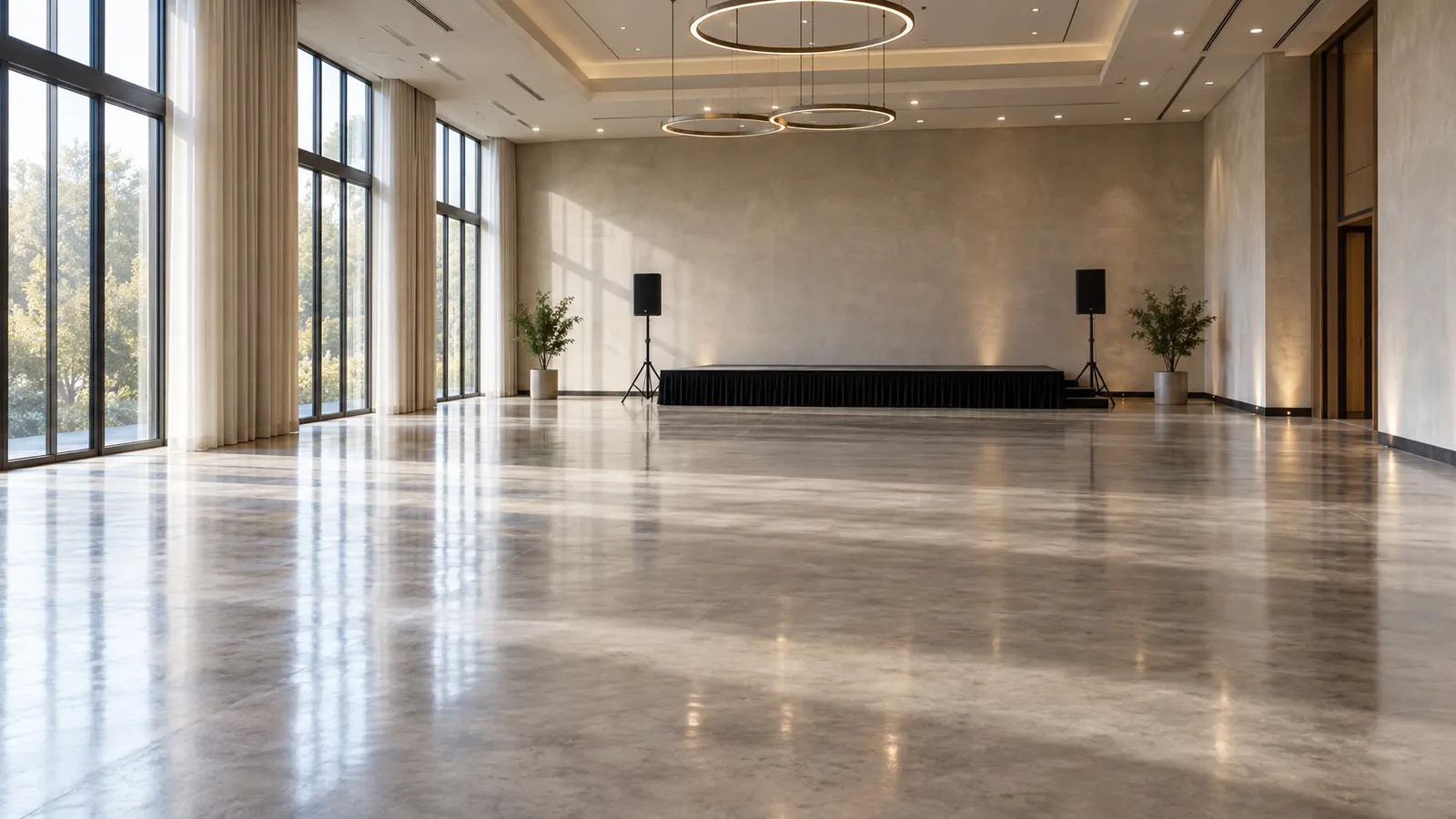
Sound spreads out from a speaker in every direction it's allowed to. Soft surfaces, like carpet, curtains and upholstered chairs, take in part of that energy. Hard, flat surfaces, like glass, polished concrete, plaster and metal, send most of it back into the room. A hard-walled space such as a loft, a warehouse conversion, a glass-fronted ballroom or a bare gymnasium gives the sound many return paths, and each return arrives a little after the direct sound.
Why late sound hurts speech
Your ear blends a reflection with the original if it arrives within a few milliseconds. Sound travels roughly one foot per millisecond, so a reflection from a wall that's 40 feet farther away than the speaker lands about 80 milliseconds late, and by then the brain hears a second word instead of a thicker first one. Consonants are short and quiet, so they're the first thing to smear. That's why a keynote can sound loud and still be hard to follow.
Why an empty room sounds worse
Every person in the room is a small sound absorber. A soundcheck in an empty ballroom exaggerates the problem, and the same room with a full crowd sounds noticeably drier. That's useful and a trap. Don't fix an empty room by cutting highs until it sounds dull, because once the crowd arrives, speech will lose clarity. Check at the volume and the settings you'll run with an audience, and keep a few tools ready to adjust once people fill the floor.
Features that make it worse
- Parallel walls that bounce sound back and forth
- Tall ceilings, glass walls and polished floors with no soft surfaces
- Speakers pointed at the back wall or at windows
- A long, narrow room with one pair of speakers at the front
Look at the room during your site visit and ask yourself what the sound will hit after it leaves the speaker.
Glass, plaster and polished floors give sound plenty of surfaces to bounce from.
Speaker Placement and Aiming
Placement is the single biggest lever, and it costs nothing. The goal is simple: put as much direct sound as possible on the audience's ears, and as little as possible on the walls.
- Put the speakers in front of the microphones. A speaker behind or beside an open mic feeds sound back into it. Keep every mic behind the line of the speaker fronts.
- Raise them. Speakers on stands or on a portable stage platform send sound over the first rows and onto the people behind. A speaker on the floor sends it across the room at ear level and into the back wall.
- Aim them at the crowd. Point each speaker at the back third of the audience, not at the center of the back wall. Walk the room and listen. If you can hear the speaker bouncing off a glass wall, the aim is wrong.
- Avoid corners and wall edges. A speaker tucked into a corner or against a wall sounds boomy and sends sound along the walls.
- Keep them away from windows and mirrors. Angle the cabinets slightly inward so the sides of the sound pattern miss the glass.
A commercial PA speaker has a defined coverage pattern. It covers a certain width and height in front of it, and the sound outside that pattern is weaker and messier. Spread the speakers so the patterns overlap just enough to cover the audience without crossing at the walls. If you're unsure about the room, ask your AV team to walk the venue with you before the event. Our event sound system rental guide explains what gear to expect and how a typical setup comes together.
Coverage, Not Volume
When a room sounds bad, the instinct is to turn it up. In a reverberant room, that makes the problem worse. Louder sound means louder reflections, and the ratio of direct sound to reflected sound gets no better. Clarity comes from improving that ratio, not from raising the level.
Why more speakers at lower levels help
A long room covered by one pair of speakers at the front has a problem: the people at the back are far from the speakers, so the system has to run loud to reach them, and the people at the front are blasted. The louder it runs, the more the room rings. Placing additional speakers closer to the back half lets each one run quieter. Quieter speakers excite the room less, and every listener is nearer to a source, so the direct sound dominates.
Match speakers to the space
- Small rooms: one or two speakers at the front, elevated and aimed at the back third, are often enough for speech.
- Long or wide rooms: a main pair at the front plus a second set partway down the room, placed so the crowd is covered evenly.
- Rooms with a low stage or an open floor plan: speakers on stands rather than on the floor, so the sound clears the heads in front.
- Bass: subwoofers add low-end punch for music. They're available on request, subject to availability, but they don't help speech clarity and can make a boomy room worse if you overuse them.
Size the system to the job
Speech needs clarity more than power. A presentation or ceremony in a hard-walled room can sound better on a modest, well-placed system than on a large one pushed hard. Tell your vendor what you're doing: a keynote, a band, a dinner with a DJ, or all three. Each needs a different layout, and the right answer for each is scoped and quoted to your event.
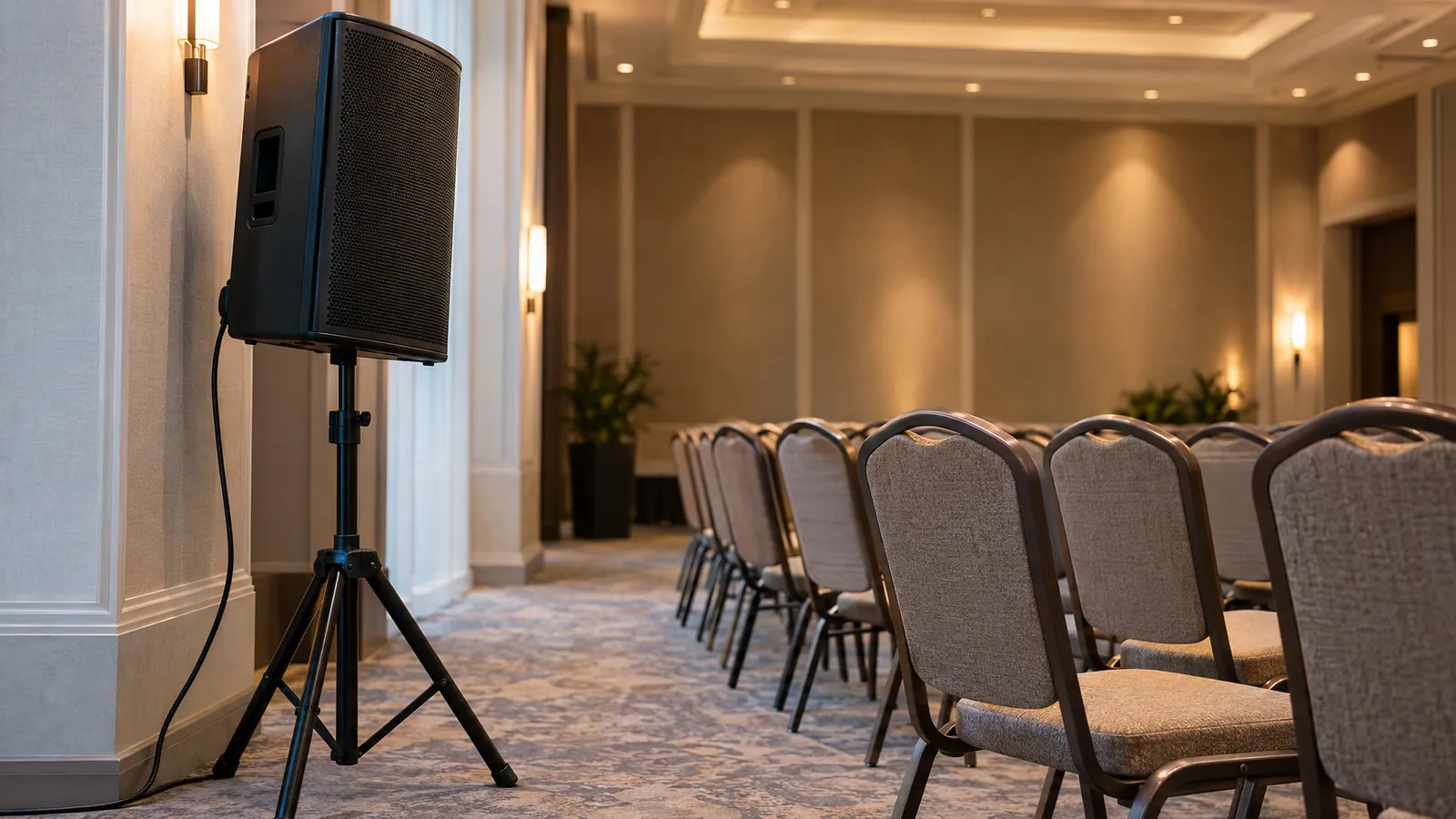
A raised speaker tilted toward the audience puts direct sound on listeners instead of the walls.
Mic Technique: Keep Room Sound Out of the System
Every microphone is also a room microphone. The farther a speaker's mouth is from the mic, the more the mic hears the room, and the more echo goes back through the PA. Fixing technique is the cheapest way to cut reverb, because it reduces the problem at the source.
Get close and stay close
A handheld mic works best about a hand's width from the mouth. A speaker who holds it at chest height forces the engineer to turn the gain up, and a higher gain picks up the room and the speakers' own sound. Brief every presenter at the soundcheck: mic near the chin, pointed at the mouth, and not swinging between questions.
Choose the mic for the job
- Handheld: best for hosts and Q&A, because the person controls the distance.
- Headset: sits at a fixed distance from the mouth, so it suits presenters who move around.
- Lavalier: clips to clothing, and it's the farthest from the mouth, so it picks up more room sound. It looks clean on camera, and it needs more care in a reflective room.
- Podium mic: works for fixed speakers, as long as they stay at the lectern.
Our comparison of handheld, lavalier and headset mics for Bay Area events goes through the trade-offs. Wireless microphones, mixers and podium mics are available on request, subject to availability, with a quote.
Mute what isn't in use
An open mic that no one is speaking into still adds room sound. Mute or pull down every channel that isn't active. For a panel with four speakers, only the person talking needs to be live, and a technician who rides the faders will reduce echo noticeably compared with leaving everything open.
Watch the ring
If a mic starts to ring when it's near a speaker, don't just lower the volume for the whole room. Move the speaker, move the mic or ask the presenter to step back from the speaker's front. Those fixes address the cause instead of the symptom.
EQ and Delay: Clean Up What Placement Can't
Once the speakers are in the right place and the mics are used well, EQ and delay finish the job. Treat them as polish, not rescue. No amount of EQ turns a badly aimed system into a good one.
EQ for a reflective room
Hard rooms tend to build up energy in the low-mid range, the "boxy" or "muddy" zone that makes voices sound thick. Two moves usually help speech:
- Cut the low end on voice channels. A high-pass filter on every speech mic removes rumble and thump that the room amplifies. Voices don't need it.
- Trim the muddy range a little at a time, listening from several seats. A small cut often does more than a large one.
- Ring out the system. Raise the mic gain until it just begins to ring, find the pitch and pull that narrow band down slightly. Stop before the voice sounds thin.
Make EQ changes with the room's real conditions in mind. If you cut highs in an empty room because it sounds harsh, the crowd will arrive and the speech will go dull. Make small moves, then re-check once the room fills.
Delay speakers
In a long room with a second set of speakers partway down, the sound from the front pair arrives later at the back than the sound from the nearer speakers. If the two aren't lined up, the listener hears the same word twice, which sounds like echo even though no wall is involved. The fix is a small delay on the rear speakers, set so their sound lands just after the sound from the front, as if it all came from the stage.
The delay time follows from the distance, because sound travels roughly one foot per millisecond. A speaker 50 feet from the front pair needs about 50 milliseconds of delay, plus a few extra so the front pair still feels like the source. Delay needs a mixer or processor that supports it, and a technician who knows how to set it. Mixers are available on request, subject to availability, and any delay layout is scoped to your room and quoted to your event.
Tell your vendor about the room's length up front. A layout with delay needs more planning than a simple front pair, and it's better to know the day you request the quote.
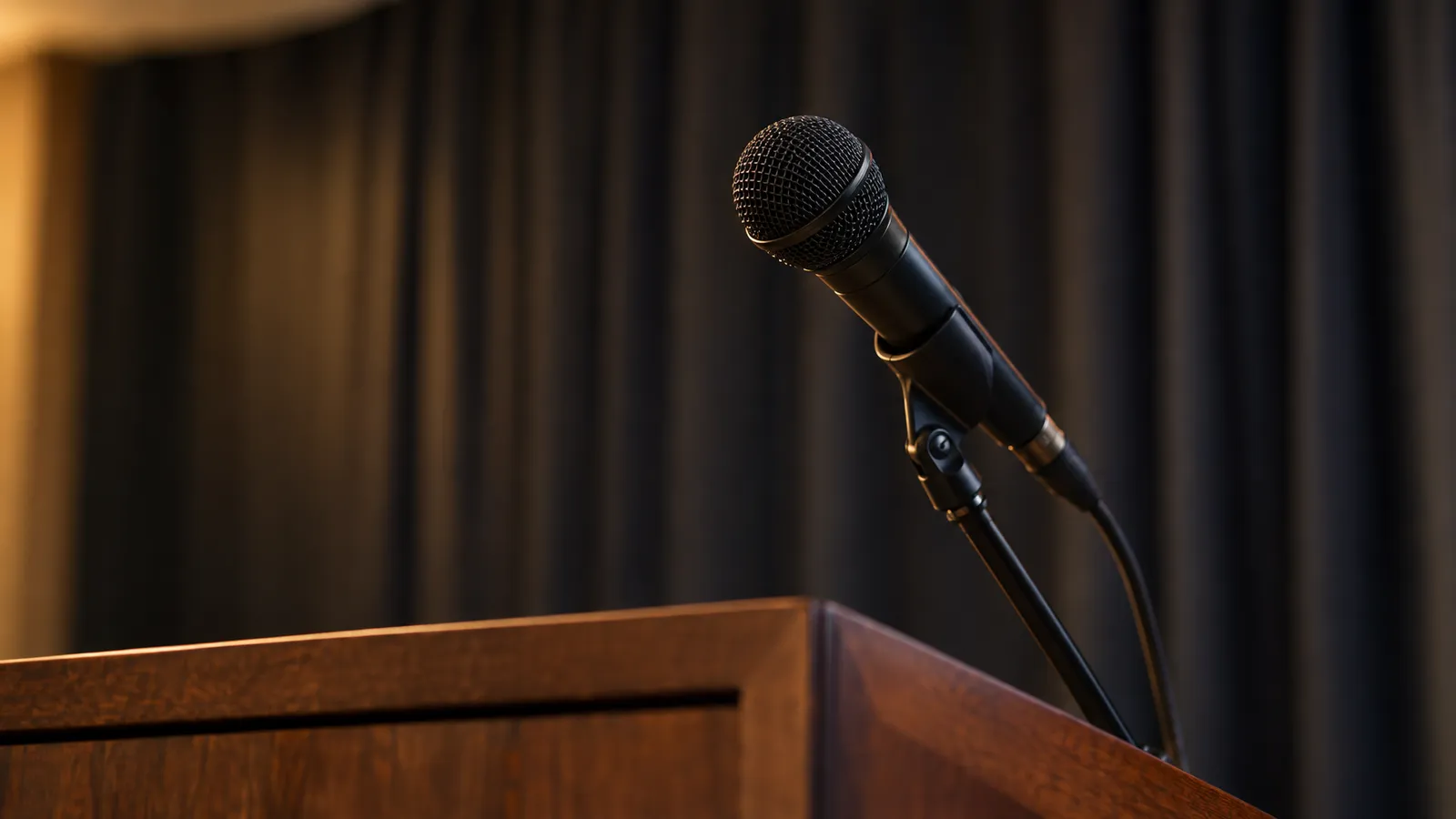
A mic close to the mouth hears the speaker instead of the room, and drapes behind it help soften the space.
Soften the Room Itself
You can't rebuild a venue, but you can reduce how much sound it reflects. Even small changes help, because every soft surface takes some energy out of the room.
Quick wins on event day
- Drapes and pipe-and-drape. Fabric along a bare wall behind or beside the stage cuts reflections. Pipe and drape is available on request, subject to availability, with a quote.
- Banners and fabric backdrops hung on hard walls break up flat surfaces.
- Rugs and carpet runners over polished floors take down floor bounce, especially near the stage.
- Soft furnishings: upholstered seating and tablecloths absorb more than bare chairs and tables.
- Close doors and curtains on glass walls, and ask the venue whether blinds can be drawn.
- Fill the room. A full crowd is the best absorber you'll have, so schedule the program when people are seated rather than milling around the edges.
Layout choices that help
Reorient the room if the venue allows it. A stage on the long wall puts the audience closer to the speakers and shortens the distance to the farthest seat. A stage at the end of a long, narrow room makes the back rows far away and the walls close to both sides.
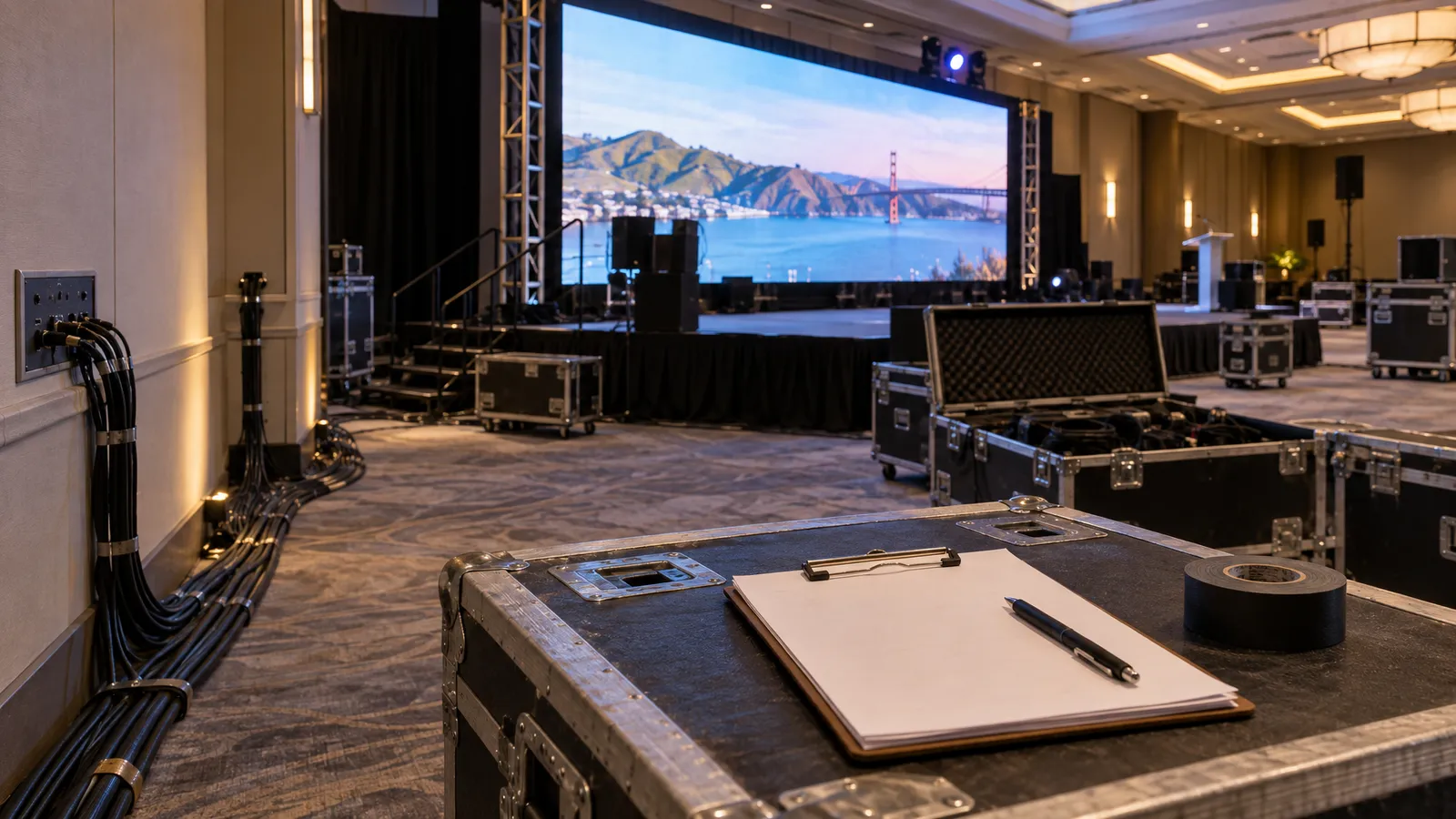
If the program allows it, a screen or LED wall can also act as a surface that reflects sound, so avoid aiming speakers at it. When you plan the stage layout, think about where the sound goes as well as where the picture goes. Our guide to setting up a sound system for a live event covers the order in which to set up and test.
Ask the venue what it already has. Some rooms keep acoustic panels, curtains or portable partitions in storage that they'll set up on request.
What to Ask a Rental Vendor Before the Event
Most sound problems are cheaper to solve in the planning stage than during soundcheck. When you request a quote, give your AV team the information they need and ask these questions.
What to tell them
- Venue name and room size, with a floor plan if you have one.
- Wall, floor and ceiling surfaces: glass, concrete, plaster, carpet, curtains.
- Audience size and seating style: theater rows, round tables or standing.
- The program: speeches, panel, live music, DJ, video playback.
- How many microphones and whether presenters will move around.
What to ask
- Can someone visit the room, or review photos, before the day? A site check shows the problems that a floor plan hides.
- How will you cover the room? Ask how many speakers, where they'll go and how they'll be aimed.
- Is a second speaker set or delay needed for a room this shape?
- Who will run the sound? Ask whether a technician stays during the program to adjust levels and mute unused mics. Technicians and operators are scoped and quoted to your event.
- When can we do a soundcheck with the actual speakers and microphones?
- What's the backup plan if a wireless mic drops out?
Browse what we rent, including the commercial PA speaker, then tell us about the room. We design a custom solution around each event, and equipment beyond the listed catalog is available on request, subject to availability. Availability is confirmed for your date when you request a quote.
A good vendor will answer these questions with specifics about your room instead of a generic package. If the answer to "how will you cover the room?" is "we'll bring a big system," ask again.
FAQ: Echo and Bad Sound at Events
How do you get rid of echo at an event?
Aim the speakers at the audience and away from walls and glass, raise them on stands, and add speakers closer to the back of long rooms instead of turning the volume up. Then keep microphones close to the speaker's mouth, mute unused channels and adjust EQ and delay. Soft surfaces such as drapes, rugs and a full crowd reduce what's left.
Why does my event venue echo so much?
Hard, flat surfaces like glass, concrete and plaster reflect sound instead of absorbing it. The reflections arrive after the direct sound and blur speech. An empty room echoes more than a full one, because people absorb sound.
Does turning the volume down fix echo?
It can help, because quieter speakers excite the room less. But the better fix is a better speaker layout, so you can run lower and still be heard. More speakers placed closer to the audience improve clarity at lower levels.
What is the difference between echo, reverb and feedback?
Echo is a distinct repeat of the sound. Reverb is a smeared tail that follows it. Feedback is a ringing or howling that builds when a speaker's sound re-enters an open microphone. Speaker placement helps all three, and the other fixes differ slightly for each.
What should I ask an AV rental company about bad room acoustics?
Ask how they'll cover the room, how the speakers will be placed and aimed, whether a delay layout is needed, who will run the sound during the event and when the soundcheck is. Give them the venue, the room's surfaces and the program so the answer fits your space.