The Short Answer: Add Up the Amps, Then Split Them Across Circuits
Event power requirements for AV equipment come down to one calculation: total watts divided by voltage gives amps, and those amps have to be spread across enough circuits that no single breaker runs near its limit. A standard US wall circuit is 120 volts. A 15-amp circuit delivers 1,800 watts at most, and a 20-amp circuit delivers 2,400. For loads that run for hours, plan on 80% of that: 1,440 watts on a 15-amp circuit, 1,920 watts on a 20-amp one.
That's the whole idea. The trouble is that nobody at the venue hands you a number, and gear spec plates list peak draw, not what the rig pulls at 8 p.m. when the LED wall is showing bright white and the haze machine is heating up.
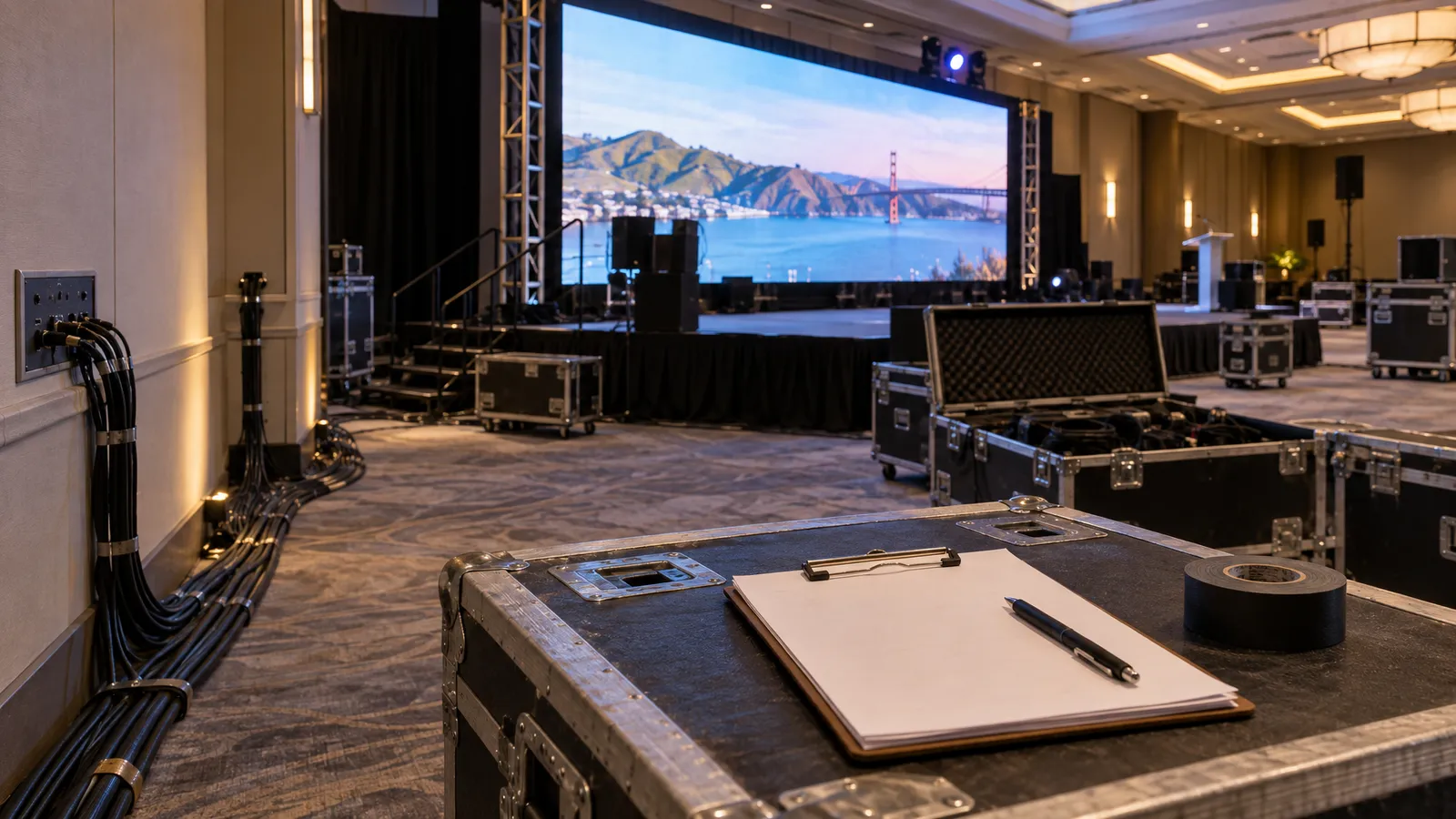
Most power failures at Bay Area events aren't dramatic. A ballroom in a hotel has plenty of electricity in the building but only two outlets on the stage wall, and both feed the same breaker. A warehouse in Oakland has a big panel but it's 80 feet from the stage. A courtyard has a single weatherproof outlet shared with the caterer's warmers. Each of those is a planning problem you can solve a week out, and a trip hazard or a dark screen if you wait for load-in.
This guide walks through the order we'd work in: build a load list, ask the venue the right questions, plan cable runs, and decide early whether you need backup power. If you're still choosing a vendor, our checklist for choosing an AV equipment supplier covers the other questions worth asking.
Watts, Amps and Volts: The Math in Four Lines
You don't need an electrician's license to size an event. You need four lines of arithmetic and the nameplate on each piece of gear.
- Find the draw. Each device has a label or spec sheet with watts, or with amps at a stated voltage. If it lists amps, multiply by 120 to get watts.
- Add by group. Total the LED wall, audio, lighting and effects separately. Groups make it easy to assign circuits later.
- Convert to amps. Divide each group's watts by 120.
- Apply the 80% rule. Divide by 1,440 (15-amp circuit) or 1,920 (20-amp circuit) to see how many circuits the group needs.
Here's a worked example using made-up nameplate numbers, only to show the method. Your rig will differ, so use the real specs.
- LED wall panels and processor: 2,400 W
- Powered speakers and a mixer: 1,200 W
- Eight LED pars at 100 W each: 800 W
- One haze machine: 600 W
The total is 5,000 W, or about 42 amps at 120 volts. Divided by 1,920 W per 20-amp circuit, that's 2.6, so you round up to three dedicated 20-amp circuits. In practice you'd put the LED wall on its own circuit, audio on a second, and lighting plus effects on a third, so that a tripped breaker takes out one system and not the whole show.
Two caveats. Lighting and LED draw varies with content and brightness, so size for the high end. And motors, heaters and amplifiers pull a surge when they start, which is why you stagger power-up instead of flipping every switch at once.
A written load list, kept next to the gear, is the cheapest power insurance there is.
Build a Load List by Gear Group
A load list is a one-page table: every powered item, its wattage, and which circuit it will sit on. Build it by group, because each group behaves differently and fails differently.
LED walls and screens
LED panels are the biggest single draw at most events, and they draw more when the picture is brighter. Ask for the panel and processor specs for the size you're renting. A configuration from our P1.9-3.9 LED rental screens scales from 12 m² to 48 m², so the power plan changes a lot between the small and large ends. Give the wall its own circuit or circuits, and keep the processor on the same circuit as the panels it feeds, so a single breaker can't leave you with lit panels and no signal.
Audio
Powered speakers, like our commercial PA speakers, pull power in proportion to how loud they run, not how loud they could run. Put audio on a circuit separate from lighting and effects. Dimmers and heaters can inject noise, and you don't want a hum in the keynote.
Lighting
LED fixtures are light on power, but a rig of moving heads adds up, and each one has a startup draw. Count every fixture, the lighting console and any dimmer packs. Stagger startup in groups.
Effects
Haze and fog machines use a heating element, so their draw is high for how small they are. Cold spark machines are low-heat effects, but they still need a dedicated outlet. Check each spec plate and give heaters their own circuit. Whether an effect is cleared for a venue is a separate question for the venue and the fire authority.
Questions to Ask the Venue About Circuits
A venue coordinator can tell you where the power is and who controls it, but only if you ask in their terms. Send these questions in writing at least a week before load-in and keep the replies with your load list.
- How many dedicated circuits are on the stage or screen wall, and what's their amperage? Ask for the breaker panel location and whether the stage outlets share breakers with house lighting or the kitchen.
- Is there a separate panel or a distribution point I can reach? Some ballrooms have a labeled stage-side panel. Many don't.
- Can the AV crew access the breaker panel during load-in and the event? A tripped breaker you can't reach is an outage.
- Are the circuits GFCI-protected? Outdoor and some indoor outlets are. A GFCI can trip on gear that otherwise runs fine.
- What are the house rules for cable runs? Some venues restrict taping to floors, crossing walkways or running through fire doors.
- Is there an in-house electrician or a required outside vendor, and what are the hours? Some buildings require their own electrician for any tie-in to a panel.
- What else will share the power that night? Catering, a photo booth, a DJ or a band can all land on the same circuits.
Write down the answers, then match them to your load list. If a group needs three circuits and the venue gives you one, you have a week to find another solution. A venue's own panel limits are theirs to confirm, so treat anything not in writing as unconfirmed.
When you request a quote from us, share your venue's circuit answers and your rough equipment list. Delivery, setup, technicians and operators are scoped and quoted to your event, and availability is confirmed for your date when you request a quote.
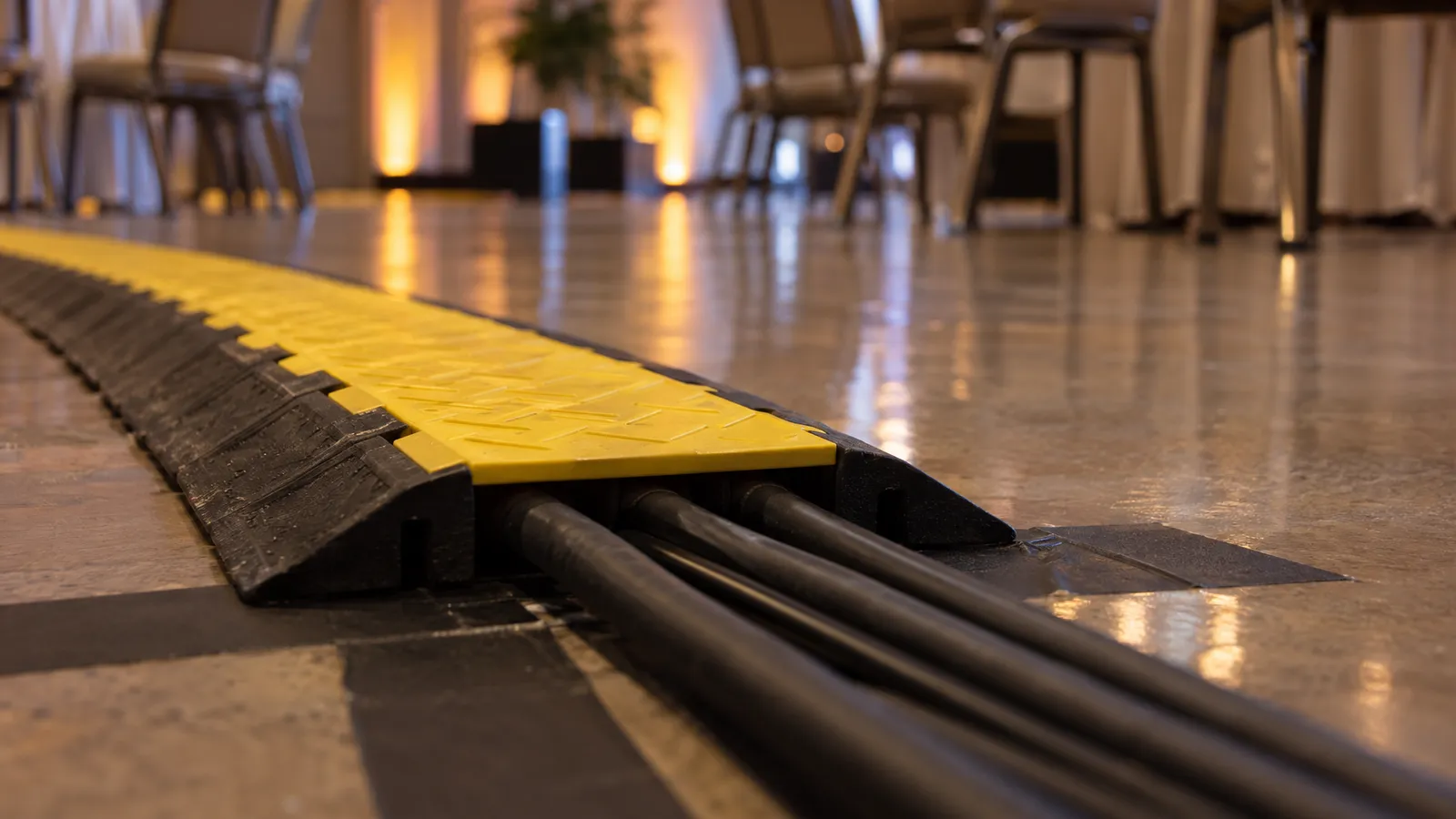
Cable ramps keep power runs flat and guests from tripping over them.
Planning Cable Runs: Distance, Gauge and Guest Safety
Once you know which circuit feeds which group, plan the physical path. A good power plan on paper can still fail if the cable is too long, too thin or in the wrong place.
Keep runs short and use the right cable
Long, thin extension cords lose voltage, and gear that's already near a circuit's limit will run hot or trip. Use heavy-duty cords rated for the load, run each group's power from the closest outlet or panel, and don't daisy-chain power strips. A strip rated for office use isn't a distribution system. If the closest outlet is across the room, ask the venue about a closer one before you reach for a longer cord.
Separate power from signal
Run audio and video cables apart from power where you can, and cross them at right angles when you can't. Parallel runs invite hum in the audio. Keep the LED processor's data cable short and away from the heaviest power runs.
Protect the guests
- Cover every cable that crosses a walkway with a ramp or cover. Tape alone isn't enough where people walk in heels.
- Keep cables out of doorways, exits and stair landings.
- Run along walls and truss legs where possible, and label both ends of every run.
- Leave slack at the gear so a tug on a cable doesn't pull a stack down.
For stage builds with overhead lights, power for the fixtures has to be planned with the rigging itself. Our truss and rigging safety checklist covers who signs off on load and hardware, and the power drops should be part of that same walk-through. Outdoors, cable connections need weather protection and are a good place to start with our rain plan for AV gear.
Backup Power: When a Generator Makes Sense
Most indoor events at hotels, galleries and corporate venues don't need a generator. The building's electrical service is enough, and the real job is getting the right number of circuits to the right wall. A generator enters the conversation in three situations:
- The venue has no usable power where you need it. Parks, vineyards, open lots and some rooftops fall in this category.
- The venue's circuits can't carry your load list. If the math in this guide shows you need five circuits and the room has two, you need another source.
- A power loss would be costly. A livestream, a televised keynote or a ticketed show may justify a backup path even when the building has power.
To be clear about our side: VENEGEEST doesn't offer generators or power distribution. We can tell you what the gear we rent will draw, but sourcing a generator, distribution boxes and a licensed operator is a job for the venue or a power vendor. Ask the venue first, since many outdoor and event sites have preferred vendors and their own rules about fuel, noise and placement.
Cheaper insurance for the parts that matter most
You don't have to back up the whole rig. A small battery backup (UPS) on the LED processor, the lighting console and the laptop or media player keeps the show's brain alive through a brief dip, so a flicker doesn't turn into a five-minute reboot in front of the room. Speakers and big loads rarely belong on a small UPS, and a breaker trip isn't a power cut, so keep the spare circuit plan in mind too.
Whatever backup you choose, decide who owns the decision to switch over and who's standing next to the panel when it happens.
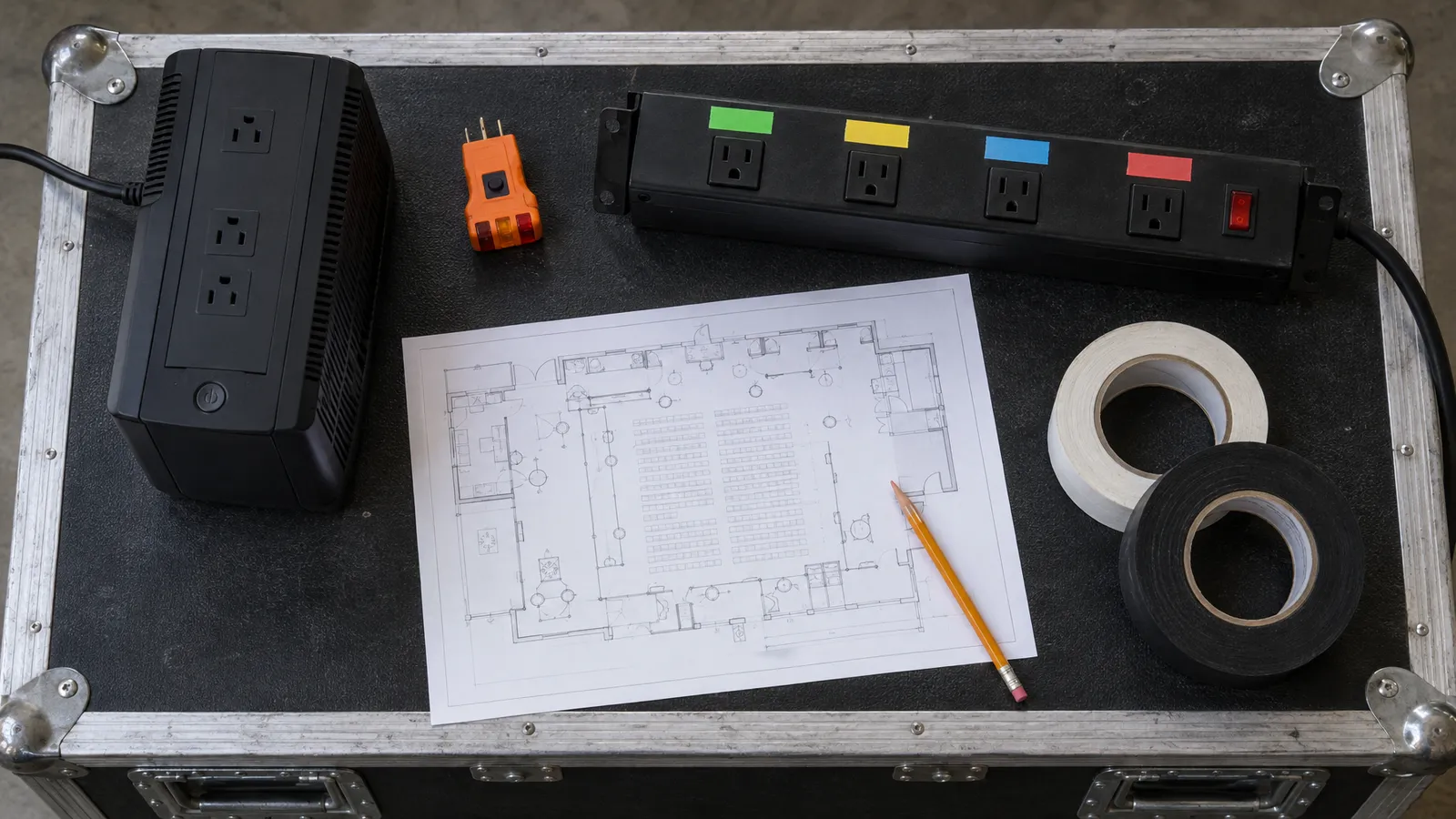
A circuit tester, labels and a small battery backup cover most of what a power check needs.
Load-In Day: A Ten-Minute Power Check
Even a clean plan needs a quick check when the crew arrives. Do this before any gear is plugged in, ideally with the venue contact beside you.
- Find the panel. Locate the breaker panel, confirm the circuit labels match what the venue told you, and note who has the key.
- Test the outlets. A plug-in tester shows reversed wiring or a missing ground in seconds. Check every outlet you plan to use.
- Confirm what's shared. Ask again what else is plugged into those circuits. Caterers and DJs often show up after you.
- Lay out cable before you connect. Run, cover and label first. Power up last.
- Stagger the startup. Turn on audio first, then lighting, then the LED wall, then effects, and watch the panel as you go.
- Walk the room once more. Look for cables across exits, loose connections and anything warm to the touch.
If a breaker trips, don't keep resetting it. Find the load that tripped it, move it to another circuit and write down what you changed. Repeated trips mean the circuit is over its limit, not unlucky.
The same plan feeds the schedule for the day. Knowing when power is live and who has panel access lets the crew set load-in times that don't collide with other vendors. If you're building a stage or an overhead rig, the guide to AV equipment for live music venues is a good companion for sizing the rest of the setup. To talk through your own load list, you can browse what we rent and request a quote with your venue details.
FAQ: Event Power for AV Equipment
How much power does an LED wall need at an event?
It depends on the size, brightness and content of the wall. Add up the watts from the panel and processor spec sheets, divide by 120 volts to get amps, and then divide by 1,440 watts for a 15-amp circuit or 1,920 watts for a 20-amp circuit (the 80% rule for long runs). Give the wall its own circuits, separate from audio and lighting, and size for the brightest content you'll show.
How many circuits do I need for AV equipment at a venue?
Group the gear into LED, audio, lighting and effects, add the watts for each group, and divide by the usable watts per circuit. A small PA and a few lights might fit on one or two circuits, while an LED wall with sound and effects often needs three or more. Always round up, and keep each group on its own circuit.
Do I need a generator for an event?
Usually not indoors. A generator is worth considering when the venue has no usable power, when its circuits can't carry your load, or when an outage would be costly. VENEGEEST doesn't offer generators or power distribution, so arrange them with the venue or a power vendor, and ask the venue about its rules first.
Can I plug everything into one extension cord or power strip?
No. A single cord or strip can overheat or trip the breaker when it carries a full AV load. Use heavy-duty cords rated for the load, avoid daisy-chaining, and feed each gear group from its own circuit as close to the equipment as possible.
What should I ask a venue about power before booking AV?
Ask how many dedicated circuits are at the stage or screen wall, their amperage, whether they share breakers, who can reach the panel, whether outlets are GFCI-protected, and what the house rules are for cable runs. Get the answers in writing a week before load-in.