Why "How Big a Screen Do I Need" Has No One-Size Answer
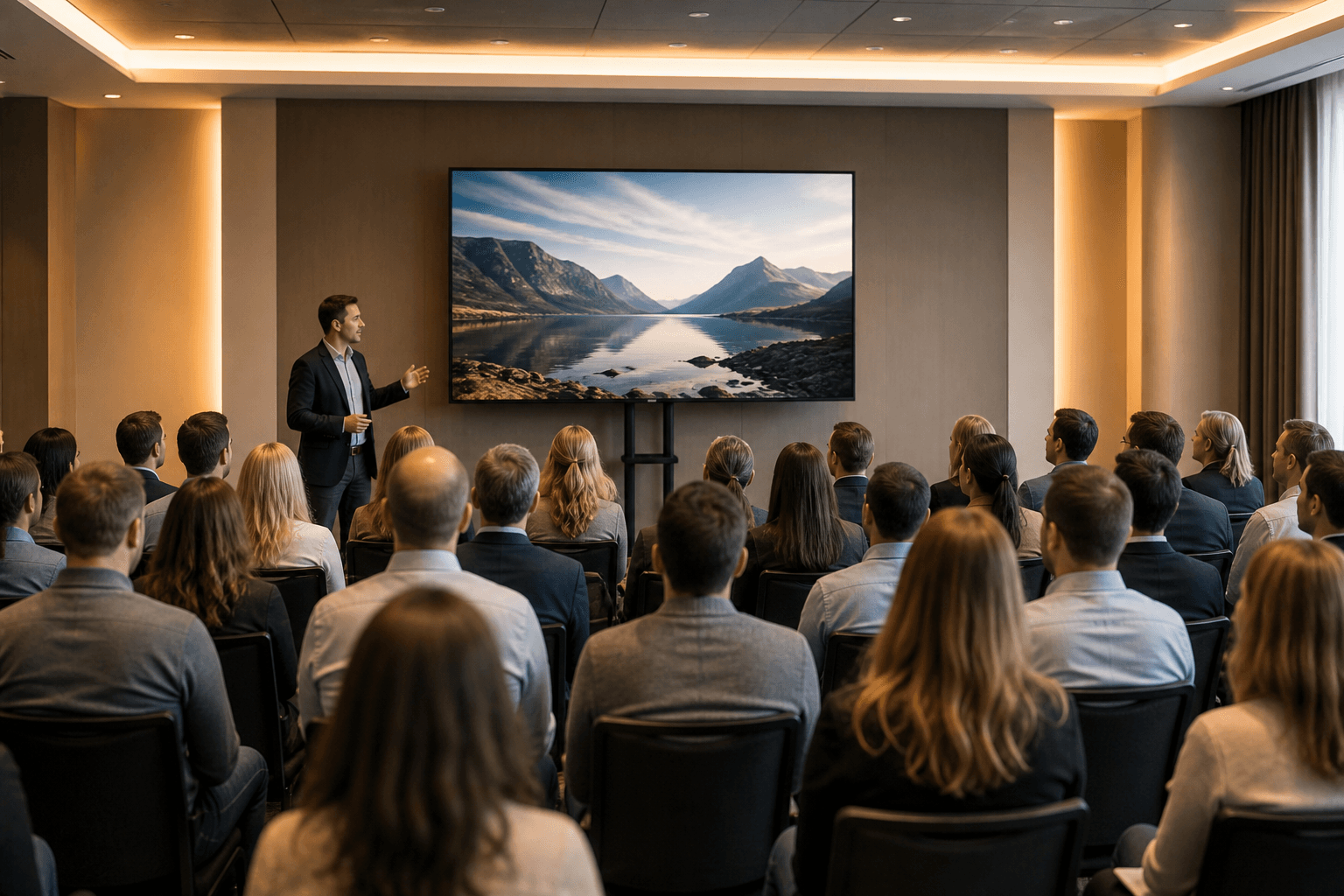
Ask five event planners what size screen to rent and you'll get five different answers, because the answer depends on three things: how far your back row sits from the screen, how many people need to read it at once, and whether the content is mostly text (slides, agendas) or mostly video and motion graphics. A 55-inch TV that looks plenty big in a showroom disappears in a 200-person ballroom. A 10-foot LED wall that feels massive in a warehouse might be overkill for a 30-person boardroom pitch.
The question often comes as "what size TV do we need for X people" or "will a 65-inch screen work in a room this big." Both are the right instinct, but headcount alone doesn't answer them. A screen that is too small leaves the back of the room struggling to read it; one that is bigger than the room needs costs more than it has to.
This guide walks through two display formats, our LED TV displays for smaller rooms and our modular LED rental screens for larger venues, and gives you a practical way to size either one before you request a quote. We'll cover viewing distance math, illustrative guest-count examples, and what changes the price.
The Viewing Distance Rule: A Starting Estimate
Size by image height, not diagonal. A long-used starting estimate is the InfoComm 4-6-8 rule: the farthest viewer within about 6× the screen's height for typical slides and video, or 4× for detailed content like spreadsheets or fine print. AV designers used it until the newer DISCAS standard, which takes the content itself into account, such as the size of its text, along with the distance to the farthest viewer. The 4-6-8 figures still give a quick first estimate; the final check is your actual slides seen from your actual seats. Flip the rule around and you get a rough sizing method.
- Measure your farthest seat from the screen. Say your back row sits 40 feet from where the display will go.
- Divide by 6 for general content (slides, video, speaker support). 40 feet ÷ 6 ≈ 6.7 feet of image height. A 16:9 image's height is about half its diagonal, so that is a screen of roughly 13.5 feet (about 160 inches) diagonal, which is LED wall territory.
- Divide by 4 for detail-heavy content (financial tables, dense text). That same 40-foot back row wants about 10 feet of image height, a screen close to 18 feet wide.
- Run it the other way for TVs. A 65-inch TV is about 2.7 feet tall, so by the 6× estimate it covers a back row of roughly 16 feet for slides; an 85-inch (about 3.5 feet tall) about 21 feet; a 120-inch (about 4.9 feet tall) about 29 feet.
By this rule, a 65-inch TV can suit a boardroom table where nobody sits more than about 16 feet away for slides. If your farthest seat is beyond what the largest available TV reaches for your content, the options are a larger image, such as a modular LED wall, or additional screens placed closer to the back rows, which we cover in the next section.
One more variable: ceiling height and sightlines. A screen mounted low behind a podium can be blocked by standing guests or centerpieces on round tables, and a larger image does not bring back text hidden behind a head or a podium. Check the sightline from the seats most likely to be blocked, and solve it with placement, mounting height or an additional display.
Size a display from the farthest seat and the content it will show.
When a TV Rental Is Enough
Our LED TV display rentals come in 43″, 65″, 75″, 85″ and 120″ sizes, which can suit boardrooms, breakout sessions, small general sessions and cocktail-hour signage. If your farthest seat is within the reach of one of those sizes for your content and the sightlines are clear, a TV on a stand or wall mount can be enough, and the listed TV rates are lower than the LED screen's.
Here are illustrative examples based on the image-height rule above. Guest count matters mainly because of how far back it pushes the farthest seat, so check your own distances:
- Up to 15 guests, boardroom style: a 43″ or 65″ LED TV Display, depending on how far the far end of the table sits.
- 15-40 guests, classroom or theater seating: 65-85 inch TV, or two TVs, for example on opposite walls; check the view from every seating position.
- 40-60 guests in a single row block: by the 6× estimate, the 120″ LED TV Display ($120/day) covers a back row of roughly 29 feet for slides, to be checked with your actual slides; if the back row is farther than that, look at a larger image such as an LED wall, or additional screens.
Our TV floor stand is worth mentioning here too: it lets you place a display anywhere in a room without wall mounting, which matters for hotel ballrooms and rented venues where you can't drill into the walls. It also makes it easier to move a display between a general session and a breakout room on the same day.
Don't ignore ambient light. A screen that looks fine in a room with dimmable lighting can be harder to read near windows or under bright lighting. If your room has floor-to-ceiling glass or bright stage lighting, ask for the brightness specification of the exact display you're quoted, and check the room at the time of day the event runs.
When You Need a Modular LED Wall Instead
When your farthest seat is beyond what the largest available TV reaches for your content, a larger image is one answer. That is where our P1.9-3.9 LED rental screen comes in; additional screens nearer the back of the room are another.
Modular LED walls are built from individual panels that tile together, so the screen isn't limited to a fixed size, you build it to the room. VENEGEEST's LED rental screen builds from 12 m² (about 13×10 ft) up to 48 m²: the smaller end suits a mid-size general session, the larger end a keynote stage or gala main screen. The "P" number is the pixel pitch, the spacing between pixels in millimeters. Planar gives a rule of thumb, "Pixel Pitch x 10 = Approximate Viewing Distance in Feet," for the distance at which individual pixels stop being noticeable: roughly 19 feet for P1.9 and 39 feet for P3.9. Planar also notes that a comfortable viewing distance is subjective and depends on eyesight and content, so treat these as approximations, not limits. Viewers closer than that distance may see individual pixels; viewers much farther back gain less from a tighter pitch. The LED video wall rental guide goes deeper on pitch and builds.
Bright rooms and outdoor sites are a separate question from size. Whether a display stays readable in daylight or under stage lighting, and how it looks on camera, depends on the specific model's brightness, the ambient light and the conditions on the day. Outdoor or weather-exposed use needs a configuration rated for it. Before booking, ask for the brightness and any weather rating of the exact panels or TV you're quoted, and confirm they suit your site.
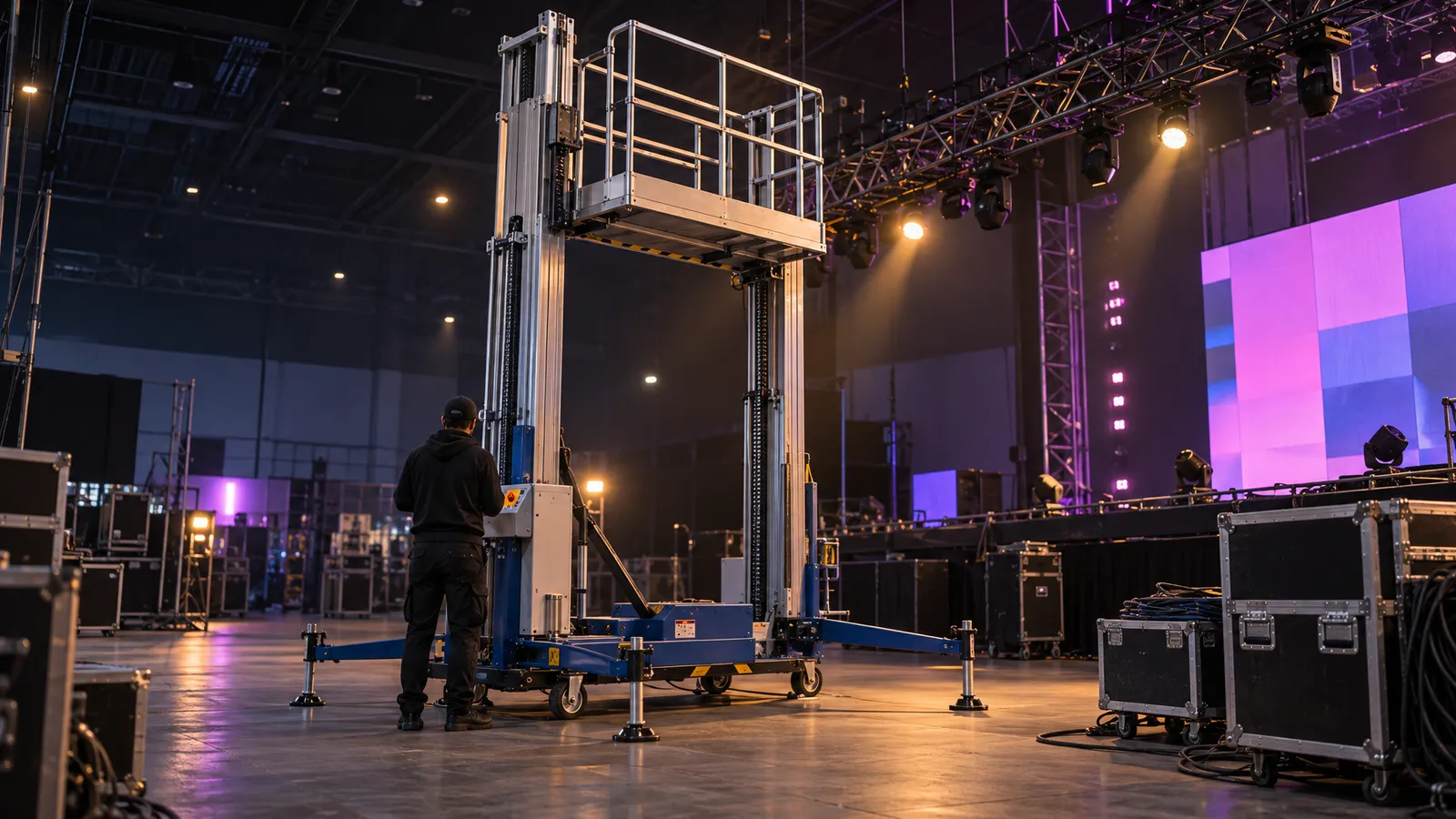
The tradeoff is setup complexity: LED walls need truss or ground-support rigging, and a longer load-in window, and delivery, setup and technician time are scoped and quoted to your event. Expect to be asked about load-in access and timeline when you request a wall quote.

Modular LED walls are assembled from panels, so the screen size can be built to the room.
Quick Sizing Chart by Event Type
These examples match common event formats to the viewing-distance guidance above. They are illustrations, not rules: your actual farthest seat, content and sightlines decide.
| Event type | Guests | Display to consider | Listed day rate |
|---|---|---|---|
| Boardroom meeting | Up to 15 | 43-65 inch TV on a floor stand or wall mount | $35 (43″) or $55 (65″); floor stand $20 |
| Training session or classroom | 15-40 | 75-120 inch TV, or dual TVs for wide rooms | $75 (75″), $95 (85″) or $120 (120″) per TV |
| General session or town hall | 40-100 | If the back row is beyond a TV's reach, a modular LED wall from about 12 m² (13×10 ft), or additional screens | LED Rental Screen listed at $200; the quote depends on panel area, truss and rigging |
| Keynote stage or gala | 100-400 | A larger LED wall, up to 48 m², with the pitch chosen from the nearest and farthest viewing distances | LED Rental Screen listed at $200; the quote depends on panel area, truss and rigging |
| Outdoor product launch or festival stage | — | A display sized to sightlines and specifically rated for outdoor use and the expected light; confirm the rating of the exact equipment you're quoted | Quote on request |
Room shape changes the answer too. In a long narrow ballroom or an L-shaped space, the farthest or most off-angle seats may need a larger image or a second screen. When in doubt, send your room dimensions, seating plan and the content you'll show, and ask for a recommendation rather than relying on a chart alone.
For events that also need supporting displays, a foldable LED ad screen (2 m² to 12 m², on casters, $200/day) can be used for lobby signage or sponsor recognition, so the main stage screen isn't doing double duty as both program display and advertising.
What Actually Drives the Rental Price
Screen size is only one factor in an AV quote. When you're comparing options, keep these cost drivers in mind:
- Format, not just size. A TV rental is a flat rate for the unit plus stand: VENEGEEST's LED TV Displays run $35/day (43″), $55 (65″), $75 (75″), $95 (85″) and $120 (120″), and the TV Floor Stand is $20/day. The P1.9–3.9 LED Rental Screen is listed at $200/day; ask how the quote changes with the panel area, truss and rigging your room needs.
- Pixel pitch. Ask whether the pitch you choose changes the quote, and match it to your viewing distances rather than picking the tightest available.
- Labor and load-in time. A TV on a stand is a simpler setup than an LED wall, which needs panels assembled on truss or ground support; ask how long the build takes for your size and when it has to start. Delivery, setup and technician time are scoped and quoted to your event.
- Duration and rehearsal time. Each day rate covers a 24-hour rental period, so if your agreed rental period, including any rehearsal, runs past 24 hours, additional days are billed; rentals of five or more consecutive days get a discounted weekly rate. Include rehearsal time when you ask for a quote.
- Content playback and technician support. Static slides need less than live camera feeds or multi-source switching. If your event needs someone running the screen live, that technician time is scoped and quoted to your event along with the hardware.
Asking for "the biggest screen you have" without measuring the room can overspend the budget or run into a room that can't fit the truss and rigging an LED wall needs. Sending your headcount, room dimensions, content and load-in details up front helps prepare a suitable quote, subject to the site and technical checks the equipment needs.
FAQ: Sizing a Rental TV or LED Wall
What size TV do I need for 50 people?
It depends on where the back row sits. If 50 guests are seated in rows with a back row around 35-40 feet away, even the 120-inch TV (about 4.9 feet tall, about 29 feet by the 6× starting estimate) falls short for slides, so look at a larger image such as a modular LED wall, or additional screens. If the room is shallow and the back row is within about 29 feet, a 120-inch TV may work; check your actual slides from the back row.
Is an LED wall better than a TV for events?
Neither is "better" outright. A TV suits rooms where your farthest seat is within its reach for your content (about 29 feet for slides on the 120-inch TV, by the 6× starting estimate), and the listed TV rates are lower. An LED wall can be built larger, from 12 m² to 48 m² in VENEGEEST's catalog, but takes more rigging and setup. For bright rooms or daylight, compare the brightness specification of the exact models you're quoted rather than assuming one format wins.
How far should you sit from a rented screen?
As a starting estimate (the older InfoComm 4-6-8 rule), measure against the screen's image height, not its diagonal: the farthest viewer should sit within about 6 times the image height for general content like slides and video, or 4 times for detailed content like spreadsheets and fine print. A 120-inch 16:9 screen is about 4.9 feet tall, so by the 6× estimate it covers viewers up to about 29 feet back for general content. Whether text is readable depends on the size of the smallest element in your content, so check your actual slides from the farthest and widest seats.
What's the difference between P1.9 and P3.9 LED walls?
The number refers to pixel pitch, the distance in millimeters between LED clusters. P1.9 packs pixels tighter than P3.9. By Planar's rule of thumb (pixel pitch × 10 ≈ viewing distance in feet at which pixels stop being noticeable), that is roughly 19 feet for P1.9 and 39 feet for P3.9. These are approximations: comfort depends on eyesight and content, so use them to compare, not as limits.
Can I rent a TV for an outdoor event?
Only with a display rated for the outdoor conditions and the light you expect. Some displays are made for outdoor use, and spec details for VENEGEEST's TVs and LED screen, weather rating included, are provided on request, so ask for the brightness and weather rating of the exact equipment you're quoted, and plan cover for anything not rated for exposure.