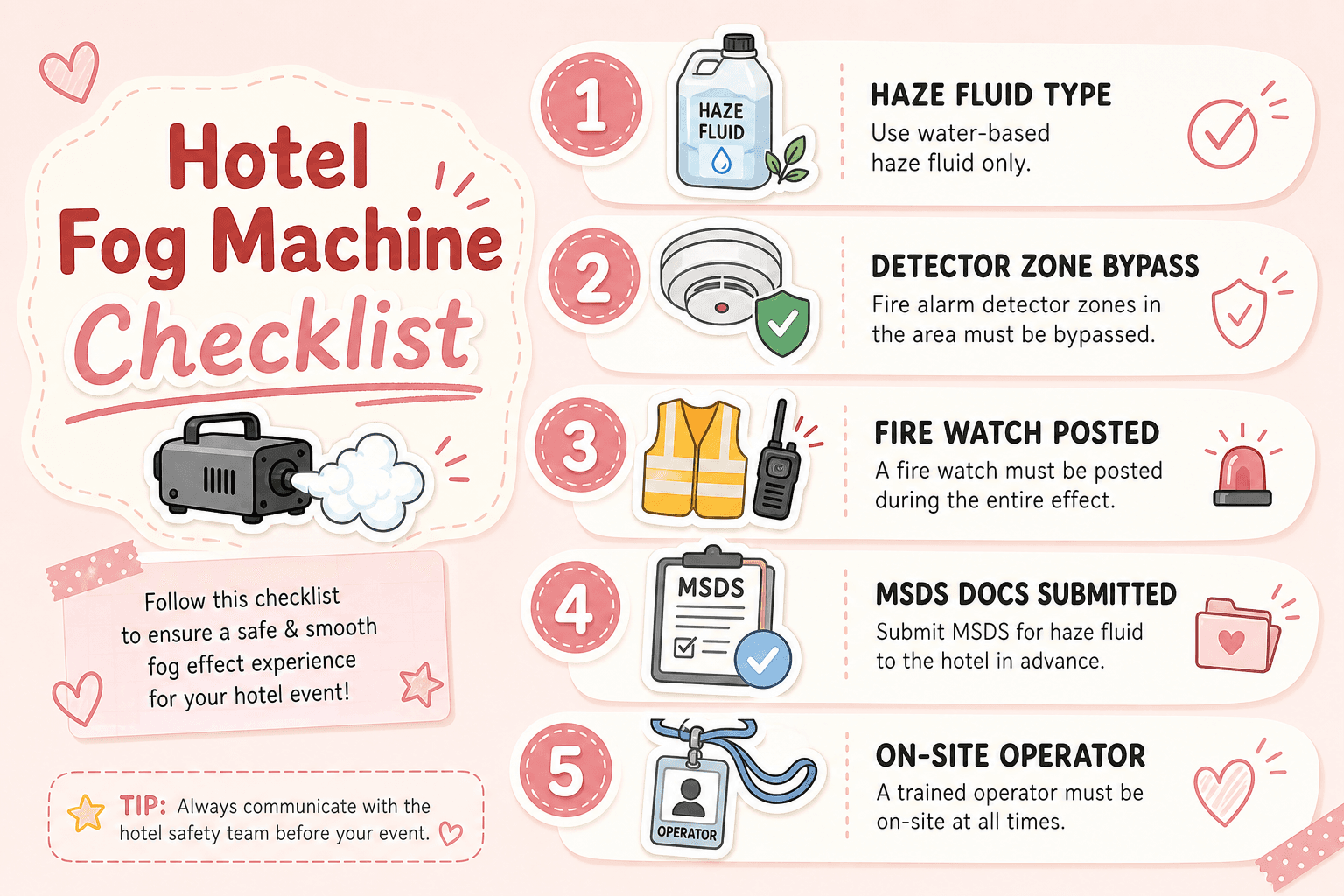
Whether you can run haze or fog in a Bay Area hotel ballroom is decided by that hotel: its event contract, its engineering team and, where a permit applies, the local fire authority, for the specific room and the specific effect. Both fog and haze can set off a smoke detector, and there is no general rule that covers every hotel, so the goal is written approval for your exact setup. Your coordinator may send the contract back with "no smoke effects" highlighted; that clause, and whatever exceptions the venue offers, is what governs your event.
This guide explains what haze, fog and low fog actually are, how smoke detectors and sprinklers respond to them, which detectors you may find in different venues, and the questions to settle with the venue before you rent a haze machine or a fog machine.
Haze, fog and low fog: what each one is
People use "fog" for all three, but they are different effects, and a venue may treat them differently. When a venue rule says "no smoke," ask whether it also covers fog, haze and low fog, rather than guessing.
- Haze. Haze machines (hazers) produce an atmosphere that tends to be less dense than a fog machine's output; Wikipedia's fog machine article puts the particle size of hazer output under 5 micrometres. In a room, haze is hard to see until a light beam passes through it, which is why lighting designers use it to make beams visible.
- Fog. A fog machine produces a visible cloud. The same article describes fog as typically created by vaporizing proprietary water- and glycol-based or glycerin-based fluids, or by atomizing mineral oil.
- Low fog. Dry-ice and chilled low-fog machines make a cloud that hugs the floor, the classic first-dance look. It is another option to ask about, not an automatic yes: the venue still decides, and dry ice brings its own ventilation questions. We compare the three in dry ice vs fog machine.
The fluid is not a separate choice you make freely. Each machine is built for particular fluids: Antari, for example, lists its own HZL and HZL-W haze fluids for its HZ-500 hazer. Fluid type also does not map neatly to the look: our catalog includes a 600W oil-based haze machine alongside fog machines that make a dense cloud. Venues may allow one fluid type and not another, so the useful documents are the manual and the fluid's safety data sheet (SDS) for the exact unit, not a general label like "water-based."
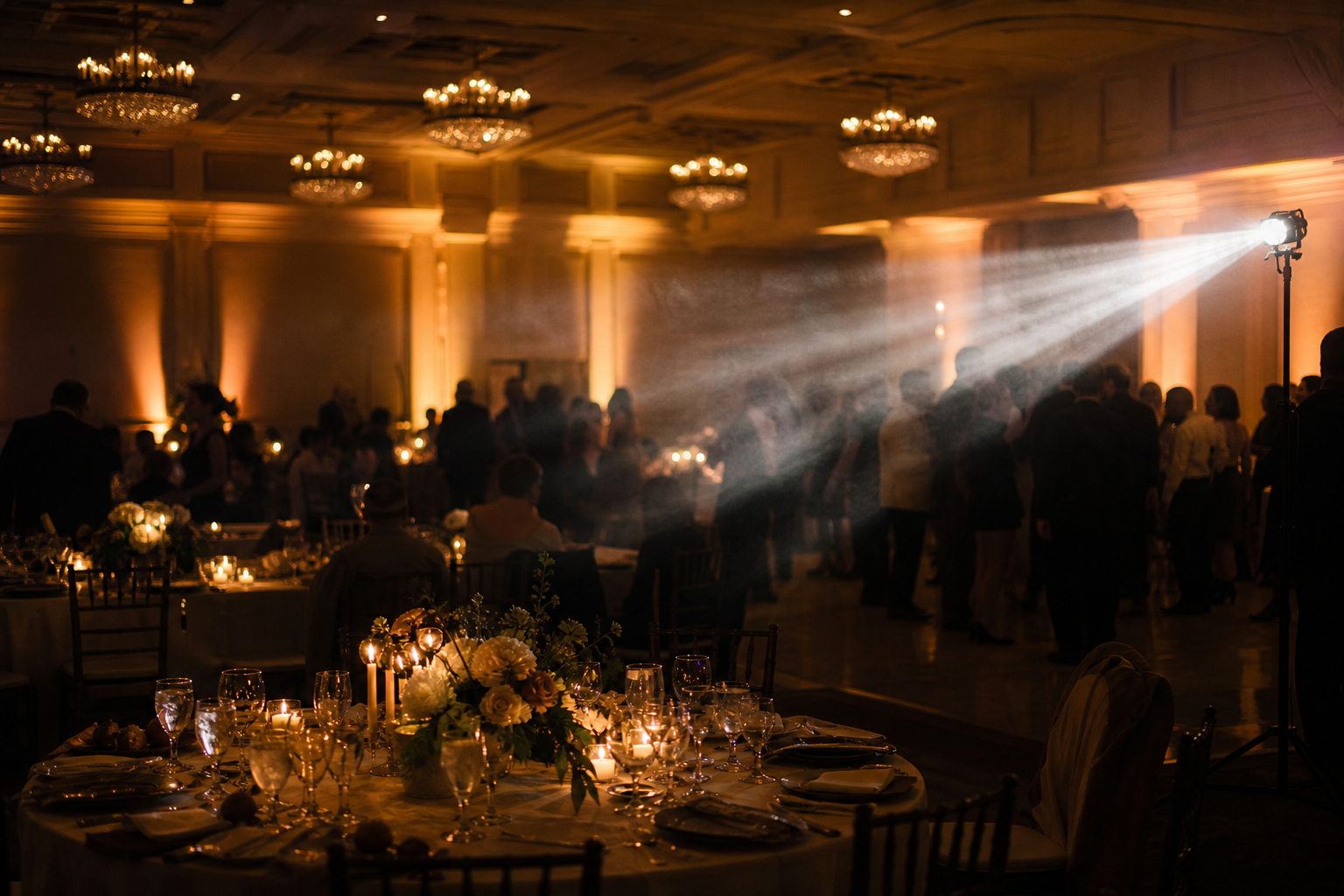
Why hotels write "no smoke effects": how detectors see particles
The detectors in a ballroom ceiling generally use one of two technologies, and both respond to particles in the air, not to fire as such.
Photoelectric detectors work, in NIST's words, "by detecting light that is reflected off particles from a light beam inside the sensing chamber." NIST adds that they "tend to be more sensitive to particles that are larger in size and white or light-colored, and thus more reflective, like those emitted by smoldering fires." A detector like this has no way of knowing whether the particles came from a fire or from a machine.
Ionization detectors "use a small bit of safely shielded radioactive material that electrically charges, or ionizes, the air molecules between two metal plates," and, per NIST, they "tend to detect small black soot particles from flaming fires more quickly." Do not assume one type is safe for haze or fog and the other is not: both work by sensing particles.
That is the practical reason behind a blanket clause. Any effect that puts particles into the air can reach a detector, and how a given detector responds depends on the effect, the output level, the run time, air movement and where the detector sits. Haze is not "less bad fog"; it is a different effect at a different density, and both can activate detectors. Only the venue's qualified fire-alarm and engineering staff can say how their system will be handled, so ask them which detector types cover the room and what they require before any effect runs.
Which detector is on the ceiling above your dance floor?
Venues do not all use one type, and the walkthrough is the only way to know. What you may find:
- Hotel ballrooms and meeting rooms: may have ionization, photoelectric or dual-sensor units, depending on the building's age and renovations. NIST's smoke detector Q&A notes that photoelectric units are less prone to nuisance alarms from cooking.
- Conference centers, expo halls and auditoriums: large open rooms may use projected-beam detectors, which send a beam across the space instead of sampling air in a small chamber on the ceiling; System Sensor (Honeywell) describes beam detectors for large open areas and high ceilings.
- Historic and converted spaces: inconsistent. A converted warehouse might have a recent retrofit, a historic hall might have older heads.
A planner who asks "what is your procedure for atmospheric effects, and who needs to approve it?" tends to get a more useful answer than "can we use fog?"
What sprinklers respond to
Sprinklers and smoke detectors are different systems. The National Fire Protection Association's sprinkler myths-and-facts sheet says home fire sprinklers "are calibrated to activate when it senses a significant heat change–typically at 135°F-165°F," and that "Sprinklers don't operate in response to smoke, cooking vapors, steam, or the sound of a smoke alarm."
That describes how ordinary heat-activated sprinkler heads work. It is not a statement about a particular hotel's whole fire-protection system, which may include smoke detection, other detection devices and alarm connections. Treat the sprinkler fact as one piece of the picture and let the venue tell you how its own system behaves. Effects that produce heat near the ceiling, such as a cold spark machine, raise their own questions for the venue and fire authority.
Questions to settle with the venue and fire authority
How a venue handles an atmospheric-effects request is its own decision, and any change to how a fire alarm system operates during an event belongs to the venue, its fire-alarm contractor and, where required, the local fire authority. It is not something a planner or an AV vendor should ask to do informally or attempt themselves. Approval steps differ from hotel to hotel and from city to city, so rather than a fixed procedure, here are the questions to get answered in writing:
- Is there a written procedure? Ask whether the venue has a documented process for haze or fog requests, and who signs off on it.
- What exactly is allowed, where? Name the room, the effect (haze, fog or low fog), the moment (full reception, first dance only, ceremony entrance), the machine, the fluid and the output you plan to use.
- Which areas are affected? Ask which detection covers the dance floor and stage, and whether the effect could drift into other areas.
- What documents do they want, and by when? Documents a venue may ask for include the machine's spec sheet or manual, the fluid's SDS, who will operate it, and an insurance certificate. Spec details for the exact units you rent are provided on request; ask for them, and for the fluid's SDS, when you request a quote.
- How will the fire alarm system be handled? Whether any detector needs attention near the effect, who authorizes it and who is responsible for the system during the event are decisions for the venue's qualified alarm personnel and the fire authority, not for the renter or the AV crew.
- Is a fire watch required? San Francisco Fire Department guidance defines a fire watch as "continuous and systematic surveillance of a building, tent, or event by one or more qualified individuals" and says the Fire Code Official may require fire watch personnel when deemed necessary for public safety; when SFFD mandates them, the property owner pays for on-site inspection personnel at overtime rates with a four-hour minimum. Ask whether that applies to your event and who pays.
- Is a permit needed? If your event involves an activity SFFD regulates, its guidance says permit applications must be submitted at least five business days before the start date, and ten business days for flame effects, pyrotechnics and fireworks. Other Bay Area cities have their own fire authorities and rules.
- Can you test the level? Ask whether a supervised test during setup is possible so the operator can set output for the room.
- What happens after the effect? Ask how long the room should clear before the next cue and what the venue needs from you at the end.
Bring your AV vendor into the engineering call so the effect, fluid and timing are described accurately, and raise the request weeks ahead, not at load-in. Under our rental terms, securing venue-specific permits and approvals is the client's responsibility, so decide early who will gather the documents and talk to engineering. If the venue says no, plan lighting that works without atmosphere.
Beyond the hotel ballroom: questions by venue type
Every building answers differently, so ask the same questions each time rather than relying on what another venue allowed:
- Historic buildings and civic venues: Some prohibit atmospheric effects outright. Ask for the venue's written event rules before you design a haze-dependent look.
- Wineries and production spaces: Working rooms may have other monitoring systems besides smoke detection. Ask the venue what is installed before committing to a haze-heavy design.
- Converted warehouses and event lofts: High ceilings change how atmosphere spreads, but the detector type and the venue's own rules still decide. Ask the same procedure and fire-watch questions as for a hotel.
- Outdoor and tented spaces: The questions change rather than disappear. Check whether the site, a tent or any nearby building has detection that atmosphere could drift into, and read the site's own rules and any permit conditions. Wind matters too: open air carries atmosphere away, and a gust through a tent flap can clear it mid-cue, so talk through placement with your AV vendor.
What you can rent from VENEGEEST
For a Bay Area hotel ballroom event, the pieces in our catalog and the pieces to line up yourself:
- Haze machines from 600W to 3000W, fog machines from 400W to 3000W, and low-fog / dry-ice machines. The 1000W Haze Machine is listed at $25 per day and the Dry Ice Low-Fog Machine at $35; other variants are quoted.
- Delivery, setup and technician services are scoped and quoted to your event. Self-pickup from our South San Francisco warehouse is also possible.
- Fluid for the machine: fog and haze fluid (and dry ice for the dry-ice units) can be provided on request — contact us for a quote — and ask which fluid the unit is set up for, so the SDS you give the venue matches what will actually run.
- Venue approvals stay with the client under our rental terms.
For more on atmospheric effects, see our equipment menu, the special effects category, the haze machine rental guide, the dry ice vs fog comparison and the dry ice fog safety guide.
FAQ: Haze, fog and fire alarms in hotel ballrooms
Will haze trigger a hotel ballroom smoke detector?
It can. Photoelectric detectors sense light reflected off particles and ionization detectors sense particles disrupting a current (NIST), and neither can tell a machine's output from smoke. Whether a particular setup triggers one depends on output, run time, air movement and detector placement. Only the venue's qualified alarm staff and the fire authority can assess and approve the exact setup.
What's the difference between fog and haze for fire-alarm purposes?
Mainly density. Haze is a thinner atmosphere that is hard to see until a light beam passes through it; fog is a visible cloud; low fog stays near the floor. Both fog and haze can activate detectors, and which one a venue accepts, and on what conditions, is the venue's decision for that room.
Why do hotels say "no smoke effects" to haze and fog?
The venue is responsible for its fire alarm system and its guests, and a venue rule may cover fog, haze, dry ice and cold sparks together. If you want an exception, ask the venue engineering manager what their procedure is, with your AV vendor on the call, and accept that the answer may still be no. Cold sparks are a separate matter: California Health and Safety Code Section 12505 lists fireworks containing zirconium, or titanium except in particle size greater than 100-mesh, as "dangerous fireworks," so check with the local fire authority as well as the venue about the specific device. When VENEGEEST's crew operates a cold spark effect, VENEGEEST holds the operating permits; a client who rents the machine and operates it carries that responsibility, including liability.
Do I need to tell the hotel if I'm using haze?
Yes. Tell the venue before the event and get approval in writing. Ask for its deadline and the documents it wants, which may include the machine's spec sheet, the fluid's SDS, operator details and an insurance certificate.
Which Bay Area hotels approve fog effects?
There is no public list, and policies differ by hotel and by room. Ask your venue directly, in writing, naming the room, the effect and the machine. Send us the venue and room with your quote request so the spec details you give engineering match the unit you rent.
Can fog or haze set off ceiling sprinklers?
According to NFPA, ordinary home fire sprinklers activate on a significant heat change, typically at 135°F–165°F, and do not operate in response to smoke or steam. A hotel's fire-protection system can include more than sprinklers, so ask the venue how its own system handles atmospheric effects.
Do outdoor weddings have any of these issues?
Possibly. Check whether the site, a tent or any nearby building has detection that the atmosphere could drift into. Wind direction, the site's own rules and any permit conditions also apply, so still ask the venue.
Get a hotel ballroom haze quote
Send us your venue, date, room name, and the moment you want haze or fog for (full reception, first dance only, ceremony entrance). We come back with a quote listing the equipment and any delivery, setup or technician time. We deliver across San Francisco, the South Bay and the wider Bay Area, or you can pick up from our South San Francisco warehouse. Call (415) 890-5555.