Why Corporate Presenters Rent a Teleprompter
A keynote speaker reading from a teleprompter can keep looking out at the room instead of down at notecards or across at a laptop screen. That's the core case for one: the script is reflected on a pane of glass at eye level, so the presenter reads while facing the audience. With a camera-mounted prompter, the same trick puts the script directly in front of the lens, so a presenter can read while looking into the camera, which matters for a hybrid town hall streamed to remote employees as much as for an all-hands in the room.
Teleprompters are common at several kinds of corporate events. Executive keynotes and product launches, where messaging has to land precisely. Earnings calls and investor presentations, where a script may need to be read exactly as approved. And award ceremonies or panel introductions, where several presenters rotate through scripted segments back to back.
The alternative, cue cards or a printed script on the podium, can work well, especially for short remarks or experienced speakers. A prompter becomes more attractive as the talk gets longer, carries exact wording such as numbers or legal disclaimers, or is being filmed. The best choice depends on the speaker's preference and how the rehearsal goes.
Conference (Presidential) vs. Camera-Mounted Teleprompters
Autocue, a prompter manufacturer, explains the principle: a monitor shows the script, which "is reflected in the beamsplitter glass," a specially coated glass that lets most light pass through and reflects some back toward the presenter. In its words, "The presenter sees the script reflected towards them, while the audience can see through the glass." The glass is transparent, but the panes and their stands are still physical objects on stage, so plan where they sit in the room and in any camera shot.
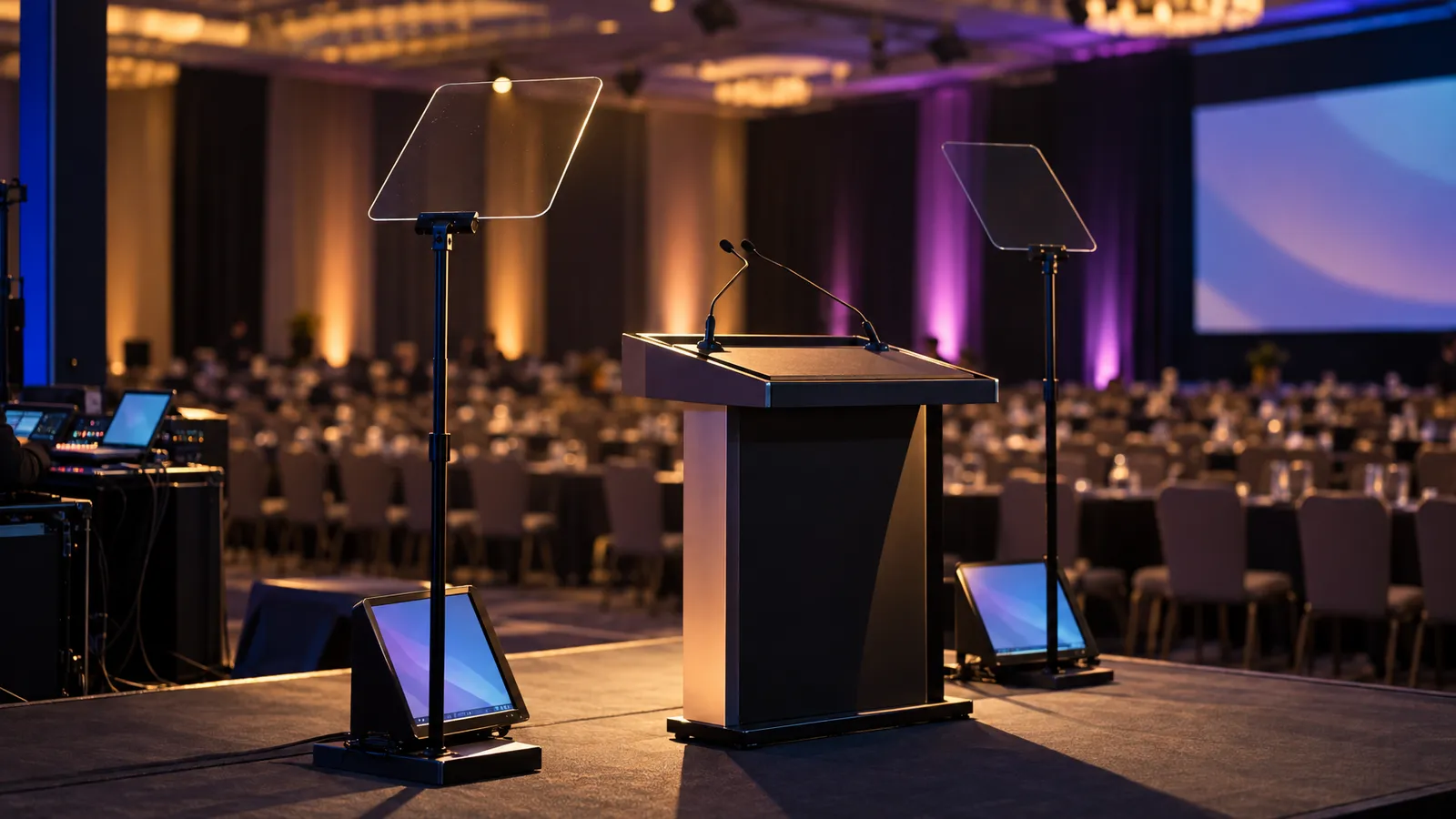
A conference-style (often called presidential) teleprompter uses tall stands that hold beamsplitter glass at eye level. Autocue describes using two stands "so the presenter can look from side to side," which lets the speaker read while turning to different parts of the audience. This is the setup you may have seen at a political speech or a large product launch. It doesn't put the presenter's eyes into a camera lens; for a camera audience, the presenter is looking toward the room.
A camera-mounted teleprompter puts the monitor and beamsplitter directly in front of a camera lens, so the presenter reads while looking straight into the camera. It's the usual choice for a webcast, a recorded video message, or any piece aimed mainly at a single camera.
For panel discussions with multiple speakers, some events use a floor monitor instead: a screen at stage level the presenter can glance at. It works for notes and scripted introductions, but reading from it means looking down, so it isn't the same as prompter glass when word-for-word delivery matters. Choosing between these comes down to two questions: who is the presenter mainly speaking to, the room or a camera, and is there a podium or open stage?
Illustrative photo of a conference keynote. Photo: Product School / Unsplash.
Integrating a Teleprompter with Your Presentation Workflow
A teleprompter doesn't operate in isolation. It's one link in a chain that includes the script, the operator's computer, the display hardware, and often a camera feed going out to a hybrid audience. Getting that chain right matters more than any single piece of gear.
Scripts get loaded into prompter software ahead of time, ideally well before doors open. That gives the operator time to format line breaks at natural pause points and check font size against the actual distance from the presenter to the glass. Scripts can change late in corporate settings, when legal wants a line reworded or a figure gets updated, so agree with your supplier how close to showtime they can accept edits.
If your event is also running a wireless presentation system for slides, coordinate both with the same AV team rather than treating them as separate pieces. Our wireless presentation systems comparison walks through screen casting options that can run alongside a prompter during the same keynote. For hybrid events where a room camera is also capturing the presenter for remote viewers, decide early whether the presenter should be reading toward the room (conference glass) or into a camera (a camera-mounted prompter), and brief the camera operator so framing matches.
Do You Need an Operator On-Site?
For a keynote, an operator is worth planning for. An operator scrolls the script to follow the presenter's pace, slowing down or holding when the speaker pauses for a laugh, and catching up if they skip ahead or go off-script for a moment. A presenter's pace shifts with emphasis and audience reaction, which a fixed auto-scroll speed doesn't follow.
Some teams have a colleague handle scrolling from a laptop instead, which can work for short, simple remarks, especially if that person rehearses with the speaker. For a long keynote or an investor presentation, a scroll that gets ahead of or behind the speaker can cause a visible stumble, so the stakes argue for someone experienced. Decide after a rehearsal, and ask the speaker what they're comfortable with.
An experienced operator can also help with the practical side: adjusting the glass height and angle for the presenter, checking that stage lighting isn't washing out the reflected text, and keeping a backup (such as a printed script) ready if a monitor fails mid-presentation. Ask your supplier what happens if a screen goes dark during a live keynote, and expect a concrete answer.
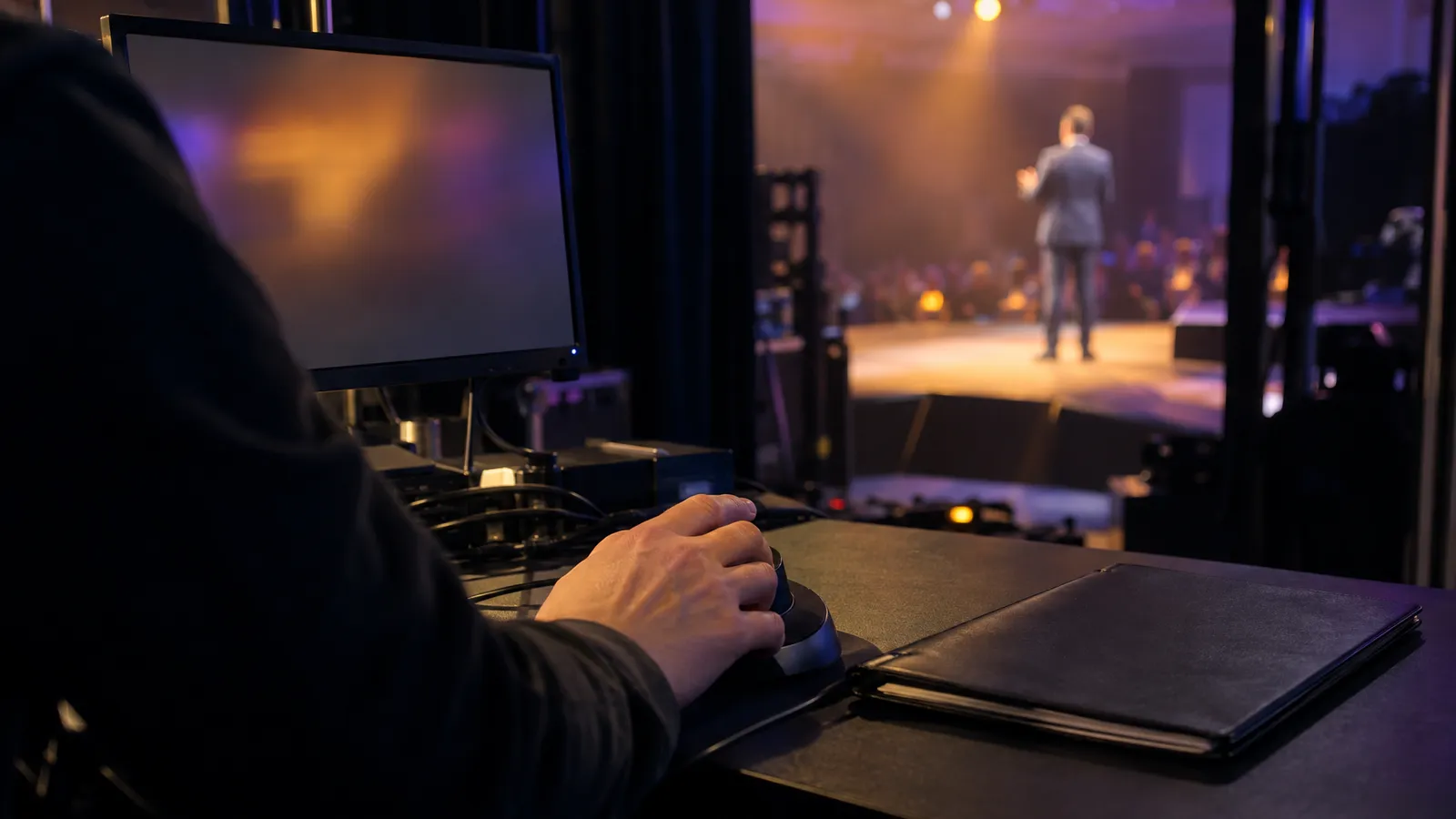
Illustrative photo of an event control position. Photo: Qeis Ismail / Unsplash.
Setup Timing: What to Plan For
Setup time depends on the configuration, the stage and what else is being built, so ask your supplier for their estimate and fit it into the venue's load-in window. If the prompter is part of a larger build with staging, lighting and sound, it usually goes in after those are placed; don't leave it for the last minutes before doors.
A few checkpoints worth agreeing with your AV supplier:
- Script delivery deadline: agree the last date and time the operator will accept a script for a clean load, especially for anything with slides or graphics timed to specific lines.
- Rehearsal slot: ask for at least one run-through with the actual presenter reading from the actual glass. Font size, glass distance and scroll speed are personal and vary between speakers.
- Camera and lighting check: if the event is being recorded or streamed, check the glass and stands in the shot and look for reflections or glare before the audience arrives.
- Backup script: a printed copy at the podium or a tablet backup in case of a hardware failure mid-presentation.
Multi-speaker events, such as panels, awards ceremonies and all-day conferences with rotating presenters, need time between speakers for the operator to load each script and adjust the glass for each presenter. Build that into your run-of-show rather than discovering it live.
What to Ask Before You Book
Not every AV supplier stocks teleprompter gear, and the operator matters as much as the hardware. A few questions worth asking before you sign:
- Has the operator worked corporate keynotes, and can they rehearse with your presenter?
- What's the backup plan if the glass or monitor fails mid-event?
- Can the supplier coordinate the prompter with other AV elements you're already renting, such as staging, lighting, or a wireless microphone system for the presenter?
- How far in advance do they need the final script, and how do they handle last-minute edits?
- How is the price built: hardware configuration, operator time, setup and rehearsal?
If you're still comparing vendors for your event's full AV package, our guide to choosing an AV equipment supplier covers the broader vetting checklist, insurance, staffing and inventory questions that apply beyond the prompter.
Teleprompters are available from VENEGEEST on request, subject to availability — contact us for a quote, and tell us the configuration (conference glass or camera-mounted) and how many presenter positions you need. For the presentation side of the same stage, the listed catalog includes a Wireless Screen Caster ($60/day) for cable-free slide sharing and LED TV displays from 43″ ($35/day) to 120″ ($120/day), which can serve as a stage-level floor monitor for slides or notes. That is not prompter glass, as explained above, but it covers speakers who only need a glance at their next slide. Daily rates cover a 24-hour period, and delivery, setup and technician services are scoped and quoted to your event.
FAQ: Teleprompters for Corporate Events
How much does teleprompter rental cost for a corporate event?
It depends on the configuration (conference glass or camera-mounted) and how many presenter positions you need. At VENEGEEST, a teleprompter is available on request, subject to availability, and the operator, setup and rehearsal time are scoped and quoted to your event. Ask for an itemized quote based on your event and number of presenters, and whether the prompter is quoted together with other gear like staging or lighting.
Do I need a teleprompter operator, or can someone on our team run it?
For a keynote an operator is worth planning for, because a presenter's pace varies during a live talk and someone needs to follow it. A colleague can scroll for short, simple remarks, especially after rehearsing with the speaker. Decide after a run-through, based on the talk and the speaker's preference.
What's the difference between presidential and camera-mounted teleprompters?
Conference (presidential) prompters hold beamsplitter glass at eye level on stands, often a pair on either side of the podium, so the presenter can read while looking across the audience; the glass is see-through, though the stands remain visible. Camera-mounted prompters put the glass in front of a camera lens, so the presenter reads while looking into the camera, which suits a recorded message or a single-camera webcast.
How far in advance do I need to submit my script?
Agree the deadline with your supplier. The operator needs time to format line breaks and check font size against the real distance to the glass, and scripts can change late in corporate settings, so also agree how last-minute edits will be handled.
Can a teleprompter be combined with a hybrid or streamed event setup?
Yes. Decide whether the presenter should be reading toward the room or into a camera, since that determines the prompter configuration, and have the prompter operator and camera operator coordinate so framing and eye line suit the stream. A wireless presentation system for slides can run alongside.