Dry ice fog puts carbon dioxide into the room, and whether that is acceptable depends on how much dry ice the cue uses, the room's volume and its real fresh-air ventilation. There is no square-footage cutoff that makes a room safe; for an indoor first dance, get the machine's consumption figure, a venue-approved ventilation plan and CO2 monitoring agreed before the day. This guide explains the arithmetic and the questions to ask, so you can share it with your planner and venue manager.
1. How a dry ice fog machine works
A dry ice fog machine is mostly a tank of heated water. The operator lowers solid carbon dioxide — dry ice — into the water. Dry ice doesn't melt; NIOSH lists it as subliming (turning straight from solid to gas) at -109°F. As it sublimes in the warm water, the cold gas chills the moist air above the water, and the water vapor condenses into tiny droplets: the white fog you see. How hot the water should be and how much dry ice to load is set by each machine's manual, so follow the manufacturer's instructions for the exact unit.
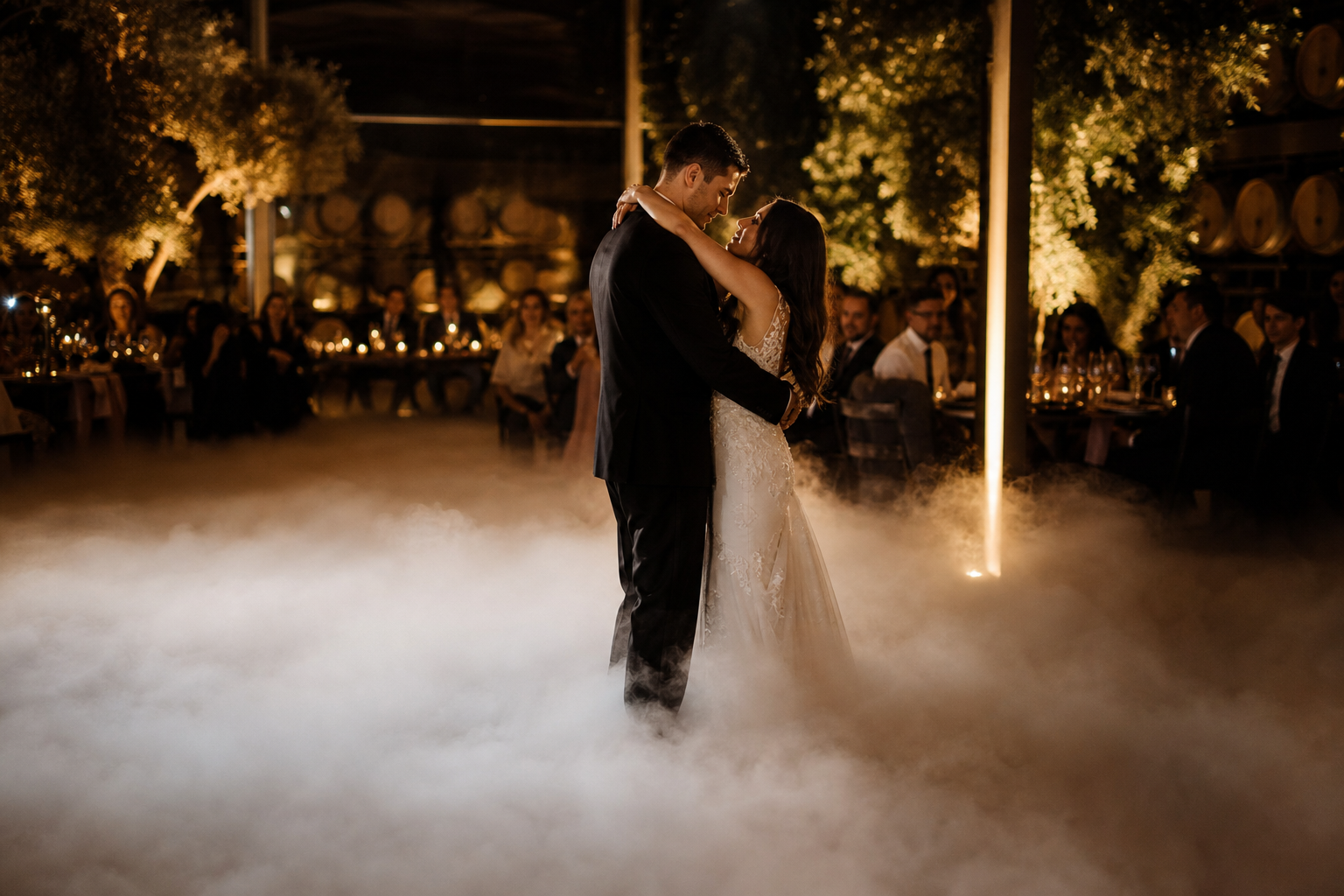
Carbon dioxide is heavier than air — NIOSH gives its relative gas density as 1.53 — and the fog is cold, so the effect pours out low and spreads across the floor. How long it stays low depends on air movement and on how quickly it warms: HVAC drafts, open doors, people walking through and the room's temperature all change it.
The important part for safety is that the visible fog and the CO2 are not the same thing. The white cloud is water droplets. The CO2 is invisible, and it is still in the room after the cloud has faded.
2. How much CO2 an effect releases
You can estimate the gas from the dry ice weight. Carbon dioxide's molecular weight is about 44 g/mol (NIST Chemistry WebBook), so one pound (454 g) of dry ice is about 10.3 moles of CO2. At room temperature (20°C) and normal pressure, a mole of gas takes up about 24 liters, which gives roughly 250 liters, or about 8.8 cubic feet, of CO2 gas per pound of dry ice.
How much dry ice a cue uses depends on the machine and how long it runs, so ask for the figure for the exact unit and cue you're booking. As one published example, Chauvet DJ says its Nimbus dry ice machine, at full output, "requires approximately 10 pounds of dry ice, five gallons of water, and lasts about the length of a song." Ten pounds works out to roughly 88 cubic feet of CO2.
For context, these are the workplace limits NIOSH lists for carbon dioxide:
- OSHA permissible exposure limit: 5,000 ppm as an 8-hour time-weighted average.
- NIOSH short-term exposure limit: 30,000 ppm (a 15-minute limit).
- Immediately dangerous to life or health (IDLH): 40,000 ppm.
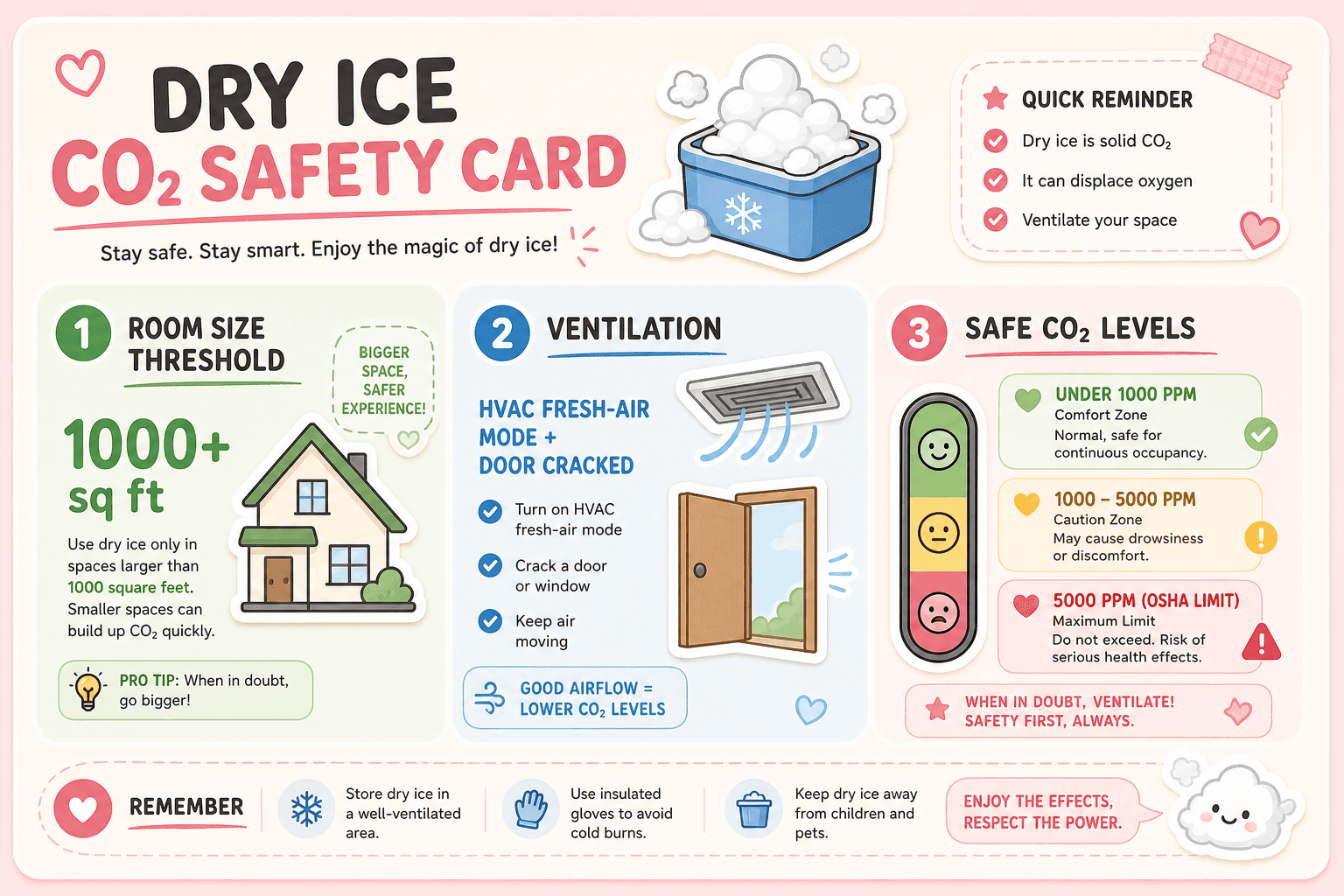
These are occupational limits for workers, with averaging periods attached. They are not a threshold below which a room full of wedding guests, including children, older relatives or people with heart or lung conditions, is automatically fine, and they are not a substitute for a qualified assessment. NIOSH lists headache, dizziness, restlessness and breathing difficulty among the symptoms of overexposure.
3. Why room volume and ventilation decide it
A hypothetical calculation shows why the room matters. Assume the 10-pound, one-song example above (about 88 cubic feet of CO2), spread perfectly evenly through a sealed room with no ventilation at all:
- A 2,500 sq ft room with 12-foot ceilings holds 30,000 cubic feet of air. The CO2 would add about 2,900 ppm on top of whatever was already there.
- A 600 sq ft room with 9-foot ceilings holds 5,400 cubic feet. The same dry ice would add about 16,000 ppm.
That is arithmetic, not a measurement of any real room, and it understates the risk in one important way: because CO2 is heavier than air and the fog is cold, the gas is not evenly mixed right after the effect. Concentrations can be higher near the floor, in low spots and in poorly ventilated corners — exactly where seated guests, children, pets or a couple on the dance floor may be. Ventilation lowers the numbers over time, but how fast depends on how much outdoor air the system actually brings in, not on the fan simply running. A system that recirculates indoor air moves the CO2 around the building rather than removing it.
CDC's report on a dry ice poisoning case makes the general point: "Improper ventilation during use, transport, or storage of dry ice can lead to inhalation of large concentrations of CO2." In that case a driver lost consciousness after carrying dry ice in a closed truck cab with the air on recirculate. An event room is much larger than a truck cab, but the mechanism — CO2 building up where fresh air isn't coming in — is the same one to plan against.
4. Rooms that need extra caution
Some kinds of space deserve a harder look, or a different effect:
- Small rooms: the arithmetic above shows how quickly concentrations climb as volume shrinks. A private dining room or residential space may simply be too small for the amount of dry ice a visible effect needs.
- Basements and below-grade rooms: heavier-than-air CO2 can collect in low spaces. Ask what mechanical exhaust to the outside the room has.
- Rooms whose HVAC only recirculates: some systems bring in little or no outside air at certain hours. Ask the venue's engineering staff how much outdoor air the system supplies during your event window.
- Wine caves: ventilation varies from cave to cave. Ask the venue for its ventilation information and whether it has CO2 monitoring of its own.
- Closed tents: a tent with every side down and heaters running behaves like a closed room.
- Outdoor sites: open air helps, but CO2 can still collect in hollows, sunken patios or next to walls, and wind can push the fog into seating. Look at the actual site.
If the space doesn't have a clear ventilation answer, choosing a different effect is the sensible outcome, not a failure of planning.
5. What to agree with the venue
For an indoor dry ice effect, raise these points with the venue manager and planner well before the event, and agree them in writing:
- The dry ice quantity and run time for the exact machine and cue, from the supplier.
- The ventilation plan: what outdoor-air setting the HVAC will be on before, during and after the effect, which doors or openings (if any) will be open, and who at the venue confirms it. Visible fog clearing is not a sign that the CO2 has cleared.
- CO2 monitoring: who will monitor, with what instrument, at what heights and locations (including low areas and where guests will be), and what reading triggers stopping the effect or moving people out. Have someone qualified set those action levels for your room and guests; one monitor clipped to the operator does not describe the whole room.
- Detectors: the fog is water droplets rather than smoke, but a dense cloud may still reach a smoke detector, so ask venue engineering how detectors are handled during the effect, and whether the building has CO2 sensors tied to the HVAC.
- Re-entry: when seated guests, children and pets can go back onto the dance floor, based on the monitoring plan rather than on how the fog looks.
- Open flames: keep floor-level candles away from the effect area.
6. What a careful dry ice booking includes
Whoever supplies the machine, look for three things:
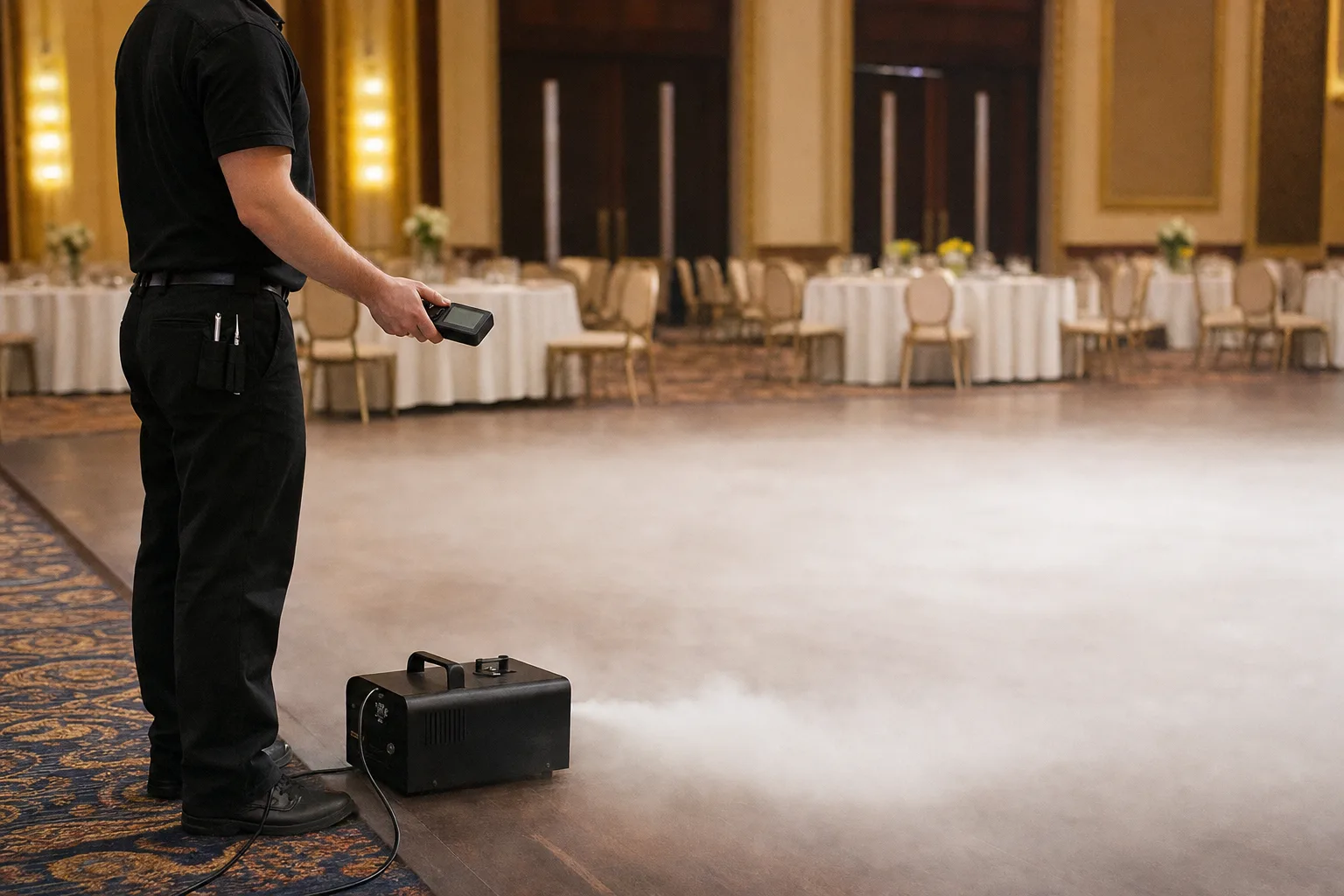
An operator on site for the full effect window, not a drop-off. The operator runs the machine, manages the dry ice load and stops the effect if the monitoring plan says to. VENEGEEST's crew runs CO2 and low fog effects, timed to the show.
A monitoring plan agreed in advance, as described above: instruments, placement in the breathing zones of the people present, action levels and who acts on them.
A ventilation note for the venue ahead of the event, including the dry ice quantity and the room volume, so the venue's engineering staff can confirm the HVAC and door arrangements.
When dry ice isn't the right call — the room is too small, the venue can't commit to a ventilation plan, or the monitoring can't be arranged — ask what other low-fog options exist. Some low-fog machines don't use dry ice at all; Chauvet DJ, for example, describes its Cumulus as producing floor-hugging fog through "ultrasonic vibrations and atomization of the fluid mixture which is then pushed out via fan." Ask any supplier how a specific unit works and what it releases before treating it as a dry ice alternative. See special effects, the dry ice vs fog machine guide (which also covers the first-dance cloud cue and what a dry ice rental involves), or fog machines and fire alarms at Bay Area hotel ballrooms.
FAQ: Dry Ice Fog Safety
How much CO2 does a dry ice fog effect release?
Each pound of dry ice becomes roughly 250 liters (about 8.8 cubic feet) of CO2 gas at room temperature. The total depends on how much dry ice the machine uses for your cue; one manufacturer example is about 10 pounds for a song-length effect at full output, or roughly 88 cubic feet of CO2. Ask your supplier for the figure for the exact machine.
Is dry ice fog safe in a closed indoor wedding venue?
It depends on the specific room: the amount of dry ice, the room's volume, how much outdoor air the ventilation actually supplies, who is in the room and how the air is monitored. Floor area alone can't answer it. Have the venue and a qualified person agree a ventilation and monitoring plan, and choose a different effect if one can't be agreed.
Will a dry ice fog machine set off the venue's smoke detectors?
The visible fog is water droplets rather than smoke, but a dense cloud may still reach a smoke detector, so ask venue engineering how detectors are handled during the effect and whether the building has CO2 sensors tied to its HVAC. Raise it well before the event.
Does the CO2 leave when the fog disappears?
Not necessarily. The white cloud is condensed water droplets; the CO2 is invisible and can remain, especially near the floor and in low areas, after the fog has faded. Monitoring, not appearance, should decide when the floor is clear.
What's the difference between dry ice fog and a regular fog machine?
A regular heat-based fog machine vaporizes fog fluid into fog that tends to rise and fill the room. Dry ice produces cold fog that hugs the floor. Other low-fog machines use different methods, such as chilling or atomizing fluid; ask how a particular unit works and what it releases.
Do I need to tell my venue ahead of time?
Yes. Ask the venue what it requires for dry ice and fog effects, and agree the ventilation, detector handling and monitoring plan with them in advance. Some rooms won't be suitable, and it's better to learn that during planning than at load-in.
Talk through your venue with us
Send the venue, date and room size and we'll talk through dry ice for that space, or other low-fog options if the room isn't a fit. The Dry Ice Low-Fog Machine rents for $35/day; delivery and setup are scoped and quoted to your event. Browse the full equipment catalog or jump to special effects.