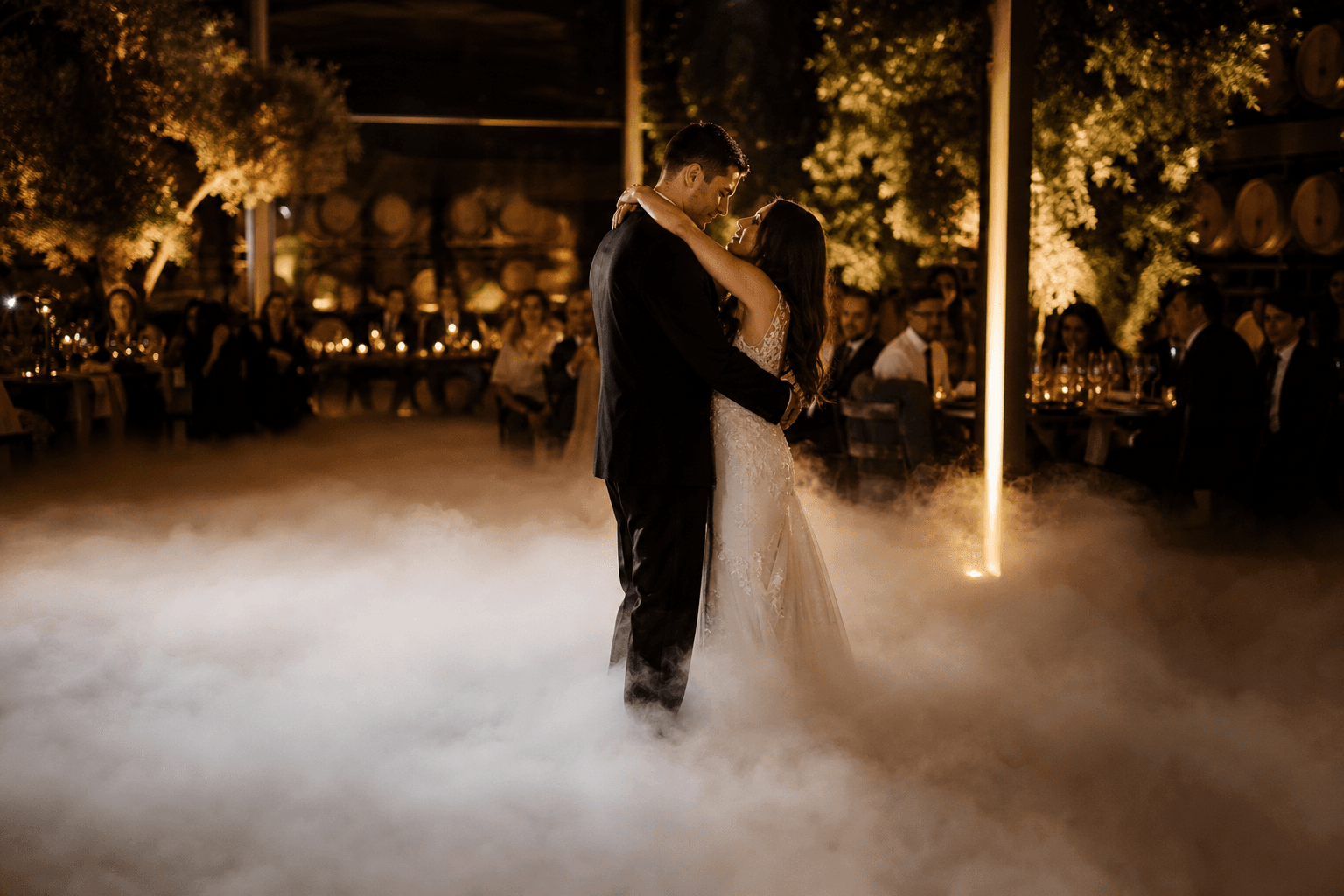
You searched "dry ice vs fog machine" because you saw a video of a couple's first dance with fog rolling across the floor like a cloud, and you want to know which machine makes that look. A standard fog machine won't do it on its own. Here is the longer version.
In more detail: Low, floor-hugging fog comes from fog that is colder and heavier than the surrounding air. Dry ice in hot water is one way to make it; a chilled-fog or ultrasonic low-fog machine is another. A standard fog machine makes fog that drifts through the air with the room's air currents. A hazer fills the room with a light haze that makes lighting show up in the air. They look different, need different handling, and each needs a check with the venue before you use it. The comparison table below puts them side by side; after it come the first-dance cue and what renting a dry ice machine in the Bay Area involves.
1. Dry ice fog: one way to get the ground-hugging cloud
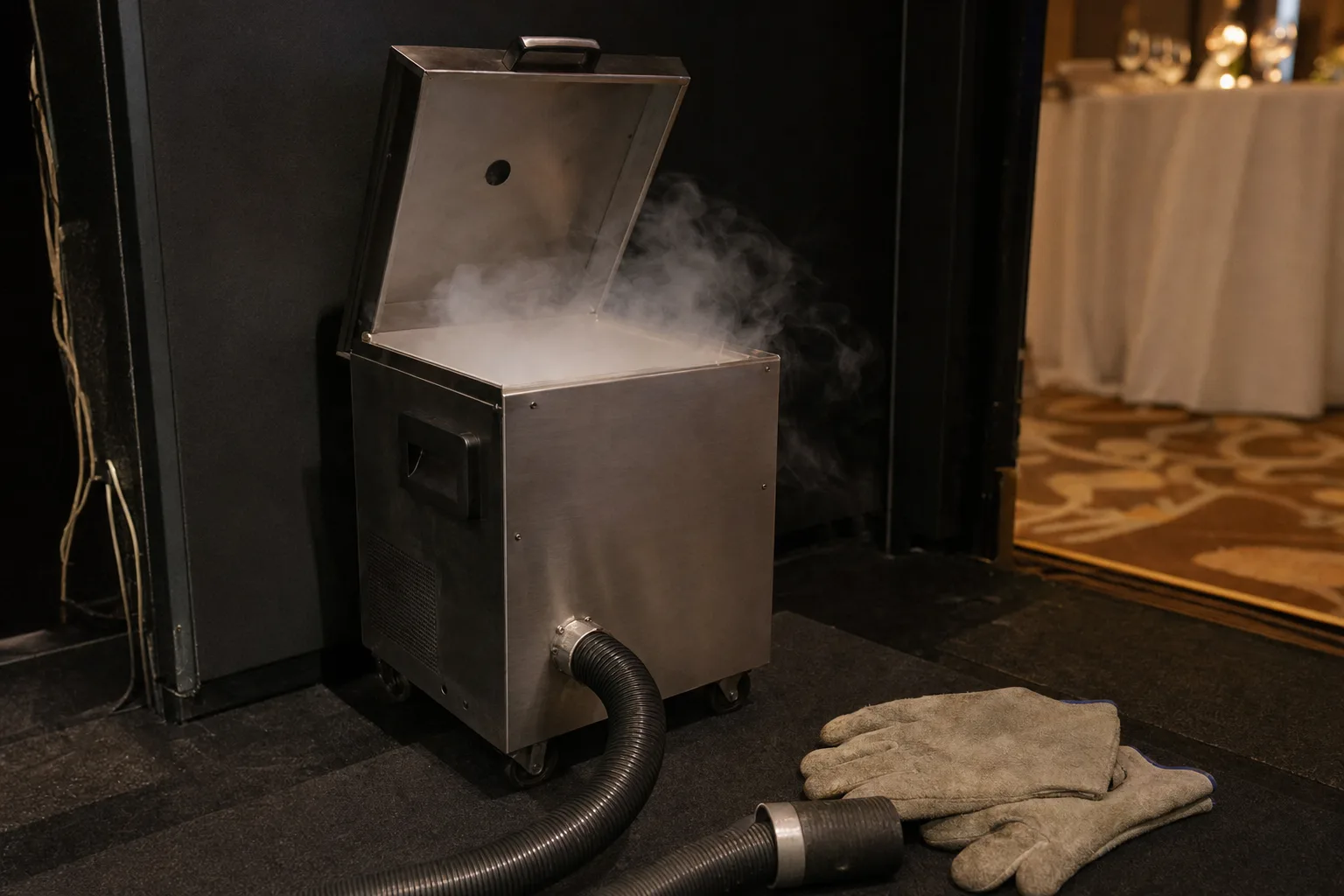
Dry ice is solid carbon dioxide; it sublimates — turns straight from solid to gas — at about −109°F (−78.5°C). In a dry-ice fog machine, dry ice goes into heated water. Chauvet's manual for its Nimbus dry-ice machine explains that the cold CO2 gas makes the water vapor form droplets in the air, and "because the CO2 is cold and heavy, the moisture sinks to the floor. The droplets in the air create the fog effect." That is the low cloud you saw in the video. The cloud is densest right after the dry ice hits the water and thins as it warms, which suits a short, timed moment.
What to know about running it:
- Quantities come from the machine. Consumption depends on the machine and how you run it, so plan from its manual. As one example, the Nimbus holds up to 10 lb of dry ice per load; Chauvet quotes about six minutes of run time and describes a load as lasting "about the length of a song." Plan your purchase from the specific machine, the number of cues and how long each one runs.
- Handling. Dry ice causes frostbite on contact; the Nimbus manual says thick gloves must be worn, eye protection is needed when breaking it, and it should be loaded "at the last possible moment." It should never be stored in a sealed container, because pressure can build up.
- Storage losses. Dry ice keeps sublimating while you store it, so it shrinks from the moment you buy it. How fast depends on the amount, its form (blocks lose mass more slowly than pellets), the cooler and the temperature, so ask the supplier how to store it and time the purchase close to the event.
- Water and floors. The machine's water gets very hot, and the Nimbus manual warns the area in front of the machine may get wet and smooth floors may become slippery.
- Ventilation and CO2. Carbon dioxide is heavier than air and can collect near the floor. The Nimbus manual says not to use it in a confined space and to make sure the room is well ventilated before starting. NIOSH lists headache, dizziness and breathing difficulty among the effects of CO2 exposure. Keep children and pets out of the fog, and follow the venue's ventilation plan. Our dry ice fog safety guide works through the CO2 arithmetic and what to agree with the venue.
Use dry ice when a single moment matters: a first dance, a grand entrance, one feature song. For atmosphere across a whole evening, look at haze instead.
2. Other ways to make low fog: chilled and ultrasonic machines
Dry ice is not the only route to a low cloud. Rosco explains that its fog is neutrally buoyant and follows air currents, but "if the fog (not the fluid) is chilled, it will be heavier than air and lie low to the ground," which is what a chiller accessory is for. Other low-fog machines work differently again: Chauvet's Cumulus uses an ultrasonic agitator that "converts distilled water into a thin mist" and, in Chauvet's words, "creates thick clouds that hug the floor without the need for dry ice."
These machines avoid buying and handling dry ice, though each has its own fluid, water and setup requirements. How the result compares with dry ice depends on the specific machine, so look at the maker's specifications and, if you can, see it running before you choose. VENEGEEST's catalog lists a range of low-fog and dry-ice machines; ask which type a given unit is when you quote.
3. Standard fog machines: filling the air
In a standard fog machine, a heating element vaporizes a fog fluid into a visible white cloud. Because that fog is roughly neutrally buoyant, it doesn't sink; it drifts with the room's air currents and fills the space. It suits haunted houses, club nights, theatrical scenes and Halloween parties, but it won't give you the pooled floor cloud on its own.
What to check:
- Smoke detectors. Chauvet's warning sheet for its fog and haze machines states that "depending on the amount of fog/haze generated, all fog/haze machines may set off smoke detectors." Whether a detector responds depends on the detector type and where it is, how dense the effect is, and how air moves in the room. Only the venue can tell you what its system allows, so ask before you plan the effect.
- How long it stays. That depends on the fluid, the output and the room's airflow; Rosco, for example, sells one fluid for a long-lasting fog and another for a lighter, faster-dissipating one. In a room with little airflow, keep the output modest so people at the back can still see the stage.
- The look. It's mid-air. If a client points at a low cloud in a video, a standard fog machine alone is the wrong tool.
- Residue. The same Chauvet sheet warns that "in certain environments, fog/haze fluid-based machines may leave a slippery residue on floors and surfaces." Ask the venue about its floors and any residue rules, and check the fluid's safety data sheet.
4. Hazers: the one that shows the light
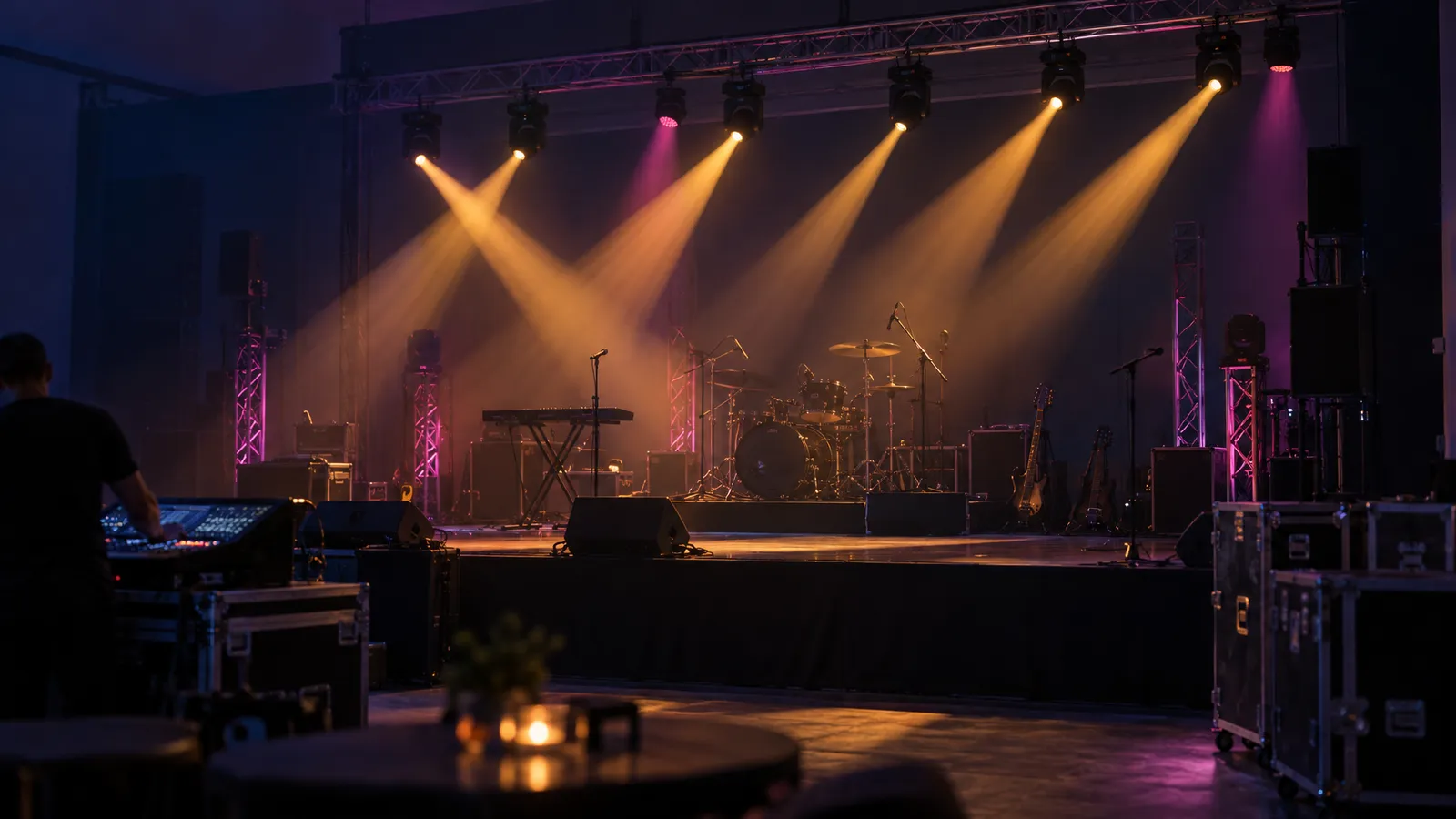
A hazer is not the same as a fog machine. Hazers put a light, even haze into the air — Chauvet describes one as filling "the room with a light haze to enhance any light show." You may barely notice the haze itself; what you notice is that beams from moving heads and spotlights become visible, because the light scatters off the haze in the air.
Hazers use different fluids, oil-based or water-based, depending on the model. Check the fluid a given machine uses and its safety data sheet rather than assuming from the product name.
Haze is one possible technique behind photos and videos where beams of light cut across a room or a crowd. If your client says "I want to see the lights," haze is the effect to talk about, not fog. Our haze machine rental guide covers the units in our catalog.
5. Dry ice vs fog machine vs hazer: comparison table
Quick reference for a busy planner. How high the cloud sits and how long it lasts depend on the machine, the fluid and the room, so the table compares how each works and what it asks of you rather than giving fixed numbers:
| Dry ice fog machine | Chilled or ultrasonic low-fog machine | Standard fog machine | Hazer | |
|---|---|---|---|---|
| Look | Low ground cloud | Low ground cloud | Mid-air cloud that fills the room | Light haze; beams become visible |
| How it works | Dry ice in heated water; cold CO2 carries water droplets down to the floor | Fluid fog chilled so it is heavier than air, or ultrasonic mist pushed out by a fan (for example Chauvet Cumulus) | Heated fluid; neutrally buoyant fog follows air currents | Light haze spread through the room |
| Consumable | Dry ice (keeps sublimating in storage) plus water | The maker's fluid or water | Fog fluid | Oil- or water-based haze fluid, depending on the model |
| What it adds to the room | Water droplets and CO2, which is heavier than air and stays after the cloud fades | Droplets of the fluid or water mist | Fluid droplets; may leave a slippery residue | Fluid particles; may leave a slippery residue |
| Setup needs | Hot water fill point, power, a dry ice supply for each cue, an operator to load it | Machine setup per the maker | Output level set for the room | Fluid matched to the machine, output level |
| Main venue checks | Dry ice handling and storage, ventilation, wet floor, detectors | Detector test with the venue, floor residue | Detector test with the venue, output level, residue | Fluid type and SDS, detector test with the venue, guests' sensitivities |
| Best for | One timed moment: first dance, entrance, reveal | One timed moment without buying dry ice | Filling a space: club nights, theatrical scenes, Halloween | Atmosphere for a whole evening of lighting |
| VENEGEEST catalog | Dry Ice Low-Fog Machine, $35/day; 3500W and 6000W dry-ice units quoted | — | 400W–3000W fog machines, quoted | 1000W Haze Machine, $25/day; other units quoted |
The catalog also lists a 700W Mini Low-Fog Machine and a 1500W Ground Low-Fog Machine, quoted on request; the listings don't say how they make low fog, so ask which method a unit uses before you plan around it. Dry ice and fog/haze fluid are provided on request; contact us for a quote. Fog machines and the other low-fog units are quoted on request, and delivery, setup and technician time are scoped and quoted to your event.
6. Indoor venues: the room and alarm questions
Before you pick an effect, three questions about the room:
- The space and its airflow. Ceiling height, room size and air movement all change how an effect spreads and how long it lasts. Air handlers blowing across the dance floor push low fog sideways instead of letting it pool. Look at the room, tell the venue what you plan, and if you can, run a short test at the planned output.
- Alarm system. Detectors respond to particles in the air: NIST explains that photoelectric detectors sense light reflected off particles inside the sensing chamber, and ionization detectors sense particles that disrupt a small current. Whether a given effect sets them off depends on the detector type, location, effect density and airflow, so it has to be assessed for the specific venue. Ask the venue manager for written approval of the effect. Any change to the fire-alarm system is the venue's decision, handled by its fire-alarm provider and the local fire authority — never something to arrange as a production shortcut. San Francisco charges a fee for repeat false fire alarms at the same address (SF Fire Code 108.13). For hotel ballrooms specifically, see fog machines and fire alarms at Bay Area hotel ballrooms.
- Ventilation. A room with strong air movement will clear fog and haze quickly; a room with little will hold it. Plan the effect around the room's normal ventilation, and with dry ice in particular, follow the machine maker's ventilation warnings. Any change to a venue's ventilation is for the venue's engineering staff to decide, not the production.
Some venues don't allow fog or smoke-generating devices at all, and others want advance notice. Ask before you book the effect, and get the answer in writing.
7. The combo: low fog for the moment, haze for the night
For a wedding or a corporate event, one approach is to run two effects for two purposes.
Light haze at low output through the evening, with the venue's approval, gives the uplights, gobos and moving heads visible shape in the air. Then for the first dance, the entrance or the keynote reveal, you run a low-fog cue for that one moment. Two effects, two distinct moments. Other one-moment uses for low fog: a short burst on a downbeat to hide a curtain pull or riser move at a band reveal, a "water" or "mist" look for dance performances (check the floor after a test run, since condensation can leave it damp), or a runway, where the number of machines depends on its length, the machine's output and how long the fog must last.
8. Dancing on a cloud: planning the first-dance cue
"Dancing on a cloud" is a common name for a low-fog cue timed to the first dance. It can be produced with dry ice or with a chilled low-fog machine, and the look differs, so ask to see how the specific unit performs. A gown can look half-swallowed by the cloud and the couple can look as if they are dancing on water.
Will it work at your venue? Rather than ranking venue types, walk the room with three questions, and put them to your venue coordinator and photographer:
- Airflow. Where does air move in the room: doors that will be open, HVAC vents blowing across the floor, an open side of a tent or terrace? Ask whether doors can stay closed and vents can be adjusted during the dance, and weigh that against ventilation: the machine manuals call for a well-ventilated room, so the plan has to satisfy both.
- Contrast and light. The photo depends on the fog showing up against the couple and the room. Talk to your photographer about how the room's lighting, wall colors and ceiling height will read on camera, and whether lighting aimed low across the floor will help the fog stand out.
- Outdoor and open-sided spaces. Wind can disperse the fog even under cover, and a space that is sheltered at one time of day may not be at another. Visit at the same time of day as the event, check the forecast, and have a backup plan or a different effect in mind.
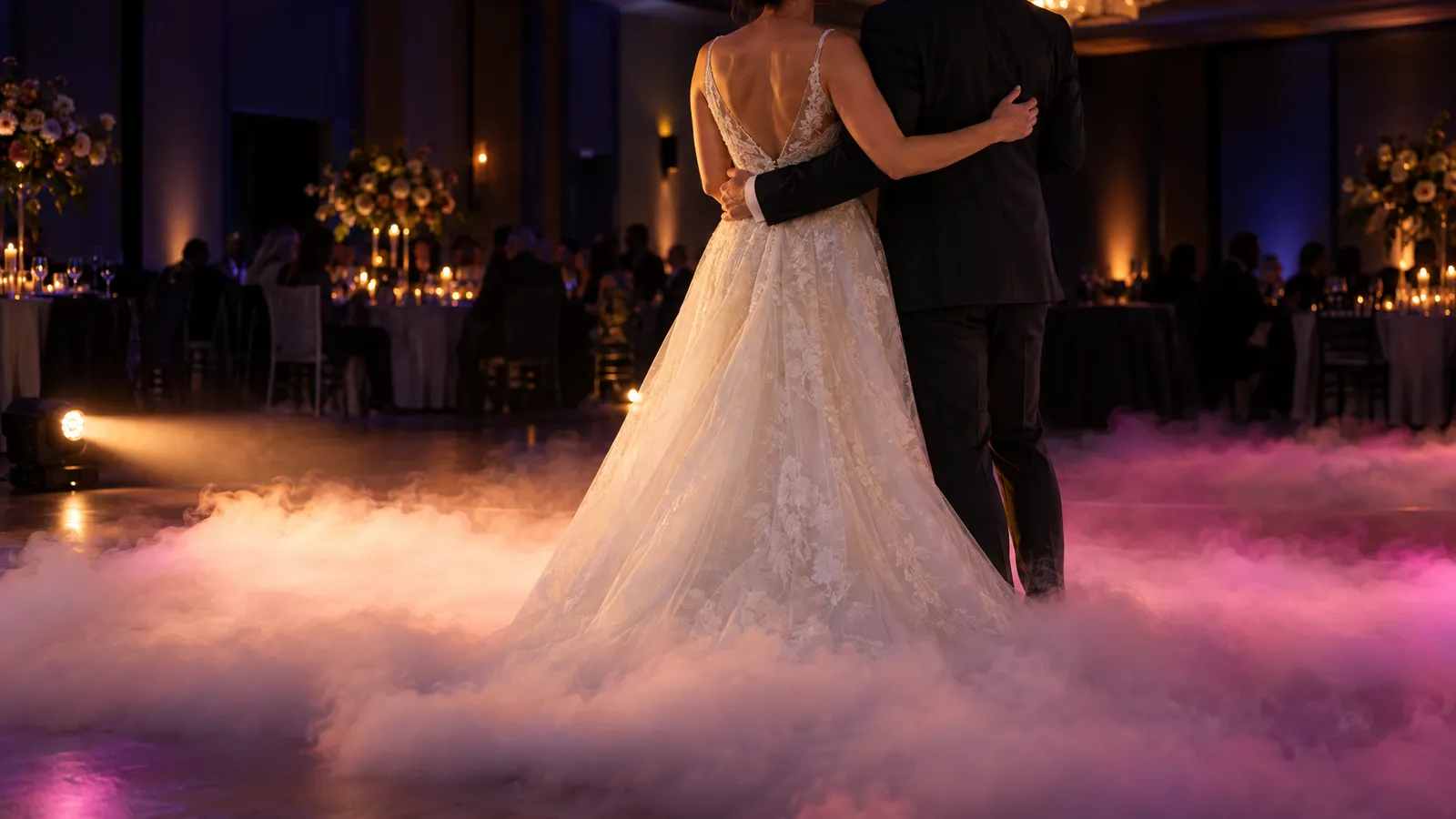
Timeline and rehearsal. Heat-up, reheat and load size all depend on the machine. As one example, the Nimbus manual lists an average runtime of 6 minutes, a dry ice capacity of 10 lb, a heat-up time of 30 to 50 minutes and a reheat time of 15 to 30 minutes, depending on whether one or both heating elements are used. Start with the machine's heat-up time and work backward: the water has to be at temperature, and the machine tested in the room, well before the dance. Agree with the operator and the DJ on the cue — who signals whom, and how long before the song starts the basket goes down — and ask the operator how long the fog takes to spread across the floor with that machine. A short walkthrough at the rehearsal, pacing where you enter, where you end and where the photographer stands, helps everyone know the plan.
Photographer and DJ. Share the cue plan with your photographer ahead of time: when the fog starts, roughly how long the machine's load lasts, and where you will enter. Low fog can make the lower part of the frame low in contrast, so ask how they plan to handle focus and exposure in it. Your DJ needs to confirm the song version and length a couple of days out; if the song is swapped for a version with a long intro on the day, the fog may have thinned by the time the dance really starts.
9. Renting a dry ice machine in San Francisco and the Bay Area
VENEGEEST rents a Dry Ice Low-Fog Machine listed at $35 per day, plus larger Low-Fog / Dry-Ice machines for bigger floors, delivered from South San Francisco. A dry ice machine rental isn't really one thing. It's four things that have to come together:
- The machine. The Dry Ice Low-Fog Machine, or 3500W and 6000W dry-ice units for larger floors (the 3500W unit is rated for about 200 m²). The same range includes 700W and 1500W ground low-fog machines. Tell us the size of the dance floor and room when you ask for a quote so the machine can be matched to the space.
- Dry ice supply. Dry ice has to be bought close to the event and kept in an insulated container that is not airtight, in a ventilated area. The amount depends on the machine, how many cues you run and how long each one lasts. When you ask for a quote, share the cue list; dry ice can be provided on request and quoted with the order, or you can buy it yourself. Because it has to be bought close to the event, check supplier hours before you plan a weekend or holiday cue.
- Someone to run it. Loading dry ice into hot water and firing on cue is a job for a person who isn't doing anything else at that moment. VENEGEEST's crew can time and run low fog to the show; technician services are scoped and quoted to your event. If you rent the machine and run it yourself, you carry that responsibility. Whoever runs it needs to handle dry ice safely, follow the machine's manual and hit a tight timing window.
- Water and power. The machine's tank is filled with water, which the machine heats, so find out where water can be filled and, after the event, emptied once it has cooled (the Nimbus manual warns that the water is scalding hot during operation). Heating elements draw real power: the Nimbus, for example, draws 12.6 A at 120 V on one element and can use a second element on a separate circuit to heat faster. Ask for the power needs of the machine you book and confirm the circuits and water access with the venue on the walkthrough, not at load-in.
Pricing and booking. The Dry Ice Low-Fog Machine is $35 per day, and a day rate covers 24 hours from delivery or pickup. Larger low-fog and dry-ice units are quoted by model. Delivery, setup, technician services and any overtime are scoped and quoted to your event; dry ice is provided on request and quoted with the order. A non-refundable 25% deposit secures a confirmed booking, with the balance due three business days before the event. Same-week delivery is available across the Bay Area for most items; availability is confirmed for your date when you request a quote. For the rest of our effects range, see special effects rental in the Bay Area.
FAQ: Dry Ice, Fog and Haze
Is dry ice or a fog machine better for low-lying fog?
For fog that stays low, use dry ice in a dry-ice fog machine or a chilled or ultrasonic low-fog machine. A standard fog machine makes fog that is roughly neutrally buoyant, so it drifts through the room instead of pooling on the floor. Dry ice gives a dense cloud for one timed moment but needs handling, storage and ventilation. A low-fog machine avoids buying dry ice but has its own fluid or water requirements. Which looks better depends on the machine and the room, so ask to see the specific unit running.
Do fog machines use dry ice, or do they need fog fluid?
A standard fog machine uses fog fluid, not dry ice. It heats the fluid into a visible cloud that drifts with the air. Dry ice is used in a different kind of machine, a dry-ice fog machine, where the ice goes into heated water. Chilled and ultrasonic low-fog machines use the maker's fluid or water instead. Each type needs its own consumable, so check which one a unit uses when you ask for a quote. Dry ice and fog/haze fluid are available on request, subject to availability; contact us for a quote.
Does a fog machine make the dance floor slippery?
It can. Chauvet's warning sheet says fluid-based fog and haze machines may leave a slippery residue on floors and surfaces in certain environments. Dry ice machines add a different issue: the machine's water gets very hot, and the Nimbus manual warns the area in front of it may get wet and smooth floors may become slippery. Keep output modest, ask the venue about its floors and any residue rules, and walk the floor after a test run before guests dance on it.
Can I rent a fog machine instead of buying one?
Yes. VENEGEEST rents a Fog Machine, and fog machines in the 400W to 3000W range are quoted on request. For a one-night event, renting means you don't buy a machine, store it or look after it afterward. Fog fluid is available on request, subject to availability. Delivery, setup and technicians are scoped and quoted to your event, and availability is confirmed for your date when you request a quote.
What safety precautions should I take when using a fog machine indoors?
- Get the venue's written approval before you plan the effect, since fog and haze machines may set off smoke detectors.
- Keep the output modest and the cues short, and keep the room ventilated.
- Read the fluid's safety data sheet, and let any guest with asthma or other sensitivities stand off the floor.
- Check floors for slippery residue after a test run.
- With dry ice, only the operator handles it, in thick gloves, never in a sealed container, and keep children and pets out of the fog because CO2 collects near the floor.
Never change a fire-alarm system yourself; that is the venue's decision with its fire-alarm provider.
Should I choose a fog machine or a bubble machine for my event?
It depends on the look. A fog machine makes a visible cloud that fills the air, which suits club nights, theatrical scenes and Halloween. A bubble machine releases bubbles, which suits a playful outdoor moment or a photo backdrop. Bubble fluid can also leave a slick film on hard floors, so check the surface and ask the venue. VENEGEEST's catalog lists both a Bubble Machine and a Fog Machine, quoted on request, so tell us the moment you want and we can suggest one.
Is dry ice or a fog machine cheaper to use?
It depends on how many cues you run and which machine you pick, so we can't give one number. On our catalog, the Dry Ice Low-Fog Machine rents for $35 per day, while fog machines are quoted by model. For dry ice you also pay for the ice itself, and it keeps sublimating while stored, so you buy it close to the event for each cue. A standard fog machine needs only fog fluid, but it won't give you a low floor cloud. Dry ice and fog fluid are provided on request and quoted with the order; send us your cue list for a quote.
What is the difference between dry ice and a smoke machine?
A smoke machine, which is an everyday name for a standard fog machine, heats a fluid into a visible cloud that drifts with the air. Dry ice is solid carbon dioxide that goes into heated water in a dedicated machine; the cold, heavy gas carries water droplets down to the floor. So the smoke machine fills the air, while dry ice makes a low cloud. Dry ice also needs gloves, careful storage and ventilation, and it leaves CO2 near the floor after the cloud fades.
Do dry ice machines set off smoke alarms?
They can't be ruled out. The visible cloud is made of water droplets, and detectors respond to particles in the air, so whether one reacts depends on the detector type, where it is, how dense the effect is and how air moves in the room. Only the venue can assess its own system. Ask the venue manager for written approval of the effect before you plan it, and never make changes to a fire-alarm system yourself; that is the venue's decision with its fire-alarm provider.
Is fog machine fluid safe to breathe around children and pets?
We can't give medical advice, and the answer depends on the fluid. Read the fluid's safety data sheet, keep the output modest, keep the room ventilated and keep cues short. Some people with asthma or other sensitivities react to fog and haze, whatever the fluid, so let anyone with concerns step off the floor. Keep children and pets out of dry ice fog in particular, because the cold CO2 collects near the floor, where they are.
Which low fog machine works best for a wedding dance floor?
It depends on the size of the floor and the room, so there's no single best machine. VENEGEEST's catalog lists a Dry Ice Low-Fog Machine at $35 per day, 3500W and 6000W dry-ice units for larger floors (the 3500W unit is rated for about 200 m²), and 700W and 1500W ground low-fog machines, quoted on request. The listings don't say how the ground low-fog units make their fog, so ask which method a unit uses. Send us the floor size, room and cue moment and we can match the machine to the space; the venue still has to approve the effect.
Will a fog machine set off the smoke alarms in my venue?
It can. Chauvet's warning sheet says that, depending on the amount generated, fog and haze machines may set off smoke detectors. Whether a particular effect does depends on the detector type, where the detectors are, how dense the effect is and how air moves in the room — and that applies to low-fog effects as well, since the visible cloud is made of droplets. Ask the venue before you plan the effect, get written approval, and run any test only with the venue's agreement.
Dry ice machine vs fog machine: which one for a wedding first dance?
For a cloud on the floor, choose a low-fog method — dry ice, or a chilled or ultrasonic low-fog machine — not a standard fog machine, which fills the air instead. Any of them needs the venue's approval first. VENEGEEST's Dry Ice Low-Fog Machine rents from $35/day, and dry ice is provided on request and quoted with the order.
How much dry ice do I need for a 5-minute first dance?
It depends on the machine and how you run it, so plan from its manual. As one example, Chauvet's Nimbus takes up to 10 lb of dry ice per load, which Chauvet says lasts about the length of a song (roughly six minutes of run time). Work out how many cues you need, and ask your dry ice supplier how to store it, since it keeps sublimating until you use it.
How long does the fog last?
It depends on the machine, the amount of dry ice per load and the room's air movement. The cloud is densest right after the dry ice hits the water and thins as it warms. If you need several separate moments through the night, list them all when you request a quote and ask how much dry ice and how many loads the plan needs.
Can I use a regular fog machine to get low fog if I add a chiller?
That is how chilled low fog works. Rosco explains that fog from a standard machine is neutrally buoyant, but if the fog itself is chilled it becomes heavier than air and lies low, which is what its chiller accessory is for. How it compares with dry ice depends on the machine and the room's airflow, so see it running if you can.
Can I rent dry ice myself and run a fog machine?
Buying dry ice on its own won't help: a regular fog machine won't make low fog from it. You need either a dedicated dry-ice fog machine (a heated water tank with a basket for the ice) or a chilled or ultrasonic low-fog machine.
Can I pick up the dry ice machine and run it myself?
Self-pickup from our South San Francisco location is allowed under our rental terms, but ask about the dry ice unit when you quote. Running it well means handling dry ice safely, keeping the water hot and firing on cue, so consider booking a technician for the effect (technician services are scoped and quoted to your event). If you run it yourself, you carry the responsibility for operating it.
Is it cold enough to hurt my feet or my dress?
The dry ice itself is far too cold to touch, so only the operator should handle it, with thick gloves. The fog is made of water droplets and can leave moisture on the floor, so check footing and think about how a long gown will move through it.
Does low fog work outdoors?
Wind scatters low fog before it can pool, so the effect needs still air, and no particular enclosure guarantees it will work. Check the specific machine's rating for outdoor use too (the Chauvet Nimbus, for example, is rated for indoor use only). If wind is likely, ask about an alternative effect such as a CO2 jet.
Is haze safe to breathe?
Haze is widely used at events at low output, but some people with asthma or other sensitivities react to it, whatever the fluid. Tell performers and guests in advance, check the fluid's safety data sheet, and never run haze inches from someone's face. The same goes for low fog: we can't give medical advice, so keep the room ventilated, keep cues short, and let any guest with concerns stand off the dance floor during the moment.
What's the difference between a hazer and a fogger?
What you see. A fog machine makes a visible cloud that fills the air. A hazer makes a light, even haze you may barely notice, which shows up where light passes through it. They use different machines and fluids for different effects.
Is a smoke machine the same as a fog machine?
"Smoke machine" is an everyday name for a fog machine: it heats fluid into a visible cloud that drifts with the air. It is not dry ice or a chilled low-fog machine, which keep the cloud near the floor, and not a hazer, which makes a light haze that mainly shows in light beams.
What happens if the effect does not work on the night?
Plan for it the way you would any live cue: confirm the song, rehearse the entrance, test the machine in the room well before the dance, and ask whether a second machine makes sense for your room. Under our rental terms, if equipment malfunctions during your rental, we make every reasonable effort to provide a replacement.
Bay Area: get it right the first time
We'd rather talk through the effect, the venue, and the moment first, then design the setup around them and send the right gear. Send us your venue, your date and your cue moment (first dance, band reveal, runway pass), and tell us the room so we can ask about HVAC and water access before the day. We deliver and set up, and our crew can time and run the effect on the night; delivery, setup and technician time are scoped and quoted to your event. Reach out through the quote form or call 415-890-5555.