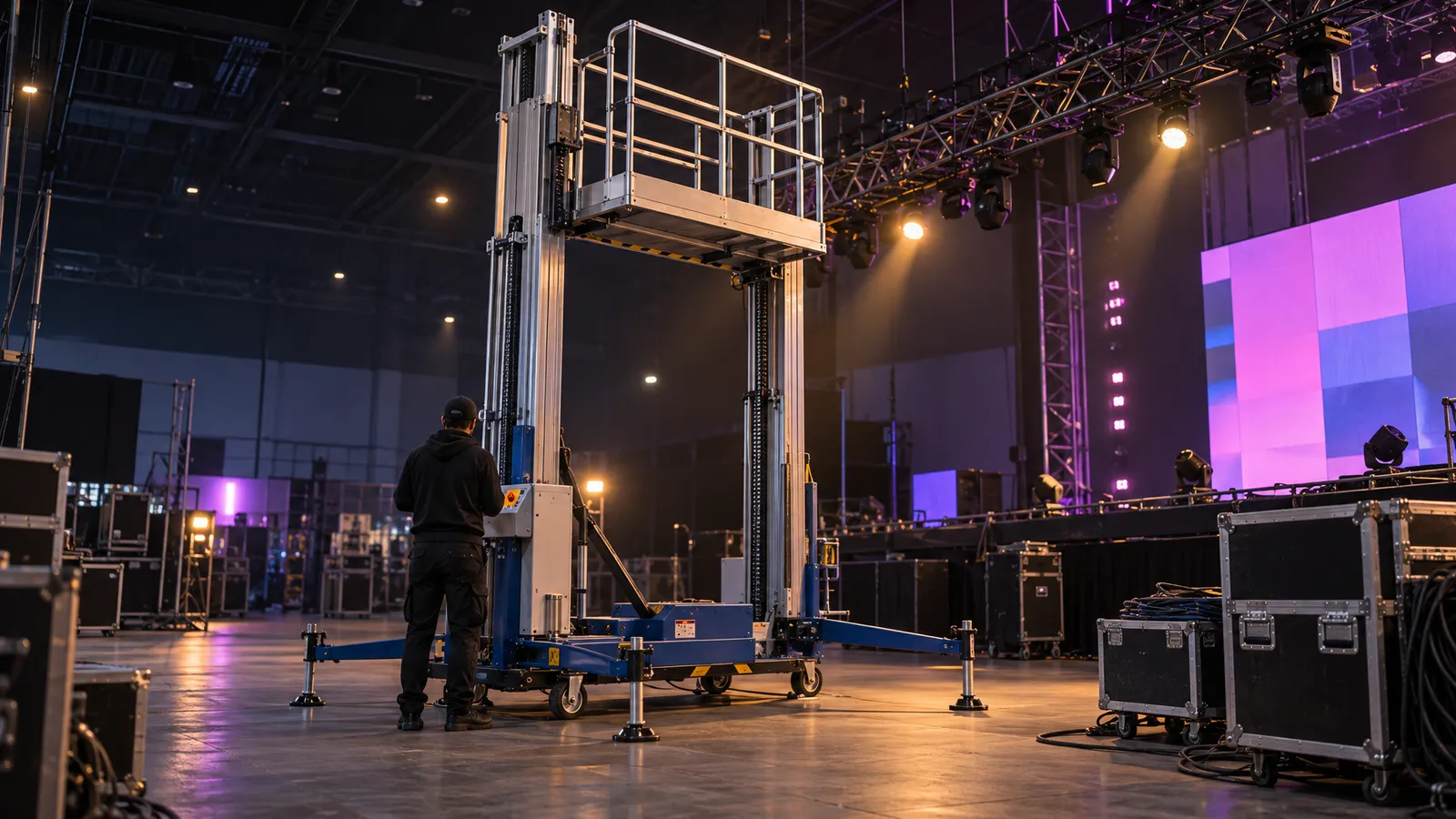
Setting up truss, lighting rigs, or overhead LED panels at height is one of the trickier parts of event production, and it is where improvising with whatever ladder or scaffold is on hand can go wrong. An electric lift scaffold is one option for that work. It's a motorized platform that raises a technician (and their tools) to working height, gives them a guarded deck to stand on while they bolt in truss connectors or aim a moving head fixture, and lowers them again without a manual crank.
If you're planning a corporate gala at a hotel ballroom, a concert load-in at an outdoor venue, or a multi-day trade show build in San Jose or Oakland, your rigging plan may include work well above the floor. Which access equipment suits that work — a ladder, a lift scaffold, another type of aerial platform — depends on the task, the height, the reach, the equipment and the site, and it should be chosen by a qualified person using the equipment manuals and a site assessment. This guide covers what an electric lift scaffold rental gets you, how load ratings work, who should be operating one, and the venue-access details that first-time renters across the Bay Area tend to overlook.
We'll also cover how scaffold rental fits into a broader rigging plan alongside aluminum H-frame truss, and why whoever operates the lift needs to be trained on it.
What an Electric Lift Scaffold Actually Does
An electric lift scaffold is a platform that raises vertically on a motorized mast or scissor mechanism, giving a technician a guarded working surface at height instead of a ladder rung. Unlike a static frame scaffold that you build level by level with pins and cross braces, the electric version goes up and down under power, which is useful when you're setting rigging points, aiming fixtures, or running cable along a ceiling over the course of a load-in day.
For event production, this shows up in a handful of recurring jobs: hanging aluminum H-frame truss sections above a stage, mounting a followspot or moving head at a fixed rigging point, running low-voltage cable along a ceiling for LED wall power, or doing a final aim-and-focus pass on lighting fixtures after the truss is already up. For work that keeps a technician at height for a while, a platform with guardrails may be a better fit than a ladder — but that is a judgment for whoever assesses the specific task.
One thing to plan for: a lift works from where it is parked. Moving between rigging points usually means lowering, repositioning and re-leveling it, and whether a particular unit may be moved while raised is set by its manufacturer's instructions — OSHA notes that following the manufacturer's instructions for safe movement "usually rules out moving the lift in an elevated position." Build that repositioning time into the load-in schedule.
Working height varies a lot from unit to unit, so confirm the unit's working height with us against your rigging points before you book. Very tall venues, like some convention center halls, may call for a different rigging approach entirely, which is a conversation worth having early. Our Electric Lift Scaffold is listed at $80 per day; delivery, setup and technician services are scoped and quoted to your event.
A lift platform with guardrails gives a technician a railed working surface at height. Photo: Bruno BD / Unsplash.
Load Ratings: What Determines How Much Weight Is Safe
Every electric lift scaffold carries a rated platform capacity set by its manufacturer, covering the combined weight of the people, tools and material on the platform. This number isn't a suggestion: OSHA's scissor lift hazard alert says to "never allow the weight on the work platform to exceed the manufacturer's load rating."
For event rigging work, the load calculation usually needs to account for more than body weight. A technician carrying a coil of cable, a drill, a truss clamp kit and a radio adds up, and if two people need to be on the platform at once, check that the unit is rated for it. Before booking, walk through what's actually going up on the platform: fixture weight if you're mounting a moving head or LED par, hardware weight for truss connections, and tool weight for the crew doing the work.
Ratings and restrictions vary by model, so work only from the actual manufacturer's capacity information and load chart for the unit you rent — including any limits that apply at particular heights or configurations. Ask us for the specific unit's rating information before it ships rather than guessing on site.
Ground conditions matter just as much as the platform rating. OSHA advises selecting "work locations with firm, level surfaces away from hazards that can cause instability (e.g., drop-offs, holes, slopes, bumps, ground obstructions, or debris)." Whether a particular floor or surface is suitable is a question for the unit's manual and the venue: check the unit's weight against the floor's load limit, check slope and ground conditions against the manufacturer's limits, and for outdoor work check wind against the unit's rating — OSHA notes that scissor lifts rated for outdoor use "are generally limited to wind speeds below 28 miles per hour," and that indoor-only units should stay indoors. If a surface doesn't meet the manual's requirements, that is a reason to choose different equipment or a different approach, not to improvise. These checks belong in a pre-event site walk, not on the morning of load-in.
Trained Operators: Why This Isn't a DIY Rental
Some rental categories are fine to hand to an event coordinator with no training — a Bluetooth speaker or an uplight kit, for example. A powered lift is not one of them. OSHA's guidance on scissor lifts is direct: "Only trained workers should be allowed to use scissor lifts, and employers should make sure that those workers show that they can use a scissor lift properly."
Training covers things like the pre-use inspection (base and stability, guardrails in place, emergency lowering function), reading the load chart for the day's job, and positioning — OSHA's alert covers fall protection, stabilization, and crushing hazards such as passing under a door frame or beam. On site, the operator also has to watch for things a checklist alone doesn't cover, like an uneven floor seam or ductwork that limits how close the platform can get to a rigging point.
Delivery, setup and technician services are scoped and quoted to your event. When you request a quote, ask about technician support for the lift, and whoever ends up operating it, confirm they are trained and qualified on that type of equipment before the event. The situation to avoid is an untrained staff member improvising with a powered lift above a busy venue floor.
If your event also involves hanging truss or moving lights, pair the scaffold rental with a look at our truss and rigging safety checklist, which walks through load ratings, inspection sign-off and pre-rig steps.
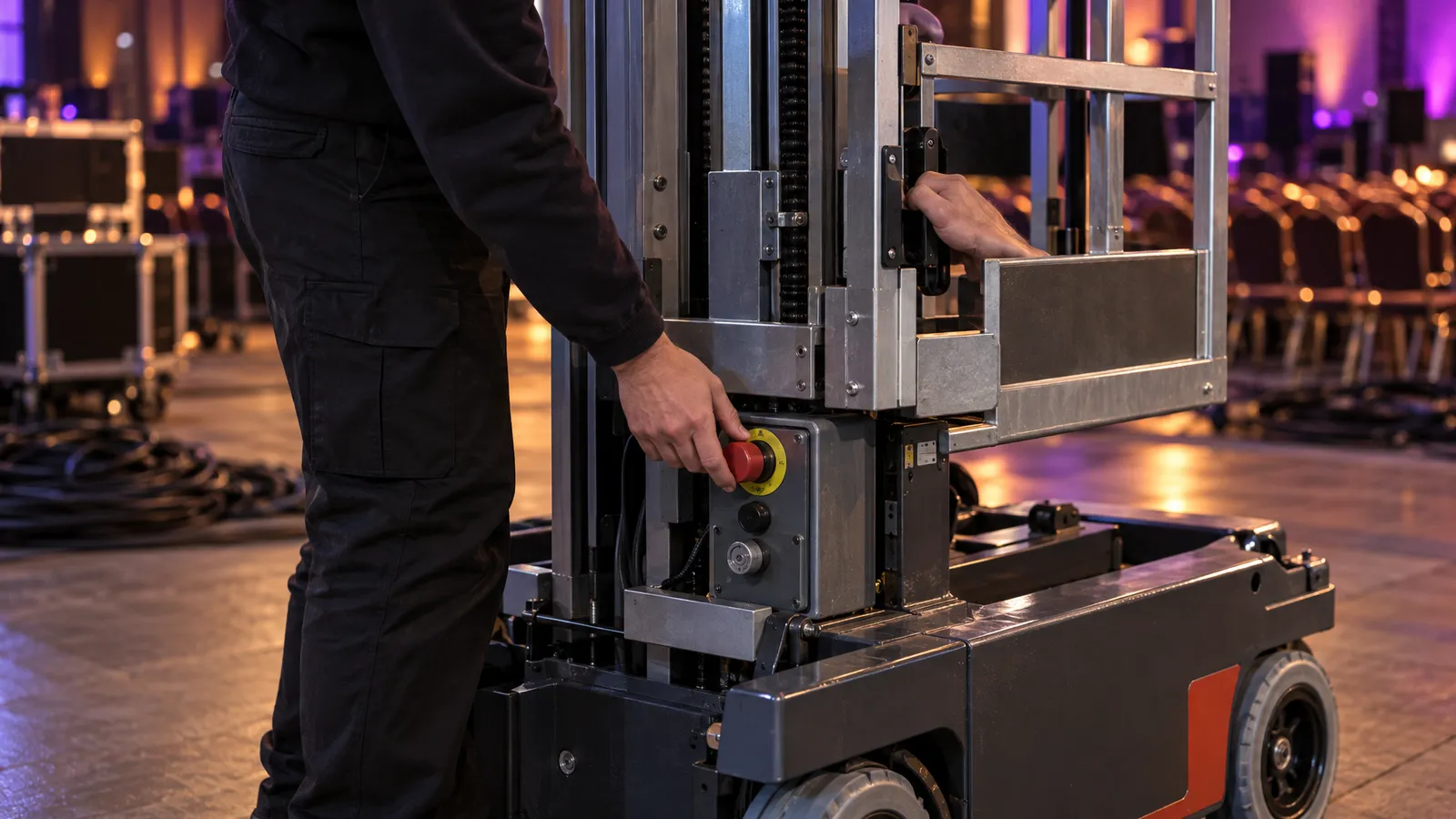
Whoever operates a powered lift should be trained on that equipment and inspect it before use. Photo: Bernard Tuck / Unsplash.
Venue Access: The Detail That Trips Up First-Time Renters
An electric lift scaffold has to physically get into your venue before it can do anything useful, and this is a step first-time renters can underestimate. These units are heavier and bulkier than a folded ladder. Before you commit to a booking, a few access questions need answers.
- Door and elevator dimensions: Compare the unit's stowed dimensions with every door, elevator and corridor on the route; a ballroom on an upper floor accessed only by a passenger elevator can rule out certain unit sizes.
- Floor load limits: Ask the venue for floor load limits on the route and in the work area, and compare them with the unit's weight.
- Path from loading dock to work area: Ramps, thresholds, and tight corners between the dock and the stage all affect which unit is practical to bring in.
- Ceiling height and obstructions: Chandeliers, HVAC ductwork, and sprinkler heads all narrow the usable space for a platform at height.
We ask for venue details, including load-in access, before the scaffold ships; our rental terms ask every client for accurate load-in and timing information. A hotel ballroom in downtown San Francisco has different access constraints than an outdoor tent build or a warehouse space, and matching the unit to the actual venue avoids a scaffold that arrives on load-in day and doesn't fit through the door.
Timing also matters here. Because access checks and unit matching take some planning, it helps to start the conversation early rather than treating the scaffold like last-minute gear. If your event date is set and rigging at height is part of the plan, getting the access conversation started ahead of time gives room to confirm the right unit and, if needed, coordinate an early load-in slot with the venue.
Pairing Scaffold Rental With the Rest of Your Rigging Plan
An electric lift scaffold is usually one part of a rigging job that also involves truss, fixture mounting, cable management and a final safety check. Thinking through the whole job before booking anything saves you from a scramble mid-build.
How truss is assembled, lifted, attached and brought to trim height — and where a lift scaffold fits into that — depends on the venue's rigging points, the truss and its load tables, the hoists or supports used and the loads hung on it. That sequence should come from a competent rigger's site- and equipment-specific plan, not from a generic checklist. Once the plan exists, it tells you when the lift is needed (for example, for attachment work or a final aim-and-focus pass) and for how long, which is what to book around.
Booking the scaffold alongside your aluminum H-frame truss order also means one vendor coordinates delivery timing, so the platform can be on site when the rigging work starts. If your event plan includes both, mention it when you request a quote.
For planners weighing overall AV vendor fit beyond scaffold and truss, see how to choose an AV equipment supplier: insurance coverage, staffing and inventory are worth checking before you book anyone.
Electric Scaffold vs. Scissor Lift vs. Boom Lift
"Lift" isn't one piece of equipment, and the categories overlap — some electric lift scaffolds use a scissor mechanism themselves. OSHA describes scissor lifts as moving the work platform "straight up and down using crossed beams functioning in a scissor-like fashion," which is what distinguishes them from boom-type aerial lifts. Reach, footprint and capacity vary widely by model within each class, so compare the spec sheets of the exact units rather than the category names.
| Equipment | How it moves the platform | What to check |
|---|---|---|
| Electric Lift Scaffold | Powered mast or scissor mechanism, vertical | Working height, rated capacity, stowed dimensions, weight, surface and slope limits |
| Scissor Lift | Crossed-beam scissor mechanism, straight up and down | Working height, platform size, rated capacity, indoor/outdoor rating, weight |
| Boom Lift | Articulating or telescoping boom, can reach up and out | Height and outreach, rated capacity, footprint, ground and space requirements |
A vertical platform suits work directly above where it can be parked; a boom is designed for reaching up and out over obstacles. Which class, and which model, fits your job depends on the rigging points, what is in the way, the load going up, and whether the unit fits the venue's doors, floors and ceiling.
Before booking any of the three, confirm the venue's door widths, floor load limits, and ceiling clearance against the unit's specifications. A lift that can't fit through a loading dock door is a wasted rental, and it's the kind of detail that should come up during the site walk covered in our truss and rigging safety checklist, not discovered on load-in morning.
FAQ: Electric lift scaffold rental
How tall of a ceiling do I need for an electric lift scaffold?
It depends on the unit, so confirm the unit's working height and stowed height with us against your rigging points and the venue's ceiling. If your rigging point is very high, or your venue has low overhead obstructions like chandeliers or ductwork, mention it in the quote request so the right unit or an alternative approach can be considered.
Can I rent a hanging scaffold for an event?
A hanging (suspended) scaffold isn't a listed item in our catalog; the access equipment we list for event work is the Electric Lift Scaffold at $80 per day. Equipment beyond the listed catalog is available on request, subject to availability, so describe the job and the rigging points when you ask for a quote. A hanging platform depends on overhead rigging points and hoists, and VENEGEEST doesn't offer chain motors or overhead rigging hoists. Whether that setup is appropriate is for the venue and a qualified rigger to decide. For most event jobs at height, a floor-standing lift is the simpler route. Call (415) 890-5555 to talk it through.
Can I get an operator with the rental?
The listed $80 day rate is for the equipment; delivery, setup and technician services are scoped and quoted to your event. Ask about technician support when you request a quote, and confirm that whoever operates the lift is trained and qualified on that equipment — OSHA says only trained workers should use scissor lifts.
Can the scaffold get through a standard hotel ballroom door?
It depends on the unit and the door. Compare the unit's stowed dimensions and weight with every door, elevator and corridor on the route, and with the floor load limits. This is why we ask for venue access details before a unit ships.
When should I request a quote for an electric scaffold rental?
Once rigging at height is part of your plan. Matching the unit to your venue's access constraints and ceiling height takes some planning, and a quote request is where we confirm the unit and load-in timing with you, especially if truss and rigging are also part of the order. Availability is confirmed for your date when you request a quote.
Do I need a lift scaffold if I'm only hanging one small truss section?
Not necessarily. There is no single height at which a ladder stops or a lift starts being the right answer: it depends on the task, the reach, the load, the equipment and the site. Have a qualified person assess the specific job using the equipment manuals and a site check, and choose the access equipment from that.