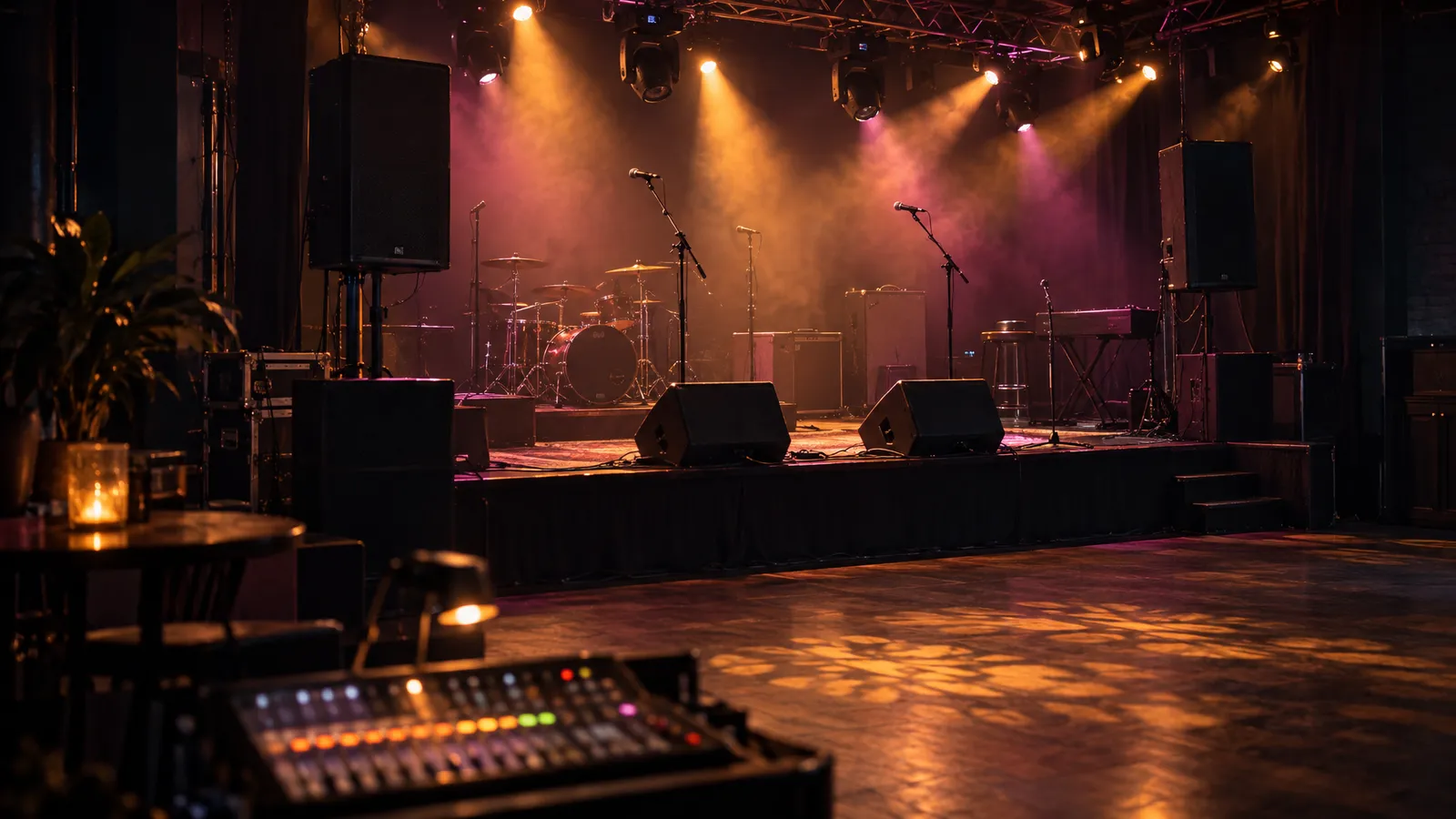
What Live Music Venues Actually Need From AV Rental
A live music venue lives or dies by three things: can the audience hear the band clearly, can the band see and hear each other on stage, and does the room look like a show instead of a garage. That's a different brief than a corporate town hall or a wedding reception. You need gear built for volume, for quick load-in/load-out between acts, and for a stage that reads well from the back row and from a phone camera in the front row.
Renting makes sense for venues whose show nights are irregular and whose gear needs differ by act. A singer-songwriter night needs a fraction of the rig a five-piece rock band with a horn section needs. Renting lets a venue scale the PA, lighting, and staging up or down per booking instead of owning a fixed setup that's either overkill or underpowered most nights.
The core categories you're working with are PA speakers for front-of-house sound, stage lighting (moving heads, LED pars, lasers, followspots) to shape the visual show, a portable stage platform and aluminum truss to build the physical performance space, and special effects like haze and cold sparks for the moments that make a show memorable. We'll walk through each one with real sizing guidance, then cover the console and control side, and close with a sample gear list with the catalog's listed prices. You can see the listed rental catalog for the gear and its listed details; VENEGEEST designs the rig around each night's act and room, and equipment beyond the listed catalog is available on request, subject to availability, with a custom quote.
PA Speakers: Sizing Front-of-House Sound for the Room
The Commercial PA Speaker is the catalog's front-of-house option, listed as a high-power event speaker. The listing doesn't give a model, SPL or frequency response; spec details are provided on request, so check them against the band's technical rider before you commit. For a small room, a pair of commercial PA speakers on stands, positioned left and right of the stage, is the usual starting point. In larger rooms, or rooms with hard walls and high ceilings that create echo, plan on additional speakers or delay speakers toward the back so the sound doesn't smear by the time it reaches the last row. Tell us the room size and capacity when you ask for a quote and we'll suggest a speaker count.
The catalog also has a Bluetooth Speaker System, listed as one controller, six speakers and two mics. It isn't a band PA. Whether it fits a quieter use, such as music between sets, depends on the room and on the system's specifications, so ask before you plan around it.
Don't overlook monitor needs on stage. Musicians need to hear themselves and each other, which usually means monitor wedges or in-ear systems separate from the front-of-house mix. Monitor wedges, in-ear systems, mixing consoles and subwoofers go beyond the listed catalog; they are available on request, subject to availability — contact us for a quote. Settle the monitor plan early, because it changes how many speaker zones the night needs. A five-piece band with drums, bass, two guitars, and vocals needs more inputs and more monitor sends than a duo, and getting that wrong is a quick route to a muddy-sounding show.
Photo: Nainoa Shizuru / Unsplash. A properly sized PA rig keeps sound clear from the front row to the back of the room.
Stage Lighting: Building a Show, Not Just Lighting a Stage
Lighting is what separates a band playing under fluorescent house lights from a band playing a show. The building blocks for a live music rig are moving heads, LED par cans, and a followspot, layered to create depth and movement instead of flat wash.
The LED Spot-Wash Moving Head (CMY), listed with CMY and CTO color mixing and dual gobo wheels, and the LED Beam-Spot-Wash Hybrid Moving Head, listed as a beam, spot and wash hybrid with a 4–50° zoom, suit a venue that books varied acts, because one fixture can do more than one job. For tight aerial beams, the catalog lists a 380W Beam Moving Head (a concentrated beam under DMX control); beams like these show in the air only when there is haze for them to catch.
For color washes across the back truss or stage deck, the Full-Color LED Par Light is listed as an 18-LED RGBW wash light at $25 a day. The LED Tri-Color Panel Light is listed for even, flicker-free illumination; if you want it for color changes, ask for its specifications first. A Followspot Light is worth adding any night there's a lead singer or soloist the audience needs to track visually, especially in a room where house lights go fully dark.
Some venues want lasers for headline sets. The catalog lists a 10W Laser Show Light (a DMX laser show system) and an Outdoor IP67 Sky Laser in 20W to 50W versions, described as weatherproof sky lasers for outdoor festivals. A laser show at this power is a regulated activity, not just a fixture rental. The FDA says that before Class IIIb and IV lasers are used for a laser light show in the United States, the responsible parties must submit a product report for the projector, a laser light show report, and an application for a variance from the Class IIIa limit of 5 mW visible output (FDA). For outdoor shows the FDA also points to FAA guidance on lasers in navigable airspace. Plan any laser effect with a qualified laser-show operator who holds the paperwork, and with the venue's approval, before it goes on a gear list.
Staging, Truss, and Control: The Physical Build
Before any sound or light gets rigged, the venue needs a stage to put it on. The Portable Stage Platform is modular, so platforms combine to the size you need; raising performers above the floor matters for sightlines in a standing-room venue where the back half of the audience needs a clear view over the people in front.
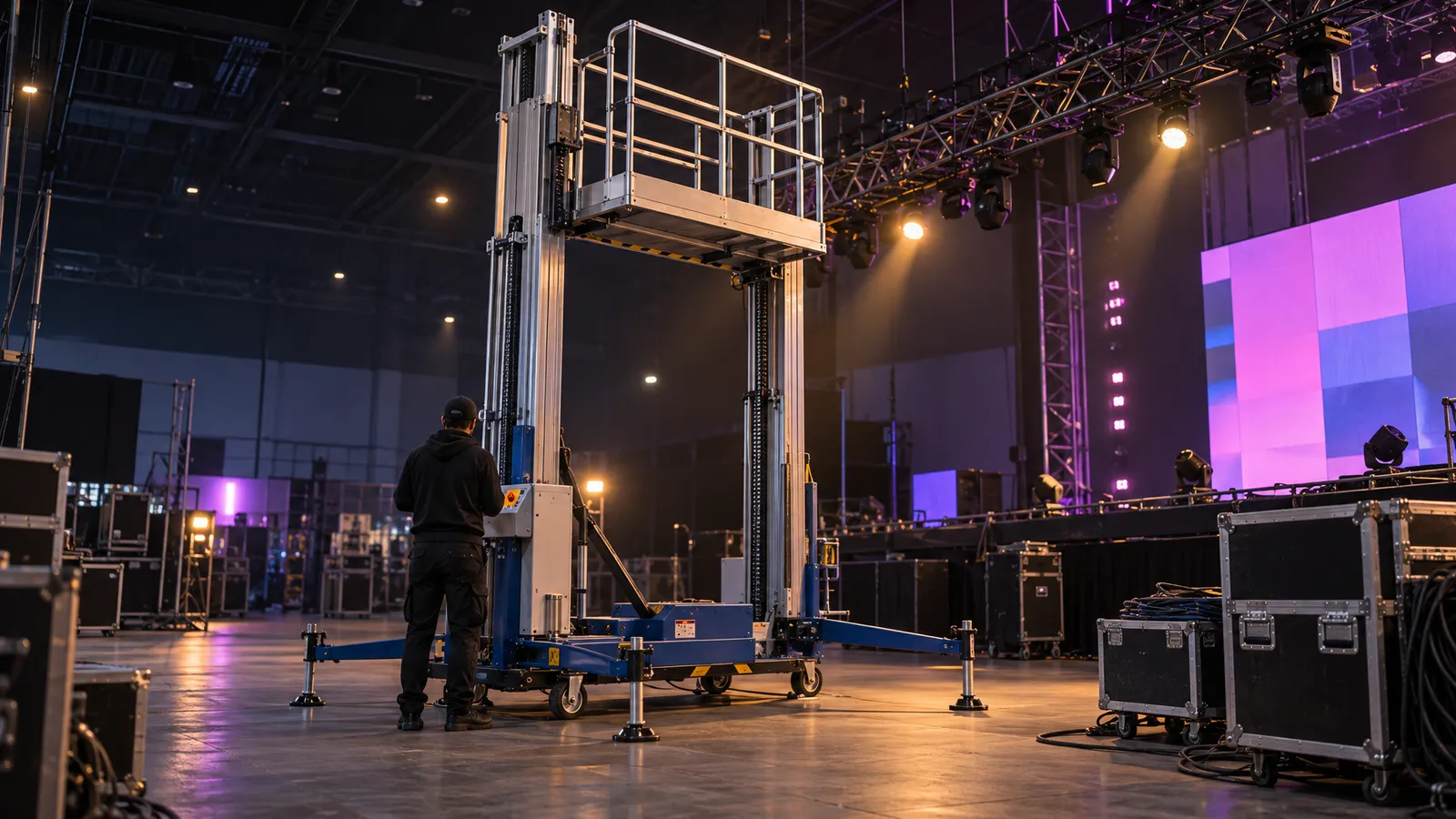
Lighting and any hanging effects need somewhere to mount, and that's where the Aluminum H-Frame Truss comes in. It can carry moving heads, par cans and other fixtures overhead so the rig isn't sitting on stands in the performance area; confirm load ratings for the spans and fixtures you plan, and have whoever rigs it work to an approved rigging plan. The catalog also lists an Electric Lift Scaffold ($80), a motorized height-adjustable lift; ask for its rated load and intended use before planning work at height with it.
All of that lighting needs to be run from somewhere. A Lighting Control Console (the catalog lists grandMA2 and Tiger Touch-series desks, among others) lets a lighting operator program cues ahead of a show and run them live, which is a different job than a house tech eyeballing dimmer levels. If your venue books touring acts, ask whether they're bringing their own lighting programmer or expect the venue's tech to run the desk. That's a staffing question as much as an equipment one, and it's worth settling before load-in day, not during soundcheck.
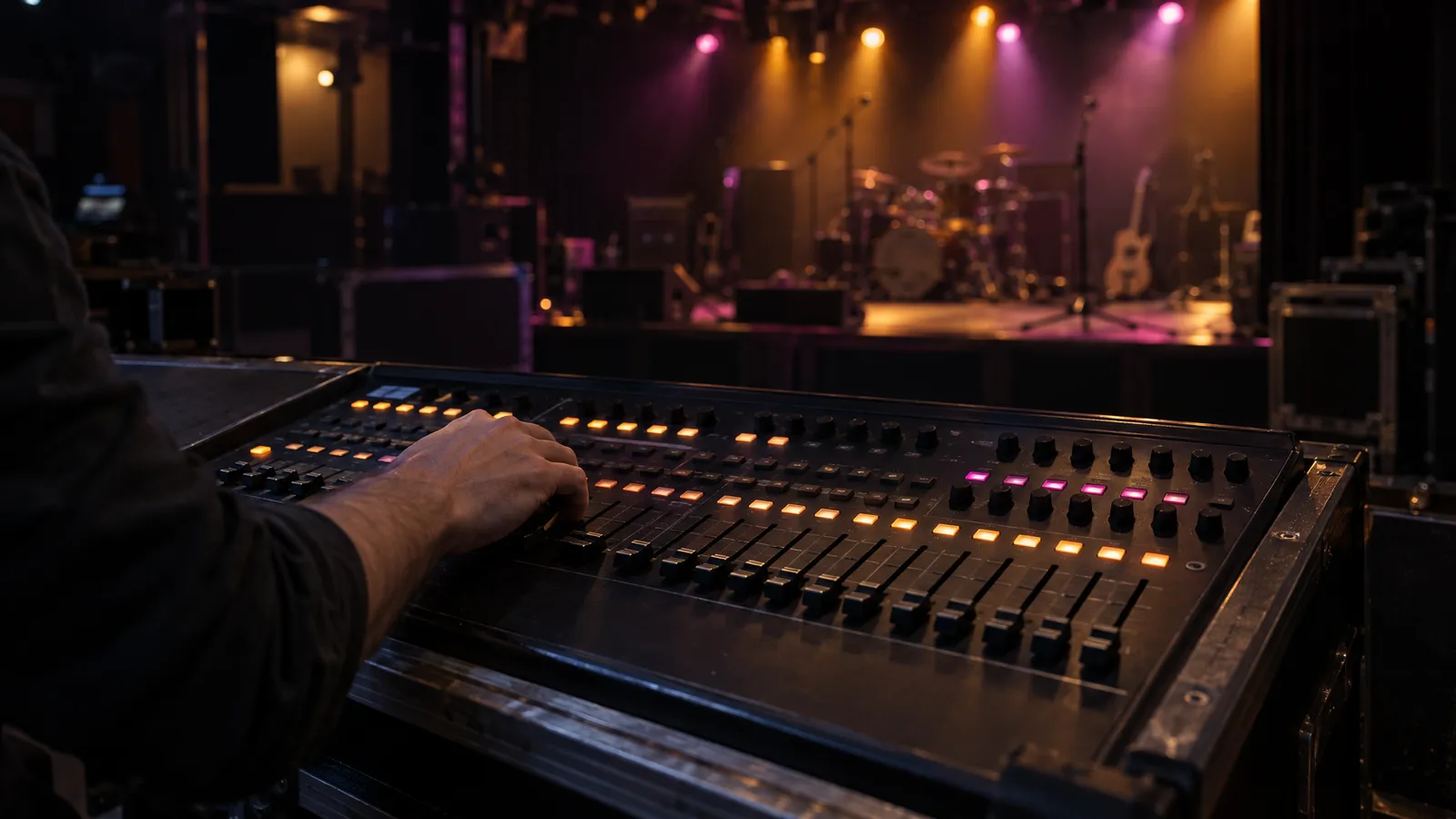
Photo: Wai Siew / Unsplash. Truss-mounted moving heads and par cans give a venue depth and movement instead of flat wash lighting.
Special Effects That Make a Show Memorable
Haze is what lets light beams show in the air. The catalog lists its Haze Machine (600W to 1200W models) for "atmospheric haze for beam visibility." It is an optional effect: spot, wash and gobo light on performers, the stage and the walls works without haze, so you need it only if you want the beams themselves to be part of the look, and only where the venue permits atmospheric effects.
Cold spark effects, as Central County Fire's bulletin puts it, have "become a popular entertainment effect" at public events. A Cold Spark Machine ($35) makes a spark fountain, but it is a fire-code item. That bulletin says spark-producing devices use powdered titanium or zirconium, that the heat from cold sparks "is still capable of igniting nearby materials," and that California Health and Safety Code Section 12505 "classifies ignitable materials with chemical compounds containing titanium and zirconium as Dangerous Fireworks"; where their use is approved, it must be performed by a pyrotechnic operator licensed by the State Fire Marshal. Central County Fire prohibits cold spark devices in Burlingame, Millbrae and Hillsborough (CCFD bulletin; statute text at California Legislative Information). Confirm with the venue and the local fire authority before booking. When VENEGEEST's crew operates the effect, VENEGEEST holds the operating permits; a venue that rents the machine and operates it itself carries that responsibility, including liability. The Rotating Cold Spark Machine ($90) is listed as a 360° rotating spark fountain; the same fire-code checks apply.
Some venues add a Dry Ice Low-Fog Machine, listed for low-lying fog effects. Whatever combination a venue picks, run these effects past your venue's fire marshal requirements before booking night-of. Requirements for cold spark and haze vary by city across the Bay Area, and some fire authorities prohibit cold spark outright, so confirm with the local fire authority before booking.
Putting a Rig Together: A Sample Night's Gear List
Here's what a mid-size venue booking a five-piece rock band for a 200-person room might rent for one night, with the per-day starting prices listed in our catalog:
- Sound: two Commercial PA Speakers for front-of-house ($200 each); stage monitors and a mixer on request, subject to availability, quoted to the night
- Staging: Portable Stage Platform modules ($30 listed) sized to the room's ceiling height and sightlines
- Rigging: Aluminum H-Frame Truss ($10 listed) spanning the stage width for overhead lighting mounts
- Lighting: two LED Spot-Wash Moving Heads (quoted by model), four Full-Color LED Par Lights ($25 each), one Followspot Light ($80), run from a Lighting Control Console (quoted by model)
- Atmosphere (optional): one Haze Machine (quoted by model) if you want visible beams and the venue allows haze
- Send-off effect: one Cold Spark Machine ($35) for the encore, if the venue and fire authority allow it
Delivery, setup, technicians and overtime are scoped and quoted to your event, and multi-item packages are quoted per project. A day rate covers 24 hours from delivery or pickup, and self-pickup from our South San Francisco warehouse is an option for venues with their own crew.
A smaller acoustic duo night in a 60-person room may need far less: perhaps a single pair of PA speakers and a handful of par cans for color wash, and no truss or moving heads. Check the speaker specifications against the act's needs either way.
The right approach is matching gear to the act and the room, not renting the biggest package available every time. If you're planning multiple show nights across a month, it's worth checking our AV event planning checklist for a load-in-to-strike timeline you can reuse for each booking, and comparing it against your venue's fire code and noise ordinance before finalizing a gear list.
FAQ: AV for Live Music Venues
How many PA speakers does a small live music venue need?
For a small room, two Commercial PA Speakers positioned on either side of the stage are the usual starting point. In larger rooms, or rooms with hard walls that create echo, venues add speakers or delay speakers toward the back so sound doesn't smear by the time it reaches the last row. Share the room size and capacity with your quote request for a specific count.
Do I need haze if I'm renting moving head lights?
Not necessarily. Moving heads light performers, the stage and walls with spot, wash and gobo effects without haze. Haze is what makes the beams themselves visible in the air, and the catalog lists its Haze Machine for beam visibility. Add it if you want that look and the venue permits atmospheric effects.
Can cold spark machines be used indoors?
The catalog describes the Cold Spark Machine as indoor-safe, which is the equipment's own product description: it is designed for indoor use. Venue approval and any fire-authority permit still apply, so it runs only where the venue and the local fire authority allow it. Central County Fire's bulletin says cold spark devices use powdered titanium or zirconium, that their heat can still ignite nearby materials, and that California Health and Safety Code Section 12505 classifies such materials as Dangerous Fireworks; it prohibits the devices in Burlingame, Millbrae and Hillsborough. Confirm with the venue and the local fire authority before booking. VENEGEEST holds the operating permits when its crew runs the effect; if you rent the machine and operate it yourself, you carry that responsibility.
What's the difference between a followspot and a moving head?
A Followspot Light is manually operated to track a performer, usually a lead singer or soloist, across the stage in real time. A moving head like the LED Spot-Wash Moving Head is usually programmed and run from a lighting console for cues, washes and effects.
Can a small venue rent gear for just one show, or does it need to commit to a season?
Rental is built for exactly this. Venues can size a rig per booking, renting a full PA, lighting, and staging package for a big touring act one week and a scaled-down setup for an acoustic night the next. Check the full rental catalog for what's available for your next show date.