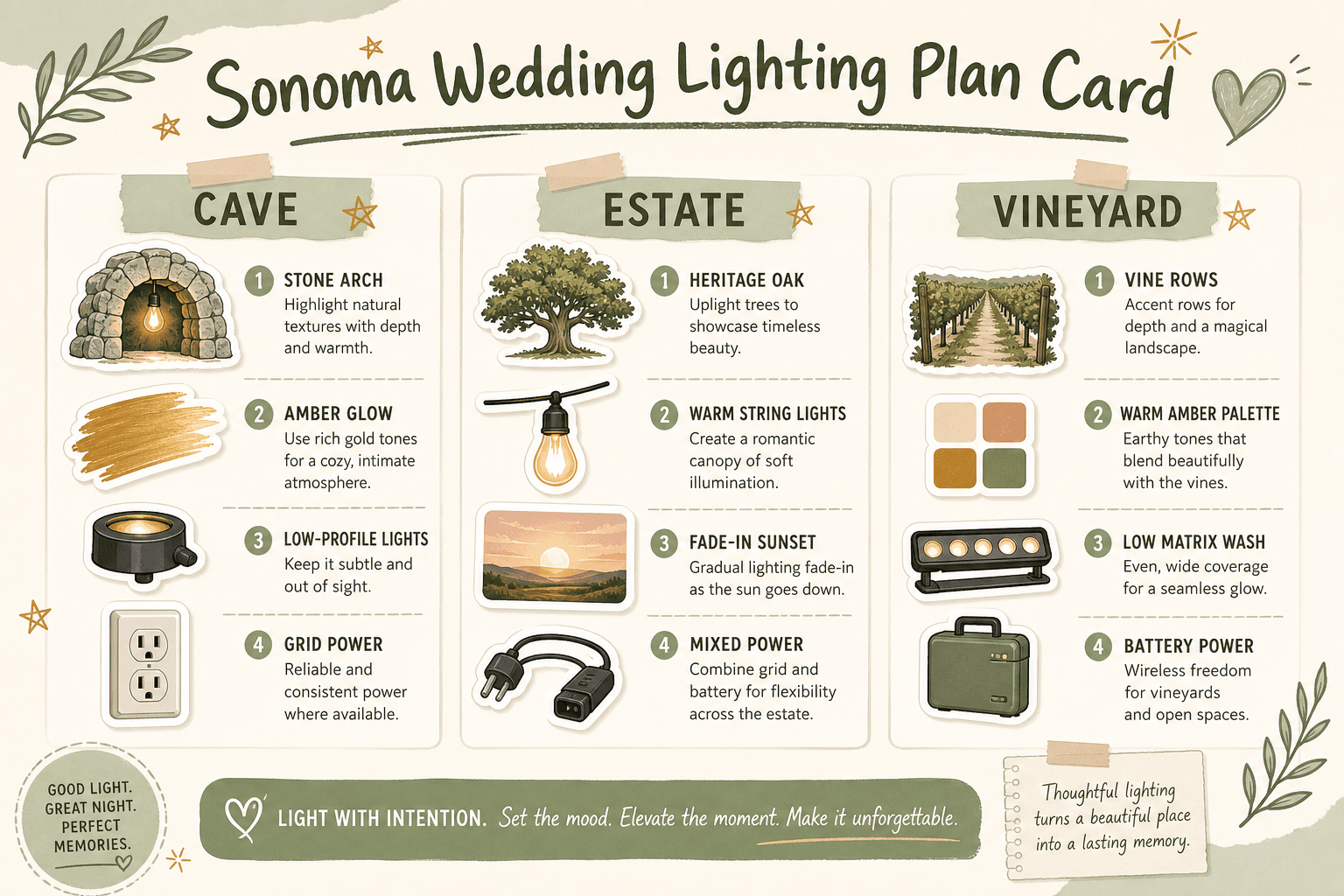
Sonoma weddings tend to happen in three kinds of space: an underground or cellar room, an estate lawn under old trees, and an open vineyard terrace. Each one asks a different question of the lighting plan. A low cellar ceiling limits what can be mounted overhead, an oak grove at sunset already has a strong focal point, and an open vineyard has no ceiling, no walls and sometimes no power at the reception spot.
Here's how to plan the lighting for each venue type, and what to ask the venue before you settle on equipment.
Three Sonoma venue types, three lighting plans
Many wedding-lighting checklists assume one ballroom with four walls and a ceiling high enough to hang fixtures. Sonoma venues often look different:
- Cave or cellar room. Low or arched ceilings, stone or barrel walls, usually a smaller guest count. Some Sonoma wineries have aging caves; whether a given cave or cellar is available for events, and for how many guests, is a question for that winery.
- Estate / oak grove. Heritage trees as the focal feature and a timeline built around sunset. Beltane Ranch, for example, describes its ceremony site as facing west, with a 200-year-old blue oak and afternoon sun "setting behind Sonoma Mountain and Bennett Peak."
- Open vineyard. A reception on a lawn or terrace overlooking the vines, with no ceiling. Chateau St. Jean lists a grand lawn "overlooking the vineyards" among its wedding spaces.
The same wedding can use two or three of these in one evening: ceremony under the trees, cocktails in a courtyard, dinner on a vineyard lawn. Give each segment its own lighting layer and its own cue list rather than stretching one rig across all of them.
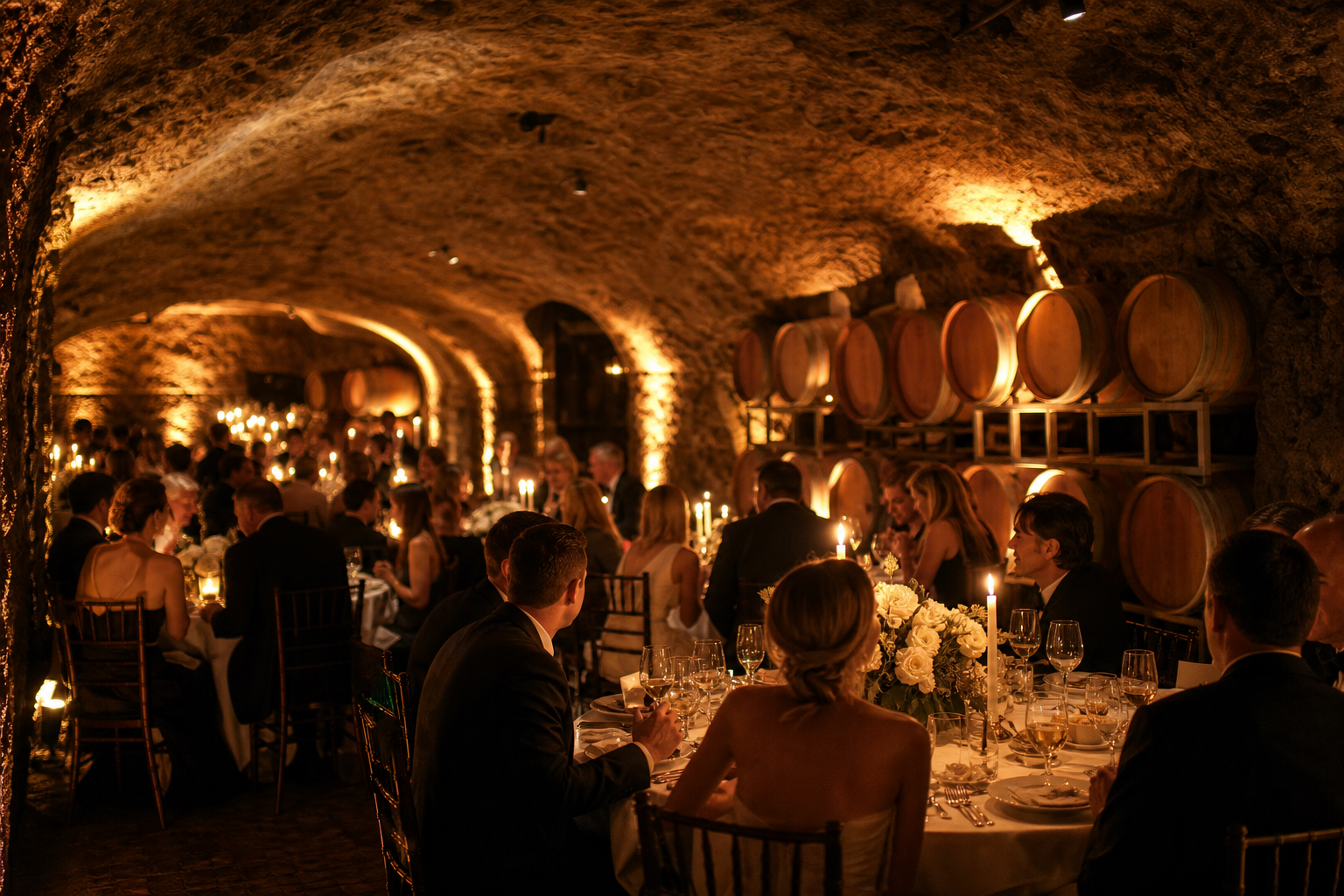
Cave or cellar: measure first, then choose low fixtures and a warm palette
Start with the room's real dimensions. Ask the venue for the ceiling height at the center and at the edges, the room's length and width, and where guests will stand and sit. Whether any overhead fixture can be used depends on the specific fixture's size, its manual's mounting and clearance requirements, and where the guests' eyeline falls in that room. In a low room, floor-standing fixtures placed against the walls are often the simpler starting point, because they need no rigging at all.
Battery uplights avoid cables in a tight room. VENEGEEST's Wireless Battery Uplight group is described in the catalog as 12–15-hour battery with wireless DMX, and it includes small variants such as the 4×18W Mini Battery Par. Physical size, beam angle and output differ by model, so check the dimensions of the unit you rent against the space you have along the wall.
Warm palette as a starting point. Stone and wood walls are usually warm in tone, and warm white or amber light tends to sit comfortably on them. Strong blues and pinks change the look of the room more dramatically. Use color on architectural details such as the bar or an arch, and keep faces in neutral or warm light so skin tones look natural in photos. Check the palette with test photos on the night, because the stone, the room light and the camera all affect the result.
Haze only with written approval. A haze machine in an enclosed underground room is not something to assume. Whether it can be used at all is unknown until the venue, and any authority the venue answers to, approves the specific machine and fluid together with a ventilation and fire-alarm plan for that room. Ask early. If the answer is no, plan the room without haze; uplighting on the walls does not need it.
How many uplights? There is no fixed ratio. The count depends on the wall length, each fixture's output and beam angle, and how much other light is in the room. Treat any number as an estimate to test against the site plan, then adjust after a test with the actual fixtures. A soft front light, such as the COB Front Light, can light the head table or the toast position separately from the walls.
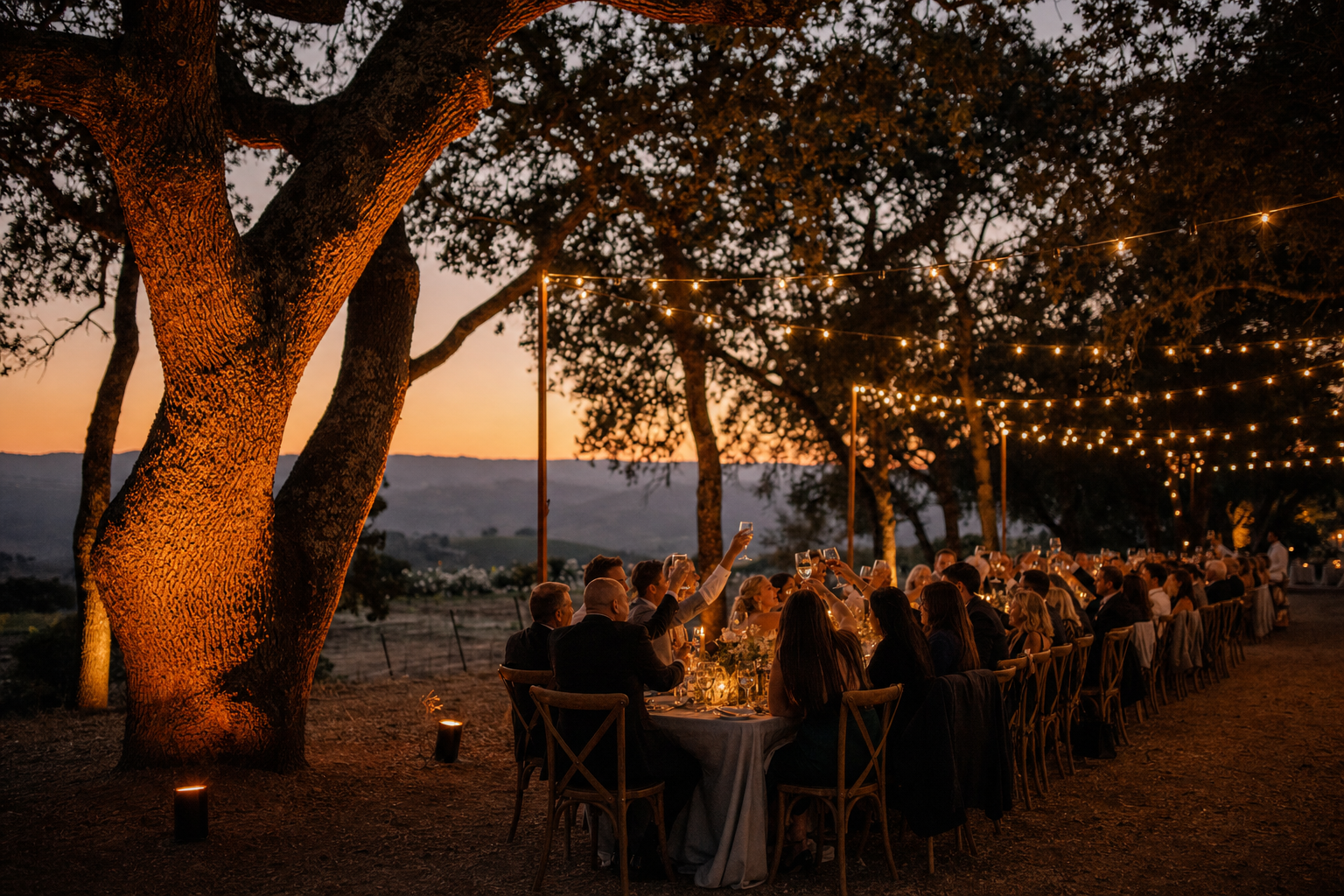
Estate and oak grove: plan the lighting around the date's sunset
An estate with heritage trees is easy to over-light. When the trees and the sky are the reason a couple chose the venue, a full perimeter of uplights can compete with them and flatten the depth of the scene. A layered plan tied to sunset keeps the natural light doing its part.
Look up the sunset time for your wedding date and the venue's location. NOAA's Solar Calculator gives sunrise and sunset for any place and date. Then build the cues around that time rather than around a fixed clock. A sample structure, to adjust to your date and site:
- Before sunset: no electric lighting visible. Fixtures are placed and powered but dark, so they don't show in golden-hour photos.
- Around sunset: bring up the ambient layer. If the venue supplies string lights, this is when they start to read against the sky. If you are adding string lights, they are available from VENEGEEST on request, subject to availability — contact us for a quote — and any overhead hanging should be designed and installed by whoever the venue approves for rigging.
- After dark: add accent light, for example a warm-amber wireless uplight at the base of a few feature trees, aimed up the trunk to show the canopy.
What to consider skipping: uplights evenly spaced around the whole perimeter. On an estate, a handful of chosen positions (bar, head table, arbor, one or two feature trees) often says more than a uniform ring. Walk the site at the time of day of the event, if you can, and decide on the spots there.
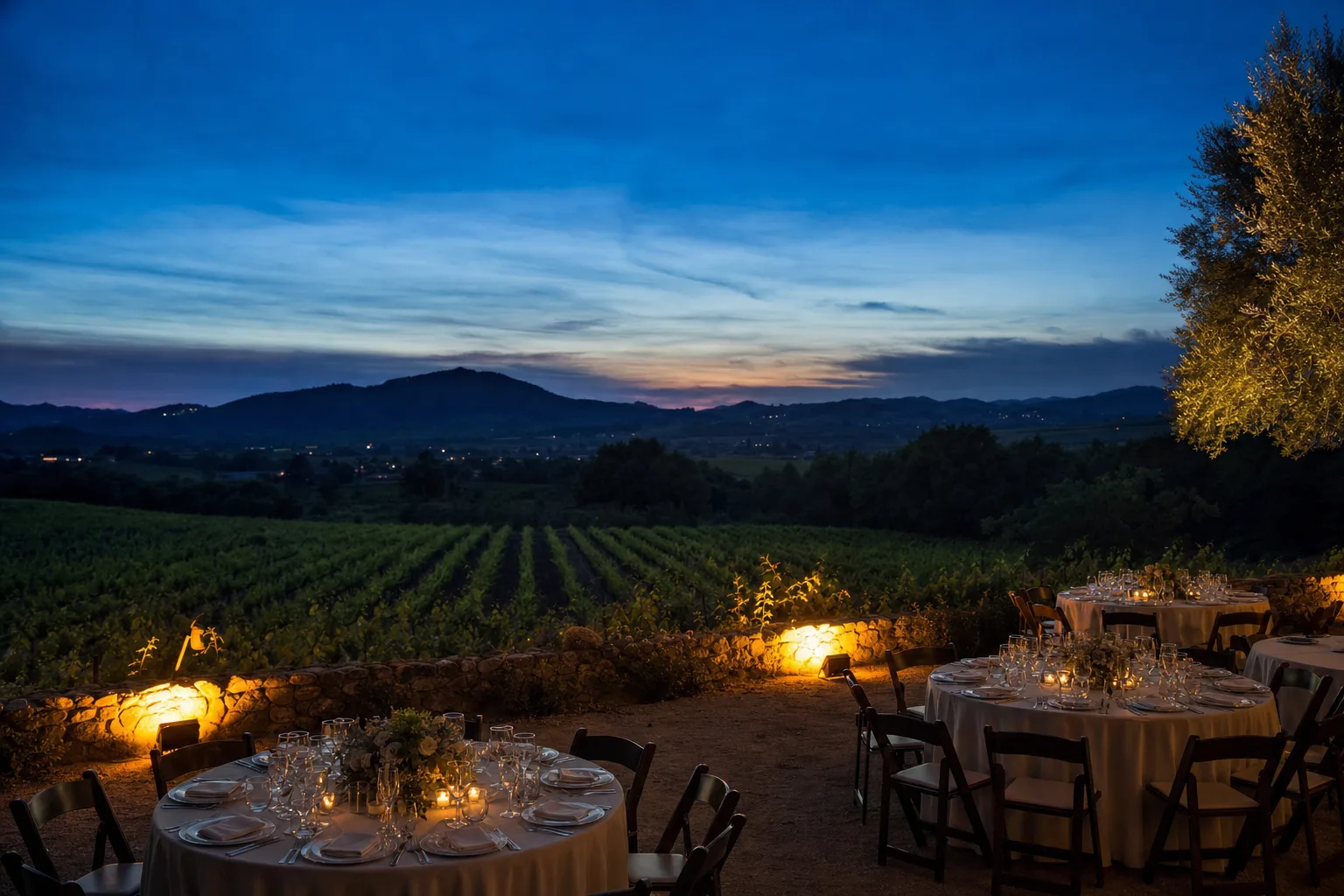
Open vineyard: walk the site at the event hour
Shadows and sun depend on the site. How the vine rows, trees and buildings shade a reception area depends on the row direction at that vineyard, the height of the vines, the terrain, and the sun's position on your date. There is no Sonoma-wide rule. The practical step is a walk-through at the same time of day as the reception, ideally close to the wedding date, to see where the light falls. If some tables sit in shade while others are in full sun, try rotating or moving the table layout and check again. NOAA's Solar Calculator also shows the sun's azimuth and elevation for a date and time, which helps if you can't visit at the right hour.
No ceiling, no rigging, sometimes no power. Some vineyard reception areas have no permanent infrastructure, so ask the venue what power is available and where. Battery uplights avoid running cable across a lawn; the catalog lists the group at 12–15 hours of battery, so compare that with your load-in-to-teardown window and ask about runtime at the brightness you plan to use.
Dance-floor wash without overhead rigging. Whether moving heads or any overhead fixture can be used under a tent or pergola depends on the structure's measured height, what it is rated to hold, and the fixture's own clearance requirements, so that is a question for the tent provider and whoever rigs it. A simpler option is a set of LED par cans on the ground or on stands, throwing color across the floor without anything hung overhead. For the edges, a few wireless uplights along the tent line pointing inward add color behind the guests.
Evenings in wine country can cool down after sunset, so check the forecast for the date and let guests know to bring a layer; warm-colored light will not change the air temperature.
Questions to ask a Sonoma venue before planning
Venue rules and facilities change, so get current answers from the venue's event team rather than relying on a general guide. Useful questions:
- Which spaces can you use, and when? Many estates offer several spaces for different parts of the day. Chateau St. Jean, for example, lists an inner courtyard, a grand lawn and an olive grove.
- What lighting does the venue already supply? Chateau St. Jean says its string lighting will "enhance the ambiance" of events. If the venue already has string lights, plan accent lighting that works with them rather than duplicating them.
- Where is power, and what can it carry? Ask for the location of outlets or panels near each space and what they can support, and whether generators are allowed.
- What are the rules on haze, fog and special effects? Get the answer in writing, for each space.
- What are the event hours and sound limits? Chateau St. Jean, for example, states evening events run from 5 PM to 10 PM. Other venues set their own hours.
- Who may hang anything overhead? Ask whether the venue requires a specific vendor, certificate of insurance or approval for rigging.
For the matching audio plan, see the Bay Area wedding AV checklist.
Power, permits, and the sound ordinance
Sound limits in wine country are set by the county's noise rules and, often more specifically, by each venue's use permit, which can fix an end time for amplified music and a maximum level. Check the venue's use-permit sound limits before you plan the evening, and build the timeline so the last dance lands before the cutoff.
Power by venue type: in a cave or cellar, ask which circuits are available for your setup. On an estate, a mix of venue power and battery uplights for tree positions avoids running cable across a lawn where guests walk. In an open vineyard, battery fixtures reduce what you need to power; if a DJ or PA needs a generator, ask the venue whether one is allowed and where it may go, and keep it away from the dance floor and dining area.
If your reception involves a DJ booth with its own rig, such as moving heads, par cans or haze, see the DJ booth lighting guide. For when each fixture type fits, moving head vs par lights compares the two.
What we rent for Sonoma weddings
Wireless Battery Uplights: the catalog lists this group at 12–15-hour battery with wireless DMX and IP65, with variants from a 4×18W Mini Battery Par up to 12×18W and 18×18W battery pars; check the specific model's rating and size for your venue. LED Par Cans for a dance-floor wash from the ground or stands. The COB Front Light ($35) for the head table or toast. A Haze Machine ($25) where the venue has approved it in writing. List prices cover a 24-hour rental period. We design the plan around your venue and each segment of the evening, and equipment beyond the listed catalog, such as string lights, is available on request, subject to availability — contact us for a quote; plan any catenary rigging with the venue and whoever it approves for rigging. Delivery, setup and technicians are scoped and quoted to your event.
For the full menu, see the equipment catalog, or the stage lighting category.
FAQ: Sonoma wedding lighting
Can I run haze inside a Sonoma wine cave?
Not unless the venue approves it in writing. Whether haze is allowed in an enclosed underground room depends on the venue's rules, the specific machine and fluid, and a ventilation and fire-alarm plan the venue (and any authority it answers to) signs off on. Ask early, and plan the room so it still works without haze.
What's the Sonoma County sound ordinance cutoff for outdoor weddings?
It depends on the venue. County noise rules and each venue's use permit set the end time and level for amplified music. Check the venue's use-permit sound limits and confirm the cap in the venue contract.
Can I use moving-head fixtures at a vineyard reception?
It depends on the structure and the fixture. Under a tent or pergola, the measured height, what the structure is rated to hold and the fixture manual's clearance requirements decide whether anything can be mounted overhead, so ask the tent provider and the rigger. Power is the other question: ask what the site can supply. LED par cans on the ground or on stands are a simpler way to wash the dance floor with color.
Do I need uplighting at an oak-grove estate venue?
Often less than a full perimeter package. If the trees and the sunset are the focal point, a few warm-amber uplights at the base of feature trees and at the bar or head table may be enough. Decide on the positions during a walk-through at the event hour, and check with test photos.
Are battery uplights bright enough for a 150-guest vineyard reception?
For perimeter and accent lighting they are a common choice; VENEGEEST's battery pars go up to 12×18W and 18×18W models and the group is listed at 12–15 hours of battery. Whether they are enough depends on the area, the throw distance and the look you want. For a large dance floor, consider grid- or generator-powered LED par cans for the floor and battery uplights for the perimeter, and test the plan on site.
Get a Sonoma lighting plan
Send your venue, date, guest count and the answers you have from the venue with the Request A Quote button at the top of any page, or call (415) 890-5555, and we'll put together an equipment list for each segment of the evening. We deliver from South San Francisco across the Bay Area; tell us the venue and date and we'll confirm whether delivery to it is available.