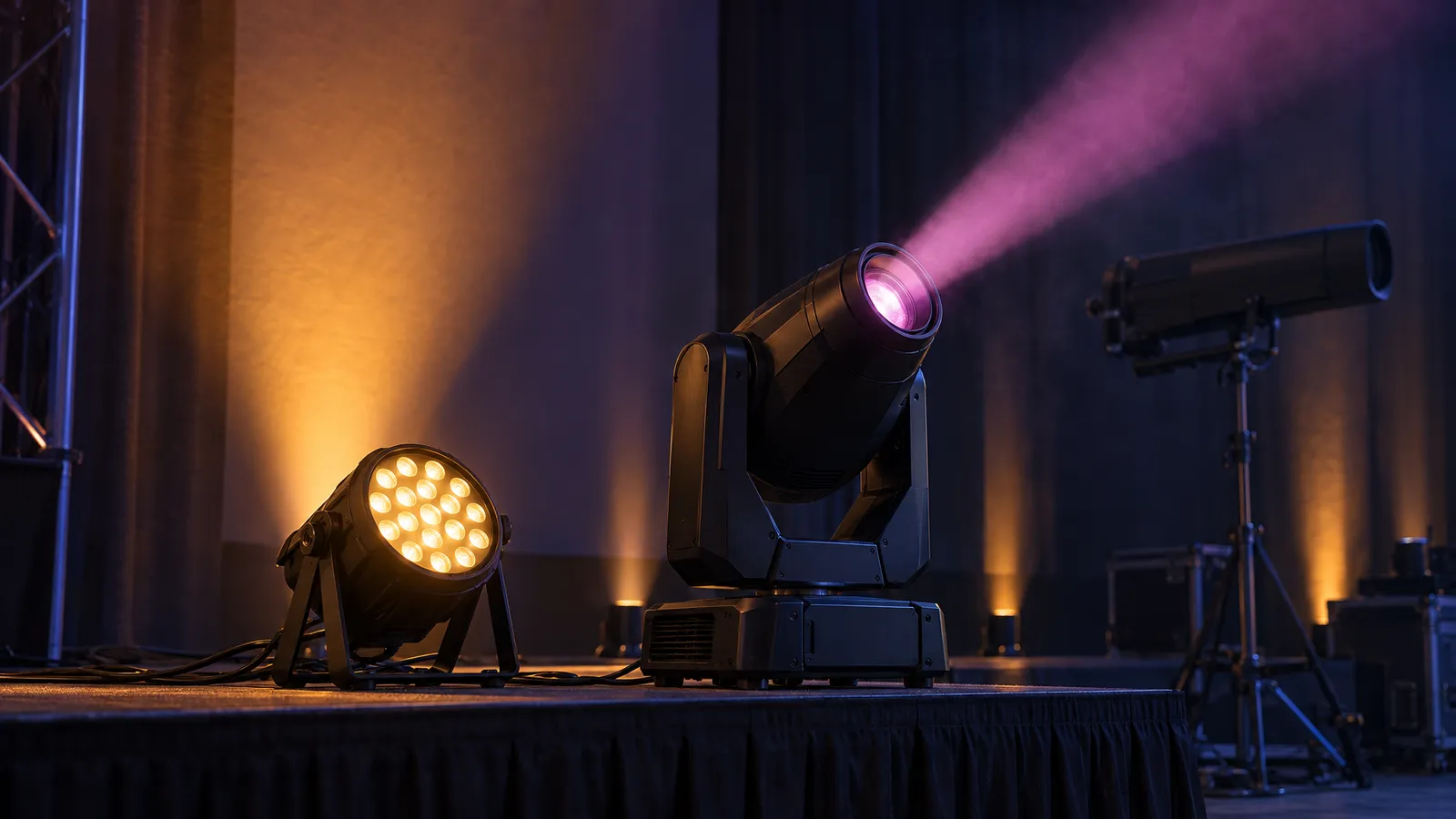
Short answer: par cans are fixed wash lights that paint a surface in color and stay where you point them. Moving heads have motors that pan and tilt the light, so they can re-aim, sweep and change looks during a show. Many event rigs use both, and if you want the beams themselves to show in the air, haze helps where the venue allows it. The rest of this explains why.
The same four fixture families show up at weddings, corporate galas and club nights alike — par cans, moving head washes, moving head spot/beams, and the occasional followspot. Once you understand what each one is built to do, reading a rental list stops feeling like guesswork.
Par cans: the fixed wash light
A par can is a fixed-direction fixture. You aim it once, set a color, and it stays pointed there for the whole show. The modern version is an LED par — often RGBW or RGBAW — that hangs on truss, sits on the floor as an uplight, or clamps to a pipe.
How far a par throws useful light depends on the model's LEDs, lens and beam angle, so check the manufacturer's photometric data for the fixture you are renting. Typical jobs for pars:
- Uplighting. Pars around the perimeter of a room, washing the walls in a color such as amber or deep blue — a common wedding and gala look. For rooms without convenient power, wireless battery uplights do the same job without cable runs.
- Stage front wash. Pars on the downstage edge light faces so the audience can see speakers and performers.
- Backdrop and drape color. Pars aimed at pipe-and-drape or a cyc give a saturated background behind a stage.
- Theatrical key and fill. Traditional theater rigs also use conventional theatrical fixtures with gel for color.
Pars are simple to rig and program. The tradeoff: they do not move. If you need light to follow someone down an aisle or sweep across the dance floor, a par cannot do it on its own.
In this catalog, the Full-Color LED Par Light is an 18-LED RGBW wash light at $25/day, and the LED Par Can range includes IP65-rated models.
Moving head wash vs spot/beam: what changes when the head moves
A moving head is a lighting fixture mounted in a motorized yoke: pan and tilt motors let it aim itself around the room, and most models can also change color and other settings remotely. What sits inside the head differs a lot between types. A wash mover behaves somewhat like a par on a yoke, while spot, beam and profile movers use different optics, with gobos, focus and in some models framing shutters. Moving heads are usually programmed and run from a lighting control console over DMX.
Moving head wash
A wash mover has a wide, soft-edged beam. It throws a color wash like a par does, but it can re-aim between cues. Use cases:
- Sweeping audience color. Wash movers hung on truss can flood the audience in one color during a peak moment, then change for the next song.
- Stage wash that changes scenes. Because a wash mover can re-aim for each cue, one fixture can light different areas at different moments of the show — though not several areas at the same time, which still takes several fixtures.
- Color on bigger surfaces. Large drapes, walls and the back wall of a warehouse venue.
Moving head spot or beam
This is the fixture people often picture when they hear "club lighting." A spot or beam mover has a narrower, harder-edged beam than a wash. Beam angles, zoom ranges and output vary by model: for example, Chauvet DJ lists its compact Intimidator Spot 160 at a 17° beam angle. Beam fixtures are built for very narrow shafts of light; spots typically add gobos (cut-out patterns) and focus. A narrow beam concentrates light into a small angle, which makes it look intense, but that is a different measure from total light output — compare models on their published photometrics.
What you get from spot/beam movers:
- Aerial beam looks. Narrow beams fanning out and moving to music, most visible where haze is in the air.
- Gobo projection. Patterns, monograms or custom shapes projected on a wall, ceiling or dance floor — weddings use this for a couple's monogram, corporate events for a brand mark.
- Performer specials. A tight spot can pick out a single performer on an otherwise dim stage.
For programmed, independently controlled looks, a mover needs a controller — a hardware console or lighting software. Some models also offer standalone modes: Chauvet DJ's Intimidator Spot 160, for instance, runs in "Automated or Sound mode" and can link up to four fixtures without a console. Each fixture has a personality file (sometimes called a profile) that tells the console which DMX channels control what; the channel count depends on the model and the mode you pick (the Intimidator Spot 160 offers 5- or 11-channel modes). Check the manual for each fixture and plan your DMX universes from the actual modes you use.
Followspots: when you need a human operator
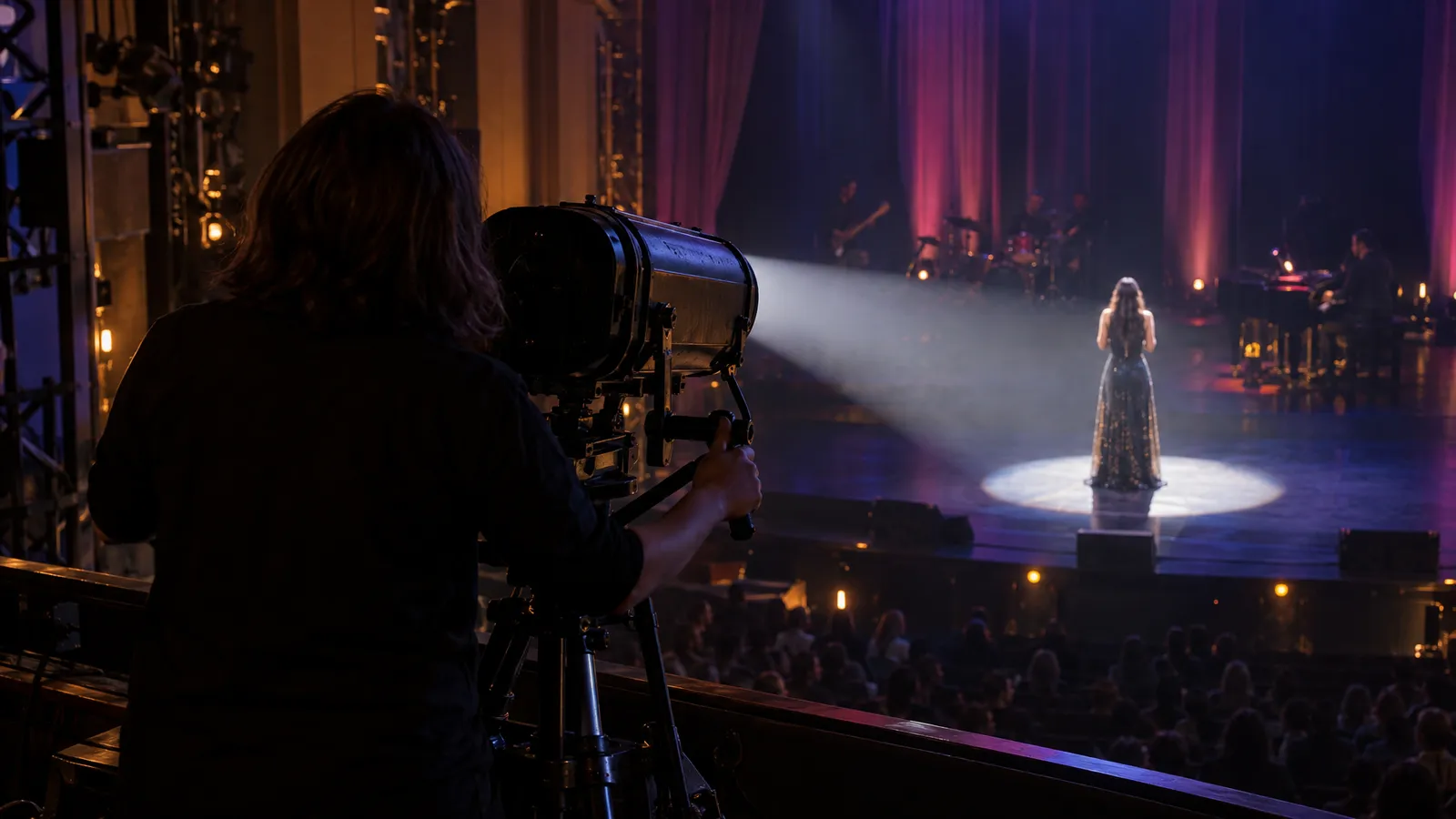
A followspot is a narrow, intense fixture on a stand with handles, run by an operator who tracks a performer by hand. People still rent them because a person can react to movement that was never programmed — a couple walking a curving aisle, a presenter who wanders into the audience, a singer who changes their blocking.
A followspot may suit your event if:
- The performer's path is not pre-programmed and rehearsed.
- You need a tight, clean pool of light on one subject for an extended moment.
- Automated tracking systems are outside your budget.
If the event is short and the blocking is fixed, a spot mover with rehearsed cues may cover the same moment. The catalog's followspot is a 330W–440W manual unit at $80/day.
Side-by-side comparison
Quick reference for reading a rental list. Throw, beam angle and DMX channel counts are model-specific, so confirm them in each fixture's spec details (provided on request):
| Fixture | Aim | Beam | Best for | Notes |
|---|---|---|---|---|
| LED par (RGBW) | Fixed | Wash | Uplighting, stage wash, drape color | Usually the lowest-cost fixture on a list; the catalog's Full-Color LED Par is $25/day |
| Conventional theatrical fixture | Fixed | Varies; gel for color | Traditional theater, dance, key light | |
| Moving head wash | Motorized pan and tilt | Wide, soft-edged | Changing audience color, scene-changing stage wash | Needs a console or software for programmed looks |
| Moving head spot | Motorized pan and tilt | Narrower, with gobos and focus | Gobos, monograms, aerial effects, performer specials | Some models run in automatic or sound-active modes |
| Moving head beam | Motorized pan and tilt | Very narrow | Aerial effects that read as shafts of light in haze | Beams are most visible where haze is in the air and the venue allows it |
| Followspot | Hand-operated on a stand | Narrow, intense | Live performer tracking, awards moments | Needs an operator; the catalog's 330W–440W manual unit is $80/day |
Choosing for your event type
How many fixtures a room needs depends on its size and shape, wall and ceiling surfaces, the fixtures' output and beam angles, and the look you want, so treat the notes below as starting points for a conversation, not counts.
Wedding (outdoor or ballroom). Pars or battery uplights for the room, wash movers on truss for dance floor color, and spot movers if you want a gobo monogram or aerial effects when the dancing starts. A DJ booth lighting setup usually covers the booth itself separately.
Corporate gala or keynote. Pars for uplighting and stage wash, wash movers for audience color during awards moments, spot movers if you want logo gobos. A followspot if a presenter walks into the audience. Beam fixtures mostly belong to the after-party.
Club night. Beam and spot movers do most of the work here, with a few pars for the bar or booth, and haze where the venue permits it.
Concert. Often all four families: pars or washes for the stage, wash movers for the audience, beam movers for aerials, spot movers for gobos and a followspot for the lead performer.
Why beams show up in haze
You see a beam of light in the air only when something in the air scatters it toward your eyes. In clean air you mostly see where the light lands, not the shaft between the fixture and the surface. Haze adds a fine, even suspension of particles, so the beam's path becomes visible — Chauvet DJ describes its Hurricane Haze 4D as filling "the room with a light haze to enhance any light show." Haze is optional: moving heads still project gobos and color onto surfaces without it, and many venues restrict it. If you want visible aerial beams, ask the venue whether a hazer is allowed.
Haze is not the same as fog. Hazers produce a less dense effect than fog machines, with smaller particles that take longer to fill a space. Standard heated fog is thicker, and as it mixes with cooler air it rises and spreads rather than staying low; ground-hugging fog comes from chilled methods such as dry ice or a low-fog / dry-ice machine. For beam visibility, haze is the usual choice. Read more on haze machine rental in the Bay Area if you're putting together a package.
A practical note: haze and fog can set off some smoke detectors, so check with the venue before you book. Any change to a building's fire alarm system is for the venue to authorize and its qualified personnel to carry out under procedures the venue and the local fire authority approve — never something to arrange informally on the day.
FAQ: Moving Heads, Pars and Followspots
Do I need a lighting operator to run moving heads?
It depends on the show. Some models have automatic or sound-active modes that run without a console, but programmed looks that change with the event need someone to program cues and run the console. VENEGEEST can provide a lighting operator who runs the console for events that change through the evening; technician services are scoped and quoted to your event.
Can I use moving heads outdoors?
Only fixtures rated for it. Some models carry IP ratings for outdoor use — the catalog's LED Beam-Spot-Wash hybrid moving head includes IP66 variants — while others are indoor-only. For an outdoor event, ask for rated fixtures or plan cover and a weather backup.
How many pars do I need for ballroom uplighting?
It depends on the room's perimeter, wall features, ceiling height, the fixtures' beam angle and how even you want the wash. Share the floor plan and photos of the room when you ask for a quote, and treat any count as a plan for that room rather than a rule.
What's the difference between a beam, a spot, and a wash on a moving head spec sheet?
Mainly the beam angle and optics: beam fixtures are the narrowest, spots are wider and usually add gobos and focus, and washes are the widest and softest. Exact angles vary by model, and some hybrid movers zoom across more than one range, so read the spec sheet for each fixture.
Do I need haze for par-only events?
Usually not. Pars produce wash light on surfaces rather than a look built on visible beams, so haze adds little. It matters more when moving heads or beam effects are part of the plan.
Can I rent just one moving head for a small event?
Yes. A single mover can project a gobo or add movement to a small room, and some models run in automatic modes. Matched pairs or groups make symmetrical looks easier to program, so decide based on the look you want.
Putting it together
Picking event lighting is mostly matching fixture types to the job: pars for color on surfaces, wash movers for changing floods, spot/beam movers for aerials and gobos, followspots for live performer tracking. Add haze when you want visible beams and the venue allows it. The rest is programming, budget and venue logistics.
If you're producing an event in the Bay Area, send the venue, dates and run of show using the Request A Quote button, or read more about VENEGEEST. Delivery, setup and technicians are scoped and quoted to your event. For the adjacent pieces, see the DJ booth lighting guide and the haze machine rental rundown.