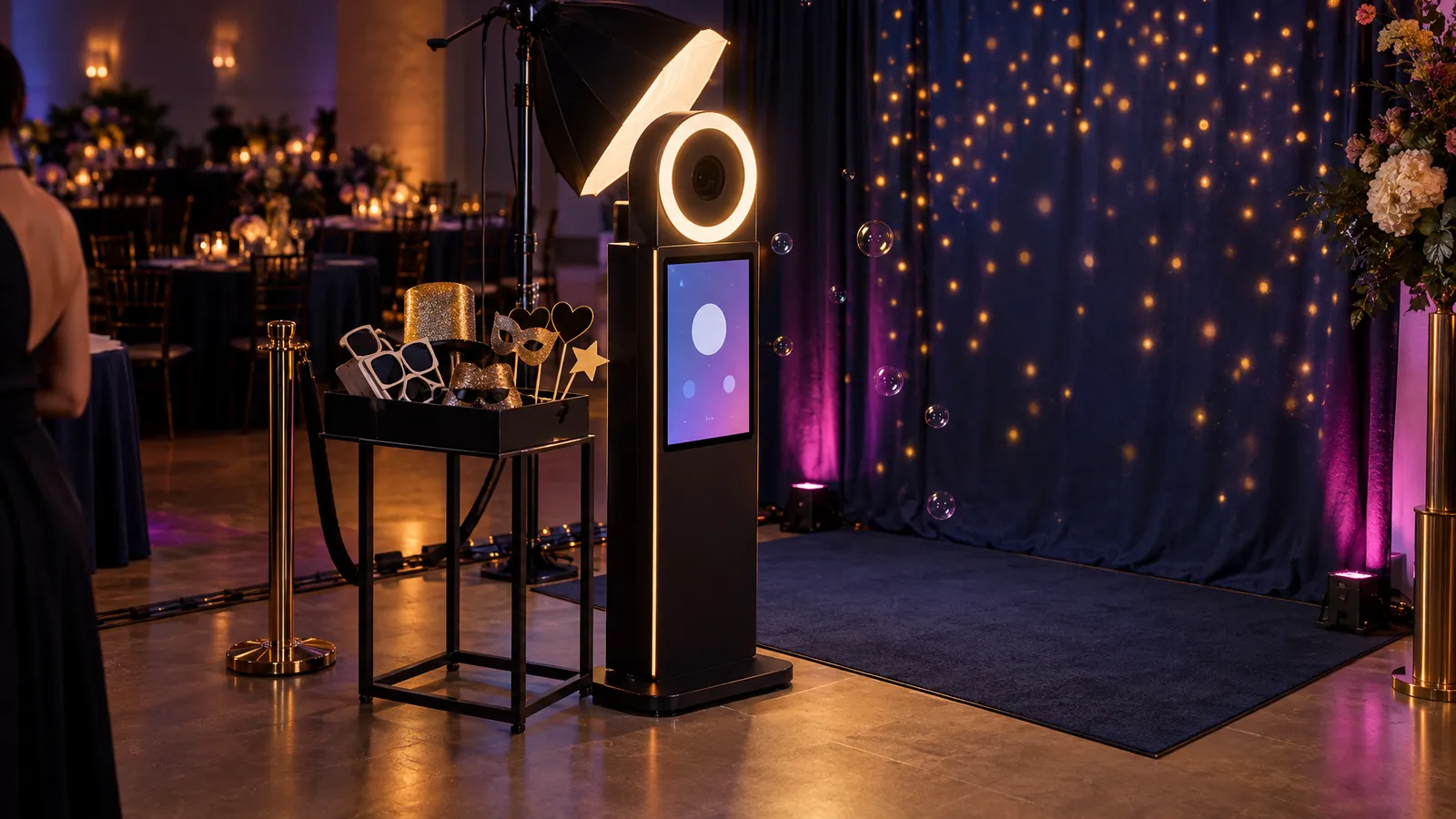
Setting up a photo booth and interactive effects well comes down to a handful of decisions: where the booth goes and how much room it gets, how it is lit, whether the venue's power and data can support instant sharing, and which atmospheric effects suit the room. This guide walks through each, from site survey to breakdown, with the questions to settle for your own event rather than fixed rules. A booth gives guests something to do between courses and, with digital delivery, a photo on their phone, while effects like firefly projection or bubbles can mark the moments that matter.
Site Survey & Booth Placement: Traffic Flow vs. Sightline Interference
Start with the real dimensions. Ask the booth provider for the footprint of the booth and its backdrop, then add room for props, the people waiting and a clear walkway past it. An 8×8 or 10×10-foot area is a useful starting point for sketching the floor plan, not a rule; the right size depends on the booth, the backdrop, group sizes and the venue's circulation and accessibility requirements. Keep the booth within sight of the dance floor but outside the DJ's sightline, and consider trying a spot near the entry or lounge seating rather than one tucked behind the cake table, where guests are less likely to notice it.
Venues with exposed brick or greenery walls can serve as a physical backdrop and save renting a fabric step-and-repeat. The trade-off is physical: you get the wall's color and texture rather than a backdrop chosen to match the event's palette. Digital overlays, such as names, dates or a logo on the photo, are added in the booth's software and are a separate choice from the physical backdrop.
Power and data are the hidden costs. A booth rig with its camera, lighting and kiosk needs an outlet close by, so ask whether the venue charges for power drops. Cellular data works in many venues, but concrete basements and heavy masonry buildings can weaken it, and then you need a hardwired ethernet drop or a mobile hotspot with an external antenna. The Interactive Photo Booth ($400/day) includes instant sharing, so connectivity matters; confirm the specific delivery options and features when you book.
- Sketch the booth, backdrop, prop table and queue on the floor plan using the provider's actual dimensions, leaving walkways and exits clear.
- Consider placing the booth along a side wall so the queue does not cut across the room; check sightlines from the head table and DJ booth during setup.
- Confirm power close to the booth. Extension cords across walkways are a trip hazard, so ask whether the venue restricts cabling in guest areas.
- Request a backdrop stand if the venue wall is mirrored, glass, or covered in exit signage; a plain backdrop keeps reflections and signs out of the frame.
- Test upload speed with a phone speed test before doors; if it is weak, switch to hardwired ethernet or accept delayed delivery.
Lighting the Booth: Ring Light vs. Softbox
A booth has its own camera, but guests will often take phone photos around it too, so light that flatters faces helps both. Soft, even light on the subjects is the goal; how you get there depends on the lights, their power and distance, and how wide the group is. A single ring light suits a solo or small-group frame; as groups get wider, people at the edges can fall off in brightness, so check the edges of the frame with a real group and add a second light at an angle if they go dark.
For corporate events with branded backdrops, check that light falls evenly across the whole backdrop width. Two softboxes on stands, one either side of the camera and angled inward, can spread light more evenly than a single overhead source; confirm it on the camera's own preview rather than by eye. At outdoor daytime events, natural light may be enough on its own; as it fades toward sunset, a Full-Color LED Par Light ($25/day) set to a warm color can add fill. Test it against the ambient light so it doesn't overpower it.
How much light do I need for a booth in a dimly lit venue?
In a room that dims for dinner service, the booth's own lights have to do most of the work. Bring subject faces up enough that the camera can shoot clean exposures without raising sensitivity so far that the image gets noisy, or slowing the shutter so much that groups moving between poses blur. Test with a real group during setup, not a single person. If the venue has colored architectural lighting, such as purple uplights on brick, two different things matter. Colored light falling on the guests themselves is reduced by making the booth's front lights strong enough, relative to the room light, that they dominate on faces and clothing. A separate light aimed at the backdrop controls how the background looks and helps separate subjects from it, but it does not change the color on people's clothes. Check white balance on a test shot with someone in a white shirt.
Atmospheric Effects: Firefly Projection, Bubbles, and CO2
The Firefly Projection Light ($20/day) projects a firefly effect across ceilings and walls for an enchanted-forest look. Set it well back from the projection surface and angle it upward so the effect covers the ceiling or a wall without spilling onto faces or table settings. In a lower-ceiling room, try aiming it at a single accent wall so it doesn't fill the whole space.
Bubbles photograph well, but popped bubbles leave a soap film, and on polished concrete, high-gloss tile or sealed hardwood that film is a slip risk. A reduced-residue professional fluid helps; our guide to bubble machines indoors covers flooring, fluid and fire alarms in detail. Consider saving the Bubble Machine ($40/day) for the first dance or grand exit rather than open dancing, and keep someone ready to wipe the landing zone on hard floors. Where slip risk is a concern, one alternative is the CO2 Jet / Cryo Cannon, which the catalog describes as a vertical CO2 column for moments like brand reveals. Confirm the CO2 supply and venue approval with your quote.
- Run firefly projection during cocktail hour or lounge periods, when it isn't competing with centerpiece lighting at dinner.
- Keep bubble runs short, and keep them away from polished concrete, high-gloss tile and sealed hardwood.
- Position the CO2 jet behind the subject or product so the plume rises in the background without hiding faces, and confirm clearances with the venue.
- Test the firefly projection angle during load-in: too steep and it lands on guests' heads, too shallow and it hits the back wall above eye level.
- Try a warm Full-Color LED Par Light aimed up through the bubbles to backlight them, and check how it looks on camera.
Integration Workflow: Instant Sharing, Branded Overlays, and Video Modes
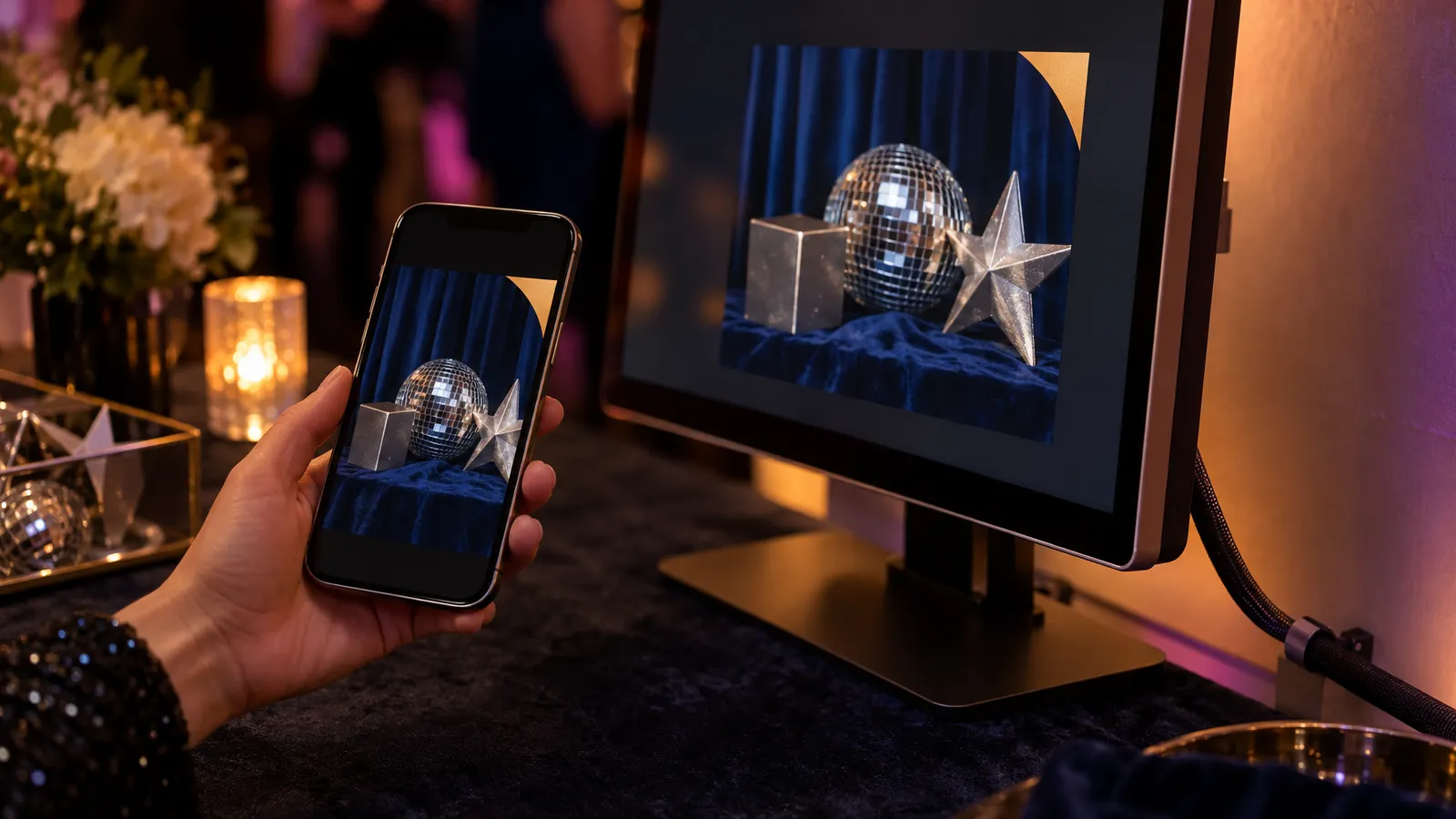
With an interactive booth, the photo can reach the guest's phone before they leave. Decide how fast that needs to be: if real-time social sharing is a goal of a corporate activation, prioritize fast delivery; if it isn't, a slower method may be fine. Set up the overlay template before doors. One common approach is a logo and brand colors in a corner for corporate events, and the couple's names and event date for weddings. Looping video modes (GIF or boomerang), where a booth offers them, produce larger files than stills, so they need solid data to deliver quickly. For corporate activations specifically, see our interactive photo booth guide for corporate events.
For branded corporate activations, you can add a second screen, an LED TV Display (43″ at $35/day or 65″ at $55/day), beside the booth to loop a gallery of submitted photos, if the booth setup supports a live gallery (confirm when you book). At venues with multiple rooms, you could also try a second display in the lounge or registration area to point people toward the booth. The display needs its own power and a video connection from the booth kiosk, so plan cable routing during load-in to avoid tape-downs across high-traffic paths.
- Choose the delivery method to match the event's goal: fast phone delivery where real-time sharing matters, email where it doesn't.
- Keep branded overlays small enough that faces stay the subject of the photo.
- Run video modes only if cellular or hardwired data holds up under a speed test before the event starts.
- If you use a gallery display, place it where guests at the booth can see it.
- Give the booth operator a backup delivery method in case one fails.
Accent Lighting & Uplight Integration
If the room glows amber or purple, a booth sitting in plain white light can look disconnected from it. One way to tie it in is Wireless Battery Uplights behind the booth, washing the backdrop wall in the event's color. The catalog lists them at 12–15 hours per battery with wireless DMX, so the room's color, booth area included, can change at key moments like the first dance or cake cutting; for example, warm amber during cocktail hour and a cooler color when dancing starts.
Battery-powered uplights remove the need for power runs across walkways, which matters at venues that restrict cabling in guest areas and at outdoor spaces with no power nearby. A few uplights around the booth can mark the booth area without physical barriers or signage.
- Match the booth's accent lighting to the room's palette during setup, and check the color on-site with the planner or designer before guests arrive.
- Set uplights a few feet off the wall and angle them upward, and check for bright spots at eye level.
- Use wireless DMX to change booth lighting with the DJ's cue points without touching a fixture.
- Consider placing uplights in pairs, left and right of the booth, if you want a symmetrical look in wide photos.
FAQ: Photo Booth & Interactive Entertainment Setup
How much space do I need for a photo booth at a 150-guest wedding?
Guest count alone doesn't set it. Get the booth and backdrop dimensions from the provider, then add room for props, the people waiting and a clear walkway; an area of around 10×10 feet plus space in front for a queue is a reasonable first sketch to check against the floor plan. An alcove or side lounge that fits it without cutting into dance-floor or dining space works well; otherwise, try a side wall so the queue doesn't cut across the room.
Can I use a photo booth outdoors in the Bay Area?
Yes, with wind protection and a power plan. Wind can topple lightweight backdrop stands and scatter props, so weight every stand and favor greenery walls or venue architecture over loose fabric backdrops. Direct sun can blow out highlights on faces, so plan shade or a canopy. If the event runs past sunset or the booth runs on mains power, confirm a venue outlet or generator close to the booth before the day.
What is the difference between a standard photo booth and an interactive booth?
The labels vary by provider, so compare what each booth actually includes: printed strips, digital delivery to the guest's phone, a touchscreen, custom digital overlays or video modes. The Interactive Photo Booth ($400/day) includes instant sharing; confirm specific features when you book.
How do I prevent the photo booth from interfering with the DJ or band?
Position the booth outside the DJ's sightline to the dance floor and away from the nearest speaker so booth audio cues (countdown beeps, shutter sounds) do not compete with the PA. For bands with stage setups, consider an adjacent room or alcove so the queue does not block the stage view from dining tables. Coordinate load-in timing with the entertainment vendor so booth setup happens before sound check, not during it.
Do I need a dedicated attendant for the photo booth?
It helps. An attendant can reset props between sessions, deal with technical issues (connectivity drops, a frozen kiosk), look after the equipment and, at corporate events, check that branded overlays display correctly. Ask for attendant time in the quote; technician services are scoped and quoted to your event. The attendant should arrive well before guests to finish setup, test connectivity, and confirm the overlay template with the planner.