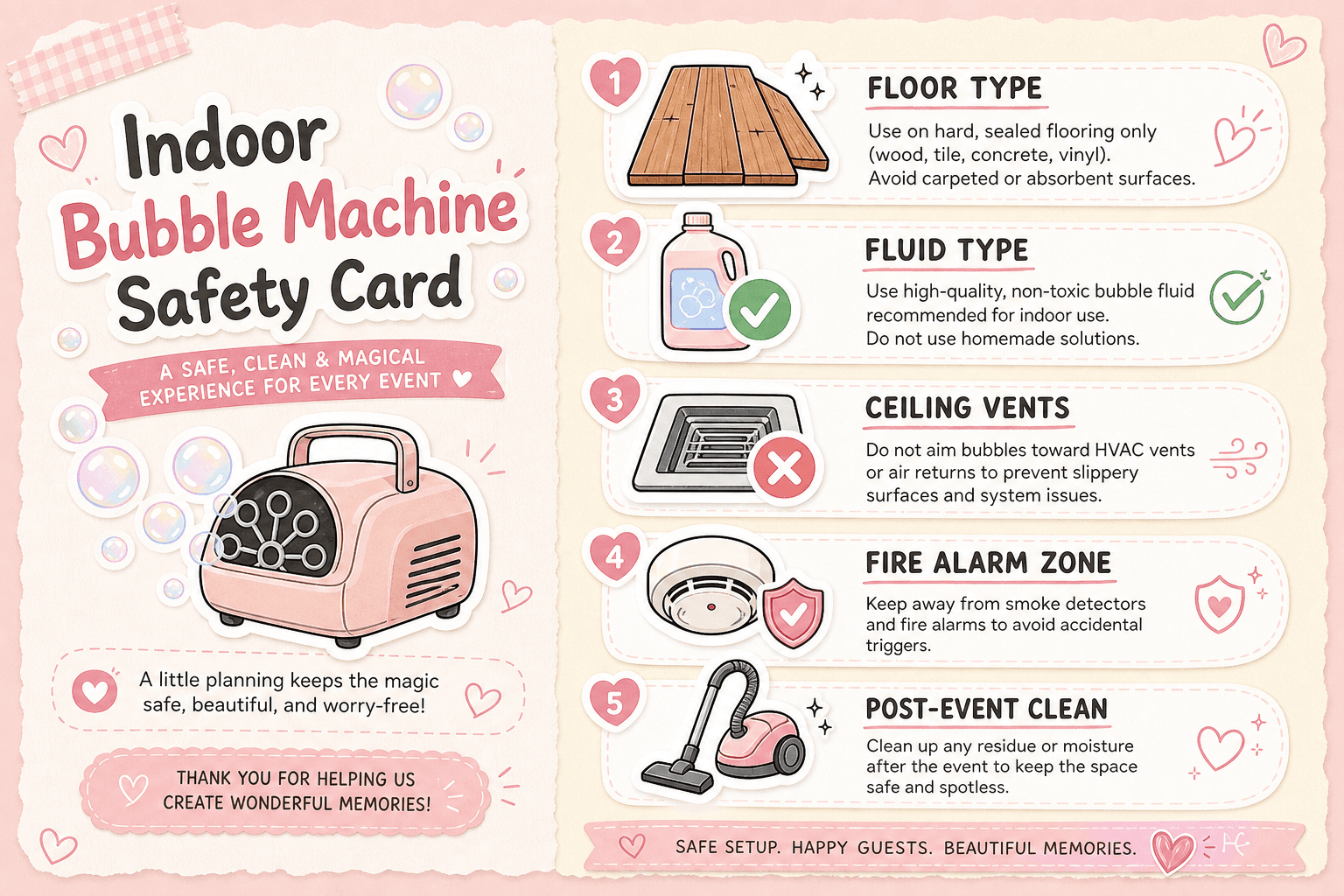
A bubble machine can often run indoors, but whether it suits a particular room comes down to three things you can check before you ask the venue: the fluid in the machine, the floor under the bubbles, and where the room's smoke detectors and air vents are. A venue manager who says no is usually not being difficult. Bubble fluid comes down onto the floor, and at least one machine maker's own manual warns that it leaves a slippery surface.
This guide takes each concern in turn using what fluid makers, machine manuals and fire-safety researchers actually publish. It then covers what to put in front of the venue so they can decide.
The short answer
- Fluid choice. Fluids are not all the same, and each maker makes its own claims. Rosco, for example, says of its bubble fluid that "these bubbles remain dry and will not create a slippery residue." Ask for the spec sheet and safety data sheet for the exact fluid going into the machine, and follow its directions.
- Floor surface. Whatever the floor is made of, plan the landing zone as a possible slip area. Chauvet's manual for its B250 bubble machine says to make sure bubbles are not shooting into anyone's face or "above heavy traffic areas, as bubble fluid leaves a slippery surface." Test on the real floor, watch it while the machine runs, and agree a cleanup plan with the venue.
- Detectors and vents. We did not find a fluid or machine maker that publishes smoke-detector test results for bubbles, so do not assume a detection system will ignore them. Show facilities where the machine will sit and let them assess it against their own system.
What the fluid makers and machine makers say
Bubble fluid is sold under many labels, and the only claims you can rely on are the ones printed for the product you will actually use. Two published documents show why it pays to read both the fluid's sheet and the machine's manual.
Rosco's spec sheet describes its fluid as water based and says the bubbles "remain dry and will not create a slippery residue." The same sheet says the fluid "will not stain hair or clothing nor sting patrons eyes and is easily cleaned up with soap and water," and lists "No residue to damage sensitive electronics like sound or lighting control desks" among its features. Rosco's product page words the floor point slightly differently: the bubbles "will not leave behind a slippery surface nor harm sensitive electronics like lighting or sound desks."
Chauvet's quick reference guide for the B250 takes the opposite starting point. It warns that "bubble fluid leaves a slippery surface," recommends Chauvet's own bubble fluid (BJU or BJG) as "specially formulated for use with CHAUVET bubble machines," and says not to add "perfume, alcohol, gasoline, or other flammables to the fluid." It also notes that fluid left in the reservoir for a long time "may thicken."
These two statements are not a contradiction to resolve in the fluid's favour. A low-residue claim applies to that one fluid, used as its maker directs. A machine maker's slip warning applies to where you aim the machine, whatever fluid is in it. The practical steps:
- Use the fluid the machine's manual recommends, or one the manual does not rule out, and never add anything to it.
- Get the fluid's spec sheet and safety data sheet before the event. Venue engineering may ask to see what is going into their room.
- Treat a low-residue claim as a reason the venue might agree, not as a reason to skip testing and cleanup.
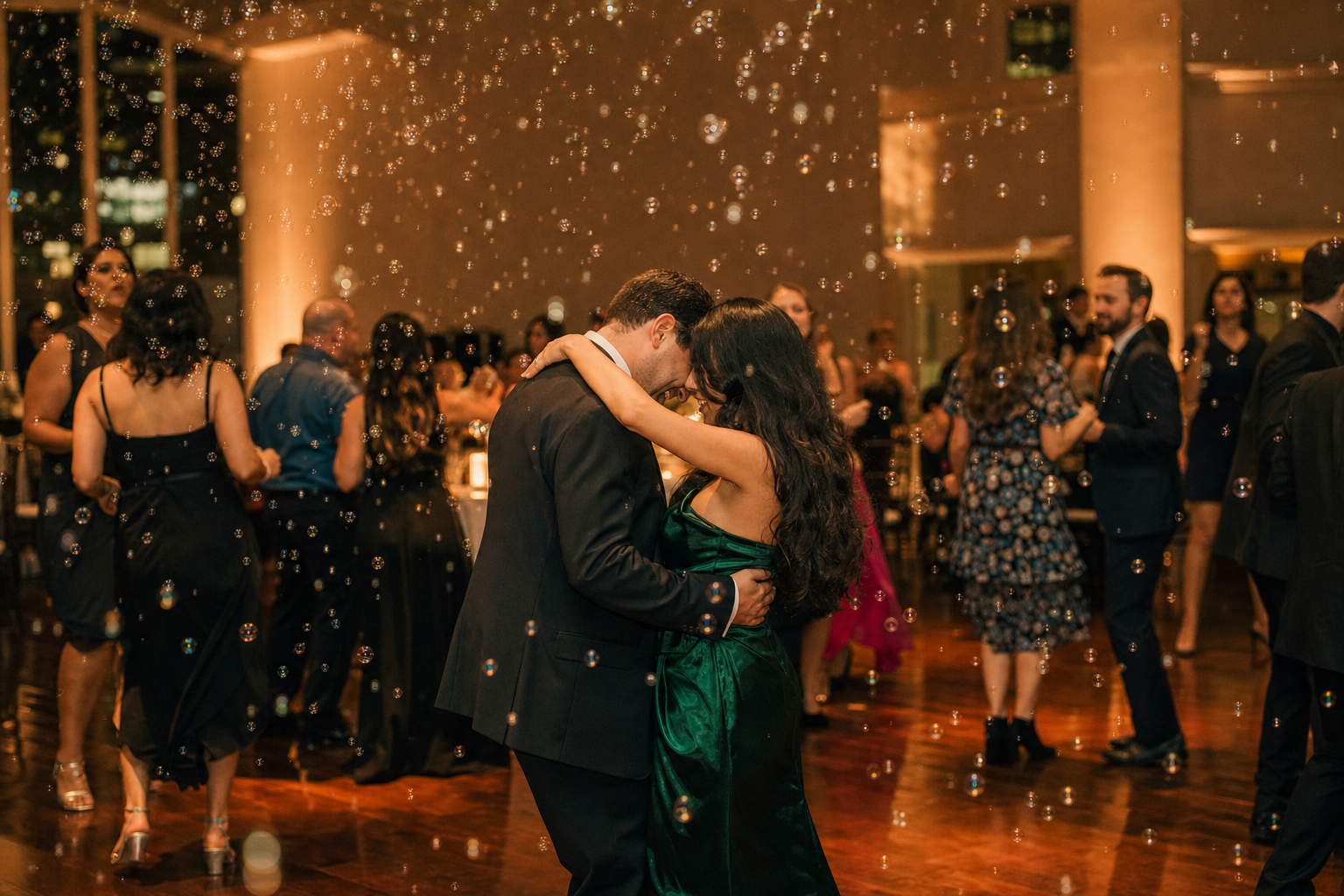
Floors: plan for moisture on every surface
It is tempting to sort floors into safe and unsafe, but no published source we found does that, and the finish, the fluid and the amount of foot traffic all change the answer. What you can do is find out what the floor is and check it for yourself.
- Ask about the finish first. Find out whether the floor is carpet, sealed wood, stone, tile, vinyl or polished concrete, and whether the venue has rules or cleaning requirements for liquids on it. Carpets and some finishes have their own cleaning instructions, and the venue knows them.
- Run a test. During the walkthrough or load-in, run the machine briefly with the fluid you will use over the actual floor. Look at the landing zone and walk on it before you decide on placement.
- Aim away from traffic. Follow the manual. Chauvet's B250 guide says bubbles should not be aimed directly into faces or above heavy traffic areas. A packed dance floor is a heavy traffic area, so aim across an edge or an open space rather than straight down onto the busiest spot, and run the effect in short cues.
- Mount it the way the manual says. The same guide calls for a flat, level surface (no more than a 5° incline), a safety cable when the unit is mounted overhead, and at least 20 in (50 cm) of clearance from adjacent surfaces. That model is also rated for indoor use only.
- Watch the zone and clean it. Have someone watch the floor while the machine runs and wipe up wet patches as they appear. Agree with the venue on how the floor is cleaned afterwards (vacuum, mop, or their own cleaning crew) and who does it.
- Watch the threshold. Where guests walk between an outdoor patio and an indoor floor, wet shoes carry moisture inside. Ask the venue about mats, and keep an eye on the doorway.
Smoke detectors: let facilities make the call
Venue engineers ask about fire alarms for any airborne effect, and they are right to. NIST explains the two common sensing methods. Photoelectric alarms work "by detecting light that is reflected off particles from a light beam inside the sensing chamber," and they sound once the reflected light reaches a threshold. Ionization alarms use a small shielded radioactive source to ionize the air between two metal plates; smoke particles attract the ions and carry them away, which reduces the current and triggers the alarm.
Both methods respond to particles, not to fire itself. NIST points out that alarms near kitchens can pick up particles from cooking "even if you don't burn it." We found no published test showing how detectors respond to bubble droplets, so the accurate position is that it depends on the room, the system and the placement. That is a question for the venue's facilities team, not something a rental supplier can promise.
What to give facilities so they can assess it:
- The machine model and the fluid's spec sheet and safety data sheet.
- A floor plan marking where the machine sits, which way it points, how high it is mounted, and how long each cue runs.
- Whether the machine also makes fog. Several of the larger bubble machines in our catalog are bubble-and-fog combos, and the fog side needs the same conversation as any fog or haze effect.
- Questions for them: where the detectors and the supply and return vents sit in relation to the machine, what type of detection the building uses (including any air-sampling system), and whether they allow the effect at all.
Any change to a detection system is the venue's decision and is carried out by the venue's own people. Do not rig a machine pointing up towards the ceiling unless facilities have looked at that exact plan.
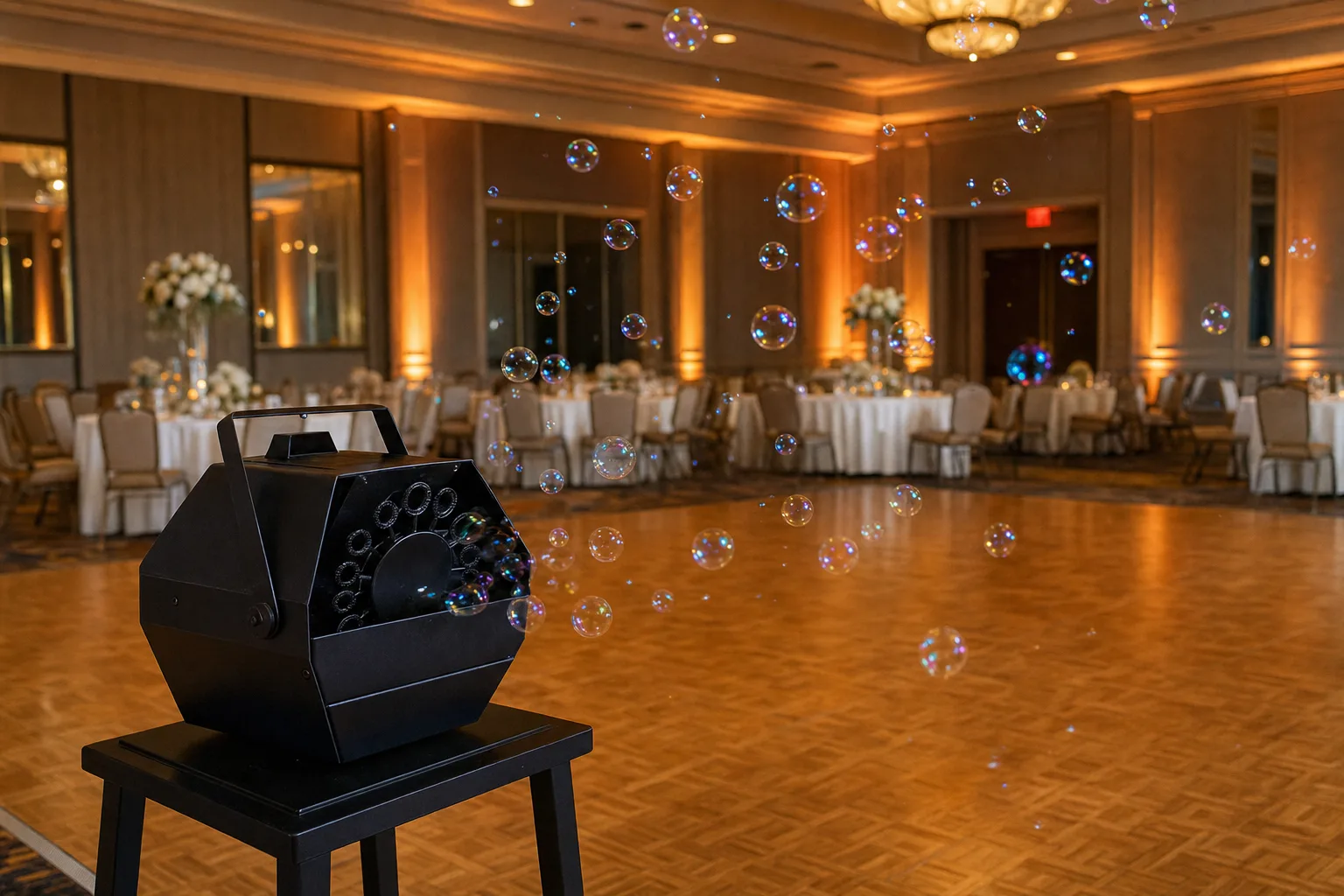
Indoor venue types: questions to ask
- Carpeted hotel ballrooms. Ask about the venue's carpet rules, who cleans after the event, and whether there is a cleaning charge. Bring the fluid sheets and your cleanup plan.
- Historic rooms and lower ceilings. A lower ceiling puts the detectors closer to wherever the bubbles travel. Raise that with facilities, and ask about air returns and supply vents near the planned position.
- Mixed-surface halls. Ask which zones they will allow bubbles over, and plan the machine's aim around those zones.
- Converted warehouses and polished concrete. Ask how the venue handles liquids on that finish, and test before the guests arrive.
- Civic buildings. Expect the strictest rules. San Francisco City Hall's published event rules expressly prohibit smoke, fog or snow generating devices, "including simulated snow, foam, bubbles, or confetti," in the building's interior and exterior areas, along with pyrotechnics. A bubble machine there is ruled out under those rules; ask the City Hall events staff only to confirm the rules currently in force.
No venue type is a yes by default. The request is easiest to assess when it arrives complete: the fluid sheets, a placement plan away from vents and detectors, the run times, and a cleanup plan.
What we rent
- A Bubble Machine at $40 per day, plus a range of bubble machines from a 60W mini unit up to 900W–2000W bubble + fog + LED models, sized to the room. Ask what fluid the machine runs on so you can get its spec sheet for the venue.
- Cue it, don't leave it running: bubbles work best as a short effect for a moment, not as background, and short cues also keep the amount of fluid on the floor down.
- Delivery, setup and technician time are scoped and quoted to your event; self-pickup is also available.
For the rest of the reception, our cold spark fountain guide covers the first-dance effect, and our special effects rental page shows the full range.
When to skip bubbles indoors
- The venue will not accept liquid on the floor. A confetti cannon or streamer launcher gives a dry moment, though confetti cleanup needs the venue's agreement too. Cold sparks put no liquid on the floor, but they need their own sign-off from the venue and the local fire authority, since California classes fireworks containing zirconium or fine titanium as dangerous fireworks.
- Facilities will not clear the effect for their detection system. Take the no. Any other airborne effect, fog included, needs its own assessment by the same team.
- You cannot staff the floor. If nobody can watch the landing zone and wipe it during the event, the slip warning in the manual is hard to manage.
The right effect for the moment is the one the venue agrees to under conditions you can meet.
FAQ: Indoor Bubble Machines
Will a bubble machine ruin our venue's carpet?
It depends on the fluid, the carpet and the cleanup, and nobody can promise it without testing. Some fluid makers publish low-residue claims (Rosco says its bubbles "will not create a slippery residue"), while Chauvet's machine manual warns that bubble fluid leaves a slippery surface. Ask the venue for its carpet rules, test with the actual fluid, and agree a cleanup plan in advance.
Do bubble machines set off fire alarms?
We found no published test that answers this for bubbles. Smoke alarms respond to particles, and NIST notes they can react to non-fire particles such as those from cooking. Give the venue's facilities team the machine model, the fluid sheets and a placement plan, and let them decide for their system. Treat any bubble machine that also makes fog as a fog effect too.
What floor surfaces are safe for indoor bubble machines?
No surface is automatically safe. Plan every landing zone as a possible slip area, keep bubbles away from heavy traffic as the Chauvet manual directs, test on the actual floor, and have someone watch and wipe the area during the event.
How much bubble fluid does a wedding need?
It depends on the machine, its output setting and how long it runs, so size it with the machine you rent and the length of the moment. Whatever the quantity, have the fluid's spec sheet ready for venue engineering.
Who handles venue approval?
Under our rental terms, the client is responsible for securing any venue-specific permits or approvals. What helps the venue assess the request: the fluid sheets, a floor plan with machine placement away from vents and detectors, and a cleanup plan. Tell us the venue and we can help you put that information together.
Get a quote
Send your venue, date, and the moment you want bubbles for (ceremony exit, first dance, grand entrance), and we'll design the setup around your venue and that moment and quote it. If a venue has already said no, call us at (415) 890-5555 and we can talk through what information to bring back to the manager. We serve San Francisco, the South Bay and the wider Bay Area. Browse the full equipment catalog to see how bubbles fit alongside the rest of your wedding effects.