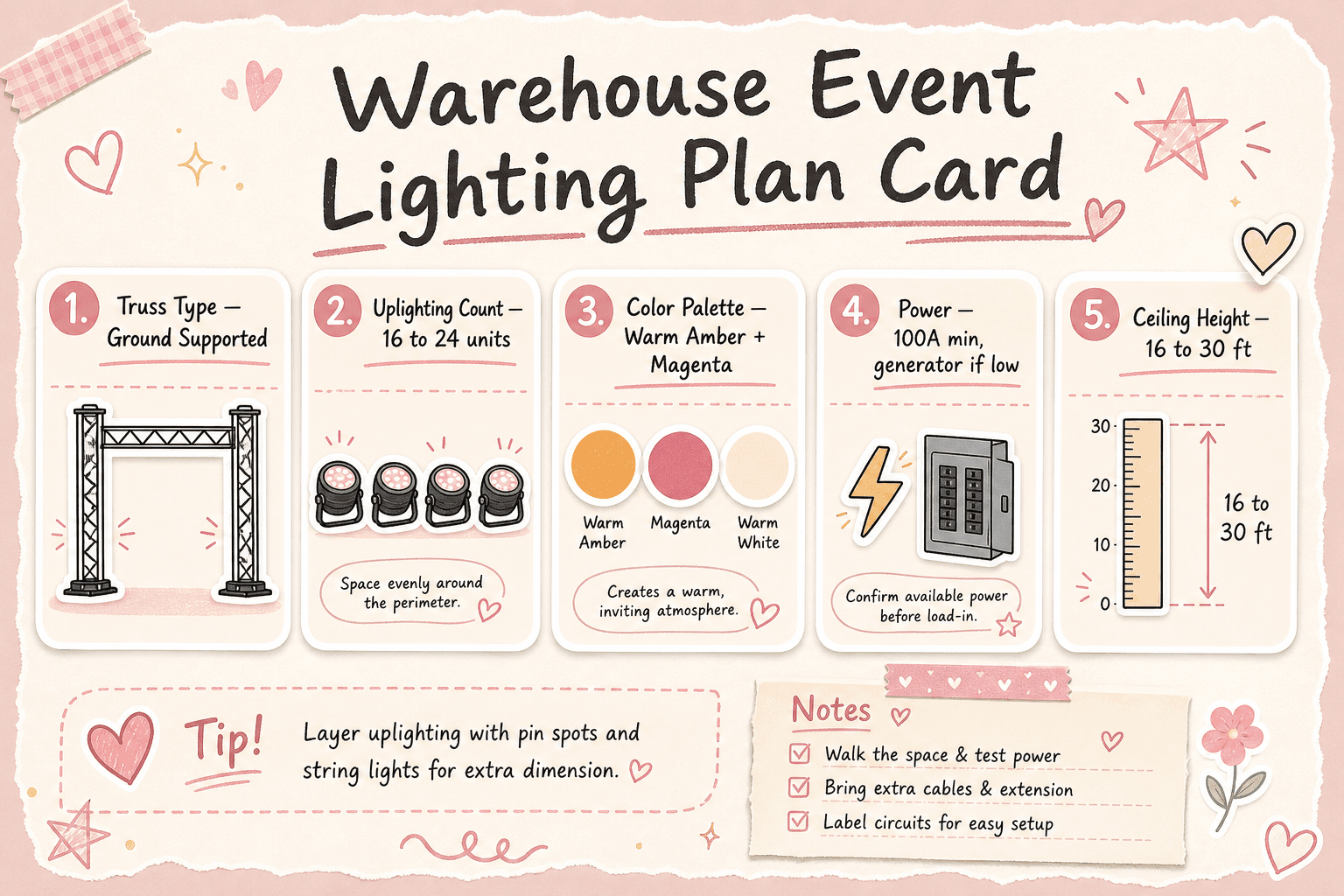
Lighting a converted Oakland warehouse starts with the building's own facts: ceiling height, whether any overhead points are documented as rated for rigging, the size of the load-in door, the floor, the power available to vendors, the fire alarm system and the venue's rules on haze and amplified sound. Get those in writing from the venue, then build the lighting plot around them. This guide covers what to ask, how truss and stands are chosen, uplighting on brick, moving heads and haze, and power.
Converted industrial rooms host weddings, galas and launches, but a room that was built for work may come with little or no event lighting. The questions below are what turn "a great space" into a plan that fits it.
Get the room's facts first
Ask the venue for these before anyone designs a rig:
- Dimensions: floor area, clear ceiling height where the dance floor and stage will be, and the width and height of the load-in door.
- Rigging: whether any beams or points are documented as rated for hanging loads, and by whom. If there is no documentation, plan on ground-supported truss or stands.
- Floor: what the floor is built from and on which level the event is, so the truss or stand supplier can check it against the loads they plan to put on it.
- Power: which outlets and panels vendors may use, their voltage and breaker ratings, and what else shares those circuits (HVAC, catering, the venue's own equipment).
- Fire and life safety: the venue's policy on haze and fog, the type of smoke detection in the room, and who the venue's fire and life-safety contact is.
- Sound: the hours and levels the venue's permit allows for amplified sound, in writing.
Truss and stands: ground-supported by default
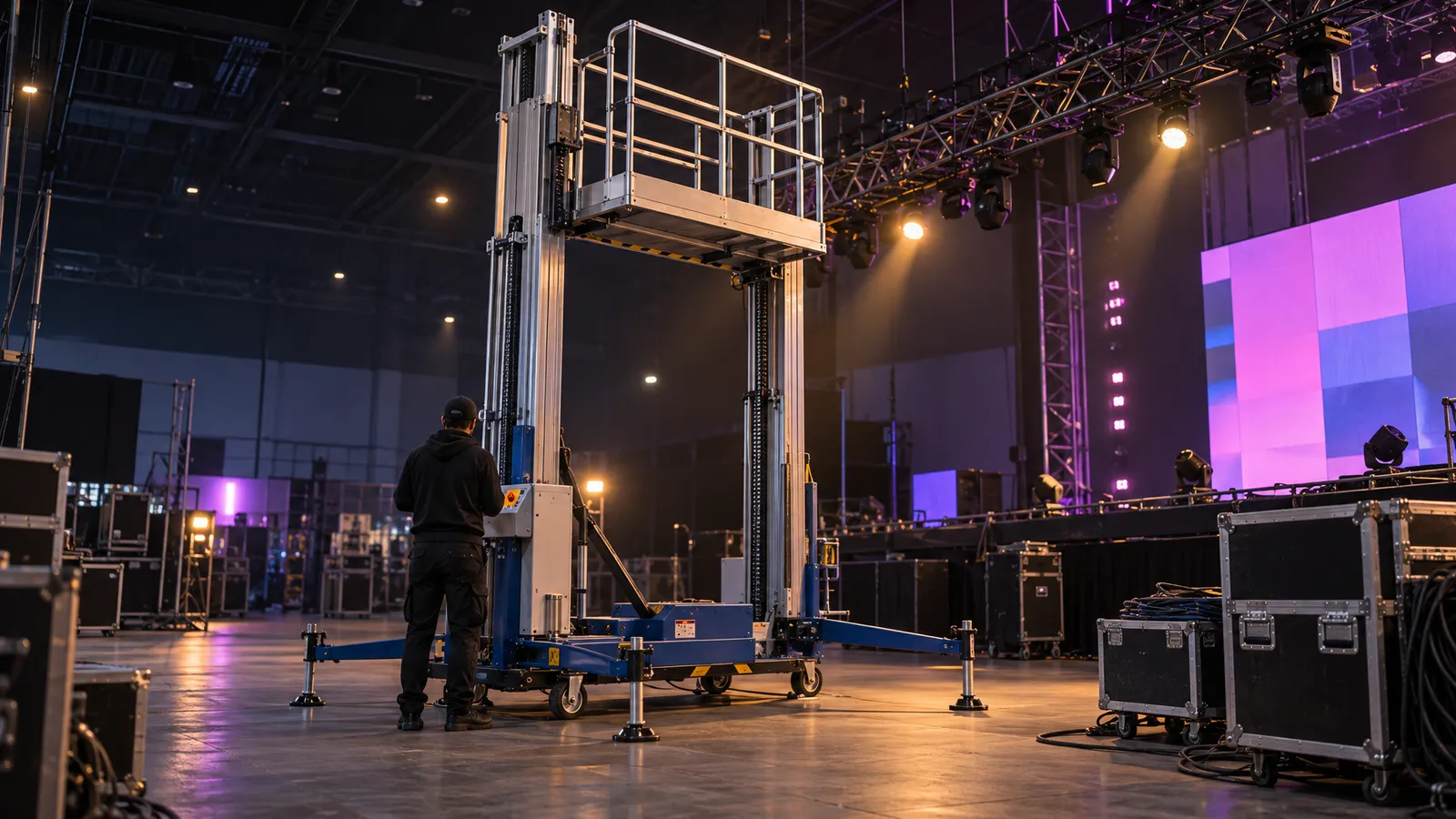
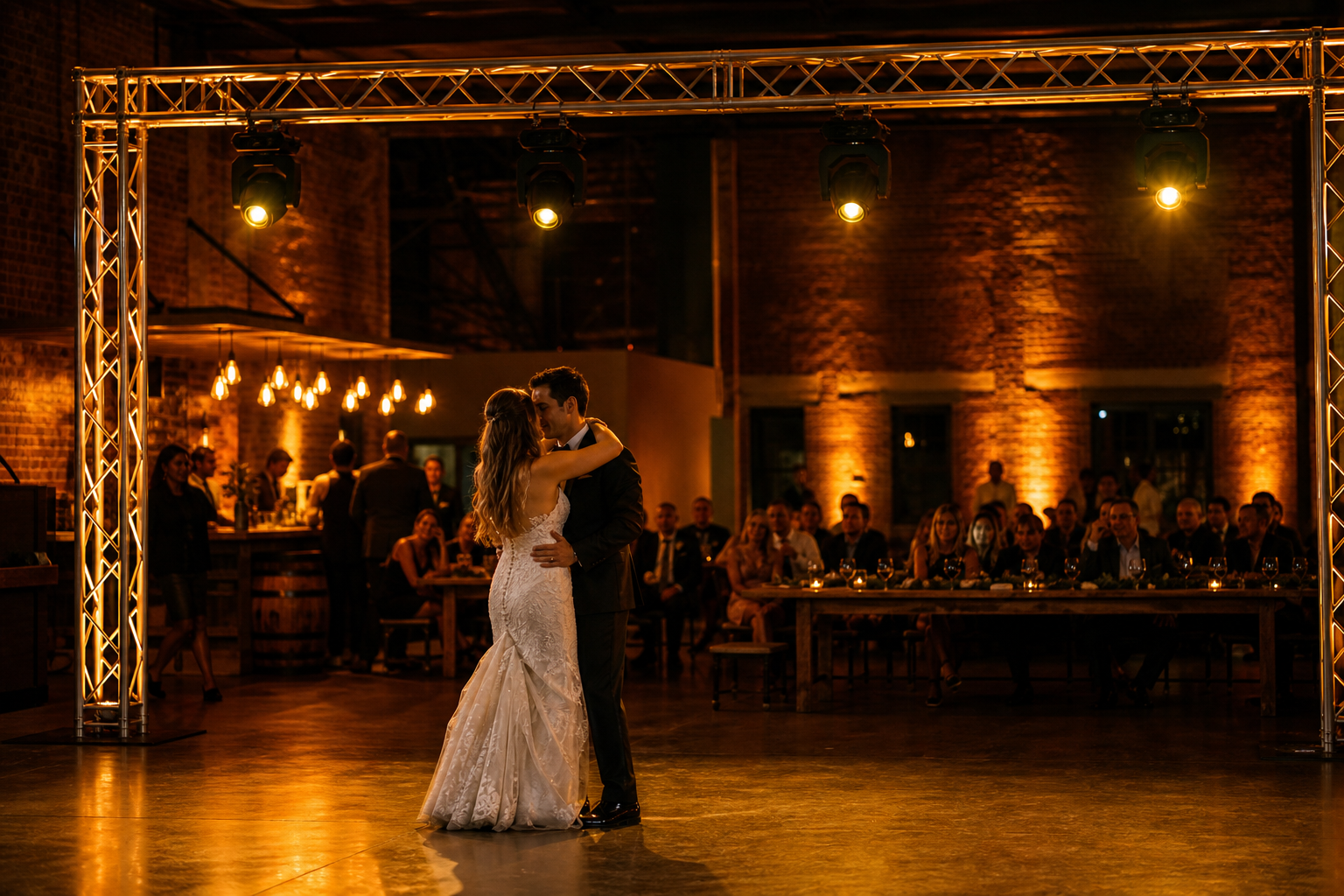
If the building has no documented rigging points, lighting goes on ground-supported structures: truss towers with a horizontal span between them, or lighting stands.
Truss. ANSI E1.2, "Design, Manufacture and Use of Aluminum Trusses and Towers," is the entertainment-industry standard covering aluminum trusses, towers and components such as tower bases and corner blocks (ESTA). In practice that means the design should come from the truss manufacturer's own load data for the specific truss, span and loading, not from a rule of thumb. Ask whoever supplies the truss:
- which truss and bases they are using, and the manufacturer's allowable load for the span you want;
- the total weight of the fixtures and cable going on it;
- the height it will reach against your clear ceiling height;
- how the sections come in through your load-in door; and
- whether the floor has been considered for the load at each base.
Our catalog lists an Aluminum H-Frame Truss ($10 per day).
Stands. In a smaller room, fixtures on stands can be quicker to set up than truss. Stands and truss put fixtures in different places: a horizontal span lets you hang fixtures over the middle of the room, while stands keep them at the edges, which changes the angles you can aim from. Follow the stand manufacturer's rated height and load.
Uplighting on exposed brick
The walls are often the room's best feature, and color choice matters more on textured brick than on smooth drywall. These are design preferences, not rules; test them on the actual wall at the walkthrough.
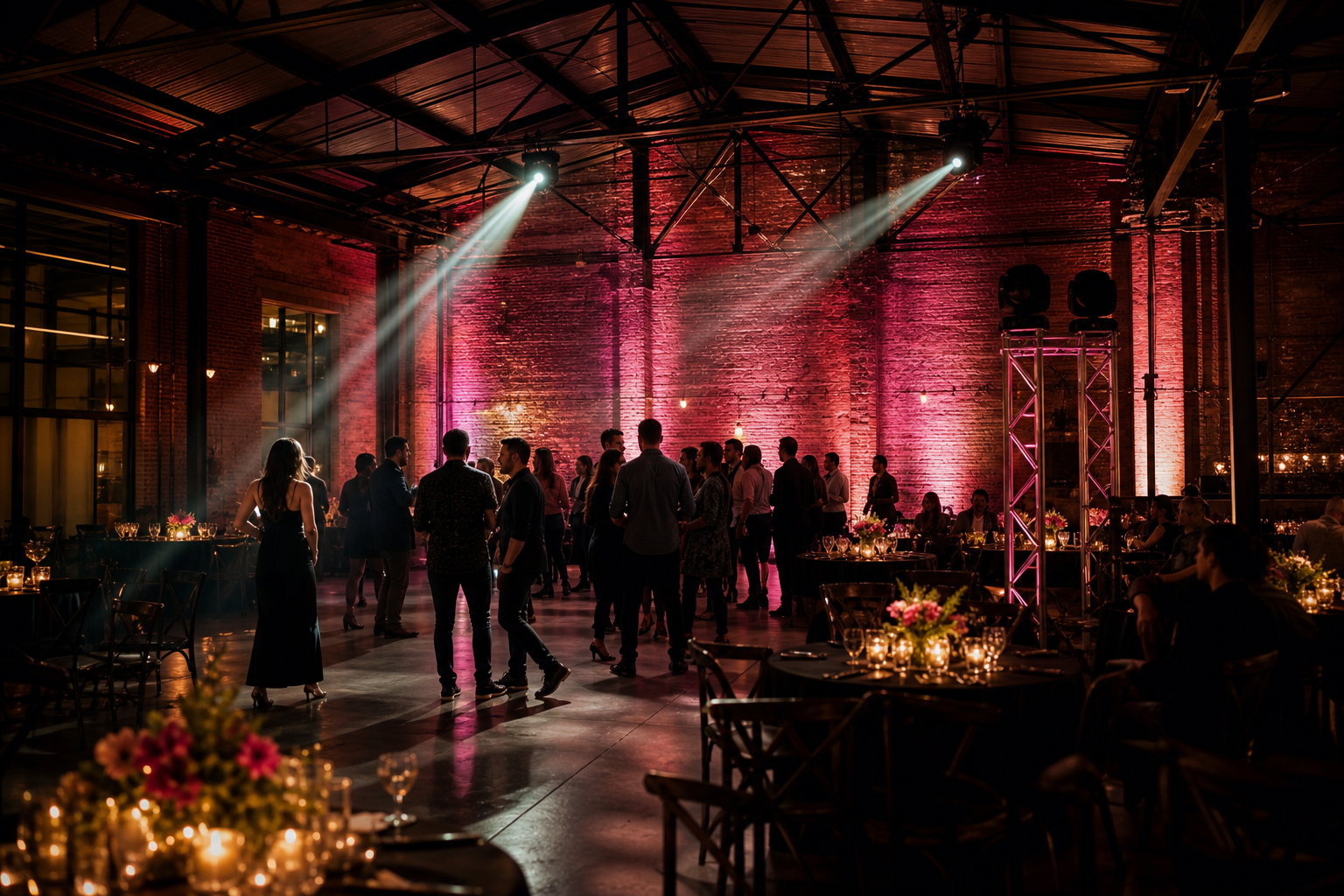
- Warm amber. A common default on brick: it brings out the red and orange tones and reads like late golden hour.
- Deep magenta and saturated rose. Romantic without going pastel-pink.
- Deep purple toward indigo. Works best crossed with a warm key light; on its own it can look cold on dark brick.
- Warm white. An uncolored warm wash reads as architectural lighting, which suits corporate galas and understated weddings.
Colors many planners skip on brick: cool blue, bright green, lime and cyan, and fast color chases on the walls. Save chases for the dance floor.
How many fixtures a wall needs depends on the wall's height and color, the fixture and the look you want, so ask for a test at the walkthrough or a lighting plot rather than a per-foot formula.
Battery or hardwired. Wireless battery uplights avoid extension cords across walking lanes and take nothing from the building's circuits during the event; the catalog lists 12 to 15 hours per charge, wireless DMX and IP65 variants. Check the runtime against your event length including setup, and use hardwired fixtures where the plan needs more output or a longer run than the batteries give.
Moving heads and haze
Moving heads add motion, color changes and projected patterns. Whether they are worth it depends on the room and the event: a seated dinner may need little more than good wall and table light, while a dance floor or reveal may use them all night.
Choose from the fixture's data, not its wattage. Beam angle, zoom range and output differ by model; the catalog's LED beam-spot-wash hybrid, for example, lists a 4–50° zoom. Coverage of a dance floor depends on the fixture's angle, the throw distance and where the fixture hangs, so how many fixtures you need is a lighting-plot question. Our moving head vs par lights guide compares the fixture types.
Beams need atmosphere. Tight beam effects show up as visible shafts only when there is haze in the air; our catalog lists haze machines for beam visibility. In a large room with open doors or strong air movement, haze may clear faster, so plan door and HVAC use for the moments you want beams.
Haze needs approval. Haze and fog can interact with smoke detection. Before planning any atmosphere, ask the venue and, where required, the local fire authority to approve the specific haze or fog procedure, including whether detection will be handled in some way and whether a fire watch is required. Our fog vs haze fire alarm guide covers the questions to ask; DJ-booth lighting is in our DJ booth lighting rental guide.
Power: a load schedule, not a panel size
Whether a building's power is enough can't be read from the panel's amperage alone; it depends on the voltage, the circuits available to vendors, what else is on them, and what your equipment draws at the same time. The reliable route:
- List every powered item: lighting fixtures, haze machines, the console, sound, DJ or band gear, catering equipment.
- Take each item's rated input power from its spec sheet or nameplate.
- Mark what runs at the same time.
- Give the list to the venue and an electrician or power vendor, who compare it with the circuits available and decide how to split the load, or whether supplemental power is needed.
Battery uplighting reduces what runs on the building's circuits. If a generator is needed, plan it with the venue and a power vendor. Ready.gov's generator guidance says generators and fuel should always be used outdoors and at least 20 feet away from windows, doors and attached garages, and to let the generator cool before refueling (Ready.gov); that guidance is written for homes, so follow the generator manufacturer's instructions and the power vendor's placement plan for a warehouse. Ask them about ground-fault protection too: ANSI E1.19 is the entertainment-industry recommended practice for selecting, installing, using and maintaining Class A GFCIs for personnel protection (ESTA).
Sound permits
Ask the venue what its permit allows for amplified sound and until what hour, and get it in writing. That permit, not a guess based on the neighborhood, is the rule your event runs under. Hard concrete, brick and steel surfaces also make a room echo, so share the lighting and sound plans with each other: speaker positions, the DJ booth and the truss all compete for the same floor space.
What we rent
From our catalog: aluminum H-frame truss, wireless battery uplighting, beam, spot-wash, pixel-wash and hybrid moving heads, LED par cans, a haze machine ($25 per day) where the venue approves it, DMX lighting consoles and commercial PA speakers ($200 per day), with a technician if you book one. Delivery, setup and technician time are scoped and quoted to your event; equipment beyond the listed catalog is available on request, subject to availability. Full equipment in our equipment catalog; the stage lighting category covers movers, pars and wash fixtures.
FAQ: Oakland Warehouse Event Lighting
How much lighting do I need for a 5,000 square foot warehouse?
Floor area alone doesn't decide it. The fixture count depends on the ceiling height, the wall surfaces, where fixtures can hang or stand, each fixture's beam angle and output, and the look you want. Send the room's dimensions and photos and ask for a lighting plot; a test at the walkthrough settles uplighting color and spacing.
What color uplighting works on exposed brick?
Warm amber and warm white are common choices because they bring out the brick's red and orange tones. Deep magenta, saturated rose and deep purple crossed with warm light also work for evening moods. Many planners avoid cool blue, bright green, lime and cyan on brick. Test on the actual wall.
Will an Oakland warehouse have enough power for our lighting?
It varies by building. Ask the venue which circuits vendors may use and their ratings, list the rated input power of every item you plan to run, and have an electrician or power vendor compare the two. Battery uplighting reduces the load on the building.
Can we use haze and beam lighting in an Oakland warehouse?
Only with the venue's approval, and the local fire authority's where required. Ask the venue about its haze policy and smoke detection, and have the specific haze procedure approved, including whether a fire watch is required.
How late can amplified music run at an Oakland warehouse?
It depends on the venue's permit. Ask the venue what hours and levels its permit allows for amplified music and get the answer in writing before you plan the timeline.
Get a quote
Booked an Oakland warehouse and trying to figure out what rig fits the room? Send the venue, date, guest count, room dimensions and whatever the venue told you about rigging, power and haze, and ask for a lighting plan and a quote. Call (415) 890-5555 or email info@venegeest.com.