A Napa vineyard wedding's AV plan turns on three questions that only the venue and your vendors can answer: what power is available to event vendors, what the venue's use permit says about outdoor amplified sound, and how the ceremony and reception spaces handle wind. This guide lists the questions to ask, the documents to request, and where the published rules are, so the plan rests on your venue's facts rather than on rules of thumb.
Start with the venue, not a rule of thumb
Every vineyard property is different. Wineries have electrical service for their own operations, but whether any of it is available to event vendors, how much, and where the outlets sit relative to the dance floor is a venue-by-venue question. The same is true of sound: Napa County's exterior noise rules are in County Code Chapter 8.16, and a winery's use permit can add its own conditions on outdoor amplified music. Venues inside city limits follow municipal rules instead.
Before anyone quotes equipment, ask the venue's events lead for three things in writing:
- Power: which outlets or panels event vendors may use, their voltage and breaker ratings, which circuits they share with catering or the venue's own equipment, and the distance from each to the ceremony site and the dance floor.
- Sound: the exact use-permit condition for outdoor amplified sound, including any end time, any location limits, and any sound-level threshold or monitoring requirement.
- Site rules: where a generator may sit if one is needed, where cables may cross guest paths, and whether effects such as low fog or cold sparks are allowed at all.
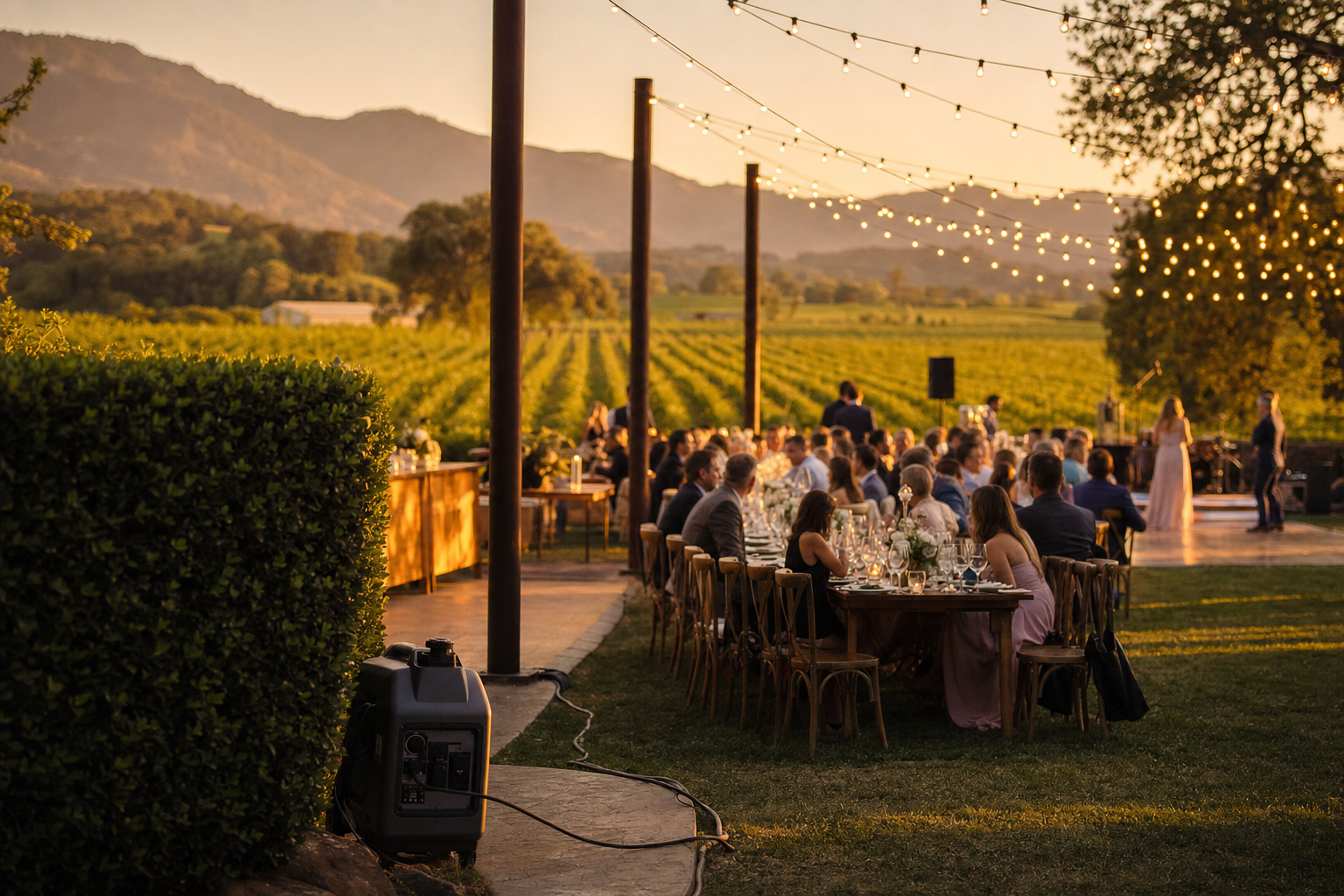
Power: build a load list, then let the power vendor size it
There is no reliable way to size power from a guest count. What matters is the equipment actually on site and how much of it runs at the same time. The practical sequence:
- List every device that needs power: speakers, amplifiers or powered subs, the mixer, wireless mic receivers, moving heads, wash lights, the low-fog machine, the DJ or band's gear, plus catering equipment and decorative string lights.
- Record each device's rated input power from its spec sheet or nameplate. Don't infer draw from a product name; even for an item with a wattage in its name, such as the catalog's 380W Beam Moving Head, take the input rating from the spec sheet. Ask each vendor, including us, for the spec sheets of what they are bringing.
- Mark what runs simultaneously during the busiest part of the night and what only runs briefly.
- Hand the list to the venue and the power vendor or an electrician, who compare it against the available circuits and decide whether a generator is needed, what size, and how the load is split between circuits.
Wireless battery uplights help here: they run on batteries during the event (the catalog lists 12 to 15 hours per charge), so they take nothing from a circuit or a generator once they are placed.
Ask about power quality and separation. Tell the power vendor that the load includes audio and lighting electronics, and ask which generator and distribution they recommend for it and whether sound and lighting can be kept on circuits separate from catering. Electrical separation is about circuits and distribution; whether one generator or several makes sense is the power vendor's call.
Generator safety and refueling
If the venue has too little vendor power, you need a generator, fuel and distribution, typically from a power vendor. Ready.gov's generator guidance, written for home use, sets out the basics: generators and fuel should always be used outdoors and at least 20 feet away from windows, doors and attached garages; keep the generator dry and protected from rain; connect equipment with heavy-duty extension cords; and "let the generator cool before refueling. Fuel spilled on hot engine parts can ignite." It also says to follow the manufacturer's instructions carefully (Ready.gov).
For a wedding, that has two consequences:
- Runtime is a planning question, not a guess. Ask the power vendor how long the selected unit runs at your load on a full tank, and whether that covers setup, the event and teardown.
- A refuel means a shutdown. If the night is longer than one tank, a refuel means stopping the unit and letting it cool, which means an outage on that unit. Agree with the power vendor in advance how that is handled: a second unit, a larger tank, or a planned break that doesn't land during toasts or the first dance.
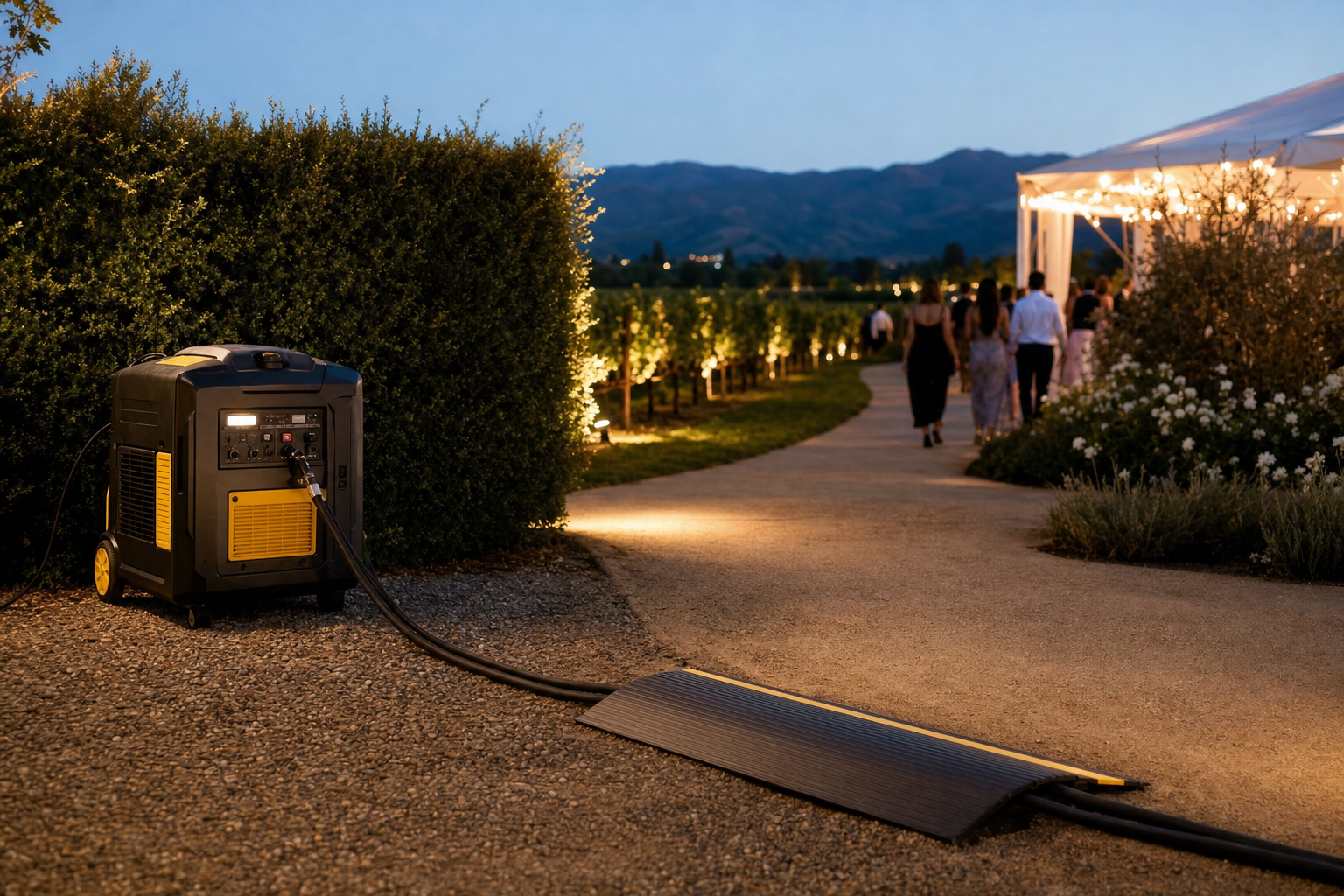
Placement is a trade-off between distance from guests, cable length and noise. Ask the power vendor or electrician to plan cable runs and conductor size for the actual distance and load, and to route cables under ramps or away from guest paths.
Sound limits: read the use permit
In unincorporated Napa County, what a winery may do with outdoor amplified music is often written into its use permit, and those conditions differ from property to property. A public example: in 2020 the Napa County Planning Commission considered a request from Rombauer Vineyards to remove a sentence from a use-permit condition, applied in 2012, that said "there shall be no amplified sound system or amplified music [used] outside of approved, enclosed winery buildings." An outdoor music sound study was prepared, and the staff report recommended approving amplified music for five marketing events only, with sound thresholds for two band locations measured 25 feet from the band, "monitored by the sound engineer and adjusted to maintain the established threshold at the event" (Napa County Planning Commission staff report, Aug. 5, 2020).
The lesson is not that report's specific numbers, which apply to that winery alone. It is that a venue's permit can control whether outdoor amplified music is allowed, where, for which events, and how it is measured. So:
- Ask the venue for the permit condition itself, not a summary on its website.
- If the condition sets a level or a measurement method, give it to whoever runs sound, and plan to measure the way the condition says.
- If it sets an end time, build the schedule around it (see below).
- If it limits amplified sound to certain areas, place the dance floor and speakers accordingly.
Wind and outdoor equipment
Wind affects speakers on stands, tent structures and ceremony microphones, and conditions differ by site, season and hour. Rather than rely on general wind lore, check the forecast for the venue in the days before the event and walk the site at the time of day the ceremony will happen.
- Tents and anything hung from them: only hang speakers or lights from a tent if the tent vendor confirms which points are rated for that load and approves the plan. Ask the tent vendor for the wind limits of the specific structure and what happens if they are reached.
- Stages and truss towers outdoors: ANSI E1.21, "Temporary Structures Used for Technical Production of Outdoor Entertainment Events," sets minimum design and performance parameters for temporary ground-supported structures at outdoor events; ESTA notes the 2024 version is referenced by the 2024 International Fire Code (ESTA). Ask whoever supplies a stage roof or tower how their structure is rated and what their wind plan is.
- Speakers on stands: follow the stand manufacturer's height and load ratings, secure the stands, and have a plan to lower or move them if the wind picks up.
- Ceremony microphones: fit a windscreen and test the mic at the ceremony spot during the walkthrough, ideally at the same time of day.
Building the night around the cutoff
If the permit sets an end time for amplified music, plan backward from it so the moments that matter happen well before it:
- Ceremony: officiant's microphone tested at the walkthrough, with a wind plan if the site is exposed.
- Cocktails and dinner: background music and toasts at a level that keeps conversation easy.
- Dancing: schedule the first dance and the main dance set early enough that the peak lands before the cutoff. Low fog for the first dance and cold sparks only if the venue and the local fire authority have approved them.
- Last call: agree with the DJ or band lead when the final song starts.
- After the cutoff: unamplified options, if the venue allows them, and whatever the permit says about when guests must leave.
On cold sparks specifically: Central County Fire's bulletin says spark-producing devices use powdered titanium or zirconium, that the heat from cold sparks "is still capable of igniting nearby materials," and that California Health and Safety Code Section 12505 "classifies ignitable materials with chemical compounds containing titanium and zirconium as Dangerous Fireworks" (Central County Fire Department). Confirm with the venue and the local fire authority before you plan one. When VENEGEEST's crew operates the effect, VENEGEEST holds the operating permits; if you rent the machine and run it yourself, that responsibility and the liability are yours.
What we rent
From our catalog: wireless battery uplighting, commercial PA speakers ($200 per day), low fog and cold sparks ($35 per day) where the use permit and the local fire authority allow them, and an on-site technician if you want one. Delivery, setup, and technician time are scoped and quoted to your event. We design the setup around your venue and requirements, and equipment beyond the listed catalog is available on request, subject to availability — contact us for a quote. A generator, fuel and tent rigging come from a power or tent vendor.
Adjacent reading: the Bay Area wedding AV checklist covers sound sizing and lighting layers; the outdoor wedding AV guide covers outdoor setups in more depth; first-dance effects in cold spark and dancing on a cloud. Full catalog at our equipment list; effects only at special effects rental.
FAQ: Napa Vineyard Wedding AV
What time does outdoor amplified music have to stop in Napa?
It depends on the venue. Outside city limits, Napa County's noise rules (County Code Chapter 8.16) and the winery's own use permit apply, and a permit can limit whether, where and when outdoor amplified music is allowed; inside city limits, municipal rules apply. Ask the venue for the permit condition in writing.
Do I need a generator for a Napa vineyard wedding?
Only the venue and a power vendor or electrician can answer that. Ask the venue which circuits event vendors may use and their ratings, build a list of every device's rated input power, and have the power vendor compare the two. A generator usually comes from a power vendor.
How big a generator do I need?
That depends on the actual load list, what runs at the same time, the voltage and the runtime you need, so let the power vendor size it from the spec sheets of the equipment on site. Ask how long it runs at your load on a full tank, and plan any refuel as a shutdown, because Ready.gov advises letting a generator cool before refueling.
How does wind affect outdoor AV?
It can move speakers on stands, load tent structures and add noise to ceremony microphones. Check the forecast for the venue, follow the stand and tent manufacturers' ratings, have the tent vendor approve anything hung from a tent, and test the ceremony mic with a windscreen at the walkthrough.
What should I ask a Napa venue before booking AV?
Which power is available to vendors and where, the exact use-permit condition for outdoor amplified sound, where a generator and cables may go if needed, and whether effects such as low fog or cold sparks are allowed.
Get a quote
Send your venue, date, guest count, the venue's events lead and what the venue told you about power and sound, and we'll put together a quote for the equipment and any SFX line items the venue approves. Ask us for the spec sheets of the items on the quote for your power vendor's load list. We serve San Francisco, San Jose and the South Bay, and the wider Bay Area.