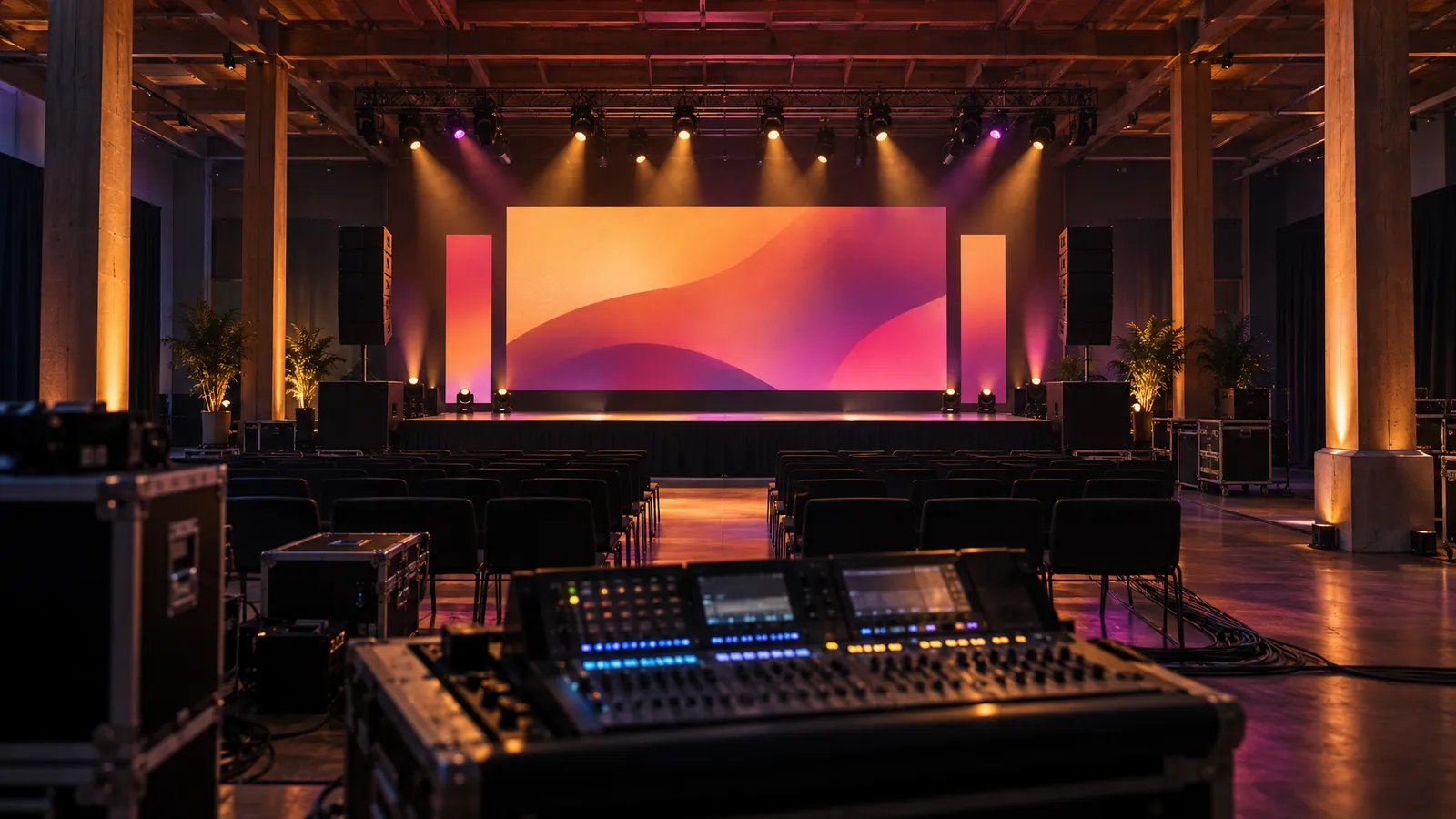
An event production company supplies and runs the technical side of an event: sound, LED video, lighting, staging and effects, plus the crew who deliver, set up, operate and strike it. VENEGEEST is a Bay Area AV equipment rental and event production company based in South San Francisco. It rents that gear by the day and provides setup and on-site technical support, while your planner or in-house team owns the guest list, catering, talent and budget.
What an Event Production Company Does (and What It Doesn't)
People use "production company" for two different businesses. One is a full-service agency that plans the event, books talent, manages vendor contracts and hands you a single invoice for everything. The other is a technical production house: it supplies the equipment, designs the rig around your run of show, and puts technicians on site to install it, run it and take it down. VENEGEEST's catalog and site describe the second kind: equipment rental plus delivery, setup, live technical support and strike, so the stage, screens, speakers and lights work when the program starts. If you also need help with planning, budgets or talent, ask about that scope directly rather than assuming it is included.
That distinction matters when you compare quotes. An agency proposal may fold AV into a bigger number, and the AV may be subcontracted. A technical production quote lists the gear by the day plus the delivery, setup and technician time needed to run it. If you already have a planner, or you are the planner, you usually want the second kind of quote, because you can see exactly what you are paying for and change one line without renegotiating the whole event.
Useful questions for any company you're comparing: who is responsible for the equipment on the quote, and who will be standing at the control position when your keynote starts — the company's own technician or a subcontractor? Either arrangement can work; the point is to know who is responsible for the gear and the crew on the day.
What VENEGEEST Supplies for San Francisco Events
The rental catalog covers five categories, so sound, video, lighting, staging and effects can come from one vendor and one crew instead of several working around each other on load-in day. VENEGEEST designs a custom solution around each event's scenario and requirements, and equipment beyond the listed catalog — extra subwoofers, mixers or wireless microphones, for example — is available on request, subject to availability; contact us for a quote. Per-day starting prices from the catalog:
- LED video: the P1.9–3.9 LED rental screen, configurable from 12 m² to 48 m², from $200/day; a foldable LED ad screen (2–12 m², on casters) from $200/day; LED TV displays from $35/day for a 43″ to $120/day for a 120″, and a wireless screen caster at $60/day.
- Sound: the commercial PA speaker at $200/day, or the Bluetooth speaker system (one controller, six speakers, two mics) at $60/day for smaller rooms.
- Lighting: 380W beam moving heads at $50/day, full-color LED pars at $25/day, followspots at $80/day, COB front lights at $35/day, plus lighting control consoles and wireless battery uplights quoted per project.
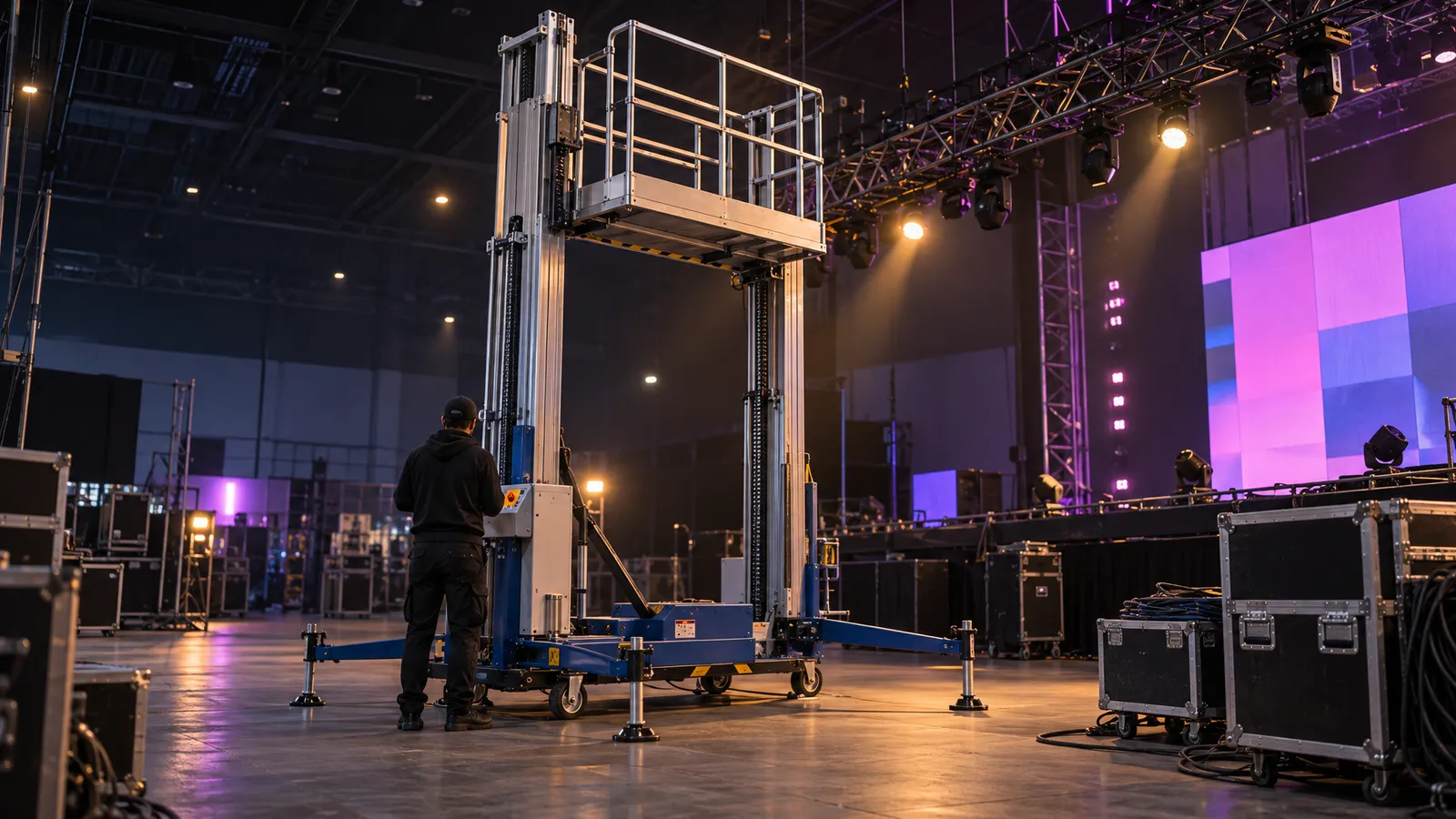
- Staging: portable stage platforms at $30/day per section, aluminum H-frame truss at $10/day, and an electric lift scaffold at $80/day.
- Effects: cold spark machines at $35/day, dry-ice low-fog machines at $35/day, haze machines at $25/day, and an interactive photo booth at $400/day.
Effects need venue sign-off before they go on a quote. California Health and Safety Code section 12505 lists fireworks containing zirconium, or titanium except in particle size greater than 100-mesh, among "dangerous fireworks"; how a particular machine and its spark material are classified is for the local fire authority to decide, and some fire authorities restrict cold spark machines outright, so check with the venue and the local fire authority before you plan a spark moment. When VENEGEEST's crew operates the effect, VENEGEEST holds the operating permits; a client who rents the machine and runs it themselves carries that responsibility and the liability. For the full catalog and an overview of how a rental is quoted, see the AV equipment rental San Francisco page.
Setup, Live Support and Strike
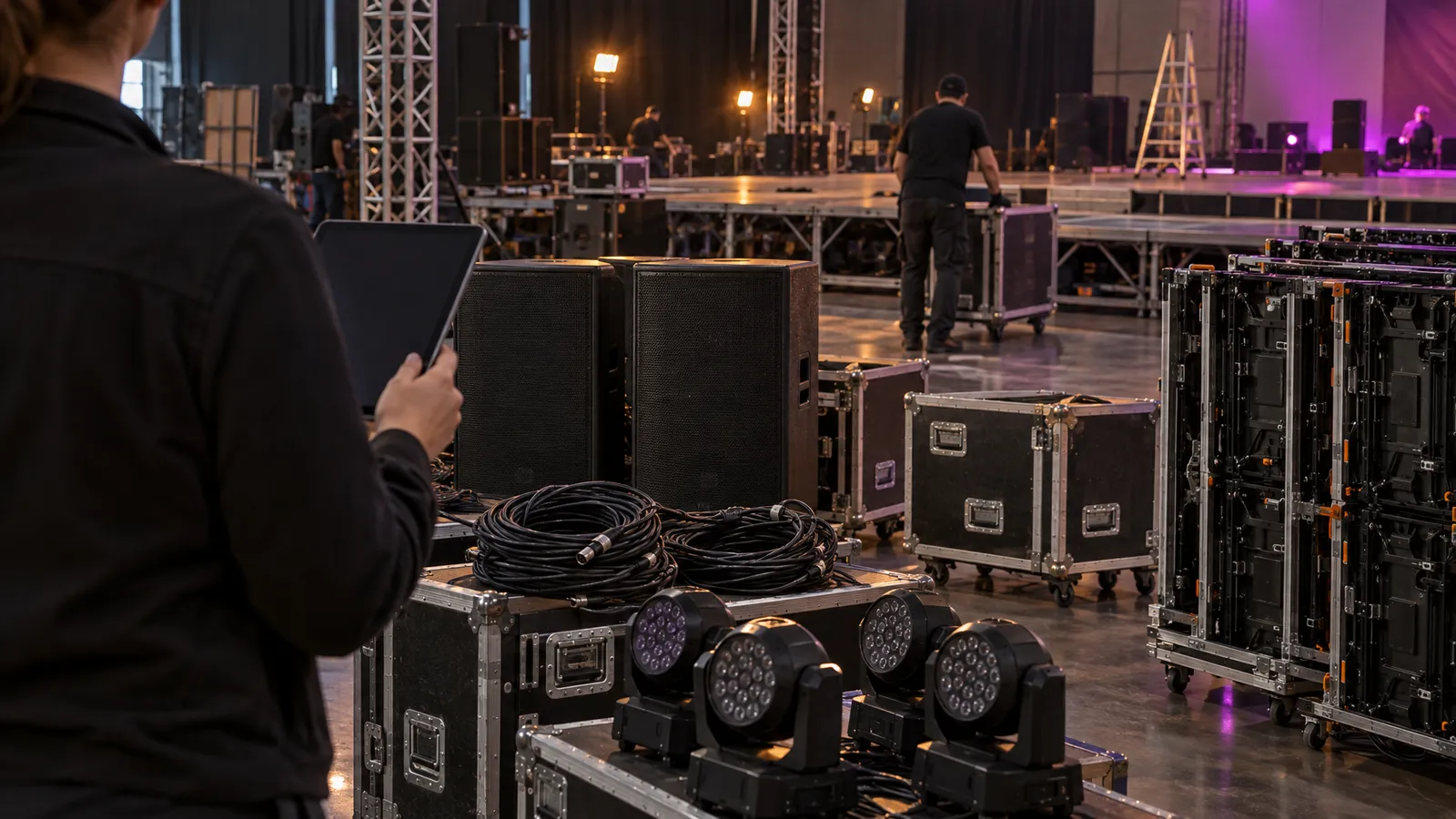
Delivery, setup, live technical support and teardown are services VENEGEEST provides alongside the rental; they are scoped and quoted to your event. For a standard setup the crew needs at least two hours; larger productions need more. The rental terms also put a few things on the client, and they are worth settling early:
- Accurate venue details: load-in access, power supply and timing windows. Delays caused by venue restrictions or incomplete information can add labor charges.
- Venue permits and approvals: the client secures any venue-specific permits or approvals needed to install equipment.
- A run of show: the crew builds lighting cues, screen content playback and mic handoffs around it. A lighting operator on the console makes sense for any program that changes look through the evening.
For self-pickup rentals, equipment is collected from and returned to the warehouse during business hours, with a valid ID and a signed rental agreement at pickup. Dry hire suits small, simple setups; anything with a console, multiple mics or truss-mounted fixtures goes better with a technician on site.
Recent Work: Three Documented Events
These are the jobs published on the VENEGEEST site, with the configuration and services each one used:
- 2026 China FIC Innovation and Collaboration Summit, Hyatt Regency San Francisco Downtown SOMA, January 11, 2026: a 3m × 10m LED video wall, 12 professional conference lighting fixtures and a complete conference sound system, with stage setup, calibration, live support and troubleshooting.
- HYSTA 26th Anniversary Celebration & Annual Conference, Santa Clara Convention Center, October 18, 2025: multi-screen LED displays across three venues, 24–30 professional lighting fixtures and three independent sound systems, with multi-venue coordination, rehearsal support and live technical management.
- Yunnan Enterprises Going Global, Grand Hyatt San Francisco, August 6, 2025: a 4m × 12m LED video wall, 16 professional stage fixtures, and a full front-of-house system with main speakers, subwoofers, a digital mixer and wireless microphones, with complete installation, setup, on-site operation and technical support.
All three were hotel or convention-center programs with a stage, LED video and speeches or panels.
How Production Pricing Works
Many catalog items show a published daily price on their item page; others, such as the lighting control consoles and battery uplights, are quoted on request. The rental terms spell out how a quote is built:
- Daily rates cover a 24-hour rental period starting from delivery or pickup.
- Weekly rates apply to rentals of five or more consecutive days at a discounted rate.
- Custom packages for multi-item productions are quoted per project.
- Services — delivery, setup, technician services and overtime — are scoped and quoted to your event.
A non-refundable 25% deposit secures the booking, and the balance is due three business days before the event. Changes to the order should come at least five business days out. Cancellations 14 or more days before the event get a full refund minus the deposit, 7–13 days a 50% refund minus the deposit, 3–6 days a 25% refund minus the deposit, and under three days no refund. An optional Equipment Protection Plan at 10% of the rental total covers accidental damage (not negligence or theft).
When you compare production quotes from several companies, line them up the same way: equipment per day, number of days, labor hours per technician, delivery, and any overtime assumptions. A lower equipment total with vague labor lines may not turn out to be the cheaper quote. For a line-by-line look at typical rental costs, see the AV rental cost guide.
What to Settle Before You Ask for a Quote
A production quote is only as good as the brief behind it. Before you call, have these answers ready:
- Venue and room: the exact room, ceiling height, and where the stage and screen will sit relative to the entrance and windows.
- Dates and hours: load-in window, rehearsal time, show hours and the time the room must be clear.
- Audience and format: headcount, seated or standing, number of presenters, panels, video playback, live music.
- Venue AV policy: some hotels have an in-house or preferred AV provider and charge a fee to bring an outside company, and many ask for a certificate of insurance. Get the venue's policy in writing during the walkthrough.
- Power: where the circuits are and how much the rig will draw. LED walls, moving heads and PA add up quickly.
Our AV event planning checklist walks through the eight weeks before an event phase by phase.
FAQ: Event Production in San Francisco
What's the difference between a production manager and a technical director on-site?
A production manager oversees the event timeline, coordinates with catering and venue staff, manages client communication, and makes sure every vendor hits their cues. They don't typically operate gear. A technical director runs the AV system: calling lighting cues, mixing front-of-house audio, troubleshooting video signal issues, and directing the tech crew. On a larger corporate event you might have one production manager on the run of show and separate operators for audio and for lighting and video.
Do San Francisco venues charge their own AV fees?
Some do. Hotels and private venues may require their in-house AV provider or charge a fee if you bring an outside company, and many require a certificate of insurance from every vendor. Policies vary by venue and change, so confirm the venue's AV policy during your site walkthrough, before you sign with any production company.
How far in advance should I book event production?
Same-week delivery is available across the Bay Area for most items, and availability is confirmed for your date when you request a quote. Starting early gives you time to settle venue approvals and the run of show before load-in.
What happens if equipment fails during the event?
Under VENEGEEST's rental terms, equipment is inspected before each rental, and if something malfunctions during your rental the company will make every reasonable effort to provide a replacement. On your side, keep a spare mic, spare cables and a USB drive with every presentation file at the control position, and test the backups during load-in.
Can I rent the gear and run it myself?
Yes. Self-pickup is allowed: equipment is collected from and returned to the warehouse during business hours with a valid ID and a signed rental agreement. You are responsible for the equipment until it is returned, damaged or incomplete gear is charged at repair or replacement cost, and event insurance that covers rented equipment is strongly encouraged. For anything with a console, multiple microphones or rigged fixtures, a technician on site is the safer choice.
Which areas does VENEGEEST serve?
San Francisco, San Jose and the South Bay, and the wider Bay Area, from a warehouse at 436 N Canal St in South San Francisco. Call (415) 890-5555 or email info@venegeest.com with the venue, dates and what you need.