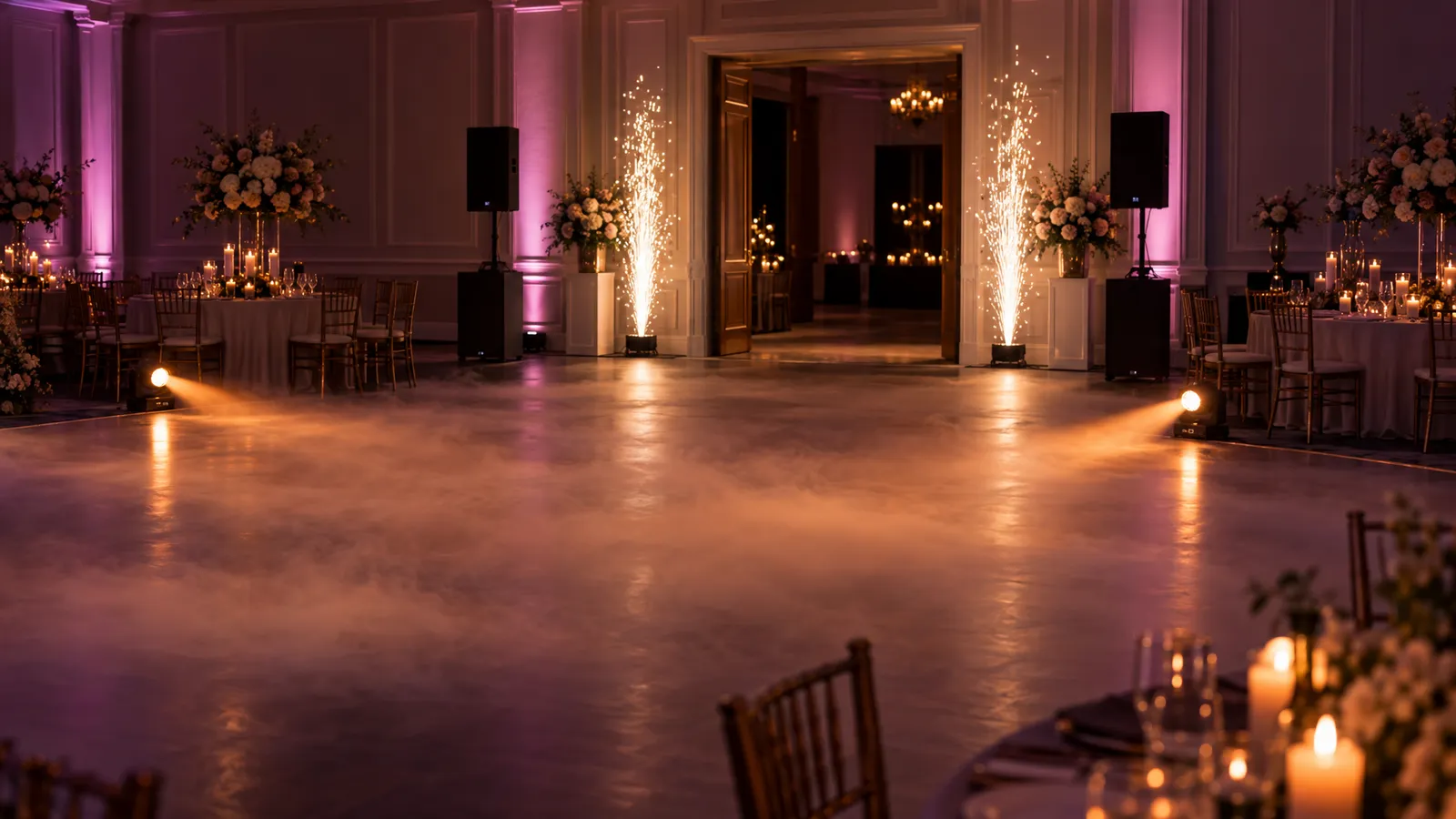
Bay Area wedding receptions happen in city ballrooms, Napa and Sonoma vineyard estates, and open-air rooftops in SoMa, and each one needs its own lighting and effects plan. What you need to rent to change the look of a venue after sunset depends on the space's existing lighting and power, fire-code restrictions, and whether the venue allows fog or spark effects at all. This checklist goes phase by phase through what to consider, with catalog specs and the regulatory questions that apply from San Francisco to Sonoma County. For sound sizing, power and booking timeline, pair it with the wedding AV equipment checklist.
Ceremony & Cocktail-Hour Ambient Lighting
Ceremony and cocktail spaces are easy to overlook, yet they are where many formal portraits are taken and where guests first see the room. If your ceremony is outdoors, battery-powered fixtures avoid extension cords across a lawn. If it's indoors in a historic venue, ask whether cables may be taped across marble or hardwood; if not, wireless fixtures are a practical choice.
For cocktail hour, a common goal is warm, even light that flatters skin tones without harsh shadows. How many uplights that takes depends on the room's layout, the surfaces you want to light, and each fixture's output and beam angle, so treat any count as a starting layout and check it on site. Battery runtime matters too: work out the real length of your event, from when the lights are switched on to the last dance, and compare it with the runtime of the specific fixture at the brightness you plan to use.
- Wireless Battery Uplights are listed in the catalog with 12–15-hour batteries and wireless DMX; several variants are listed as IP65, so choose one with a rating that suits where it will sit. Behind bars and along perimeter columns are typical positions.
- For ceremony aisles, a warm white is one option; if the ceremony is outdoors near sunset, look up the sunset time for the date and plan when the lights come on around it.
- Look at the venue's own lighting at the time of day of your event. If the ceremony backdrop or sweetheart table will be dim, two Full-Color LED Par Lights (18-LED RGBW wash lights) on stands can wash it with adjustable color.
- The Firefly Projection Light ($20) is listed as a firefly effect projection; projected effects show best once the light is low. Ask whether the unit suits the outdoor spot you have in mind.
- Battery uplights avoid the generator or long cable runs that corded fixtures need at outdoor venues without convenient power.
Reception Dance Floor Wash & Architectural Uplighting
Once guests move into the main reception space, the lighting usually needs two looks: one for dinner (softer, warmer, conversational) and one for dancing (more saturated color and movement). Uplights on the walls don't light the dance floor itself, so many couples add dedicated wash fixtures aimed at the floor. How many, and where, depends on the floor size, the fixtures and the mounting positions: par cans on stands at the floor's edges are a simple option, and truss is another if the venue allows it (ask whether it has rigging points and permits overhead rigging before you plan anything overhead).
Architectural uplighting colors walls, columns and draping. It tends to show off venues with high ceilings and period details such as columns, exposed brick or coffered ceilings. Larger rooms, including barns, have more wall to cover, so spacing and count come from the actual wall length and the fixture you rent. Wireless fixtures skip the cable management and power distribution that corded versions need.
- Size the uplight order from the venue's floor plan: mark the walls and columns you want lit, then estimate a count with the fixture you're renting and adjust after a test. Wireless Battery Uplights are quoted on request.
- A dinner look and a dancing look can be set up as presets; how you switch between them depends on the controller and how it is programmed, so ask when you book.
- Par wash lights around the dance floor, such as the Full-Color LED Par Light ($25), put light on the floor itself rather than only on the walls.
- For exposed-beam or tent ceilings, uplights on the floor pointed at the ceiling can light the ceiling plane so it doesn't disappear after dark; check the fixture's beam and the ceiling material on site.
- Match the lighting to your floral palette: warmer whites and ambers with blush and gold, cooler whites with navy and silver, or RGB colors for jewel tones. Check the result with test photos.
How many uplights do I need for a tent wedding in wine country?
It depends on the tent. Fabric color and material, the tent's size and shape, whether you want to light the poles, the ceiling or both, and the fixtures you choose all change the count, so there is no fixed number per guest or per square foot. A practical approach: get the tent's dimensions and layout from the tent provider, decide which surfaces you want lit (perimeter poles, ceiling, entry, cake table), and have the lighting count estimated from that plan, then check it in the tent before the event. For power, ask the venue and tent provider what approved power is available at the tent; wireless battery uplights avoid needing power for the uplights at all.
First-Dance & Grand-Entrance Effects
A first-dance fog effect is an option some couples add, and the type of machine you choose affects both the look and the practical requirements. Dry-ice low-fog machines produce a ground-hugging cloud using hot water and dry ice: the fog comes from the water the dry ice is placed in, and the carbon dioxide released is heavier than air, so it lingers near the floor. That same carbon dioxide is invisible, so the room needs ventilation. Cold spark machines are another entrance effect, but some venues don't allow them, and California's Health and Safety Code §12505 lists zirconium, and titanium except in particle size greater than 100-mesh, among the materials that make a firework "dangerous." Whether a given machine's spark material falls under that rule is for the local fire authority to decide, and some authorities prohibit the devices. Get written venue approval first and check with the local fire authority.
Grand entrances, including weddings with two entrances, benefit from coordinated lighting cues. A Cold Spark Machine ($35) on each side of an entrance is one way to frame the couple, but it needs the ceiling clearance and distance from people and materials that the machine's instructions call for, written venue approval and a check with the local fire authority; at an outdoor tent wedding, wind can also rule it out. For lower-ceiling venues or those with no-spark policies, a Bubble Machine ($40) is a gentler alternative; bubble fluid can make floors slippery, so keep it away from walkways and the dance floor.
- The catalog lists a Dry Ice Low-Fog Machine at $35 and a range of Low-Fog / Dry-Ice Machine variants. Dry ice can be provided on request; ask for it in the same quote, along with how much the machine needs for your cues.
- Low fog is affected by air movement: drafts, HVAC vents, open doors and wind can carry it away, so ask the venue about airflow and ventilation in the room, and keep the floor safe to walk on.
- Place cold spark machines only as the manufacturer's instructions allow, with the required clearance from drapes, fabric and decor.
- For outdoor evening receptions, projected effects on trees or tent ceilings add interest without fog or haze, which is useful when wind makes low fog impractical.
- Coordinate fog and spark cues with your DJ or band so they trigger at the moment of the couple's entrance or the first-dance chorus, and ask how the machines are triggered when you book.
Guest-Count Packages & Power Requirements
Guest count gives a rough sense of scale, but the room, the look you want and the venue's rules decide the equipment list. A small restaurant buyout may need only a few uplights and a single wash light over a small dance area; a large ballroom wedding may add more wash fixtures, effect machines, truss for overhead rigging if the venue allows it, and a lighting technician. Build the list from the floor plan and the moments you want to light, then price it. VENEGEEST designs a custom plan around each venue and set of requirements and quotes it.
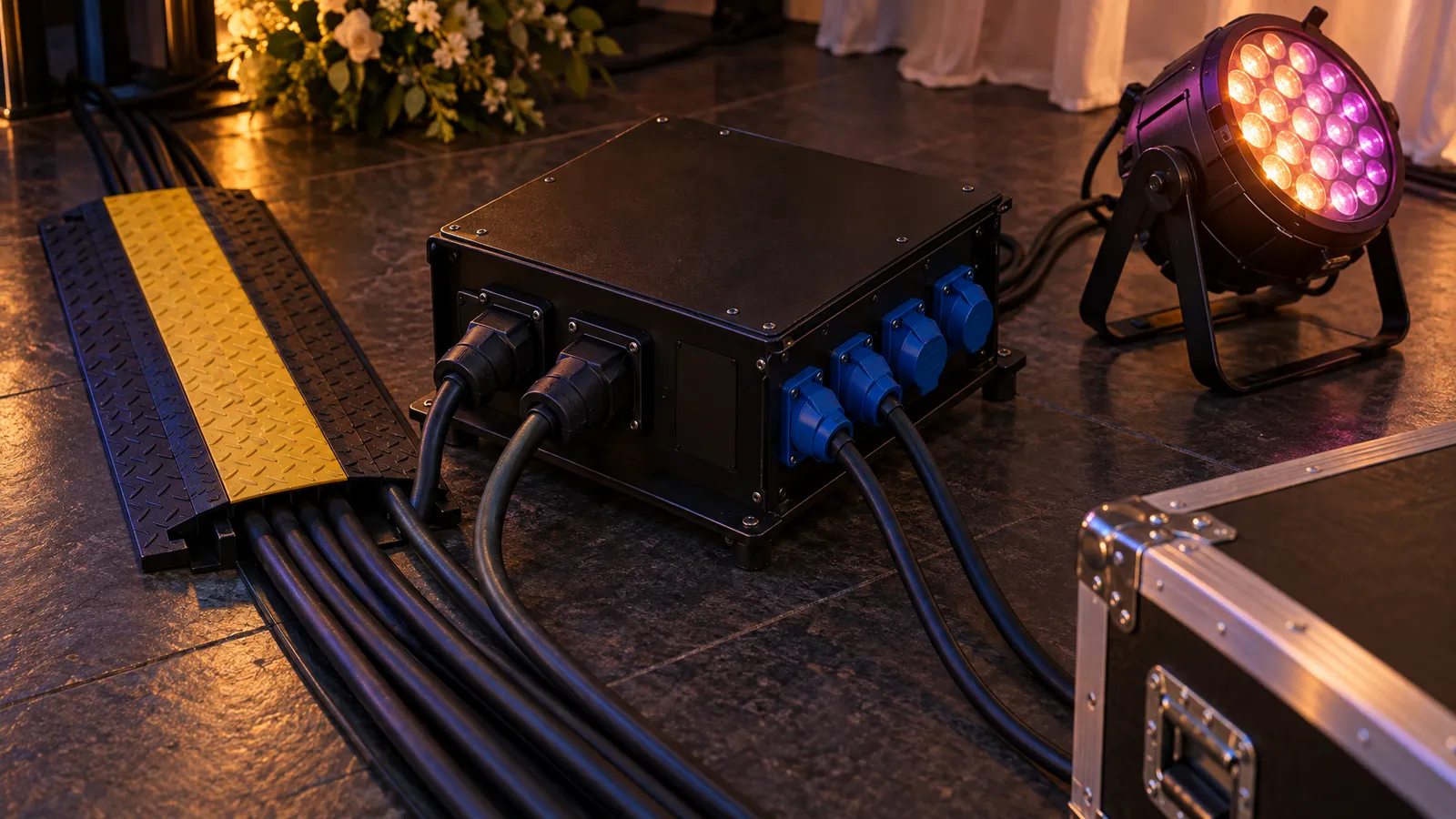
Power is a separate calculation. Every piece of equipment has a rated wattage or input current on its label or spec sheet, and heated machines such as low-fog and haze machines can draw a lot; the catalog's low-fog machines range from 700 W to 6000 W. List the actual equipment, add up its maximum draw, and have the venue (and its electrician, where needed) say which circuits can carry it. Some older venues can't supply a large corded setup without extra power arranged through the venue, so ask at the walk-through. Wireless battery uplights take the uplighting off the venue's circuits entirely.
- List prices for pricing a plan: Full-Color LED Par Light $25, Cold Spark Machine $35, Dry Ice Low-Fog Machine $35, Bubble Machine $40, Firefly Projection Light $20. Each rate covers a 24-hour rental period; delivery, setup and technicians are scoped and quoted to your event.
- Wireless Battery Uplights, the wider low-fog range and multi-item packages are quoted on request.
- An Interactive Photo Booth ($400) is listed with instant sharing and gives guests something to do during cocktail hour.
- If your venue requires an on-site tech, or you're using truss rigging, technician time for load-in, programming and strike is quoted per event.
Audio Integration for Effects & Ambient Music
Lighting and effects cues are often tied to the music: first-dance fog, spark triggers and color changes are commonly called by the DJ or band. If you're handling your own music, you need a basic sound system. The Bluetooth Speaker System (one controller, six speakers, two mics; $60) can cover background music and toasts in smaller rooms. For larger spaces or rooms with difficult acoustics (high ceilings, outdoor courtyards with traffic noise), ask about the Commercial PA Speaker ($200) and whether a sound technician makes sense.
- Ask your DJ or band whether they have triggered fog or spark effects before and what control they need; not every entertainment vendor carries DMX or wireless triggers.
- For a do-it-yourself setup, size and place the speakers from the room: the area guests occupy, how loud the program needs to be, and each speaker's output and coverage. Then do a sound check from the bar, the food stations and the back of the room, and move speakers if some spots are too quiet or too loud.
- Ask for a simple controller if you want to change uplight colors yourself during the reception (for example, amber during dinner to magenta for dancing).
FAQ: Wedding Reception Lighting & Effects
Can I use cold spark machines at any Bay Area venue?
No. Some venues don't allow them, and some fire authorities prohibit them outright: Central County Fire bans cold spark devices in Burlingame, Millbrae and Hillsborough. California's Health and Safety Code §12505 lists zirconium, and titanium except in particle size greater than 100-mesh, among the materials that make a firework "dangerous," and the local fire authority decides how a specific machine is treated and whether a permit or licensed operator is required. When VENEGEEST's crew operates the machines, VENEGEEST holds the operating permits; if you rent them and run them yourself, that responsibility, including the liability, is yours. Venues that do allow them may ask for advance notice and a certificate of insurance. Get written approval from your venue coordinator, check with the local fire authority, and ask your insurance provider whether your event coverage includes the effect.
Do I need a lighting tech on-site, or can my DJ handle it?
Decide that with your DJ, the venue and VENEGEEST based on the actual duties: how many fixtures and looks there are, whether effects need to be operated, whether anything is rigged overhead, and what the DJ has run before. Some venues require their own or certified technicians for rigging; ask the venue. Technician time for load-in, programming, live operation and strike is scoped and quoted to your event.
How much dry ice do I need for a first dance and cake cutting?
It depends on the machine, the size of the floor and how many cues you want, so ask for the machine's guidance when you book and plan enough for each cue (first dance, cake cutting, a second entrance) rather than one long burst. VENEGEEST's Dry Ice Low-Fog Machine is listed at $35; dry ice can be provided on request as part of the quote. If you buy it yourself, buy it as close to the event as practical, because it sublimates into carbon dioxide gas while it sits. Store it in a vented cooler, never a sealed container, because the gas builds pressure, and keep the room ventilated, since the gas is heavier than air and pools near the floor.
What's the difference between wireless battery uplights and corded uplights?
Wireless battery uplights run from their own battery, so they need no extension cords or power distribution. VENEGEEST's Wireless Battery Uplights are listed with 12–15-hour batteries and wireless DMX, and several variants are listed as IP65; runtime varies with the model and brightness, and outdoor or damp placement needs a variant rated for it. They suit estates, historic venues with outlet restrictions, and spaces where cable runs would cross guest pathways. Corded uplights need extension cords and cable ramps or tape to secure the runs, which adds labor and accessories, but they can make sense in a ballroom with accessible outlets and time for load-in.
When should I skip uplighting and just use venue house lights?
Look at the venue's house lighting at the time of day of your event before deciding. For a daytime or early-evening reception with plenty of natural light, or a minimalist design, house lights may be enough. After dark, many rooms look flatter under house lights alone, and uplighting can bring out columns, arches, exposed brick or a dramatic ceiling. Even if you skip uplights, consider wash lights for the dance floor; the Full-Color LED Par Light is $25 each.