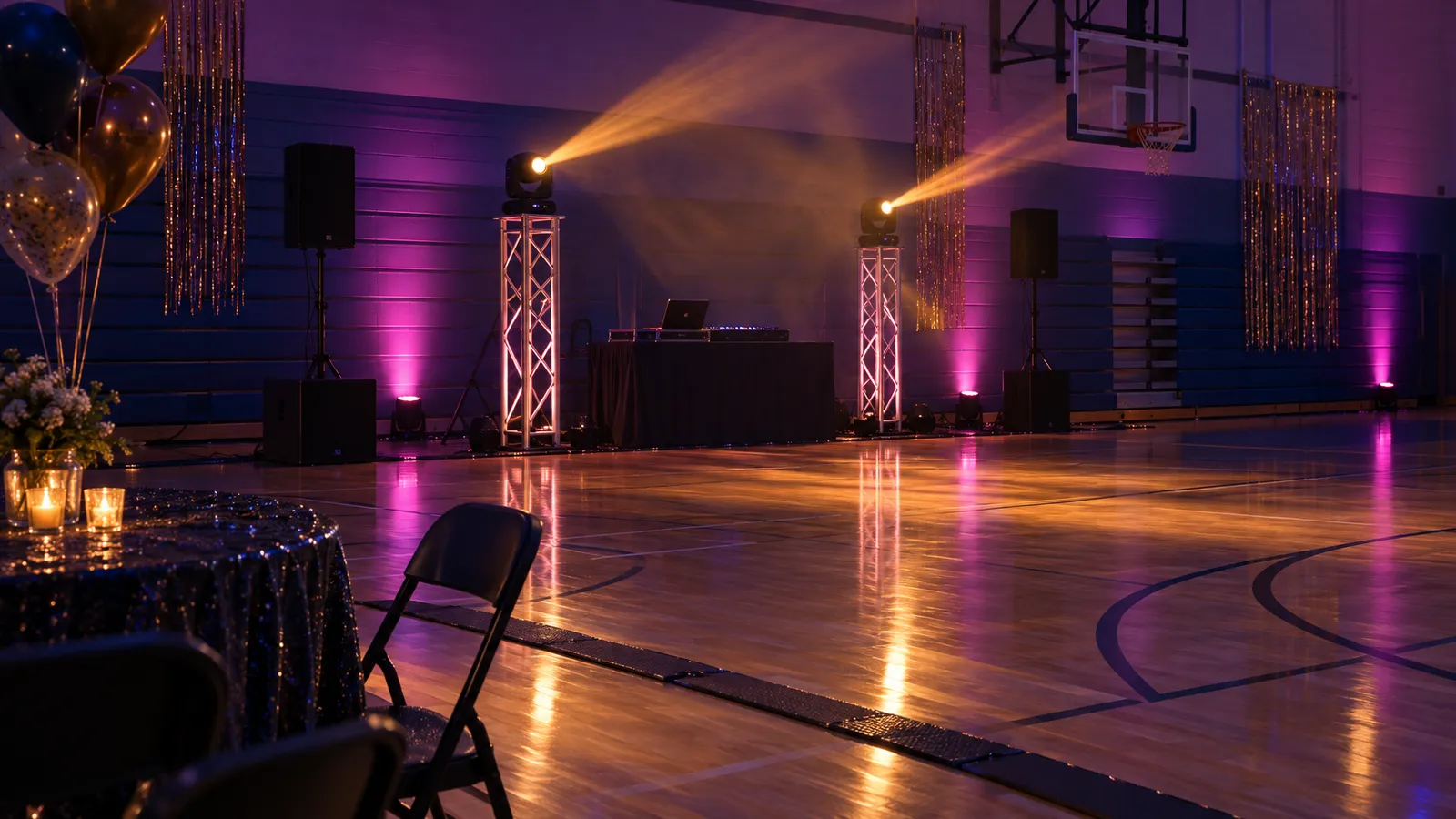
Prom and homecoming committees in the Bay Area are usually trying to make a gym, a multipurpose room or a hotel ballroom feel like a real dance night on a school budget. Start with three things before you pick any gear: how much power the room can safely give you, which effects the school and venue allow, and what look you want on the dance floor. This checklist walks ASB advisors, PTA volunteers and school event coordinators through those decisions, what your facilities director will need to approve, and how to size a package from real catalog rates.
Gymnasium Power and Circuit Mapping Before You Book Anything
Power is the question to answer before you choose fixtures: which outlets are available, which breakers they share, and how much load each circuit may carry for a night-long event. A 20-amp circuit at 120V works out to 2,400 watts on paper, but you should not plan to load a circuit to that figure for hours. What a circuit may carry continuously depends on the applicable electrical rules and the equipment connected to it, so have qualified facilities staff or an electrician set the limit for each circuit you plan to use. The DJ's console, monitors and subwoofers may need a circuit of their own, and a rig of moving heads, par cans and a haze machine can need several more.
Before signing any contract, ask your facilities manager to walk the space with a circuit diagram. Outlets that look separate may share a breaker with other loads in the building. Ask which breakers can be set aside for the event and what total load they allow. If you are considering a hotel ballroom or another venue instead, ask each venue for its available circuits and any power fees rather than assuming. If the school gym cannot support the lighting load you want, the options are to reduce the fixture count, bring in power that facilities approve, or move the event.
- Map every stage and gym-floor outlet to its breaker, and label it so the rental crew knows which circuits have been approved for the event and for how much load.
- Ask facilities staff to set the maximum load for each circuit you will use; don't treat a nominal 20-amp circuit as 2,400 watts available all night.
- Size the load from each fixture's nameplate input (power or current) in its manual or on its label, not from the wattage in a product name. A fixture name such as "380W Beam Moving Head" describes the light source, not necessarily what the whole fixture draws from the wall. Ask the rental provider for the electrical specs of the exact units you rent.
- Ask facilities to confirm which circuits have been tested under load before the event, rather than finding out on the night.
- Let the electrical provider or facilities staff specify extension cord type, gauge and length from the actual loads and the run from each outlet.
Dance-Floor Wash and Uplighting Packages by School Size
A simple starting point for a smaller dance is a set of par cans for color wash on the walls and around the floor, plus a few uplights for accent. That gives ambient color but little movement. Moving heads add sweeping beams and patterns. If the school and venue allow atmospheric effects, a Haze Machine makes the beams visible in the air; without haze, you mainly see the light where it lands on the floor, walls and people. Haze is optional and often needs approval, because smoke detectors of either type can respond to it (see the haze section below). If haze isn't allowed, plan your look around wash color, patterns projected onto walls and the floor, and uplighting.
For large dances in a conference center or hotel ballroom, pixel-wash moving heads add more variety. The LED Pixel-Wash Moving Head (B-EYE Style) is listed as a multi-cell RGBW wash "with individual pixel control," with variants up to 37 cells, for color blocks and patterns. A larger rig might combine Full-Color LED Par Lights for stage and perimeter wash, beam moving heads for aerial effects, pixel-wash heads for dance-floor coverage and LED Par Cans for truss uplighting. Add up the nameplate load, spread it across approved circuits, and include the console and programming time in the budget.
The groupings below are example starting points to discuss with the rental provider, not rules. The right count depends on the room size, ceiling height, what's allowed and the look you want.
- Smaller dance (single gym or small ballroom): LED par cans for color wash, a few uplights, and an optional bubble machine.
- Mid-size dance (full gym or medium ballroom): par cans, uplights, a few beam moving heads, and haze only if approved.
- Large dance (conference center or large ballroom): more par cans, beam and pixel-wash moving heads, haze if approved, and a Lighting Control Console with cues programmed in advance, plus an operator.
- Add a Bubble Machine ($40/day) for a crowning or slow-dance moment if the venue allows it; bubble fluid can leave floors slippery, so plan where it runs.
- To price any grouping, multiply catalog day rates by the number of units and days: the Full-Color LED Par Light is $25/day, the 380W Beam Moving Head $50/day and the Haze Machine $25/day. Delivery, setup, technician services and any overtime are scoped and quoted to your event, and multi-item packages are quoted per project.
How many moving heads do I actually need for a 500-student homecoming?
There is no fixed number. It depends on the size of the floor, where fixtures can be mounted, whether haze is allowed and the budget. A lighting operator should decide mounting positions, heights and aiming using the manufacturer's instructions for the exact fixtures, including any minimum distance from people and limits on aiming beams toward faces. Ask the rental provider to suggest a layout for your room, and check the total nameplate load against the circuits facilities approved. If the budget only covers a couple of moving heads, ask the operator how to get the most from them in your room.
Haze and Fog Effects in School Gymnasiums: Approval First
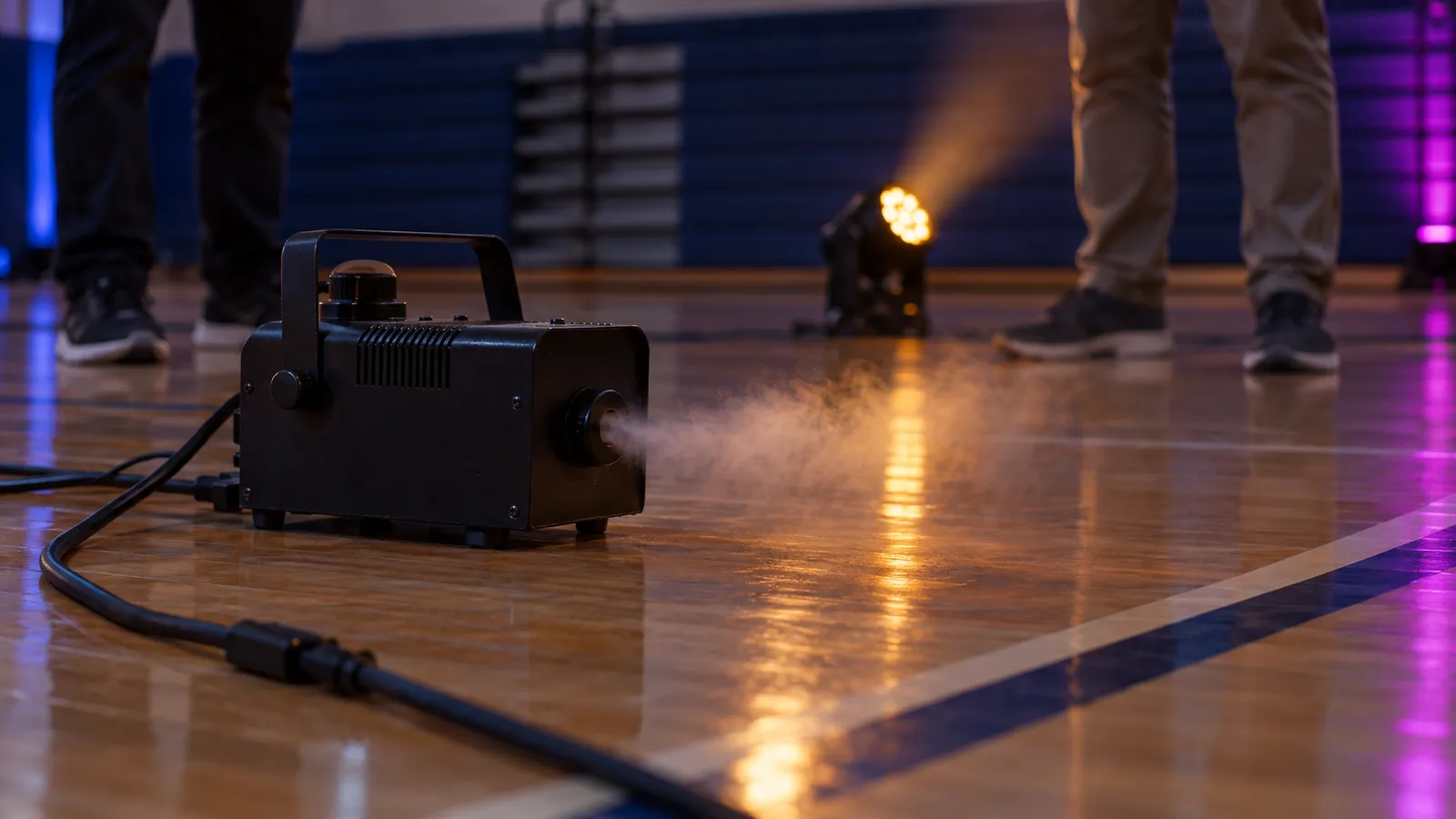
Atmospheric effects in a school building are the district's, the venue's and the local fire authority's call, so start there, and be ready to skip haze entirely if it isn't approved. The practical distinction: a haze machine produces a thin layer that makes beams visible, while a fog machine produces thicker clouds that can obscure exit signs. Both can set off smoke detectors. The U.S. National Institute of Standards and Technology explains that ionization detectors are more responsive to small particles and photoelectric detectors to larger, light-colored ones, so neither type is "safe" for haze by default. Our guide to fog, haze and fire alarms goes further into detector behavior.
If haze is allowed, get the plan approved in writing: which fluid, where the machine sits, at what output, how the building's fire alarm system will be managed and by whom, and any conditions the fire authority sets. Air handling can carry haze toward detectors, so placing the machine near an air return is not a substitute for an approved plan. Follow the manufacturer's installation and operating instructions for the exact machine, and test under supervision before guests arrive.
- Get written approval for any haze from the district, the venue and, where required, the fire authority before you book it.
- If the approved plan involves any change to fire alarm coverage, arrange it through facilities and the alarm company in advance, with whatever conditions they set.
- Set placement and output from the manufacturer's instructions and a supervised test in the room, not from a general rule.
- Confirm which haze fluid the venue accepts and order enough for the whole event; fog and haze fluid can be provided on request, with a quote.
- Treat a fog machine or CO₂ jet the same way as haze: any atmospheric effect may activate smoke detectors, so get the exact effect evaluated for your room under the approved plan, and check what your venue contract says about it, before you add one.
Sound System Scaling and When to Supplement the DJ Rig
A speaker pair that works in a small carpeted room may not cover a large gym evenly. Level drops with distance: for a point source in open space, the sound level falls by about 6 dB every time the distance doubles, so guests at the far end of a long gym can hear much less than those near the booth. Hard walls and high ceilings add reflections on top of that. Even coverage in a big room often means more speaker positions rather than one louder pair; test coverage at soundcheck by walking the room.
One option is to add Commercial PA Speakers on stands further from the DJ, fed from an auxiliary output of the DJ mixer. Position speakers above head height and angled toward the floor, and delay the far speakers so their sound lines up with the sound arriving from the main DJ position. The Commercial PA Speaker is $200 per day. For smaller events or pre-dance check-in, the Bluetooth Speaker System (one controller, six speakers and two mics) can provide background sound without a full DJ setup.
- Consider delay speakers at the far end of large gyms to even out the level.
- Confirm your DJ can provide aux outputs for supplemental speakers; not all mobile rigs can send a separate mix.
- For outdoor pre-dance gatherings or courtyard check-in, the Bluetooth Speaker System ($60/day) can provide background music without mixer infrastructure.
FAQ: School Prom and Homecoming Lighting
Can we use the school's existing stage lights for the dance floor?
Sometimes, depending on what's installed. Ask the school's theater or facilities staff what the house rig is: which fixtures, whether they are LED color-changing or conventional fixtures that take color gels, how they are controlled, and whether any can be re-aimed toward the dance floor (which may need a lift and the district's approval). Fixtures rigged to light a stage may not reach a gym floor at all. Once you know what's there, decide what to rent to fill the gaps.
What is the minimum lighting package that still feels like a real prom?
It depends on the room and what the school allows. As a worked price example only: eight Full-Color LED Par Lights at $25, two 380W Beam Moving Heads at $50 and one Haze Machine at $25 come to $325 per day at catalog rates, before delivery, setup and any technician, which are scoped and quoted to your event. Haze makes beams visible in the air but is optional and needs approval; without it, rely on wash color and patterns on walls and the floor. Ask the rental provider what they would suggest for your room and budget.
Do we need a lighting tech on-site or can the DJ run the lights?
It depends on the package and the DJ. Simple setups, such as par cans on preset color fades, may be something the DJ can manage. Moving heads, pixel-wash fixtures and programmed cue sequences need someone who can program the console; ask whether a technician should program cues in advance, show the DJ how to trigger them, or stay for the whole event. Timed moments such as a grand march or court introductions are easier with a dedicated operator. At VENEGEEST, technician services are scoped and quoted to your event.
How far in advance do we need to book lighting for May and June proms?
Request a quote for lighting and sound once the date and venue are set; availability is confirmed for your date when you request a quote. Same-week delivery is available for most items, but a confirmed booking needs a 25% non-refundable deposit, and changes to the order must reach VENEGEEST at least five business days before the event.
What happens if we trip a breaker during the dance?
Don't reset it yourself. Call your on-site facilities staff, who know the building's electrical system, and report any equipment problem to the rental company. Facilities staff can decide whether to reduce the load on that circuit or move fixtures to another approved circuit; a breaker that trips again may point to a fault that needs an electrician. The best prevention is the circuit map from the planning stage: size the load from each fixture's nameplate and stay within the limits facilities set.