A backyard wedding in Saratoga, Los Altos Hills, Atherton, Portola Valley or Woodside is shaped by three things the AV plan has to work around: the noise rules that apply to the specific address, the neighbors, and the house's electrical service. Each town sets its own rules, so the timeline should be built from the rules for your address, not from a rule of thumb. This guide covers how to find and plan around each constraint.
Five towns, five rulebooks: start with your address
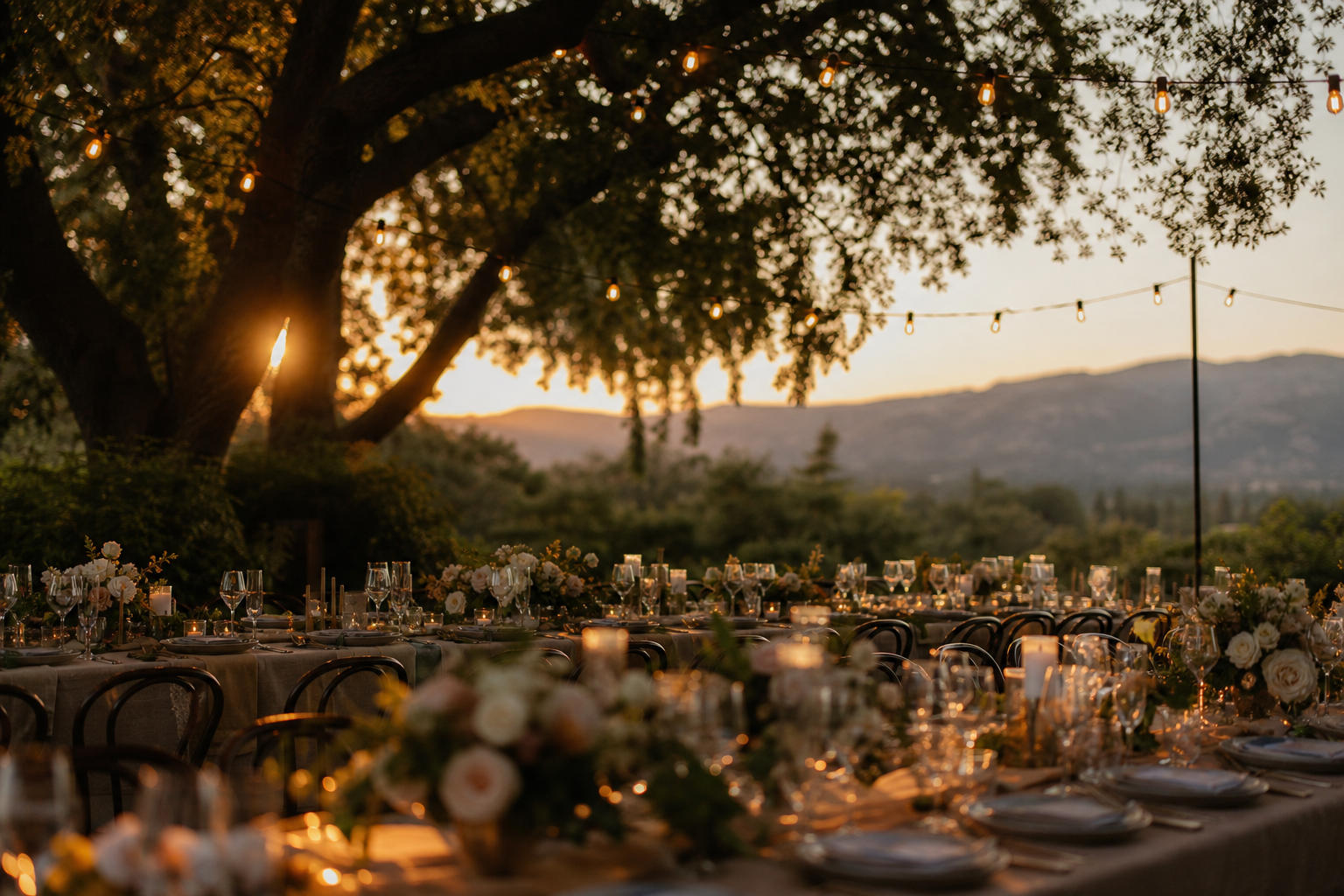
An oak grove with bistro lights looks much the same from Saratoga to Woodside. The rules underneath do not, and they can depend on the zoning of the property, the time of day, where sound is measured and whether a permit or exemption is available.
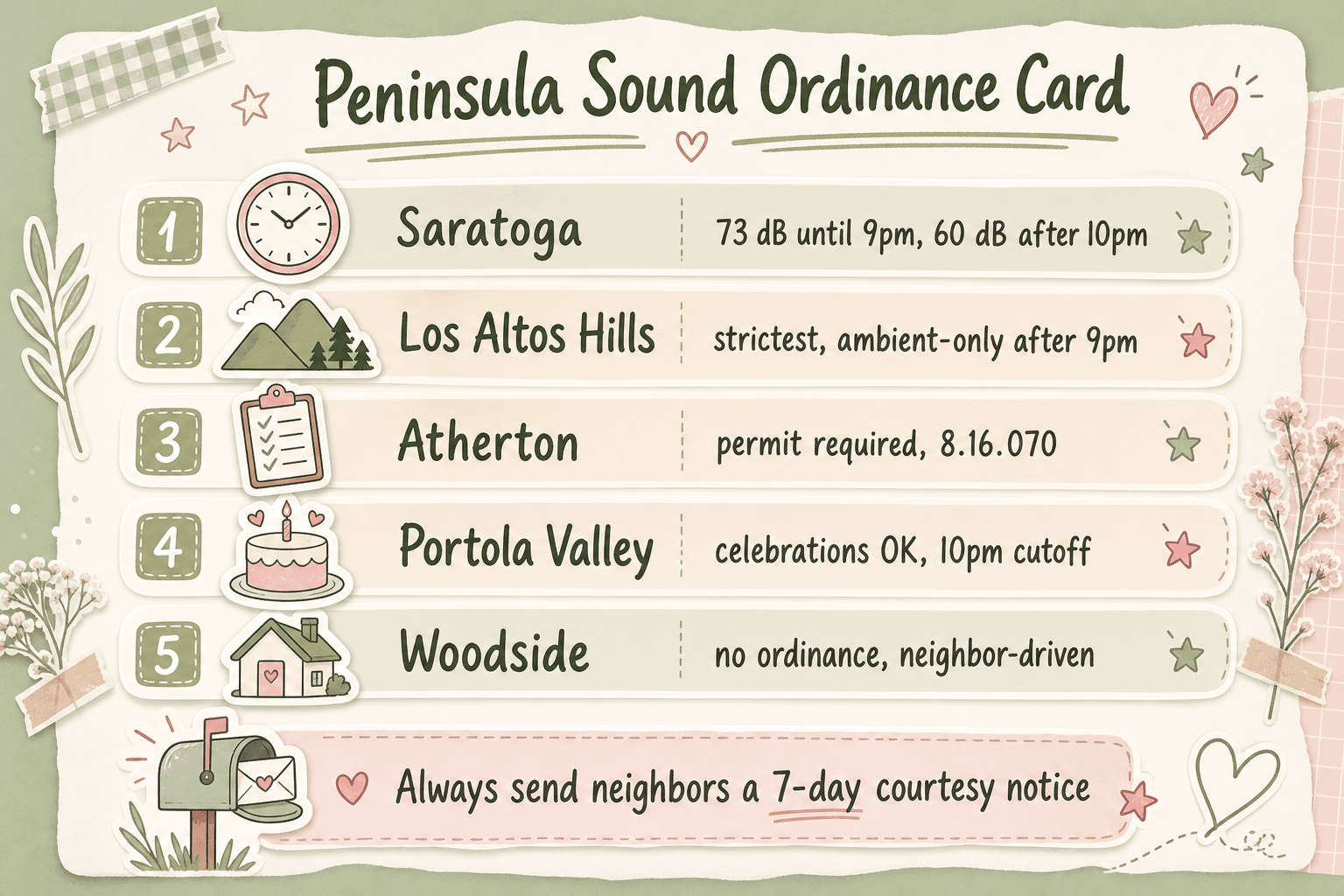
Saratoga. The city's noise standards page gives specific limits for music, but they are written for businesses and the Village. For indoor commercial music, "music may not exceed 73 decibels outside of the business" before 9 p.m., is "limited to 70 decibels" from 9 to 10 p.m., and "may not be louder than 60 decibels" after 10 p.m., and "after 9 p.m., windows and doors must be closed while music is being played." Outdoor music in the Village "may not exceed 73 decibels measured 25 feet or more from the source." The same page notes that "noise exemption permits may be obtained for certain special activities and events" and that they "are issued by the Community Development Department" (City of Saratoga). None of these figures is stated as the limit for a private backyard, so ask the city which standard applies to your address and whether your event can or should apply for an exemption permit.
Los Altos Hills. Ask the town what noise standard applies to amplified music at a private residence, including any time limits and how and where sound is measured, before you set the timeline.
Atherton. Ask the town whether amplified music at a private estate wedding needs a permit or an exception. If it does, the host or planner files it in advance; build that lead time into the calendar.
Portola Valley. Check the town's noise rules for private events, including any evening time limits, before you plan the dance set.
Woodside. Check both the town's rules and whether any San Mateo County rules apply to the property.
When you ask, get four answers in writing where you can: the limit, the hours it applies, where and how it is measured, and whether a permit or exemption is available. Those four answers are what the timeline below should be built on.
Building the timeline backward from your limits
Once you know the rules for the address, plan the evening backward from them rather than forward from the ceremony. The schedule below is a sample only: the times are placeholders to replace with the hours and limits that apply to your property.
- Ceremony. Speech clarity matters most: a microphone for the officiant and, if the couple's vows need to be heard, one for them. Low-frequency reinforcement is rarely needed for speech.
- Cocktails and dinner. Background music at a level where guests can talk.
- Toasts. Speech again; turn up for clarity, then back down.
- Dance set. Schedule the high-energy part of the evening inside the hours your address allows for amplified music, and keep measured levels within the applicable limit.
- Wind-down. If later hours carry a lower limit, plan a quieter set or move the music indoors, and confirm that the indoor option actually meets the limit where it is measured (Saratoga's business standard, for example, also requires closed windows and doors after 9 p.m.). A tent with walls or a room with the doors shut reduces sound, but neither guarantees compliance.
- Send-off. A visual moment, such as a lit exit, works without amplified sound.
Two practical points. Put the moments that matter most to the couple where they fit inside the allowed hours, not at the edge of them. And if a wind-down plan depends on moving indoors, check during the site visit that the house has space for it and that sound from inside will stay within the limit.
Power: what the house panel can actually spare
Many houses have a main service rated at a number like 200 amps. That rating is a maximum for the whole house, not a budget reserved for the wedding. What is left depends on what else is running at the same time: HVAC, a pool pump, kitchen appliances, an EV charger, plus the caterer's equipment.
Start with a list of what the event will plug in, taken from each item's nameplate or specifications. For the lighting VENEGEEST rents, the catalog lists the haze machine as a 1000W unit and the beam moving head as 380W; add LED par cans for uplighting, powered speakers, the DJ's equipment, string lights and anything the caterer and photographer bring.
Give that list to an electrician. Circuit capacity is not simply the breaker's number: as Schneider Electric explains, under the National Electrical Code a branch-circuit breaker must be sized for the noncontinuous load plus 125% of the continuous load, where a continuous load is "one where the maximum current is expected to continue for 3 hours or more" (Schneider Electric). The electrician classifies the loads, checks them against the actual circuits, and decides what can run on house power, which house loads should be switched off during the event, and whether a generator is needed.
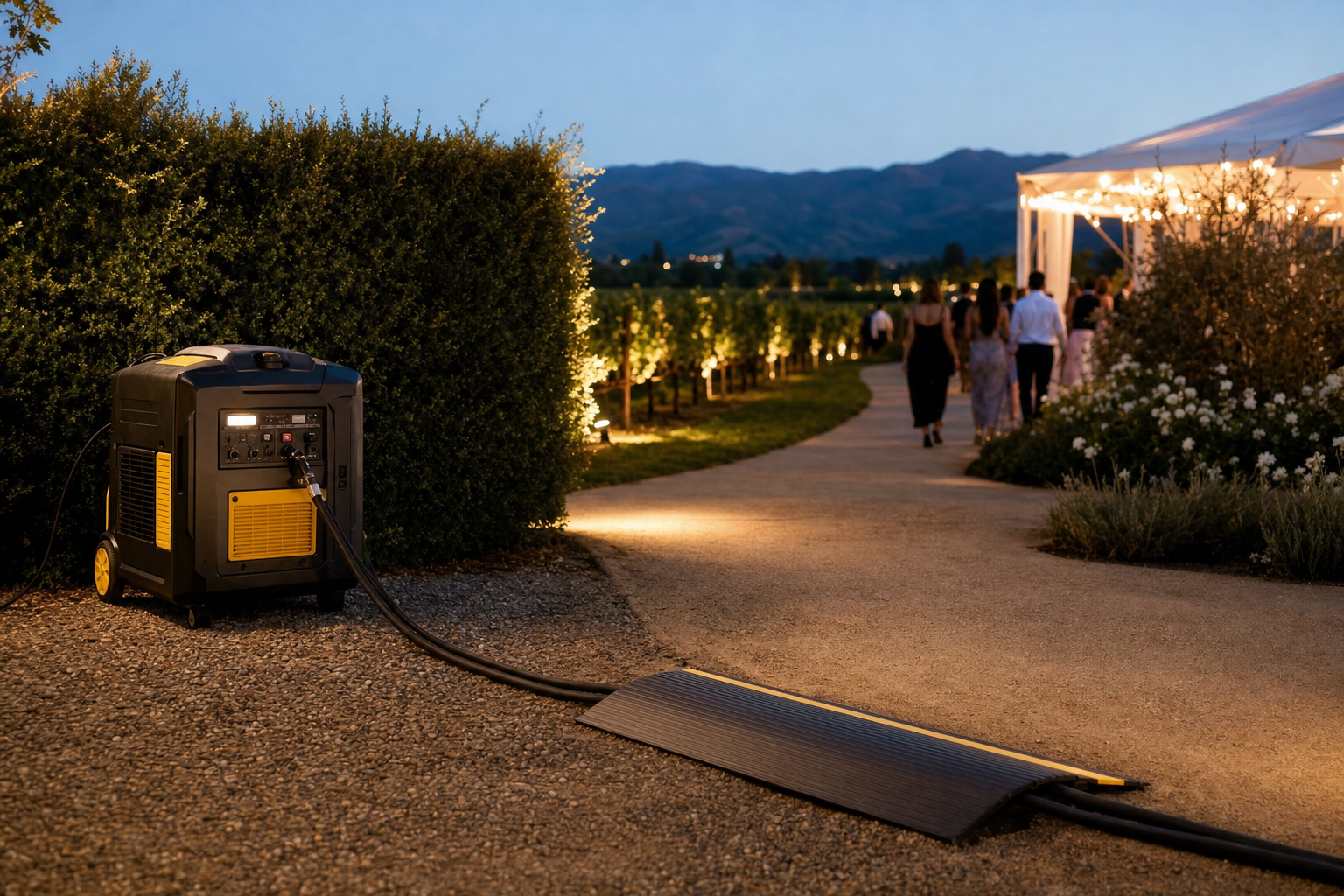
If a generator is used, choose it with the electrician and the AV provider from its electrical output and its published noise level, and follow the manufacturer's instructions for placement, fueling and connection. Its noise counts toward what neighbors hear, so its position matters as much as the speakers'. Do the electrical walk-through well before the event, so there is time to act on what it finds.
Neighbors: a courtesy notice and measured levels
A written limit is one question; how the neighbors experience the evening is another. Two things help, though neither guarantees there will be no complaint.
A courtesy notice. Let immediate neighbors know ahead of time: the date, the hours of amplified music, when it ends, and a phone number that reaches the planner on the night. It is a courtesy that gives people a way to raise a concern with you directly; it does not change the rules or how they are enforced.
Measured levels. A sound level meter at the point where the applicable rule measures sound, checked at each change of set, tells you where you stand against the limit instead of guessing. Ask the town how and where measurements are taken, so you measure the same way.
Speaker and subwoofer placement. How much sound reaches the property line depends on the specific loudspeakers, how they are aimed and arranged, and where the neighbors are, so no single speaker type is automatically quieter next door. Ask the AV provider to aim the system at the dance floor and away from neighboring homes using the manufacturer's coverage data for those speakers, and then check the result with the meter. A conventional subwoofer does not become directional just by pointing it inward, so check its level at the property line too. Place the dance floor with the neighbors in mind, not only the photo angle.
Estate venue types and what to ask
Private properties vary widely, so each has to be checked individually. Some useful questions by type:
- Gardens and estates that host events. For a venue such as Hakone Estate & Gardens in Saratoga, ask the venue for its end times, sound rules and vendor requirements.
- Historic estates. Historic estates such as Filoli in Woodside have preservation rules; ask the venue what effects, staking and rigging it allows.
- Private homes. Ask about power (service size, available circuits and outlets near where the equipment will go), access for delivery, surfaces for staging, indoor space for a wind-down, and the noise rules for the address. Whether a generator is needed follows from the electrician's load review, not from the type of property.
For the ceremony-and-reception equipment baseline, the wedding AV rental checklist walks the equipment list. For outdoor-specific gear (weatherproofing, battery uplighting, weather contingency), see the outdoor wedding AV guide. If you are also planning a cold-spark first-dance moment, the cold spark fountain guide covers the permit side; when VENEGEEST's crew operates the effect, VENEGEEST holds the operating permits, and a client who rents the machine and operates it carries that responsibility.
What VENEGEEST rents for Peninsula private estates
Sound: commercial PA speakers ($200/day), or the Bluetooth speaker system ($60/day; one controller, six speakers and two mics) for a ceremony or cocktail hour. Lighting that adds atmosphere without adding volume: wireless battery uplights (12–15 hour battery, wireless DMX) for spots without power runs, beam moving heads ($50/day) and a haze machine ($25/day) for the dance floor. Delivery, setup and technician time are scoped and quoted to your event. The electrical walk-through, the neighbor notice and the sound level meter are for the host, planner or electrician to arrange; a generator, if one is needed, can come from a power vendor.
For lighting such as uplighting, dance-floor moving heads and ceremony light, see stage lighting. Listed equipment is in the equipment catalog; VENEGEEST designs the setup around your site, and equipment beyond the listed catalog is available on request, subject to availability, with a custom quote.
FAQ: Peninsula Backyard Wedding AV
What time does music have to stop at a Saratoga backyard wedding?
The city's published music limits are written for businesses and the Village: for indoor commercial music, 73 decibels outside the business before 9 p.m., 70 from 9 to 10 p.m. and 60 after 10 p.m., with windows and doors closed after 9 p.m. They are not stated as the rule for a private backyard, so ask the city which standard applies to your address and whether a noise exemption permit, which the Community Development Department issues for certain special activities and events, is available.
Can I have outdoor amplified music after 9pm in Los Altos Hills?
Ask the town what applies to your address, including any time limits and how sound is measured, before you plan it. Build the dance set around the answer.
Do I need a permit for amplified music at an Atherton private wedding?
Ask the Town of Atherton early whether your event needs a permit or an exception for amplified music. If it does, the planner or property owner files it in advance, so build that lead time into the planning calendar.
Will a residential 200A panel power a backyard wedding?
It depends on what else the house is running, the circuits available where the equipment goes, and the equipment list. Give an electrician the nameplate ratings of everything the event will plug in; they classify the loads, check them against the circuits and decide whether house loads should be switched off or a generator added.
How do I keep the neighbors from complaining?
Nothing guarantees it, but you can make it less likely and easier to resolve: send immediate neighbors a courtesy notice with the date, music hours, end time and a phone number for the planner; keep measured levels within the applicable limit; and have the AV provider aim speakers and set subwoofer levels with the neighbors in mind, then check at the property line.
Get a quote or schedule a planning call
Send your venue, date and rough guest count, along with the noise rules you've confirmed for the address, and ask for a sound and lighting quote. Call (415) 890-5555 or email info@venegeest.com. VENEGEEST serves San Francisco, San Jose and the South Bay, and the wider Bay Area, with same-week delivery for most items.