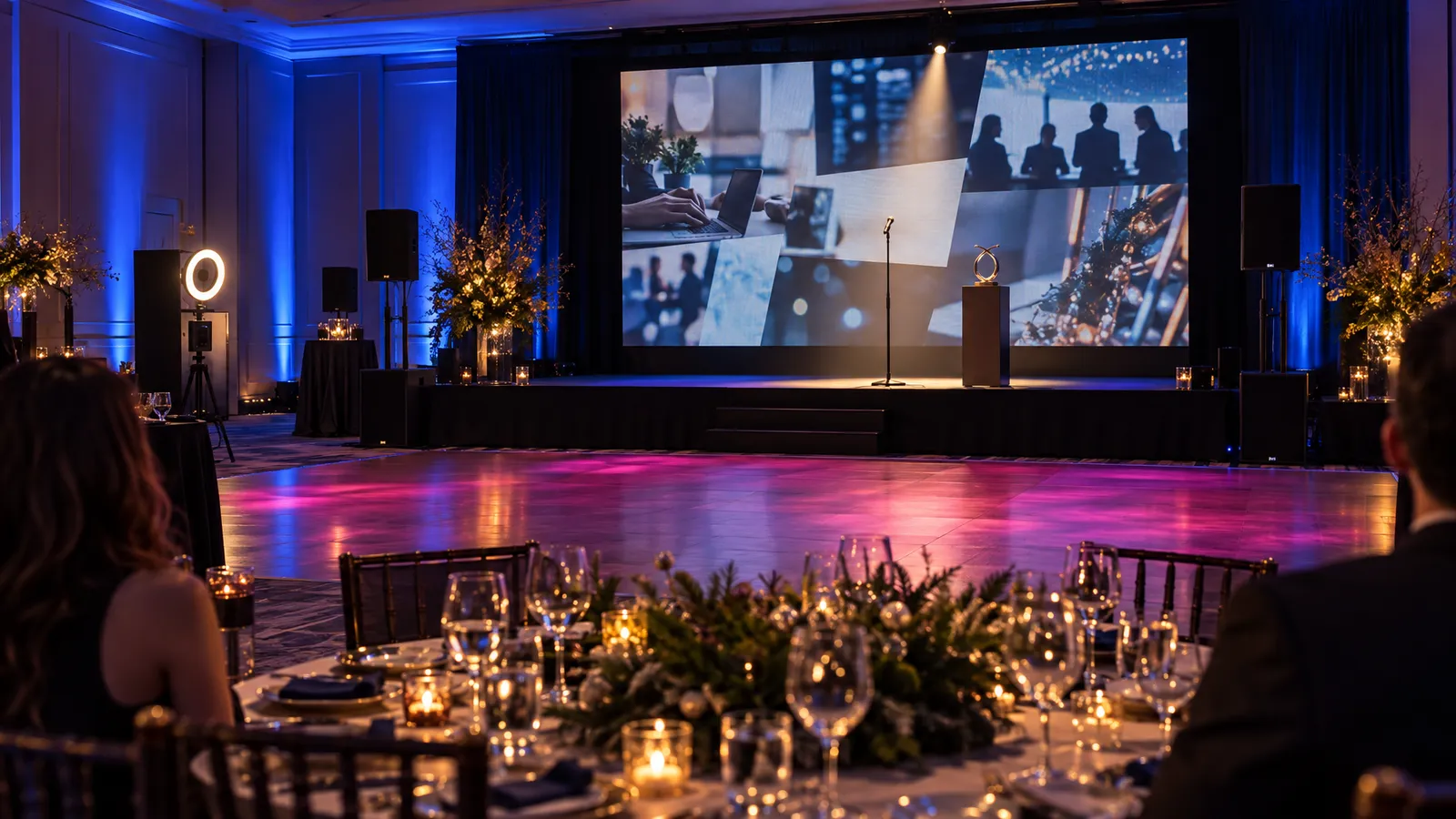
December in the Bay Area means corporate holiday parties that must thread the needle between festive and professional. Whether you're in a historic bank hall, a warehouse event space, a design showroom or a museum for a 100- to 300-person company celebration, you need an AV production checklist that delivers holiday atmosphere without fire-department headaches, supports a year-in-review video moment without awkward tech gaps, and handles the year-end awards block with actual stage presence. This guide outlines the gear, timing sequences and venue questions to settle when producing a corporate holiday party that ends up on the internal highlight reel instead of the facilities complaint log.
Upscale Holiday Color Palette: Deep-Blue and Warm-White Uplighting
Many planners steer away from saturated red-and-green washes for a corporate room. One upscale palette option runs deep cobalt blue, champagne warm-white, and occasional gold accents — colors that complement year-end branding slides and work inside venues with existing amber Edison-bulb sconces. In a room with columns, wireless battery uplights along the perimeter can run a slow fade between warm white and royal blue. There are no power cables to tape down and no daisy-chain failures when catering carts roll over cable runs. The catalog lists a 12–15 hour battery; actual runtime depends on the model, brightness and color settings, so confirm the units are fully charged and check the runtime for your settings against your load-in and breakdown times.
For venue halls without architectural features to uplight, such as an open showroom floor, substitute six Full-Color LED Par Lights ($25 per day each) mounted on vertical truss towers positioned mid-room. Aim them at the ceiling to create indirect wash rather than direct uplight. This avoids the hot-spot problem you get when firing pars straight into guests' sightlines during cocktail hour. Program a static champagne hold during dinner service, then shift to slow color rotation once the dance floor opens.
- Wireless battery uplights for column or wall wash — color mixing, wireless DMX, 12–15 hour battery per the catalog (confirm charge and settings); quoted per event.
- Deep cobalt blue and warm champagne white as primary palette — one option that sits well with year-end branding slides.
- Six full-color LED pars on vertical towers for venues with no uplight-friendly architecture — indirect ceiling wash.
- Static champagne hold programmed for dinner service — no slow fades or movement while the CEO is speaking over plated courses.
- Venue power map checked two weeks prior — ask how many circuits are available near the stage and dance floor, and whether unlocking more needs the venue's electrician.
Year-in-Review Video Moment: LED Display and Stage Transition
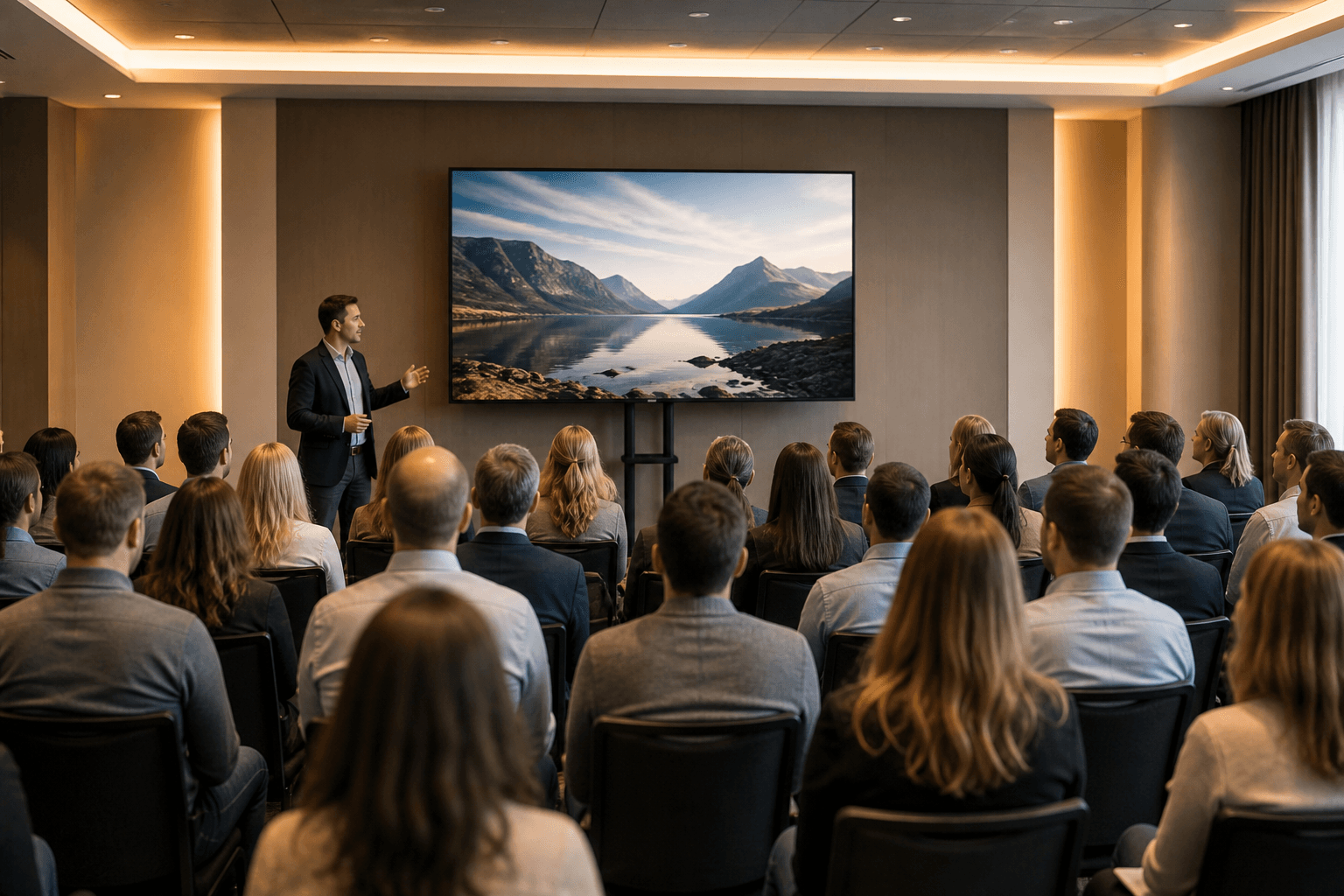
The year-in-review video segment needs an image the farthest guest can actually read. Headcount alone doesn't settle that: screen size depends on the distance from the screen to the farthest viewer and the smallest text or detail in your content. AVIXA's display image size standard (DISCAS) sizes displays from exactly those inputs — the farthest viewer's distance and the height of the smallest element they must read — and AVIXA publishes calculators for it. Measure that distance in your room, then choose among the LED TV Display sizes: the 85-inch rents from $95 per day and the 120-inch from $120. Ask how the size you choose will be supported or mounted before you book, since a stand or mount has to be rated for that display. A second display flanking the stage can help guests whose sightline to one screen is blocked, but it does not make the image any bigger for a guest at the back. Whatever you pick, test it in the room with your real slides and the house chandeliers at your planned level.
The memorable production detail is the transition from video close to live awards walk-on. Time a reveal cue to the final frame of the video — typically a logo reveal or team photo — then bring house lights up to about 60 percent while the CEO walks from backstage to center podium, and you're into the awards block without a dead-air tech gap. Many planners want cold spark machines for this moment, but they are not a no-permit effect: the machines use titanium or zirconium powder, California's Health and Safety Code section 12505 classes those compounds as dangerous fireworks, and some Bay Area fire authorities ban the machines outright. When VENEGEEST's crew operates the effect, VENEGEEST holds the operating permits; if you rent the machines and run them yourself, you carry that responsibility, including liability. Confirm permit requirements with the local fire marshal and the venue before you plan the cue; CO2 jets or a lighting hit are the fallback.
- LED display sized from the farthest viewer's distance and your smallest text (85-inch from $95 per day, 120-inch from $120), with its support or mount confirmed for that size — HDMI plus a Wireless Screen Caster ($60) for last-minute slide changes.
- A second display for blocked sightlines if the room layout calls for it; delivery and setup scoped and quoted to your event.
- Cold spark machines downstage left and right only after written approval from the venue and the local fire authority.
- Reveal cue programmed 30 seconds before video end — triggered from timecode or a manual board hit if the video editor can't embed a cue.
- House lights programmed to 60 percent after the reveal — avoids the abrupt full-bright snap that kills the moment's energy.
How Much Display Brightness Do I Need for a Venue with Ambient Chandeliers?
If your venue keeps house chandeliers up during the program to maintain the "elegant cocktail party" vibe, brightness matters as much as size. Test it by asking the venue to set house lights to your planned dinner level, then view a sample slide deck from the farthest table. If you're squinting to read 24-point sans-serif body text, the display is undersized or underlit. Budget the larger screen or ask the venue whether house lights can dim during the video block.
Year-End Awards Block: Portable Stage, Followspot Pickup, and Static Dance Floor Washes
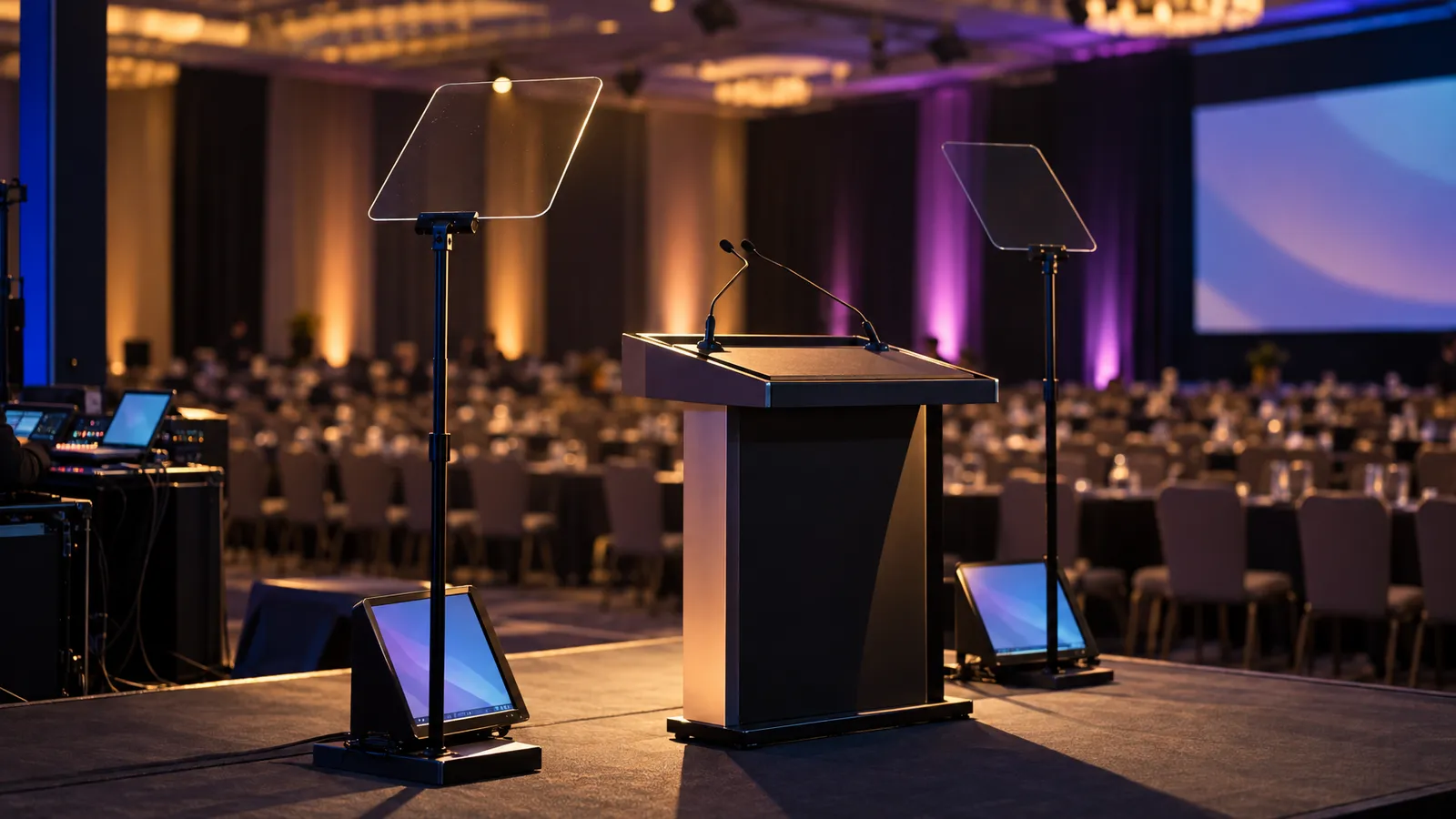
A proper awards presentation calls for a portable stage, positioned center-room or against the long wall if the venue floor plan forces it. Raising the executive line above the dinner tables makes the CEO and award recipients visible to the back rows without a video relay. The platforms are modular and combine for any size, and the Portable Stage Platform rents from $30 per platform.
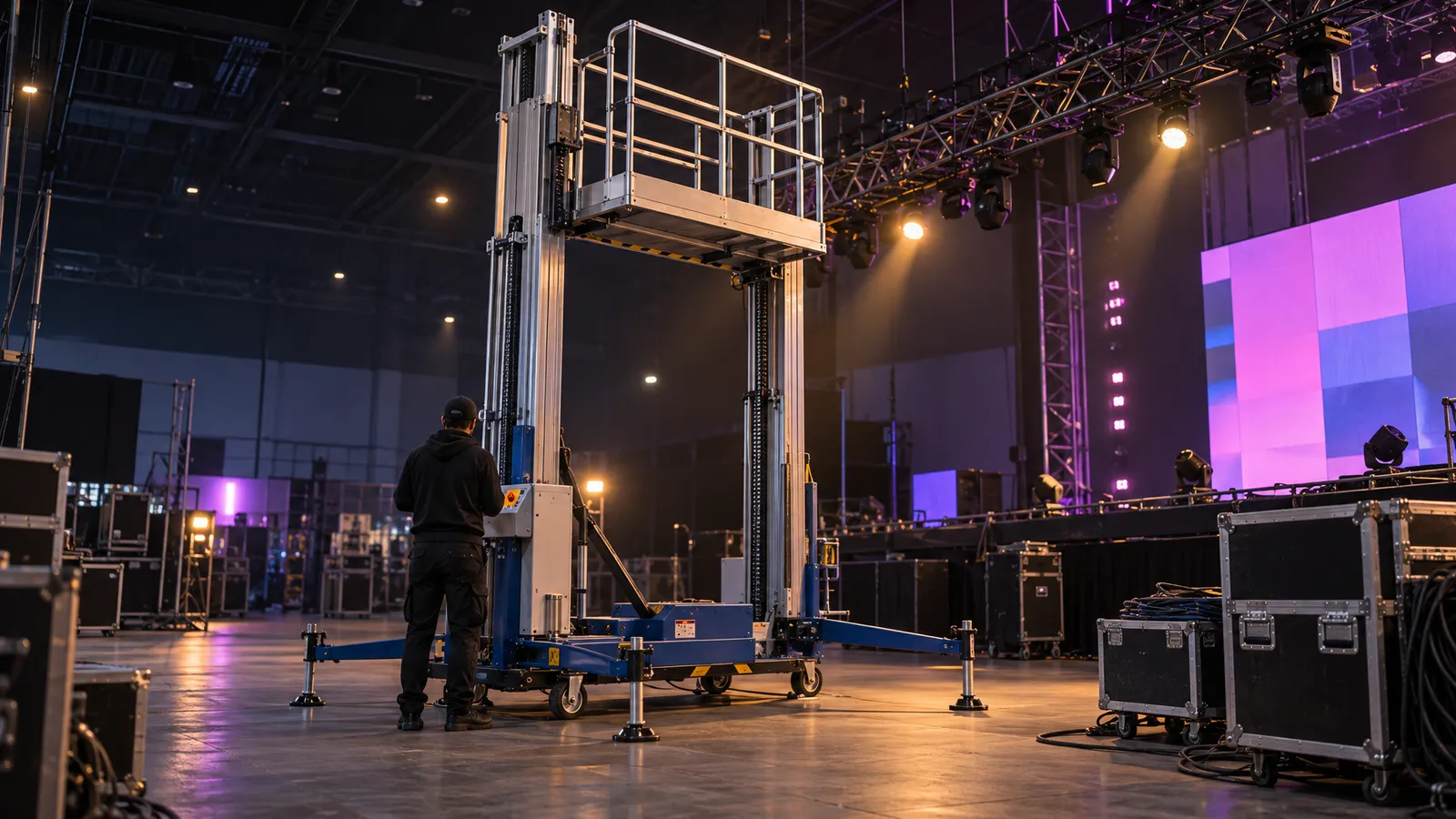
Lighting the awards block needs a single followspot, such as our 330W–440W Followspot Light ($80 per day), run from the rear of the room. The operator picks up the CEO as they walk onto stage, holds the spot at reduced intensity during the speech, then widens the beam to include award recipients as they join the stage line. Meanwhile, LED pixel-wash moving heads positioned on horizontal truss behind the stage hold a static warm-white wash at low intensity — no color rotation, no beam movement, no pixel effects. The goal is to keep background light consistent and flattering for the applause and handshake photos. Once the awards segment closes and the DJ announces the dance floor open, those same moving heads shift into color-block patterns for the party segment.
- Portable stage platforms combined to the width of your executive line, from $30 per platform.
- Single manual followspot at the rear (330W–440W, $80 per day), operated by the lighting tech.
- Four LED pixel-wash moving heads on horizontal truss behind stage — static warm-white hold during awards, programmed color blocks for the dance floor.
- Followspot intensity set during rehearsal so speakers are well lit on camera without being dazzled.
- Static background wash at low intensity through the awards segment, then dynamic once the DJ cues dance music.
Holiday Party Effects: Bubbles, Cold Spark, and No-Smoke Venue Rules
Many venues restrict haze and fog because of fire-alarm sensitivity, so ask before you plan any atmospheric effect. Cold spark is not an automatic workaround: give the venue's facilities manager the machine's safety data sheet and confirm with the local fire marshal, since some Bay Area fire authorities prohibit cold spark. Central County Fire, for example, bans the devices in Burlingame, Millbrae and Hillsborough and warns that the sparks, while cooler than a sparkler's, can still ignite nearby materials.
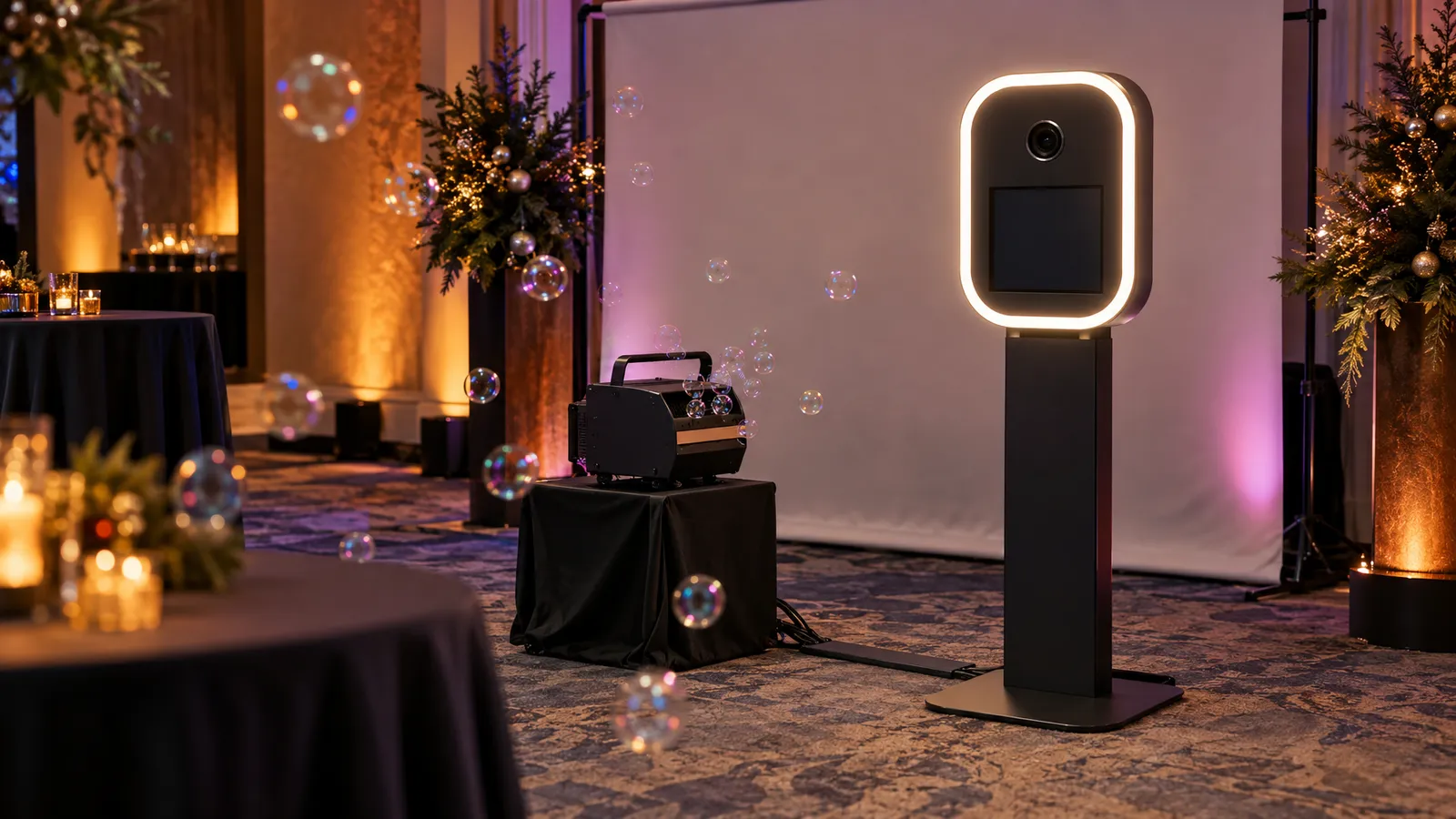
For cocktail-hour entrance moments, consider a bubble machine ($40 per day) positioned near the venue entrance or photo activation zone. Bubbles photograph well under uplighting, especially when the uplights run slow color fades through the blue-to-champagne palette. Bubble residue can make walking surfaces slippery, so use the fluid the machine's manufacturer approves, keep the output away from walkways and the dance floor, and agree placement and cleanup for the actual floor with the venue first. Our indoor bubble machine guide covers floor surfaces and detectors in detail.
- Cold spark machines for CEO walk-on and awards transitions only with venue and fire-authority approval, safety data sheet provided to facilities in advance.
- Bubble machine for cocktail-hour entrance, with the floor finish and fluid cleared with the venue.
- Haze or low-lying fog only where the venue's contract and facilities team allow it.
- Interactive photo booth with instant sharing, from $400.
- Bubble machine positioned a few feet from the photo booth — creates layered visual depth in photos without obstructing faces or the branding backdrop.
Audio for Cocktail, Dinner, and Dance Floor Segments
Corporate holiday parties need three distinct audio zones: ambient background music during cocktail hour, speech reinforcement for awards and toasts, and dance floor energy once the program wraps. The Bluetooth Speaker System (one controller, six speakers, two mics) rents from $60 per day. Whether it can cover your cocktail and speech segments depends on the room size, the controller's routing and where the speakers can go, so confirm the setup with us and soundcheck it in the venue before the event. One layout to test: two speakers in the cocktail zone, two flanking the stage for speech, and two near the dance floor.
Once the dance segment opens, hand off audio to the DJ's dedicated rig or add louder speakers if your crowd skews toward a full dance floor. If part of the room will be dancing while the rest talks near the bar, spread-out speakers can keep background levels manageable in the quieter areas. If your company culture leans into the dance floor and you expect a large share of guests dancing, add Commercial PA Speakers ($200 per day each); subwoofers and mixers are available on request, subject to availability, with a quote — or book a DJ package with its own mains and subs.
- Bluetooth speaker system (one controller, six speakers, two mics), $60 per day — confirm coverage and routing for your room in a venue soundcheck.
- Charge or fresh batteries for the mics before doors, with a spare plan if a mic drops mid-speech.
- Speaker placement tested in the room: for example two in the cocktail zone, two stage-flanking, two near the dance floor.
- DJ handoff at the dance-floor transition — agree with the DJ beforehand which system plays where.
- Add Commercial PA Speakers or a DJ rig with subs if most guests will dance.
FAQ: Holiday Corporate Party AV Production
Do I need a fire permit for cold spark machines at SF corporate venues?
Assume you need approval and confirm it before you plan the effect. Cold spark machines use titanium or zirconium powder, and California Health and Safety Code section 12505 classifies those compounds as dangerous fireworks; some Bay Area fire authorities ban the machines entirely. Ask the venue's facilities manager and the local fire marshal what applies, give them the machine's safety data sheet, and allow plenty of lead time. VENEGEEST holds the operating permits when its crew runs the effect; a client who rents the machines and operates them carries that responsibility. If approval doesn't come, CO2 jets or a lighting cue can mark the moment instead.
What does wireless battery uplighting cost compared with plug-in uplights?
Wireless battery uplights are quoted per event; they remove power-cable runs, which matters where outlets are far from the columns. Plug-in Full-Color LED Par Lights rent at $25 per day each, so ask for a battery-uplight quote for the same fixture count and compare. Battery units make sense anywhere power access requires ladders, panel unlocking, or cable runs across catering paths.
How early do I need to book AV gear for a December corporate party in San Francisco?
Request a quote once the date is set; availability is confirmed for your date when you request a quote. Same-week delivery is available for most items, and a booking is confirmed once you receive written confirmation and pay the 25% deposit; order changes need to reach us at least 5 business days before the event.
Can I use a projector instead of an LED display for the year-in-review video?
You can. Room light falling on a projection screen reduces contrast, so a projector needs enough brightness for the room's lighting or the room needs to dim for the video. An LED TV needs no separate projection screen or projector placement. Either way, test the content with the house lights at the level you plan to use. Projectors go beyond the listed catalog and are available on request, subject to availability, with a quote; from the listed catalog, an 85-inch LED TV is $95 per day. Projectors make sense when your content demands a very wide image or the venue has a built-in house screen with professional rigging.
What's the minimum stage size for a three-person executive line during awards?
Aim for enough width that each executive stands comfortably without shoulder crowding, plus enough depth for a single step forward during individual recognition. For four or five people, add platforms to widen the stage. Height should give sightline clearance over seated dinner guests; if the stage needs a step, place it where executives walk on and off without backtracking, so the CEO can present awards left to right and executives exit on the far side.