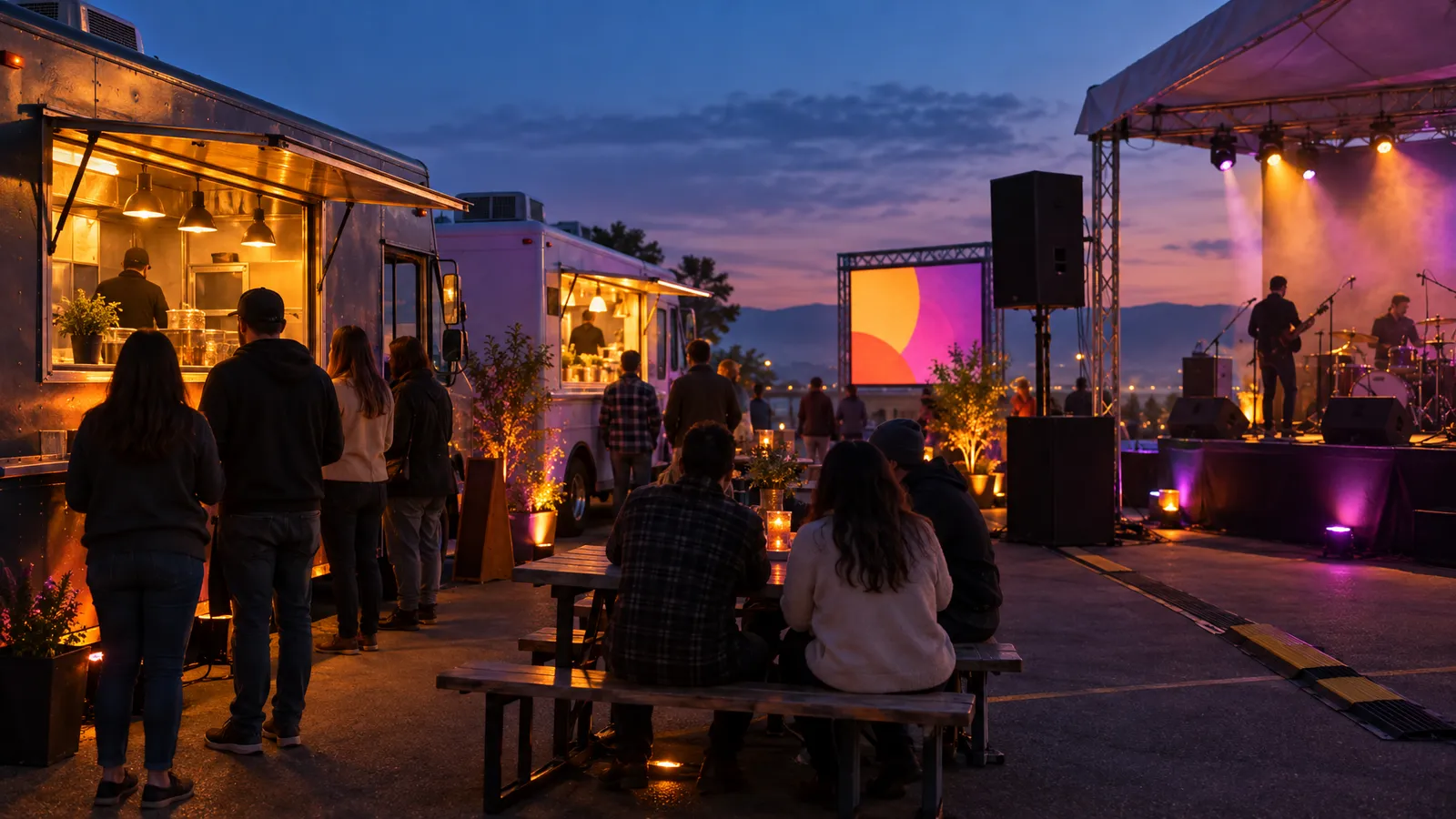
A food truck rally or outdoor food festival needs four kinds of AV: stage sound for any live music, a separate PA for vendor callouts and announcements, lighting that holds up outdoors after dark, and sponsor signage people can read from the approach path. Power comes first, because most lots have little spare power and the trucks need theirs for cooking. This checklist covers each area, with catalog prices and the permit questions to settle before you book.
Power Planning: Battery Uplights and Generator-Fed PA
Many outdoor lots offer little or no spare power unless you arrange it with the site or neighboring businesses, and food truck operators need their own power for cooking, so don't plan on tapping a truck for stage lights. A common approach is a generator (or site power, where it exists) for the main PA and battery-powered uplights for ambient zones. A wireless battery uplight runs 12–15 hours on a charge according to the catalog, and most variants are IP65. Placing several along the perimeter of a beer garden or vendor row gives ambient wash without extension cords for those fixtures.
For the headline stage, add up the rated draw of everything that needs power: for example two commercial PA speakers ($200 per day each), a mixer (available on request, subject to availability, with a quote), and four full-color LED par lights ($25 each), using the figures on each unit's spec label, and size the power source with headroom above that total. If the event includes vendor-area announcements, a separate Bluetooth speaker system ($60 per day, 1 controller + 6 speakers + 2 mics) is one option; ask how it is powered on site and how long it runs.
- Battery uplights spaced along vendor rows add ambient wash without running cords across walkways for those fixtures.
- A generator, if the site allows one, sized to the stage load with headroom and placed away from the stage and downwind of seating and food prep, can power the PA and pars.
- A separate speaker system for vendor-area announcements keeps them off the main stage mix.
- A pre-event site visit to see what power the site can actually provide near the stage; if there isn't enough, work out the options (site power arranged with the venue, a generator, battery fixtures) with the site and a qualified electrician or power provider.
- Outdoor-rated extension cords of a gauge suited to the load and length, as specified in your power plan, in case the power drop moves on event day.
Stage Configuration for Live Music Between Service Rounds
A portable stage platform is modular, and the platforms combine to the size you need ($30 per section per day). How big the deck should be depends on the act: a solo performer needs far less room than a band with drums and amps. Ask each act for its stage plot or rider, and size the deck, stairs and access from that rather than from a generic number. An aluminum H-frame truss ($10 per day) span above the stage can carry a few LED pars and give the stage a visual focal point; check the weight of everything you hang against the truss manufacturer's load data before rigging.
Whether performers need monitor or side-fill speakers, and where they go, depends on the stage size, the act, the background noise on the day and what sits around the site. Have your audio engineer lay out the stage monitoring and the main PA, and aim speakers away from nearby homes and apartments where the layout allows. If the event runs into the evening, confirm that your permit allows amplified music until that hour.
- Portable stage platforms locked together to the size the act's stage plot calls for.
- An aluminum H-frame truss span for a few full-color LED pars; confirm the load for anything you hang against the truss rating before rigging.
- Monitor and side-fill placement set by your audio engineer for the actual stage and site, checked at soundcheck.
- Stage skirting in black or festival colors hides cable runs and anything stored beneath the deck, and tidies the backdrop for sponsor photos.
- Gaff tape and cable ramps for any cable runs across walkways between the stage and the mix position — strollers, carts and wheelchairs will all cross them.
How Much Stage Width Do You Need for a Solo DJ vs. a Live Band?
It depends on the performer's setup, so start from their stage plot. As an illustration only: a solo DJ with a controller on a table might fit on a single small deck, while a band with a drum kit, amps and a keyboard needs a much larger one, and a horn section or backup vocalists add more again. Ask each act what it brings, where the drum riser and amps go, and how much room it needs to move safely, then add space for monitors and cable runs. A deck that's too small for the band pushes performers to the edges or off the stage, which hurts sight lines and makes monitoring harder.
Vendor-Row Sponsor Signage: LED Screen vs. Static Banners
A Foldable LED Ad Screen (2–12 m², on casters) can rotate sponsor logos without anyone swapping vinyl banners between sessions, and the casters make it easier to move if the layout changes. Plan how the screen will be moved and secured on the actual surface — asphalt slopes and grass behave differently — and who is allowed to move it. For a festival with six title sponsors, showing each logo for 15 seconds makes a 90-second loop, so each sponsor appears once every 90 seconds; shorten the per-logo time if sponsors want more frequent exposure. Ask how content is loaded so you can update the playlist if a new sponsor signs on the morning of the event.
Static banners are another option, for example on backdrop walls behind the main stage. Print vinyl banners with grommets and hang them on pipe-and-drape frames. Whether an LED screen reads well in a given spot depends on the panel's brightness, the content and the ambient light, so look at the specific screen in place at the time of day your crowd arrives. The Foldable LED Ad Screen rents from $200 per day; whether the ability to rotate messaging is worth that over printed banners depends on how many sponsors you're showing and how often the content changes.
- A foldable LED ad screen at the entrance to the vendor row can cycle sponsor logos in a loop; check legibility from the approach path at the time of day your crowd arrives.
- Angle the screen away from direct afternoon sun and from reflective food-truck siding that throws glare onto it.
- Casters make repositioning easier if foot traffic shifts or a truck parks in front of the original spot; agree a safe way to move and secure it.
- Ask how content is loaded onto the screen so you can update the sponsor loop on site.
- Static vinyl banners for backdrop walls or spots where a screen isn't practical; grommeted banners hang on pipe-and-drape frames.
Sound-Ordinance Cutoff Hours: SF, Oakland, and San Jose Permits
Amplified-sound cutoffs are set in each event permit, and they vary by city, by venue and by how close the site sits to homes. A plaza in a commercial district may allow music later than a park beside apartments, and an extension, where one exists, usually means extra paperwork filed ahead of time. Don't plan a lineup around a cutoff you've read about secondhand; get the time in writing.
Before booking your PA, call the city's special-events office and confirm the exact cutoff time for your venue. If your headline band is scheduled to play 8–10 p.m. and the permit only covers until 9 p.m., the set has to end at 9. Leave a short buffer before the cutoff for closing announcements over the PA — thanking sponsors and directing attendees out — rather than playing music to the final minute.
- Confirm the amplified-sound cutoff for your exact site with the city's special-events office before booking talent, and keep it with your permit.
- Ask whether an extended-hours request is possible for your site, what notice it needs, and how far ahead it must be filed.
- Plan a buffer before the official cutoff for sponsor thank-yous and closing instructions.
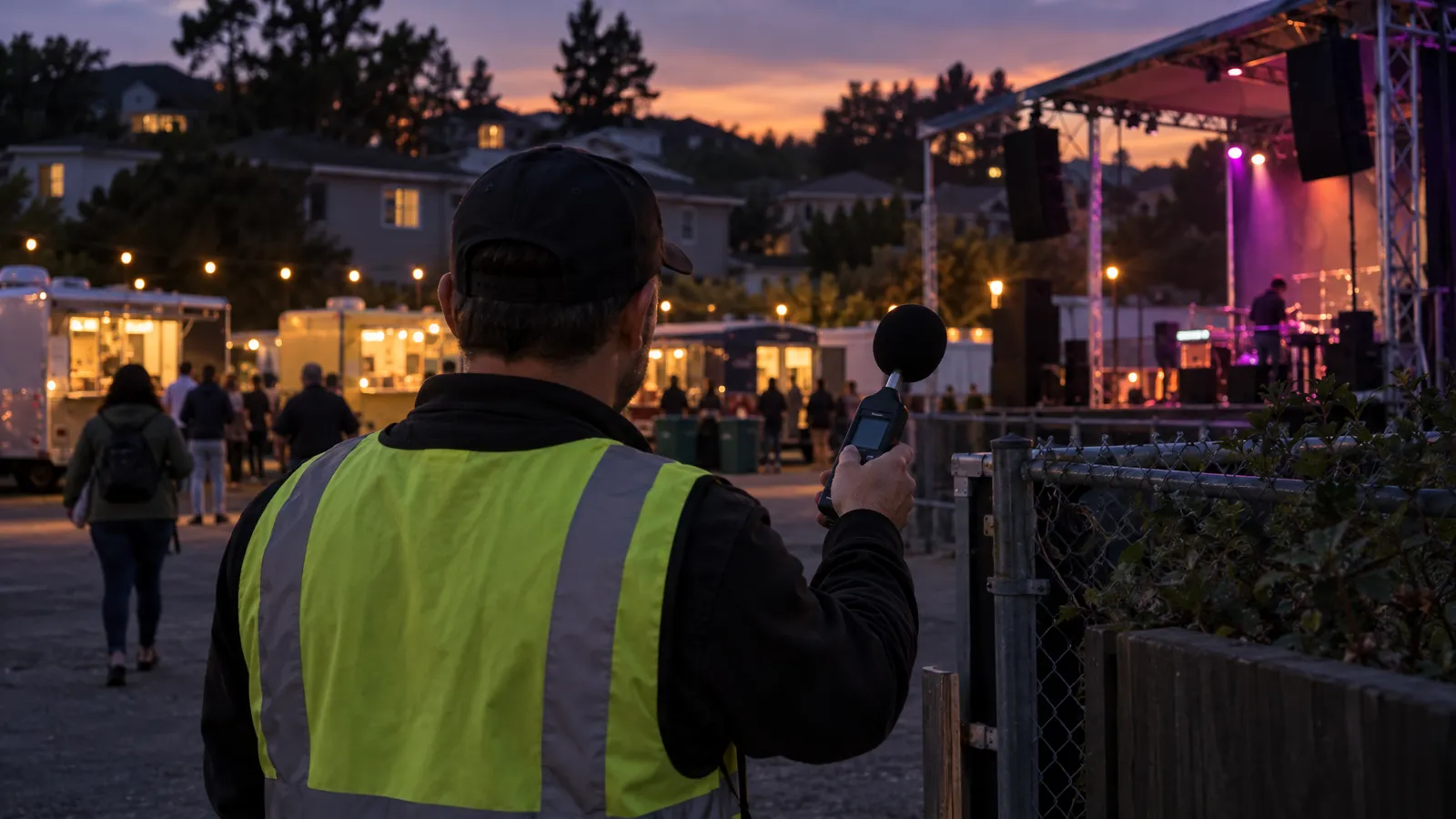
- Carry a sound level meter and check levels at the event perimeter against whatever limit your permit sets, especially on the side facing homes.
Weatherproofing and Fog-Resistant Lighting for Evening Service
Bay Area weather can change over the course of an afternoon, and evening fog or drizzle leaves moisture on equipment. For any outdoor event running into the evening, ask for fixtures with an ingress protection (IP) rating suited to outdoor use and follow each unit's instructions. It helps to know what the rating means. Under the IEC 60529 IP code, the first digit 6 means dust-tight; a second digit of 5 means water projected by a 6.3 mm nozzle "against enclosure from any direction shall have no harmful effects" in the standard test, and 7 means protection against temporary immersion up to 1 meter. An IP rating describes performance in those tests, not a promise about every condition on the day — cable connections, open battery or charging ports and how a fixture is set up all matter.
For evening visuals, the catalog lists an outdoor IP67 sky laser (20–50W), described as a high-power weatherproof sky laser for outdoor festivals. Higher-power laser shows (Class IIIb and IV) need an FDA variance, and the FAA has its own rules for outdoor laser operations, so start both well before the event. Where the laser sits, how it is aimed, where the beams terminate and which areas are kept clear are set by the approved laser safety plan and a qualified operator, not by a fixed angle.
- IP-rated fixtures for outdoor use, set up according to the manufacturer's instructions; ask what rating each fixture carries and write it into your rental order.
- Keep connectors, power distribution and battery or charging ports protected in the way the equipment's manufacturer specifies, and keep drinks away from equipment.
- For a sky laser, follow the FDA variance and FAA requirements, and let the qualified operator set placement, aiming and exclusion zones.
- Ask the rental company how its equipment should be protected overnight if the event runs over more than one day; don't apply sprays or treatments to rented connectors yourself.
FAQ: Food Truck Rally & Food Festival AV
How much does the AV gear cost for a 500-person food truck rally?
Build it from list prices. One example setup: two Commercial PA Speakers ($200 each), one Bluetooth Speaker System for vendor announcements ($60), four Full-Color LED Pars ($25 each), four Portable Stage Platforms ($30 each as listed), an Aluminum H-Frame Truss ($10 as listed) and Wireless Battery Uplights (quoted). That is $690 per day before the uplights. Delivery, setup and any sound engineer are scoped and quoted to your event. Power has to be planned too: if the site has none, plan a generator sized to the full load with the site and a power vendor.
Can I run stage lighting off food truck power instead of renting a generator?
Don't plan on it. A truck's power is sized for its own kitchen equipment, and adding a stage load risks tripping breakers mid-service. Arrange dedicated power for the stage, sized to the rated draw of the PA and lights, and if it's a generator, place it so exhaust does not drift into the food prep area or audience seating.
Do battery uplights work for lighting walkways after dark?
They add ambient wash that helps people see the vendor row and the beer garden without cords across walkways; the catalog lists the Wireless Battery Uplights at 12–15 hours on a charge, and most variants are IP65. Whether your event needs a specific lighting level in walkways is a permit question, so ask the city's special-events office what applies to your site and plan the fixture count from there.
How do I confirm whether my venue has accessible power before booking AV gear?
Request a site visit with the venue contact or city events coordinator well before the festival date. Walk the event space, note every outlet or power source and its distance from your planned stage position, and ask the contact what circuits are available to you and whether they are shared with other users. If there isn't enough power near the stage, confirm whether the site allows generators and what placement and noise restrictions apply.
Do I need a separate PA system for vendor order callouts, or can vendors use their own Bluetooth speakers?
Small portable speakers at each truck can be hard to hear once the crowd gets loud, so a dedicated vendor-area system is worth considering. The Bluetooth Speaker System rents for $60 per day and comes with one controller, six speakers and two mics. Before you plan around it, confirm the microphone type, how the speakers connect and are powered, what they can be mounted on and how far the sound carries on your site, and walk the vendor row during setup to check coverage.