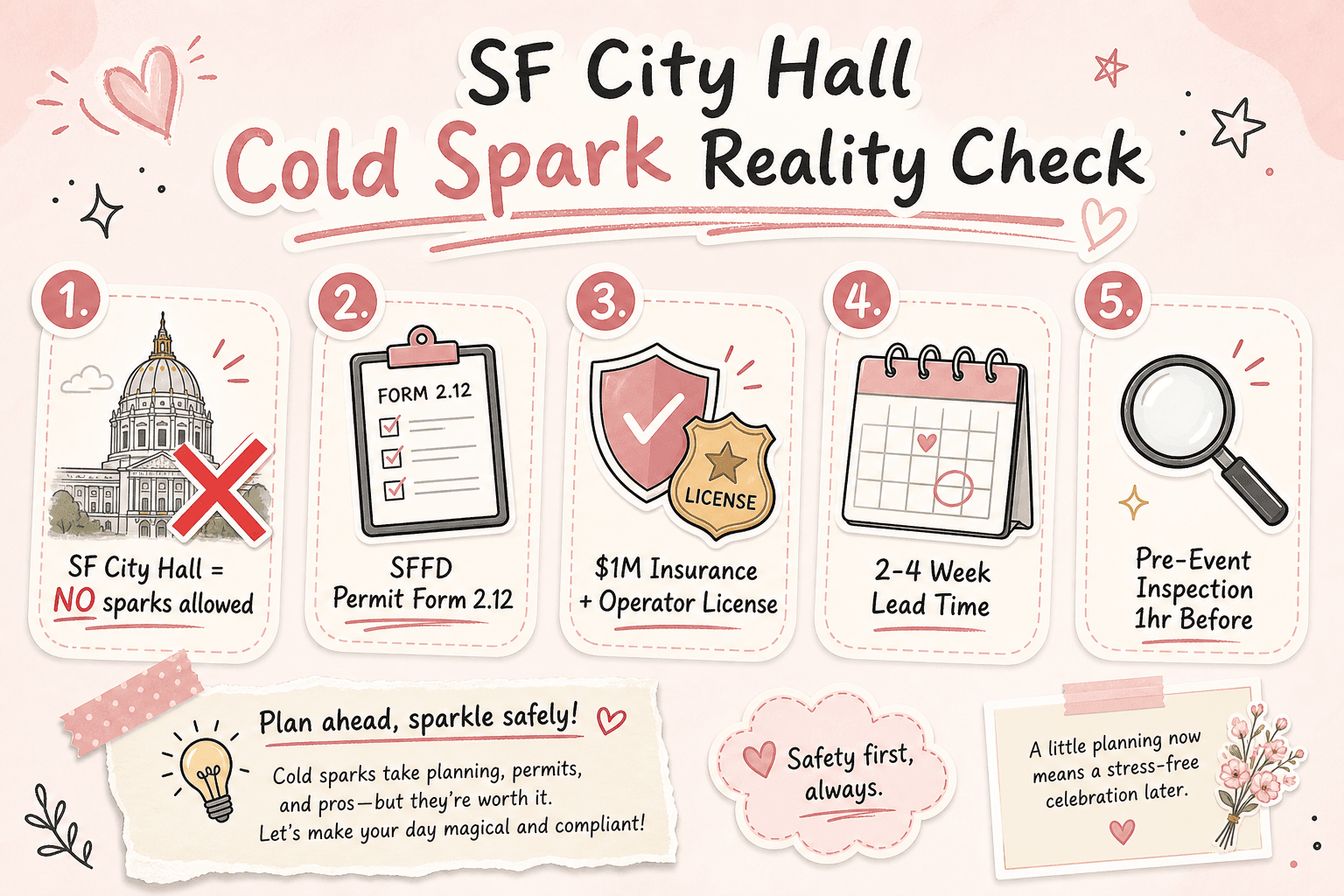
Short answer: SF City Hall does not allow cold spark machines on the premises. Not the Rotunda, not the 4th-floor galleries, not the 2nd-floor balcony, not the steps. SF City Hall Events rules are explicit: pyrotechnics, fireworks, or other similar items are prohibited inside and on the premises. The same rules also prohibit smoke, fog, snow, bubble and confetti generating devices, which rules out haze and dry ice too.
Elsewhere, the paperwork to look into is the fire authority's approval for the effect. In San Francisco that is the San Francisco Fire Department, which publishes detailed requirements for flame effect performances, but that bulletin doesn't name cold sparks, so the exact permit route is something to confirm with SFFD for your event. Marin has no single fire department at all, so there the first job is finding the agency for the exact address. Here's what the published requirements look like on both sides of the Golden Gate and what to ask, for planners 4 to 8 weeks out.
The short answer: yes (somewhere) — here's what a request needs
A first-dance cold spark moment may be approvable in SF, just not at City Hall. These ingredients are what a request has to have in place:
- A cold spark machine, not an open-flame device. For example a 350W or 600W unit (catalog: 350W 2–3 m throw; 600W 1–5 m). The machine heats titanium or zirconium granules and a fan blows the sparks out.
- A named operator on site who runs the machine. SFFD's flame effect plan identifies the effect operator by name; ask SFFD what it requires for a cold spark effect, including the operator's credential. Separately, California Health and Safety Code §12505 makes a firework a dangerous firework if it contains zirconium, or titanium "except in particle size greater than 100-mesh," and the Central County Fire Department notes that approved use of dangerous fireworks is to be performed by a pyrotechnic operator licensed by the Office of the State Fire Marshal. Whether a particular machine and its granules fall under that is for the fire authority to decide.
- Liability insurance. For flame effect performances, SFFD asks for at least $1,000,000 naming the City and County of San Francisco and its employees as additional insured. Ask SFFD whether the same limit applies to your cold spark effect, and ask the venue for its own requirement, which may be higher or require the venue to be named.
- The SFFD application. SFFD Administrative Bulletin 2.12 covers flame effect performances and says pyrotechnics must comply with Chapter 56 of the San Francisco Fire Code. For a flame effect it asks for a Temporary Open Flame Permit application, certificate of insurance, supplemental application for special events, a flame effect plan, a site plan and a design plan. The bulletin doesn't name cold spark, so ask the Fire Prevention Bureau which permit, documents and fees apply to your effect.
For flame effects, the bulletin sets a minimum of ten business days before the effect for all documents and a pre-event inspection by a Fire Department representative at least one hour before. Treat those as a reference point, confirm the deadline and inspection that apply to a cold spark effect, and submit early to leave room for questions.
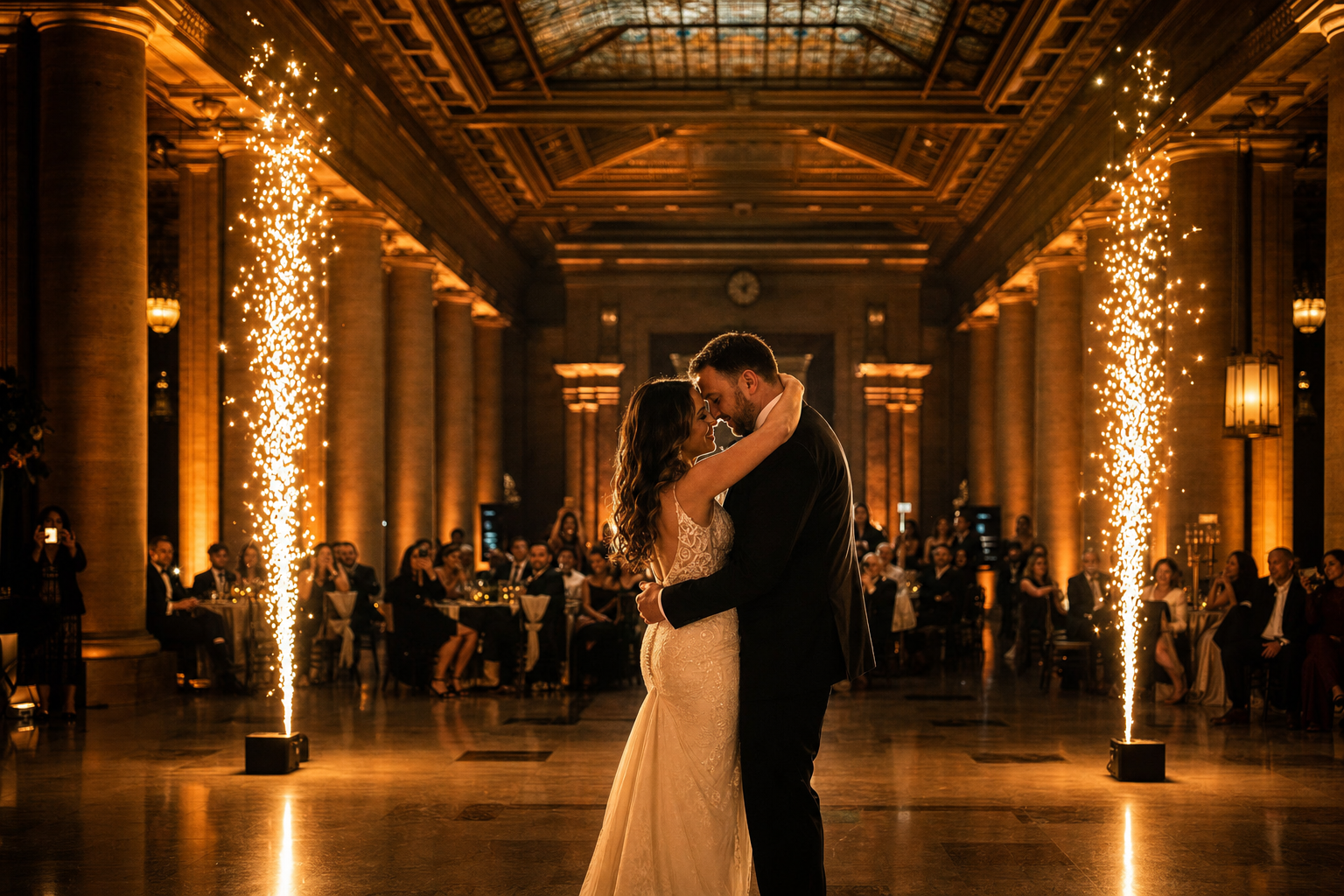
The Fire Department process: what the flame effect bulletin asks for
SFFD's Administrative Bulletin 2.12 (Flame Effect Performance Application Requirements) is the closest published checklist, and it is written for flame effects, not cold sparks; the bulletin states that pyrotechnics must comply with Chapter 56 of the San Francisco Fire Code. Use the points below as the questions to ask SFFD, not as a confirmed cold spark procedure.
Lead time. For flame effects, the bulletin's minimum for documents is ten business days before the effect. Confirm the deadline for a cold spark effect, and don't submit at the deadline. Reviewers can have follow-up questions on the site plan or the operator, and under the bulletin a fire watch request (below) has its own five-business-day deadline.
Insurance. For flame effects, the bulletin asks for liability insurance of at least $1M naming the City and County of San Francisco and its employees as additional insured. Confirm the requirement for a cold spark effect with SFFD, and ask the venue for its own limit.
Operator. The flame effect plan names the operator. Given the state classification of spark granules as dangerous fireworks, ask SFFD what credential it expects for your effect before you file. Agree in advance who loads, operates and packs down the machine.
Pre-event inspection. For flame effects, the bulletin requires a pre-event inspection by a Fire Department representative at least one hour before the effect to confirm compliance. Ask whether SFFD will inspect a cold spark effect the same way, and set the machines up exactly where the approved site plan shows them.
Fees. For flame effects, the permit fee covers three hours of Fire Department personnel time, and time beyond that is charged at hourly rates. Check the current SFFD fee schedule for the permit that applies to you. Under the bulletin, if a standby fire watch is required, it is requested on a separate Service and Overtime Request Agreement at least five business days before the event, with its own fees.
Where in SF City Hall sparks are not allowed (all of it) — and why
City Hall's wedding spaces include the Rotunda (under the dome), the 4th-floor north and south galleries, and the 2nd-floor balcony. None allow cold sparks.
Building-wide pyro prohibition. SF City Hall Events rules ban pyrotechnics, fireworks, or other similar items inside and on the premises. It's venue policy, so a Fire Department approval doesn't change the answer.
Fog and effect devices. The same rules prohibit smoke, fog, snow, bubble and confetti generating devices, so haze, low fog, dry ice, bubbles and confetti are out as well.
So the question becomes "where in SF can we get the same moment?"
After SF City Hall: finding a venue that says yes
If City Hall was the dream venue and cold sparks were the dealbreaker, ask each venue's events team; approval is venue-by-venue. Useful questions for each shortlisted venue:
- Has the venue hosted cold spark effects before, and in which rooms?
- What insurance limits does the venue require from the operator, and must the venue be named?
- What is the ceiling height in the room, and where are the sprinkler heads and smoke detectors?
- Does the venue have rules about distance from artwork, finishes or historic surfaces?
- Will the venue's facilities contact attend any Fire Department inspection?
Also check where the venue sits: some Bay Area fire authorities prohibit cold spark outright (Central County Fire bans them in Burlingame, Millbrae and Hillsborough), so the city matters as well as the venue.
Outdoor sites in San Francisco: who issues the permit
Outdoor public sites in San Francisco are run by different land managers, each with its own permit process on top of the fire code. The National Park Service's Golden Gate National Recreation Area manages sites including Crissy Field, Baker Beach and Ocean Beach, and says permits are required "for any size wedding or outdoor ceremony group" there. City parks such as Golden Gate Park go through SF Recreation and Parks, whose Special Event Application "must be submitted at least 60 days in advance." Other sites, such as parts of the Presidio, have their own managers. Confirm with the land manager what your event needs, and disclose the spark effect on any application. Private outdoor venues (patios, rooftops, winery grounds) set their own rules, and the local fire authority still applies.
Outdoors, wind also changes the plan. Wind can carry sparks sideways, which changes where they land, and whether and where a machine may run outdoors, and at what wind it must stop, come from the exact model's manufacturer instructions, the operator and the fire authority, not from a general rule.
Marin County: who has authority where
In Marin, cold sparks are decided venue by venue and fire agency by fire agency, not by one county rule. Marin doesn't have one fire department. It has several, and the lines don't always match the city map, so the exact event address decides which agency you apply to.
- Marin County Fire Department — areas of unincorporated Marin. Unincorporated addresses can also sit in separate fire districts, so check the address rather than assuming.
- Southern Marin Fire Protection District — the southern Marin communities around Sausalito and Tam Valley.
- San Rafael Fire Department — San Rafael.
- Novato Fire Protection District — Novato.
- Ross Valley Fire Department — Fairfax, Ross, San Anselmo and the Sleepy Hollow Fire Protection District.
- Others — Central Marin Fire, Tiburon Fire, Stinson Beach Fire and more.
Boundaries can change as agencies consolidate, so confirm the fire agency for the exact address with the venue events lead and with the agency itself before you start anything. Marin County Fire's permit page is a starting point for county permits.
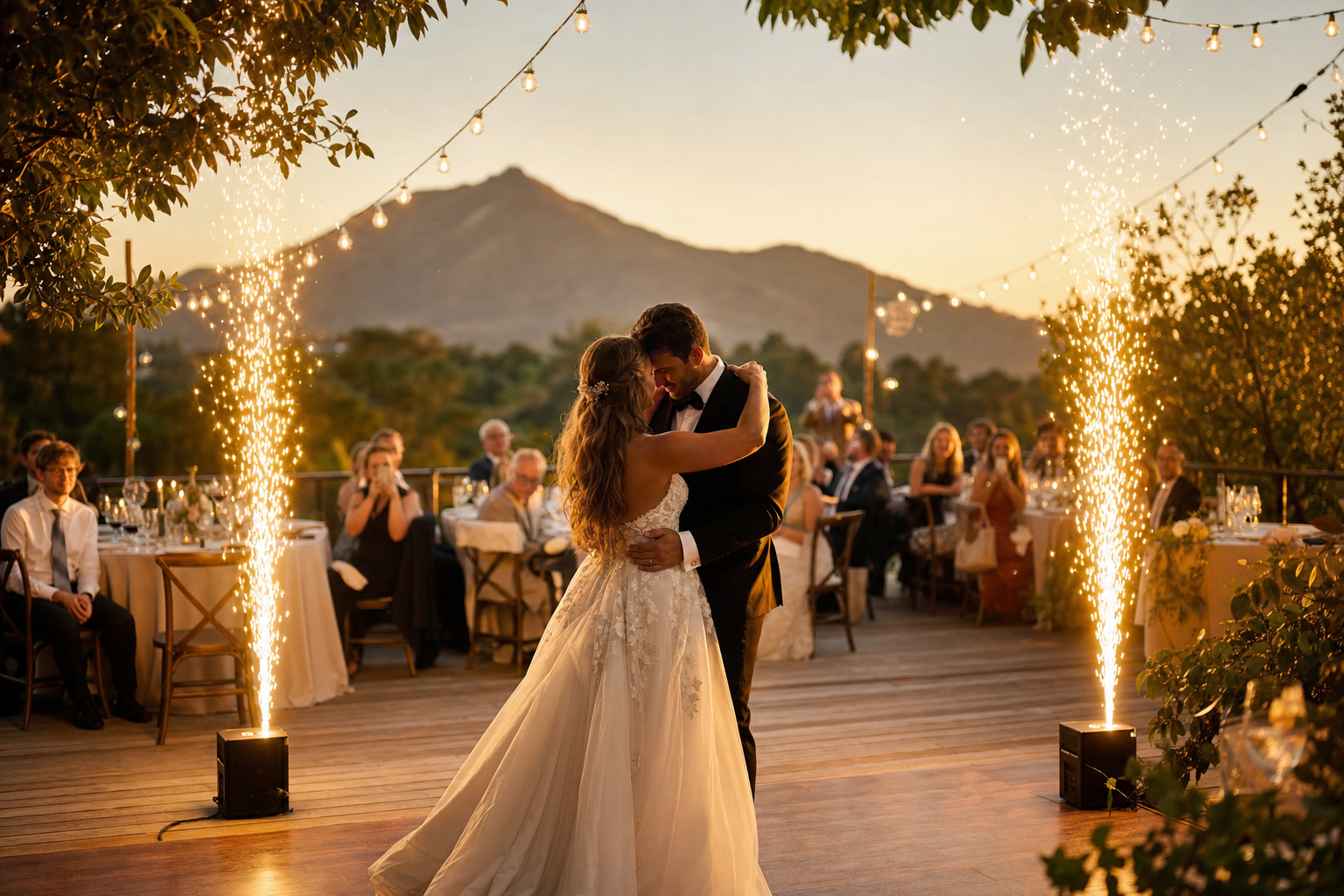
Marin: documents and timeline
Chapter 56 of the California Fire Code covers explosives and fireworks statewide, but each agency sets its own application, and a venue contract can add its own conditions. Documents and questions that may come up, depending on the agency and venue:
- The exact machine and granules. Which model and which spark granules, with the granules' safety data sheet. The fire authority classifies the device and consumable.
- Operator credentials — whatever the agency requires; if it asks for a State Fire Marshal pyrotechnic operator license, the number, type and expiration. Who operates is decided by the permit's conditions, not by the person's other role at the event.
- Certificate of insurance — if the venue or agency asks for one; the venue contract says who must provide it.
- Site plan with spark zone, machine placement, the perimeter clearance the agency specifies, exits and fixed combustibles.
- Fire watch — whether the agency requires one, and if so who provides it and for how long.
Lead time: ask the venue first, then ask each agency for its written deadline and current review time. As an illustrative planning allowance you might start four weeks or more before the date, but that is not a guaranteed turnaround: the agency's own timeline, conditions and any inspection decide it. If your event uses a public street or park, ask the city or land manager whether it needs its own reservation or special-event permit; any such permit is a separate process from the fire agency's, with its own deadlines.
Marin venues to ask about
Approval is decided per event by the venue and fire agency. None of these is a promise; each event runs its own approval cycle.
- Cavallo Point Lodge (Sausalito / Fort Baker). Ask which rooms the events team will consider and what insurance limit it wants.
- Marin Country Club (Novato). Ask about ceiling height and sprinkler positions over the dance floor.
- Marin Art and Garden Center (Ross). If house rules ban open flames and candles, that can be read as "no fire at all." A cold spark unit heats metal granules, and the sparks can still ignite nearby materials, so ask the events team directly how its rules apply.
- Sausalito Yacht Club. Ask about indoor versus dockside placement.
- Mill Valley Community Center. Ask about the larger event hall. If the reception would extend onto adjacent park space, ask the City of Mill Valley whether your site, event scope and hours need a park reservation, a special-event permit, or both.
- Falkirk Cultural Center (San Rafael). Ask which spaces, if any, the events team would consider, and what clearances from the building it would want.
Outdoor estates and West Marin: different questions
For a private estate or coastal property in unincorporated Marin — West Marin coast, Stinson, Bolinas, Tomales, Lucas Valley, San Geronimo Valley — the questions change, but the approvals don't go away:
- Pin down the exact spot. A private estate can include indoor rooms, tents, terraces and open lawn. Identify exactly where the machines would sit, and whether that spot is indoors or outdoors, before asking what applies.
- Find the right agency and land manager. Confirm the fire agency for the address, and for beaches or parkland, the land manager as well; national park sites such as those in the Golden Gate National Recreation Area have their own special park use permits.
- Fire weather. Red Flag Warnings, utility power shutoffs or fire restrictions may be in effect on your date, and any of them could change what is allowed. Check current official notices from the fire agency, the National Weather Service and PG&E close to the date, and plan the moment so the evening still works without the effect.
- Wind. Wind limits come from the exact model's manufacturer instructions and the permit's conditions, and the effect may have to be cancelled on the day.
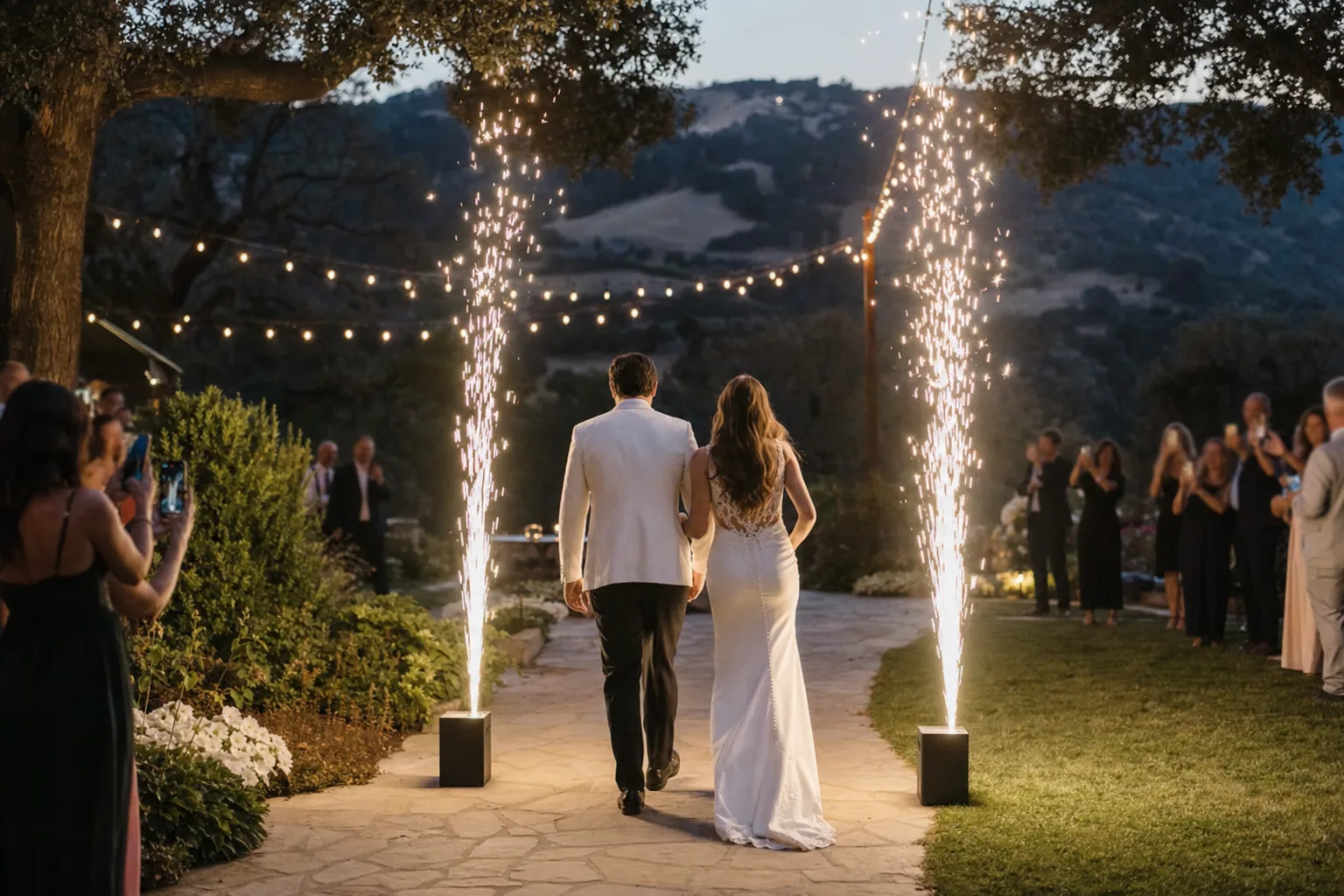
What you actually bring: specs for the review
Fire reviewers and venue engineers will want to know exactly what the machine is, how high it throws, and how it will be placed in the room. Our catalog lists these spark machine variants, among others:
- 350W Mini Spark Machine, listed with a 2–3 m throw.
- 600W Up-Spray Spark Machine, listed with a 1–5 m throw.
- 600W Hanging Spark Machine, listed with a 1–5 m throw.
- 750W Moving-Head Spark Machine.
- 1700W Outdoor Spark Machine, listed with a 5–10 m throw.
Throw height alone doesn't tell you whether a machine suits a room. Mounting, clearance to ceilings, people and combustibles, and the number of units come from the model's manual, the operator's assessment of the room and the site plan the venue and fire authority approve.
The single Cold Spark Machine is listed at $35 per day and the Rotating Cold Spark Machine at $90; the other variants are quoted per event. Put the exact model, its throw height and the spark material's SDS in the application or site plan. Don't let anyone substitute a traditional gerb or any device with an open flame for the machine named on the permit.
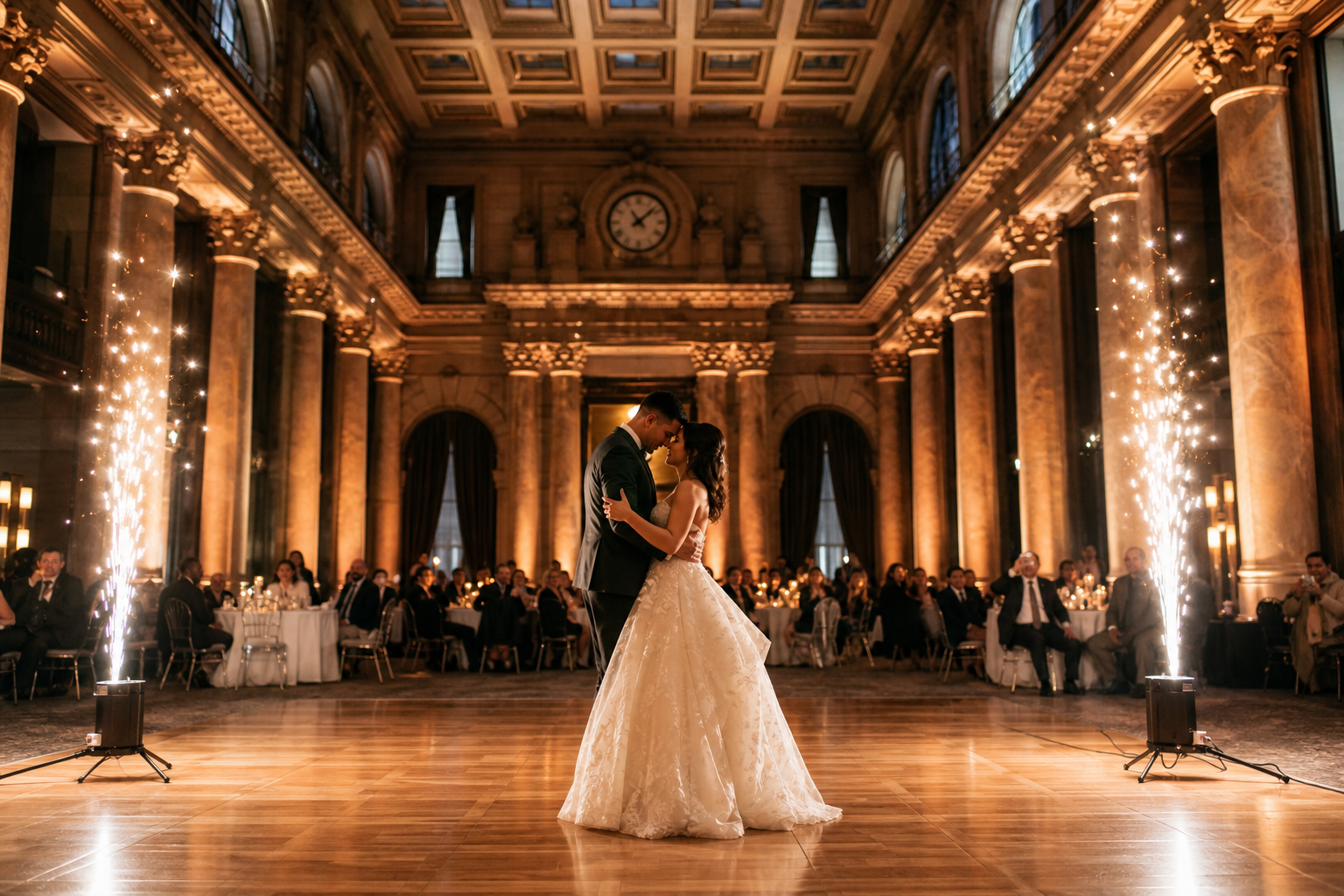
The first-dance moment: timing, fire watch, ventilation
Three operational details separate a clean discharge from one that causes problems:
Timing. Keep the effect short, and put the cue where the song lifts. The operator takes the cue from the DJ by radio or a hardwired line, and the effect is a single, rehearsed moment. That short cue is a creative choice, not a machine limit: how long a machine may fire continuously is set by its manufacturer. SHOWVEN's manual for its SPARKULAR II, for example, gives "the maximum continuous firing time for SPARKULAR® II" as 30 seconds, to prevent the heating chamber overheating, so ask for the limits of the exact model you rent.
Fire watch and extinguishers. For flame effects, SFFD's bulletin has the site plan show supplemental fire protection (trained fire safety staff, fire extinguishers, barricades and so on), and the department may require a standby fire watch; ask what it expects for a cold spark effect, and ask the same of a Marin agency. Insurers note that standard extinguishers may not be effective on the metal powder used to make the sparks, so ask the fire authority and your operator which extinguisher type to stage.
Keep clear of combustibles and detectors. One insurer's assessment of cold spark machines reports heating elements running at roughly 600 to 800°F, and Central County Fire notes that the heat from cold sparks can still ignite nearby materials, such as paper, fabric or a wedding dress. Keep machines away from drapes, dresses and décor, and place them so the plume isn't directly under a smoke detector. Ask the venue for its detector layout when you prepare the site plan.
What we handle, and what you handle
When our crew runs the cold spark effect, VENEGEEST holds the operating permits for running it; a client who rents the machines and operates them themselves carries that responsibility. Under our rental terms, the client is responsible for securing venue-specific permits or approvals, and delivery, setup and technician services are scoped and quoted to your event. The cost breaks into layers:
- Permit fee: set by the fire authority (SFFD or the Marin agency); check its current fee schedule.
- Machine rental: $35 per machine per day for the Cold Spark Machine, $90 for the Rotating Cold Spark Machine, other variants quoted. Ask how much spark granule the quote covers for your run time.
- Delivery, setup and technician time: scoped and quoted to your event; self-pickup is allowed.
- Licensed operator: when our crew operates the effect, VENEGEEST holds the operating permits for it. If you rent the machines without our crew, meeting any licensed-operator requirement the fire authority sets is your responsibility.
- Insurance: any certificate the venue or fire authority asks for is another line to budget; the venue contract says who must provide it.
What we need from you: the venue and date, the first-dance song and DJ contact, and an intro to the venue's events lead so the site plan and smoke detector layout can be requested. What we can supply: the spark machines and their specifications for the application, delivery and setup, and the machine operation on the night, each itemized in the quote. For how the machines work and how they compare with handheld sparklers, see the cold spark explainer; for models, prices and wedding layouts, see cold spark machine rental in the Bay Area, or browse the equipment catalog.
FAQ: Cold spark permits in San Francisco and Marin
Are cold sparks allowed at SF City Hall?
No. SF City Hall Events rules prohibit pyrotechnics, fireworks, or other similar items inside the building and anywhere on the premises, including the Rotunda, 4th-floor galleries, 2nd-floor balcony, and steps. The rules also prohibit smoke, fog, snow, bubble and confetti generating devices, which rules out haze and dry ice.
Where can I have cold sparks for a wedding in SF?
Only where both the venue and the fire authority approve it. Ask each venue's events team; approval is venue-by-venue, and on top of the venue's yes you need whatever the fire authority requires; ask SFFD about the permit, insurance and operator for a cold spark effect.
How long does the permit take?
Ask the fire authority, because there is no single timeline. SFFD's published bulletin is written for flame effects, not cold sparks: for flame effects, Administrative Bulletin 2.12 sets a minimum of ten business days before the effect for all documents and a pre-event inspection at least one hour before. In Marin, each agency sets its own deadline and review time. Confirm the route and deadline for your effect and address, and submit early.
What insurance do I need for cold sparks in SF?
Confirm it with SFFD and the venue. For flame effect performances, SFFD's bulletin asks for at least $1M in liability insurance naming the City and County of San Francisco and its employees as additional insured; whether the same applies to a cold spark effect is SFFD's call. Your venue may require a higher limit and to be named as well.
Do all Marin wedding venues allow cold sparks?
No. Venues with no-flame policies may treat cold sparks as fire; ask the events lead before booking. Historic buildings and barns may need extra review, and some fire agencies prohibit the devices outright. Always ask the venue events lead and the fire agency for the exact address before booking the effect.
Can we do cold sparks outdoors at a Marin beach or park wedding?
Not unless the fire agency and the land manager for that exact site approve it in writing, and some may not. Beaches and parks can be managed by different agencies, each with its own rules. Only once approval is established do wind, the model's manufacturer limits and the permit's conditions come into play, and the effect may still be cancelled on the day. Plan the celebration so it works without the effect.
What if the fire inspector shows up and says no on the wedding day?
It can happen. An approval can carry conditions, and an inspector, the weather or fire restrictions on the day can still stop the effect. Follow the approved plan exactly, ask the agency in advance what an inspection will check, and have a version of the moment planned without sparks.
Can the DJ or venue staff operate the cold spark machines?
Only if they are qualified and authorized to do so under the actual permit's conditions. What matters is the credential and authorization the fire authority requires, not the person's other role at the event. Running the machine outside the permit's terms can put the approval at risk. When VENEGEEST's crew operates the effect, VENEGEEST holds the operating permits; if you rent the machines and have your own people run them, you carry that responsibility.
Can I bring my own cold spark machine to skip the permit?
No. Bringing a different machine doesn't change what the venue and the fire authority require, and any approval is for the effect, operator and placement they reviewed. An unapproved discharge exposes the couple, planner, and venue to enforcement and can end your relationship with the venue on the spot.
Get a quote
Send your venue, date, and first-dance moment, and we'll come back with the machine options and an itemized quote for the equipment, delivery, setup and operation. We deliver across San Francisco, the South Bay and the wider Bay Area. Call (415) 890-5555.