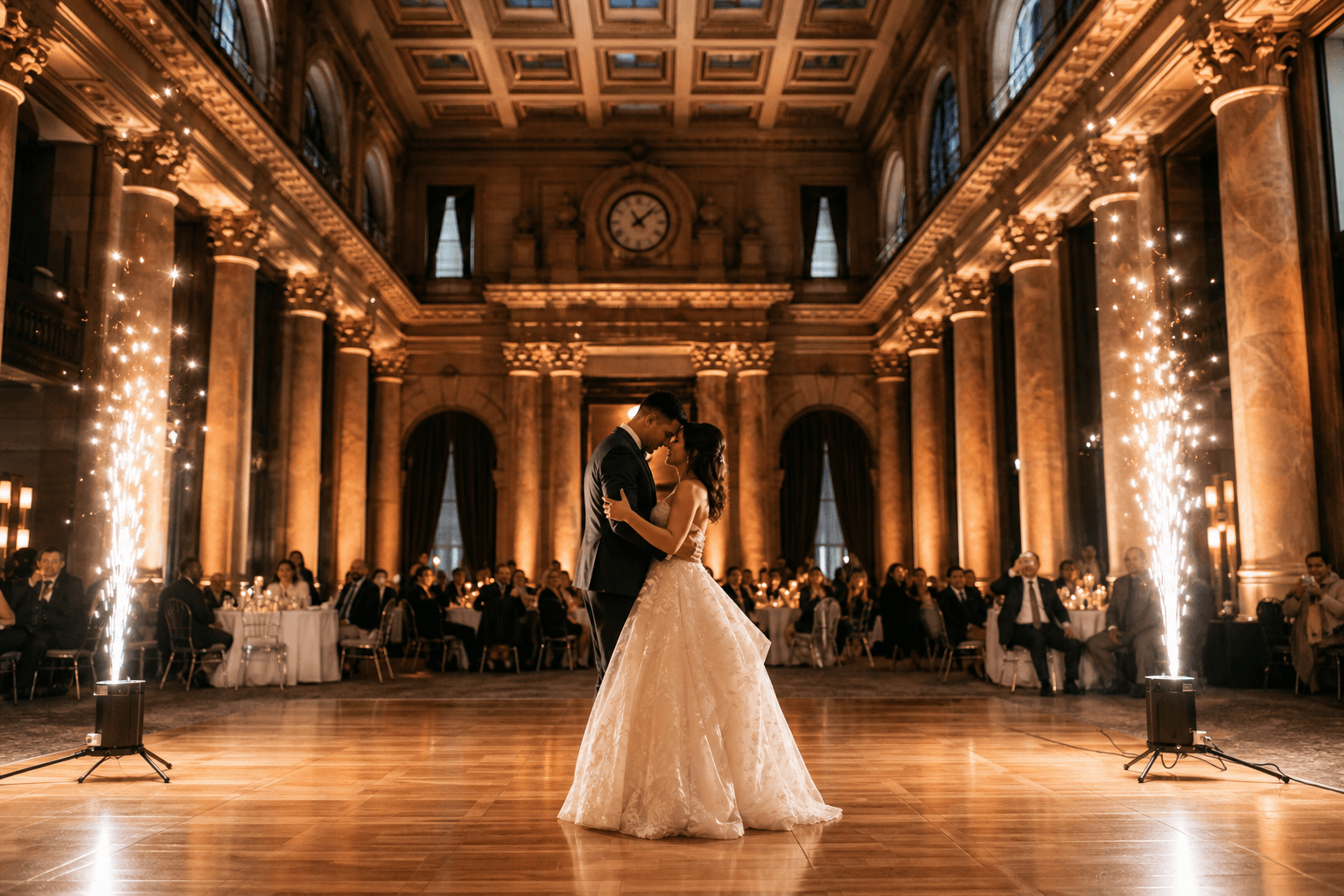
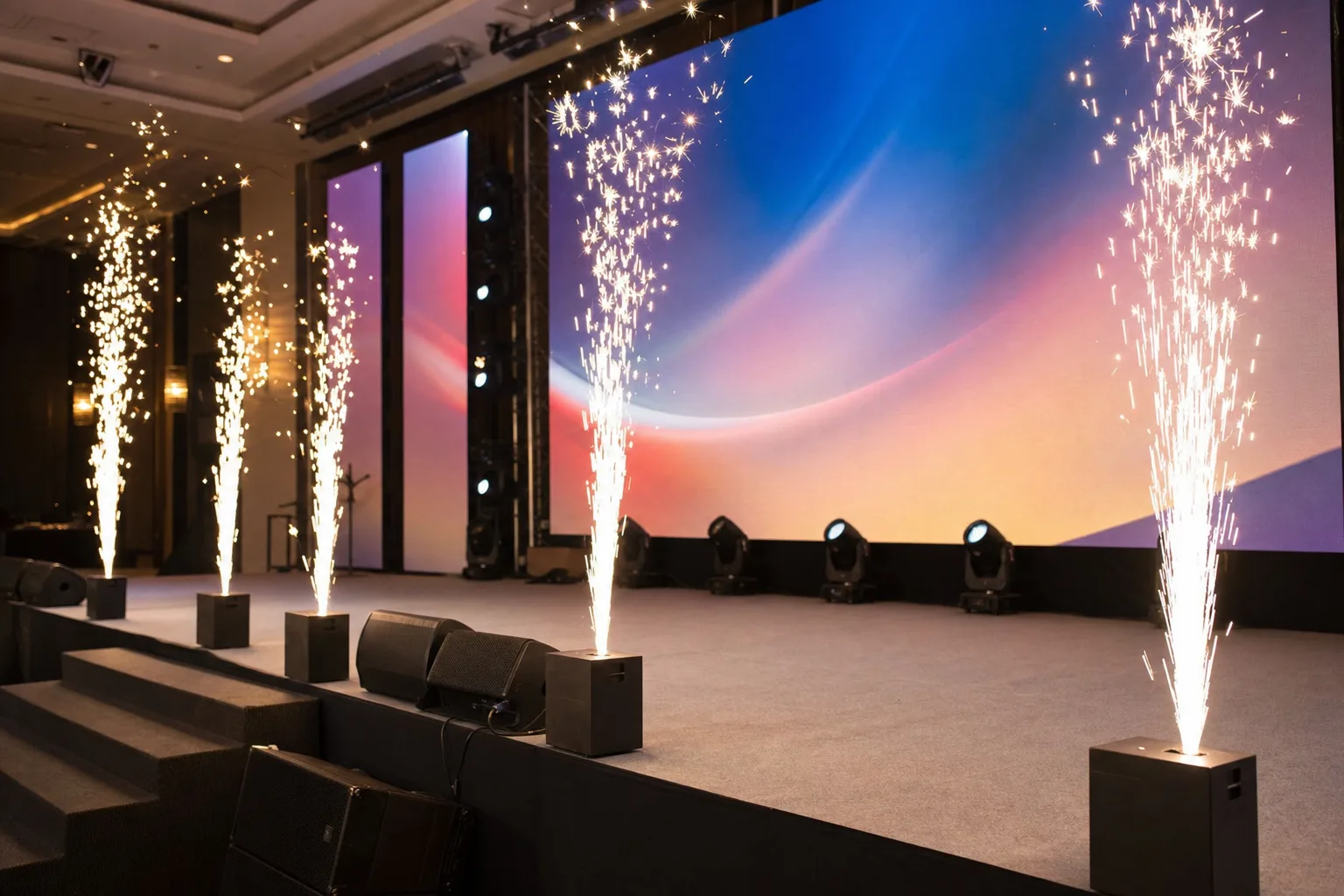
A cold spark machine is an electric stage effect that throws a fountain of bright sparks straight up into the air and looks a lot like a pyro gerb. People see one at a wedding entrance or a brand launch and immediately ask the same question: how is that not fire?
The short answer: it is hot metal, not a flame. Granules of a titanium-zirconium alloy are fed onto a heated element inside the machine, they heat until they glow, and a fan lifts the incandescent particles into a column. The particles run cooler than a sparkler's, but "cold" is a marketing word: they can still burn skin, scorch fabric and ignite nearby materials, and California law treats the granule material as dangerous fireworks.
Below is what is happening inside a cold spark machine, how it compares with handheld sparklers and pyro, and what a venue and fire authority will want to know before one fires at your event.
The "cold" misnomer: cold compared to what?
The sparks are not cold in any absolute sense. A particle leaving the machine is hot enough to glow: CryoFX describes the sparks as incandescent metal particles that oxidize at their surface and cool as they travel, with no oxidizer in the mix the way a pyrotechnic composition has one. The particles are tiny and cool quickly, and CryoFX says they run cooler than conventional pyrotechnic output. That is where the name comes from.
Don't read that as "safe to touch." CryoFX, which makes and sells these machines, says plainly that the particles "will burn skin on contact, they will scorch fabric, and they will ignite anything flammable." The Central County Fire Department makes the same point: the heat released is lower than a standard sparkler's, but "the heat generated from cold sparks is still capable of igniting nearby materials." Videos of people passing a hand through the plume don't transfer to a veil, a tablecloth or a paper decoration.
Some venues consider them where real pyrotechnics are not allowed, but some fire authorities classify the granules as dangerous fireworks and ban the machines. Where they are allowed, it is on the venue's and the fire authority's conditions.
What's inside the granule
The consumable is a small sealed pack of metal granules that looks like coarse gray sand. Pack sizes vary by machine; CryoFX cites 50-gram packs for mini machines and 200-gram packs for standard ones.
The chemistry:
- Titanium-zirconium alloy as the primary fuel. CryoFX notes some formulations add magnesium, and that manufacturers don't publish exact ratios.
- Metal, not a charge. Unlike a pyrotechnic gerb, there is no single-use tube and fuse; the machine meters granules onto its heater only while it is firing.
The legal side is simpler than the chemistry: California Health and Safety Code Section 12505 classifies ignitable materials containing titanium and zirconium compounds as dangerous fireworks, so the granules are regulated as such.
How the heating element produces the fountain
Open the case and a cold spark machine is mechanically simple. There are four working parts.
- The hopper. A small canister holds the granule charge above the firing chamber.
- The feed. A motor meters granules down into the hot chamber at a controlled rate. More granules per second means a denser fountain.
- The heating element. CryoFX puts the chamber at roughly 500 to 620 degrees Celsius, which is about 930 to 1,150 degrees Fahrenheit. Granules that land on it heat until they glow and begin to oxidize.
- The blower. A fan underneath pushes air up through the chamber, lifts the hot particles, and shapes them into the column you see on stage.
Height is controlled by feed rate and blower speed, and machines vary widely. VENEGEEST's cold spark range runs from a 350W mini unit with a 2–3m throw, through 600W up-spray and hanging units (1–5m), to a 1700W outdoor unit rated at 5–10m, plus spin, direct-spray, moving-head and burst models. Many professional units take DMX, so a lighting operator can cue a fountain on a downbeat. Run time depends on the granule charge: CryoFX cites 3 to 4 minutes of cumulative effect from a 50-gram pack in a mini machine and 12 to 15 minutes from a 200-gram pack in a standard one.
Cold spark vs handheld sparklers vs pyro fountains
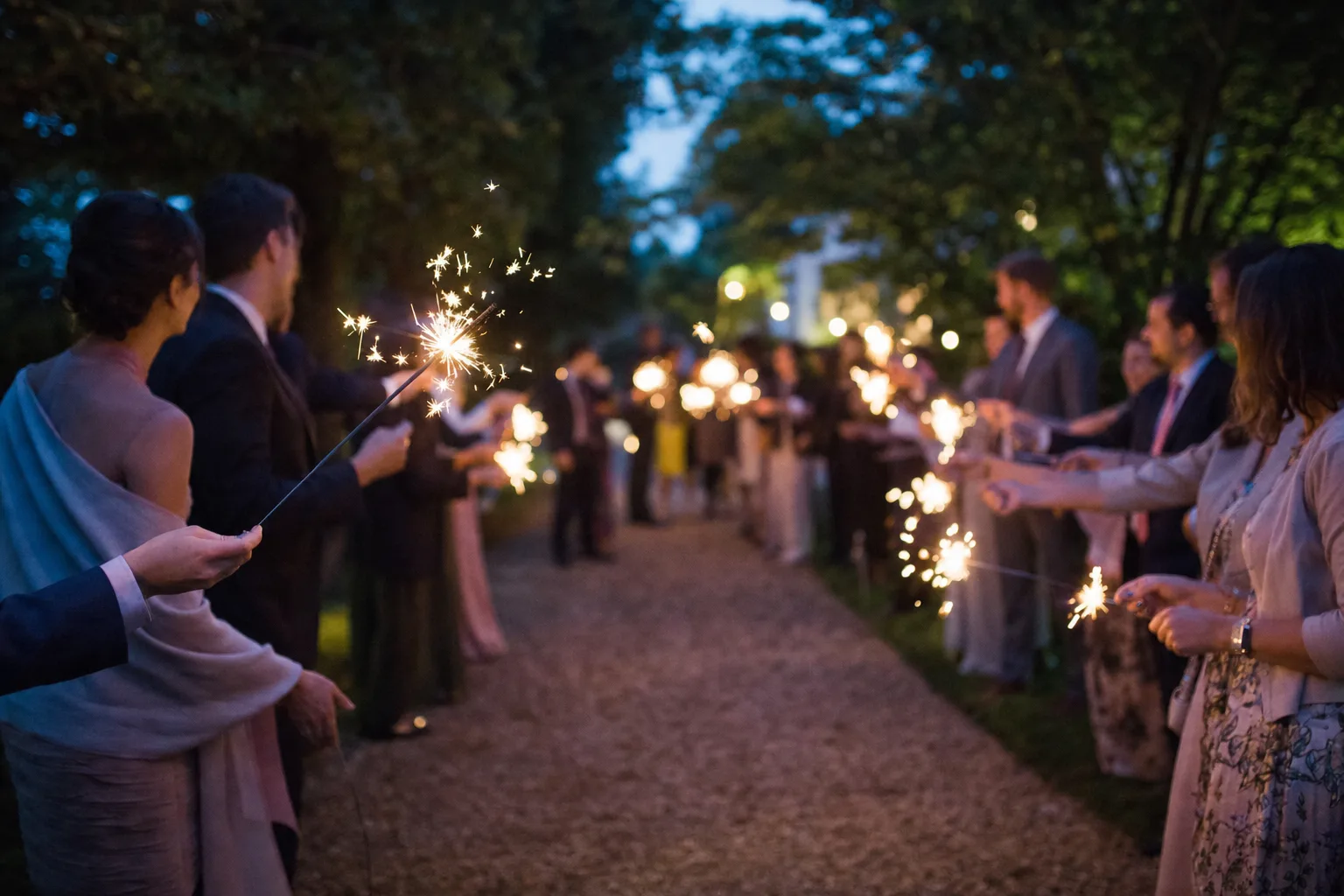
These are three different things, and a venue may treat each one differently. The handheld sparklers people picture for a send-off line, the ones sold for the Fourth of July, are fireworks. Indoors, in front of guests, pyrotechnics fall under NFPA 1126, the Standard for the Use of Pyrotechnics Before a Proximate Audience, which brings permits and licensing into play. NFPA 1126 was also amended to cover pyrotechnic effect simulation equipment, which folds cold spark machines into its definition of a pyrotechnic device. So neither effect is outside the fire rules; they sit under them differently.
So when a planner tells a couple we can do indoor sparklers, find out what they mean. They may mean cold spark machines and be using the wrong word, or the venue may not have signed off yet. Ask for the venue's approval in writing either way.
| Cold spark machine | Handheld sparkler | Pyrotechnic gerb | |
|---|---|---|---|
| What it is | Electric machine that heats titanium-zirconium granules and lifts the glowing particles with forced air; reusable, refillable | A firework held by a guest | A single-use device that runs to completion once lit |
| Heat | Cooler than a sparkler's, but still hot enough to burn skin and ignite nearby materials | Burns much hotter than a cold spark; the wire stays hot after the effect ends | — |
| How it is regulated | A pyrotechnic device under NFPA 1126; in some California jurisdictions, Dangerous Fireworks under Health and Safety Code 12505 | Fireworks; indoors, pyrotechnics before an audience fall under NFPA 1126 | Requires a licensed pyrotechnician and a permit |
| Where it is banned | Some jurisdictions prohibit it outright, including Burlingame, Millbrae and Hillsborough under Central County Fire | Your venue may prohibit it indoors entirely | Per the venue and fire authority |
| Who handles it | A technician; guests do not touch it | Guests, which is part of the appeal and part of the liability | A licensed pyrotechnician |
| Debris | Particles fall inside a fall zone that must be kept clear of anything flammable | A glowing wire and falling embers | — |
| Photo look | A tall fountain or arch effect framing the couple, programmable height and duration | A tunnel of small handhelds | A stage fountain |
If a planner says "we want sparks at the first dance," a cold spark machine on a cue is usually what they mean, subject to what the venue and fire authority allow.
Indoor venue safety: what the fire marshal will ask
Cold spark machines appear at hotels, country clubs and event venues because they are more controllable than pyro: electric, metered, and cued. VENEGEEST's catalog describes its units as indoor-safe spark fountains; that is the equipment's own product description, meaning they are designed for indoor use, and venue approval and any fire-authority permit still apply. The decision is the venue's and the fire authority's, not the machine's. California rules vary: some fire authorities treat cold spark as a permitted special effect, while others (Central County Fire) classify the granules as Dangerous Fireworks under Health and Safety Code 12505 and prohibit the machines. Ask your local fire marshal. Central County Fire covers Burlingame, Millbrae and Hillsborough, where the devices are prohibited.
Do not assume a cue will leave the fire alarm alone. CryoFX notes that detector sensitivity varies widely between buildings and that cold spark output has set off alarms, so disclose the effect to the venue's fire safety team and fire authority in advance and let them decide how detectors near the machines are handled. Standard precautions on a real production:
- Clearance to ceilings, drape, rigging, décor and guests, as set by the venue and fire authority. CryoFX recommends 15 feet of clearance around the effect and 20 to 25 feet of ceiling clearance.
- No flammable fabric, paper or balloons in the fall zone.
- A fire extinguisher within reach during the cue; CryoFX specifies a Class D extinguisher, the type rated for burning metal.
- Smoke detector coordination with venue engineering, agreed in writing — never an unannounced cue.
- A licensed pyrotechnic operator where the fire authority requires one; under California's classification, approved use of dangerous fireworks is performed by an operator licensed by the State Fire Marshal.
A venue deciding on cold spark is also likely to want documents, not just a description of the effect. Here is what venues and fire authorities may ask a vendor for:
- Certificate of Insurance naming the venue as additional insured, at the coverage amount and lead time the venue specifies.
- Safety Data Sheet for the spark granules, which the venue's fire safety officer may ask to review.
- Equipment spec sheet for the unit.
- Site walkthrough confirmation, ideally with the venue's banquet captain or in-house engineer, to mark fall zones and confirm clearance from drapes, ceiling treatments and detector heads.
- Permit and operator credentials as the local fire authority requires.
If a vendor cannot tell you which of these your venue and fire authority need, or tells you no permit is ever required, treat that as a warning sign. For how the permit side works at SF City Hall, with the San Francisco Fire Department and across Marin's fire agencies, see our guide to cold spark permits in San Francisco and Marin.
When you'd actually use one
Cold sparks belong on moments, not as ambient lighting. The cues that work:
- First dance and grand entrances at weddings — two units flanking an aisle, a short burst.
- Brand launch reveals — sparks on the curtain drop or the keynote walk-on.
- Concert downbeats and key changes — DMX-cued, several machines across the stage.
- Convention and trade show stings — short bursts to pull eyes back to the stage.
- Music video and photo shoots — controllable and repeatable, which is the part directors care about.
Sourcing: DIY purchase vs renting from a production company
Machines are sold online: as of September 2026, the manufacturer CryoFX lists its own iSparkFX machines at $799 to $1,499 on its cold spark machine page (cryofx.com/cold-spark/machine). For anything in a permitted venue, renting usually makes more sense, for three reasons.
First, consistency. A fountain that stutters on the cue looks worse on video than no effect at all, so the machine and its granules need to be matched and tested.
Second, venue paperwork. Venues may ask for a certificate of insurance, a floor plan with the machine positions, and the approvals the fire authority requires, before load-in.
Third, programming. A two-machine cue on a hand trigger looks fine. A six-machine cue across a stage, timed to a song, is a lighting operator's job.
At VENEGEEST the Cold Spark Machine is listed at $35 and the Rotating Cold Spark Machine at $90; other variants are priced on request, and delivery, setup and technicians are scoped and quoted to your event. Under our rental terms, the client is responsible for securing venue-specific permits or approvals. When our crew operates the effect, VENEGEEST holds the operating permits for running it; a client who rents a machine and operates it themselves carries that responsibility. For models, pricing, wedding send-off layouts and booking, see cold spark machine rental in the Bay Area.
FAQ: Cold Spark Machines
Are cold spark sparks actually cold?
No. The particles are hot, glowing metal, and they run cooler than a sparkler's but can still burn skin, scorch fabric and ignite nearby materials, according to both the manufacturer CryoFX and the Central County Fire Department. Treat the fountain as hot and keep people and décor out of it.
Will a cold spark machine set off fire alarms?
It can. CryoFX reports that cold spark output has set off alarms in some venues and that detector sensitivity varies widely. Whether a given system reacts depends on the detectors, the ceiling height and where the machines sit, so walk the room with the venue's engineer, tell the fire safety team and the fire authority in advance, and let them decide how detectors near the effect are handled.
Do you need a permit?
California rules vary: some fire authorities treat cold spark as a permitted special effect, while others (Central County Fire) classify the granules as Dangerous Fireworks under Health and Safety Code 12505 and prohibit the machines. Ask your local fire marshal, and expect the venue to ask for an insurance certificate and a placement plan.
Is cold spark allowed everywhere in the Bay Area?
No. Central County Fire Department prohibits cold spark devices in Burlingame, Millbrae and Hillsborough, and other fire authorities set their own permit requirements. Check with the venue and the local fire authority for your specific site before you book the effect.
My planner said indoor sparklers are fine at our venue. Should I trust that?
Ask the planner to put it in writing, and ask which permit applies. If they cannot name one, or they meant cold spark all along, you have your answer. Handheld sparklers indoors fall under the pyrotechnic rules in NFPA 1126, and your venue may prohibit them entirely; whatever the plan, the venue has to approve it.
How long does a granule charge last?
CryoFX cites 3 to 4 minutes of cumulative effect from a 50-gram pack in a mini machine, and 12 to 15 minutes from a 200-gram pack in a standard machine. If your moments are short bursts, one charge can cover several cues.
Why should I invest in a cold spark machine instead of renting one?
Buying can make sense if you fire effects regularly, for example as a venue or a touring production, and you can take on everything the machine brings with it: a regulated granule supply (California classifies titanium-zirconium granules as dangerous fireworks), a Class D extinguisher, the venue's insurance and safety paperwork, trained operators, and testing before each show. It also doesn't help in places that ban the machines outright, such as Burlingame, Millbrae and Hillsborough. For an occasional event, renting is usually the simpler path: the Cold Spark Machine is listed at $35 and the Rotating Cold Spark Machine at $90, against $799 to $1,499 for CryoFX's own machines as of September 2026. Delivery, setup and technicians are scoped and quoted to your event, and when our crew operates the effect, VENEGEEST holds the operating permits. See our guide to cold spark machine rental in the Bay Area for the full range.
What power supply frequency does a cold spark machine require?
Our catalog lists each cold spark unit by wattage (a 350W mini, 600W up-spray and hanging units, and a 1700W outdoor unit), not by frequency. Venue outlets in the United States supply 60 Hz AC, and each model's rated voltage and frequency are on its spec sheet; spec details are provided on request. Plan the circuit with the venue or a power vendor, since higher-wattage units draw more, and keep the machines off circuits shared with other heavy loads. VENEGEEST doesn't supply generators or power distribution. DMX, where a unit has it, is a control signal for cueing and is separate from the power supply.
Can I use one outdoors?
Where the venue and fire authority allow it. Wind is the main problem: it bends the column and pushes sparks sideways, which is both ugly and a clearance issue, so keep a wide clear zone downwind. Fire season matters too: the particles can still ignite dry material, so ask the property and the local fire authority whether fire-season restrictions cover cold spark rather than assuming an open-flame ban exempts it. VENEGEEST's range includes a 1000W IPX4 waterproof unit (2–6m) and a 1700W outdoor unit (5–10m).
How far back do guests need to stand?
Follow the clearances in the manufacturer's manual for the specific machine, and confirm with the venue. Mark the zone with floor tape during setup so the photographer and guests know where to be.
Can we still do a traditional sparkler exit outdoors at a private residence?
Possibly, depending on the city, the time of year and the property. If you are bringing your own sparklers, check with the local fire department first, and expect restrictions during fire season.
What's the difference between Sparkular and other brands?
Sparkular is one widely discussed cold spark machine brand, and other manufacturers make competing units. They share the same basic mechanism (granules heated on an element and lifted by a blower), but throw height, spray direction, approved consumables and clearance requirements are model-specific. Follow the exact model's manual for its granules and safety zone, and the venue's and fire authority's conditions on top of that.
The takeaway
A cold spark machine is a precise piece of stage equipment, not a magic trick. It heats real metal particles until they glow to produce a real fountain of light, in a machine that meters the fuel and can be cued to the second. That control is why it has become a common alternative to pyro fountains and handheld sparklers for indoor moments, but the sparks are still hot and the material is still regulated. If you are planning a moment where a short fountain would earn its place, clear it with the venue and the fire authority first, then rent the machine and put the cue in the run of show.