An awards ceremony asks AV to do two things at once: keep a long run of category announcements moving, and give each recipient a moment that looks deliberate on stage and in the photos. Trade associations in hotel ballrooms, HR teams running recognition dinners and nonprofit boards hosting annual galas all face the same decisions — how to light the walk-up, where the nominee reels play, which reveal effects the venue will allow, and who calls the cues. This guide walks through those decisions as questions to settle with your venue and your AV supplier, not as fixed formulas. If the ceremony is part of a fundraising dinner, our gala and charity auction AV checklist covers the auction side.
Screen Configuration and Sightline Strategy for Ballroom Awards
The first screen decision is usually between one upstage screen behind the podium and a pair of side screens flanking the stage. A single center screen such as a P1.9–3.9 LED rental screen keeps nominee reels, winner names and sponsor slides on the same plane as the presenter, which gives photographers one backdrop to frame. It suits rooms where the stage sits against one wall and most tables face it.
Side screens help in wide rooms or long, narrow ones, where guests at the far wings or the back see the center screen at a steep angle or from a long way off. LED TV displays (43″ to 120″ in the VENEGEEST catalog) can repeat the stage content closer to those tables. The TV floor stand is specified for 32″–85″ screens up to 132 lb, so a larger display needs a support rated for it, confirmed with the quote. The trade-off is that the stage photo loses its unified backdrop. Which layout works depends on the room's shape, the seating plan and how much text your slides carry, so the reliable way to decide is to walk the room, sit at the worst seats, and look at a sample slide at the size you plan to use.
- Screen size and pixel pitch: pick them against the real viewing distance of your farthest and closest guests. Display makers publish viewing-distance guidance for their panels; ask your supplier which pitch they recommend for your room and view a test slide before the event.
- Stand and mounting: confirm the height and screen size a stand is rated for before planning a raised side screen.
- Content feeds: decide early whether every screen shows the same feed, or whether one side carries nominee information while another loops sponsor slides — it changes the playback and switching you need.
- Room light: test your content with the house lights at the level you plan to use during the program, not in a dark room at load-in.
- Backup playback: a second laptop with the same show file, ready to switch in, is a simple guard against a crashed playback machine.
Followspot Coverage and Walk-Up Choreography
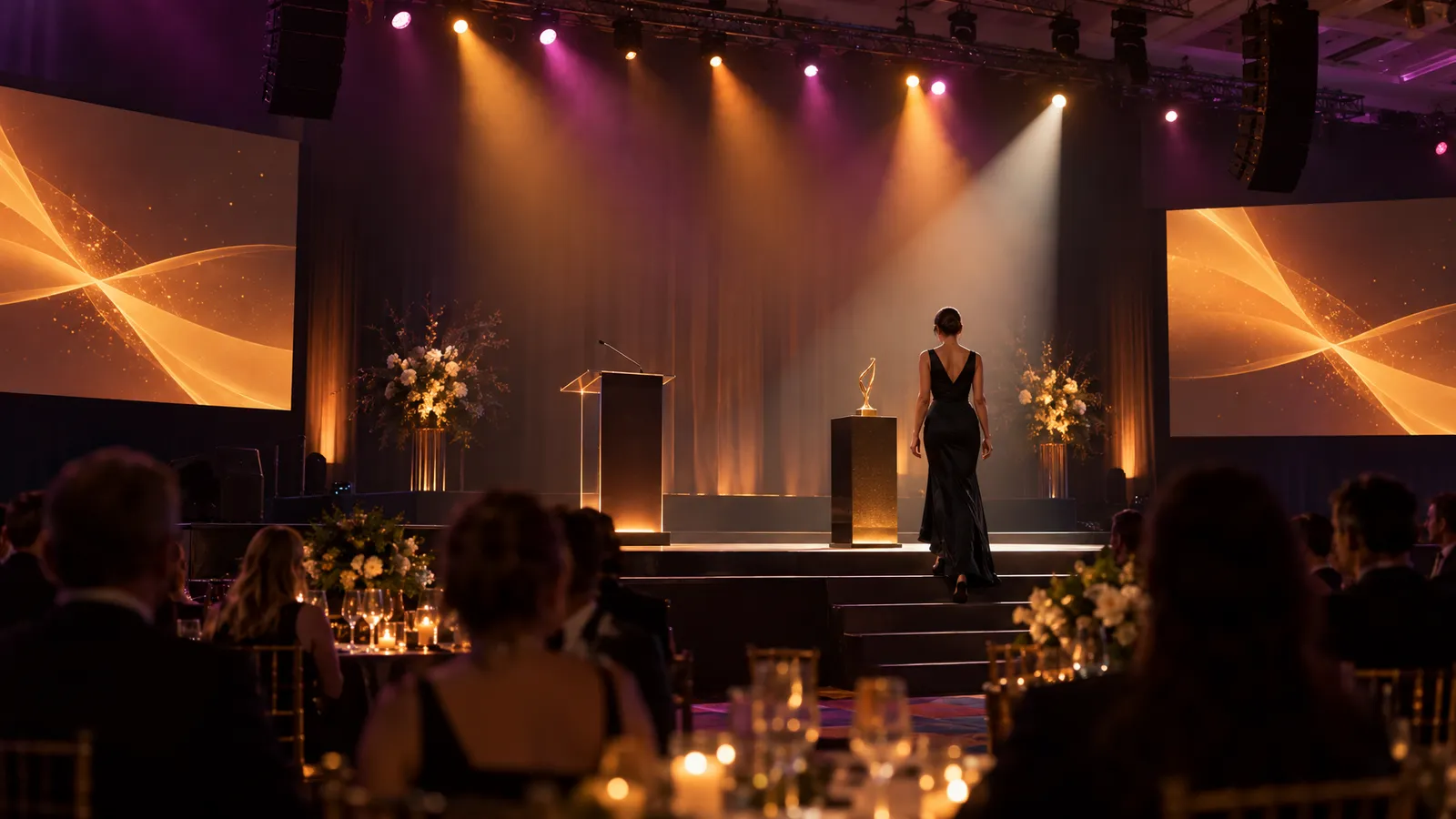
The walk-up is the moment guests remember: the winner's name is read, a followspot finds the recipient at their table, follows them to the stage and holds through the handshake and photo. VENEGEEST's followspot is a manual 330W–440W unit at $80 per day, so a person has to operate it and be told when to move.
Whether one followspot is enough depends on your program rather than on a category count. One operator can handle a simple format in which recipients come up one at a time from the audience. A second operator becomes worth pricing when presenters and recipients enter from different directions, or when the next presenter needs to be lit while the current recipient is still on stage. Where the spot sits, and how far it has to throw, depends on the room and the fixture — have your supplier check the position against the fixture's specifications and the venue's rules before you commit to it.
- Cueing: the operator should hear the stage manager's calls on headset or radio rather than guess from the room.
- Beam size: agree with the operator how tight the beam should be on the walk-up and how wide it should open for group photos on stage.
- Color match: ask for the followspot to be matched to the stage key lights, and have the photographer check white balance under both during rehearsal.
How many followspots do I need for a long awards program?
Start from the run of show. If every category follows the same pattern — one presenter at the podium, one recipient walking up from the audience — a single operator may keep up. If categories overlap, with the next presenter entering while the previous recipient is still posing for photos, a second operator avoids a dark stage during the handover. A second operator is scoped and quoted to your event, so walk through the sequence with your supplier and decide based on how the transitions actually play.
Stage Lighting for Podium and Trophy Presentation Moments
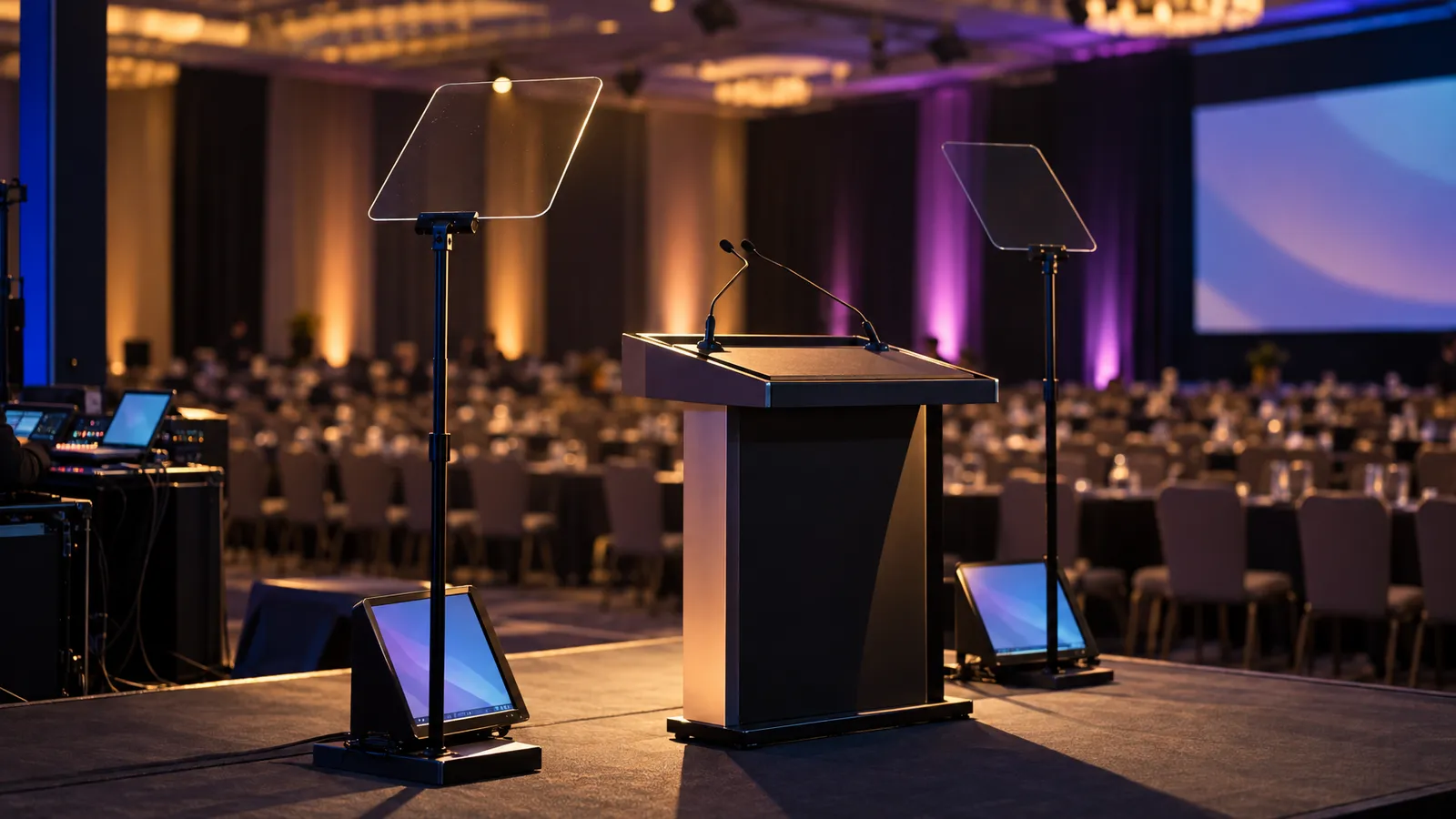
Ballroom chandeliers are designed to light tables, not faces at a podium, and overhead light alone can leave shadows under the eyes of anyone standing on stage. Adding front light aimed at the podium from the sides helps fill those shadows. Full-color LED par lights (18-LED RGBW, $25 per day each) or a COB front light ($35 per day) are catalog options; the number of fixtures, their angle and their height should come from a walk-through of your stage, not a fixed recipe.
The practical test is photographic: during rehearsal, have someone stand at the podium and on the award mark while the photographer takes test frames under the planned house and stage levels. Adjust intensity and color until faces look natural and match what guests see, and write those levels down as the show settings.
- Color: set the stage lights to sit comfortably with the room's house light and the screen, then lock the photographer's white balance to that setting.
- House-light levels: agree with the venue which house zones can be dimmed, how, and who operates them during video segments and walk-ups.
- Upstage accent: wireless battery uplights can add color to the stage wall without running power cables across the floor.
- Backup: ask what happens if a fixture fails mid-show — a spare on site, or a plan to re-aim the remaining lights.
Winner-Reveal Effects That Stay Inside Black-Tie Tone
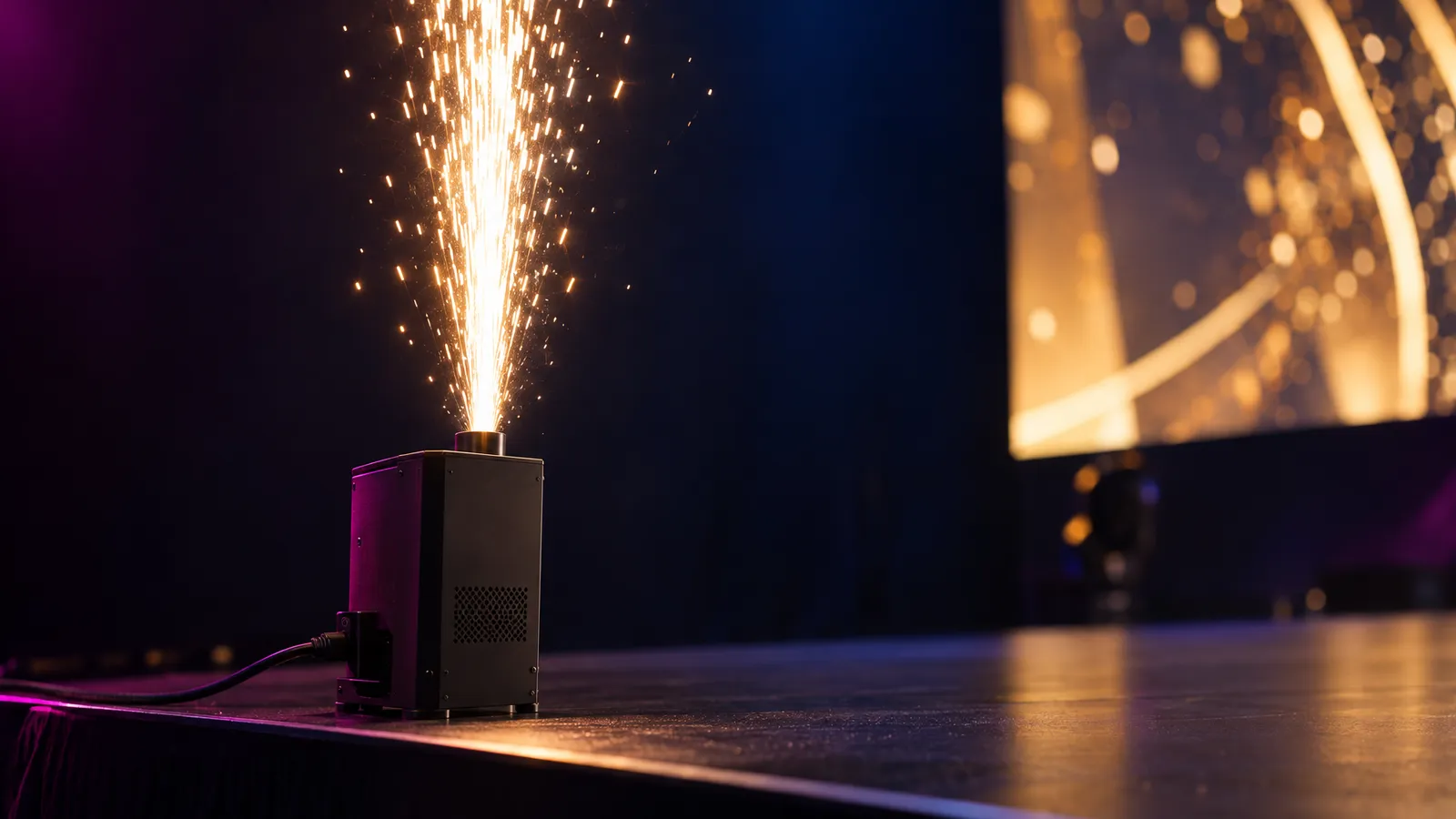
Reveal effects can mark a big award without turning a recognition dinner into a concert. A cold spark machine ($35 per day in the catalog) is one option, but it needs approval before it is planned into the show. The Central County Fire Department notes that California Health and Safety Code Section 12505 classifies ignitable materials containing titanium and zirconium — the material these devices use — as dangerous fireworks, that the sparks are "still capable of igniting nearby materials," and that Burlingame, Millbrae and Hillsborough prohibit cold spark devices. Confirm in writing with the venue and the local fire authority before you plan one. When VENEGEEST's crew operates the effect, VENEGEEST holds the operating permits; if you rent the machine and operate it yourself, you carry that responsibility, including liability. Our cold spark rental guide covers the rules in more detail.
A confetti cannon or streamer launcher is the other common choice. Many planners keep it for the final or highest honor so it stands apart from the other reveals. Venues differ on confetti and streamers, and some add cleaning charges, so read your venue contract and ask before you plan either. Where it is placed, which direction it fires and how close guests sit should follow the device's instructions and the venue's approval.
- Approval first: effects go into the run of show only after the venue (and, for cold sparks, the fire authority) has approved them in writing.
- Scarcity: an effect used on one award reads as special; used on every award it becomes routine, and consumables are an extra cost each time.
- Timing: rehearse the effect cue together with the screen reveal so the two land together.
- Fallback: effects add to the moment; the ceremony should still work if one does not fire.
Show Flow Integration — Audio Stings, Screen Cues, and Lighting Transitions
An awards block repeats the same short sequence for each category: presenter to the podium, category title on screen, winner announced, music sting, optional effect, followspot to the recipient, house lights adjusted for the walk-up and photo. Keeping that sequence tight depends on a written run of show and one person — usually a stage manager — calling each cue to the people running screen playback, the lighting console and the followspot.
Short music stings under the winner announcement are usually played from the show laptop through the PA speakers ($200 per day each in the catalog). Set their level at rehearsal with the room in mind — loud enough to be heard over applause, not so loud it startles the tables nearest the speakers — and have the audio operator watch levels during the show.
- Run-of-show document: one cue sheet with cue numbers, screen file names, lighting states and followspot pickups, shared by everyone on the crew.
- File naming: name each video or slide file with its cue number so the operator can find it quickly under pressure.
- Lighting console: a lighting control console can store the intensity and color states of console-controlled fixtures as recorded cues. Manual followspots are aimed by their operators, so their pickups stay separate spoken cues.
- Communication: give the stage manager a way to call a hold if the screen or audio is not ready, rather than announcing a winner over the wrong slide.
- Rehearsal: schedule a cue-to-cue walk-through before doors, testing every screen file, followspot pickup, lighting change and sting.
Stage Platform and Riser Configuration for Multi-Level Presentation
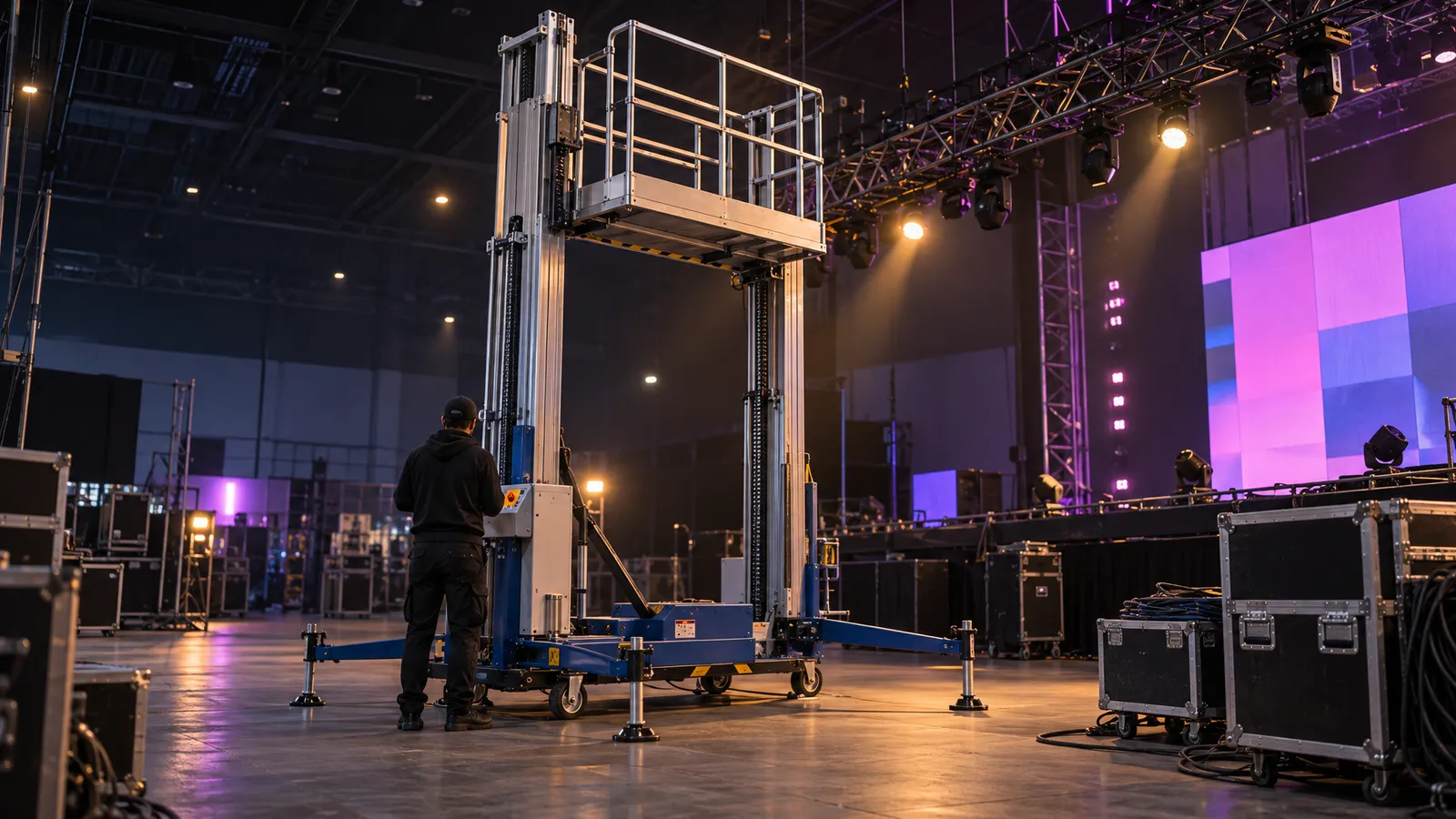
A raised stage separates the presentation area from the dinner floor and helps guests further back see the podium. Portable stage platforms ($30 per day each) combine into the footprint you need; multiple stage sizes and configurations are available, configured to your venue and requirements on request. Choose the height with the ceiling, the screen position and the sightlines from the back tables in mind, and ask the venue whether it limits stage height, for example for sprinkler clearance.
Recipients walk onto this stage in evening wear, and some honorees may have limited mobility, so stairs and access deserve planning. Stair, handrail, accessibility and exit requirements depend on your venue and jurisdiction — have the venue and your staging supplier confirm what applies, and consider a ramp or level access for honorees who need it.
- Deck size: allow room for the podium, presenters and the largest group photo you expect, plus clear space around the stage edge.
- Deck surface and skirting: finish and skirting are available on request, subject to availability, and quoted with the stage; skirting also hides cables and stored cases under the deck.
- Access: plan stairs and handrails with the venue and staging supplier, and keep the walk-up path clear of cables.
- Load-in: confirm the venue's loading-dock and service-elevator hours and schedule the build inside them. VENEGEEST's terms note that its team needs a minimum of 2 hours for standard setups and that large-scale productions may need more.
FAQ: Award Ceremony & Recognition Event AV
What's the typical AV budget range for a 200-person awards dinner in San Francisco?
Build it from day rates. At VENEGEEST, the P1.9–3.9 LED Rental Screen is listed at $200 per day, the Followspot Light at $80, the Full-Color LED Par Light at $25 and the Commercial PA Speaker at $200. Delivery, setup, technician services and overtime are scoped and quoted to your event, and multi-item packages are quoted per project. Venue-specific costs can layer on top: some hotels charge coordination or power fees, some require union labor for rigging, and some require their in-house A/V provider for part of the job, so ask the venue for its AV policy before you compare quotes.
How far in advance should I book AV for an annual awards gala?
As early as the date and venue are fixed. Same-week delivery is available across the Bay Area for most items, but availability is confirmed for your date when you request a quote. A booking is confirmed once you have a written confirmation and have paid the 25% non-refundable deposit, and the rate confirmed in your rental agreement is honored for that booking. Changes to the order need to reach VENEGEEST at least five business days before the event.
Can I use a projector and screen instead of an LED wall for nominee reels?
Yes, if the projector is bright enough for the room. Projector brightness has to be chosen for the ambient light: Epson's buying guide says that for "classrooms, conference rooms or rooms with windows, a projector with a minimum of 2500 lumens is best," and notes that when only one lumen rating is given it usually refers to white brightness, with color brightness possibly "as little as one-third" of it. A ballroom with chandeliers on and stage lights aimed at the podium can be harder to project into than a meeting room, so test the projector and screen with the room lit the way you plan to run the program, and compare that with an LED screen before you decide.
Do I need a lighting console operator for the entire event, or just for the awards block?
It depends on your run of show. If the lighting stays in one look during the reception and dinner and changes only during the awards, the operator's key time is setup, rehearsal and the awards block; if the lighting changes through the evening — a first dance, a performance, a speech — you will want an operator for those segments too. Pre-programming cues on a timer is risky for awards, because categories and speeches rarely run to the second; a live operator can hold or skip a cue when the program changes. Technician time is scoped and quoted to your event, so share the full timeline when you ask for a quote.
What's the cleanest way to handle sponsor logo placement during the awards presentation?
Put sponsors on the screen rather than on physical banners on the stage, and agree when they appear — for example, with the category title before the announcement — so logos don't cover the winner's name or the recipient's moment. Ask your AV team which file formats and resolution they want for logos and build them into the show file in cue order. Keeping the stage itself clear of banner stands also keeps the walk-up path and the followspot's view open.