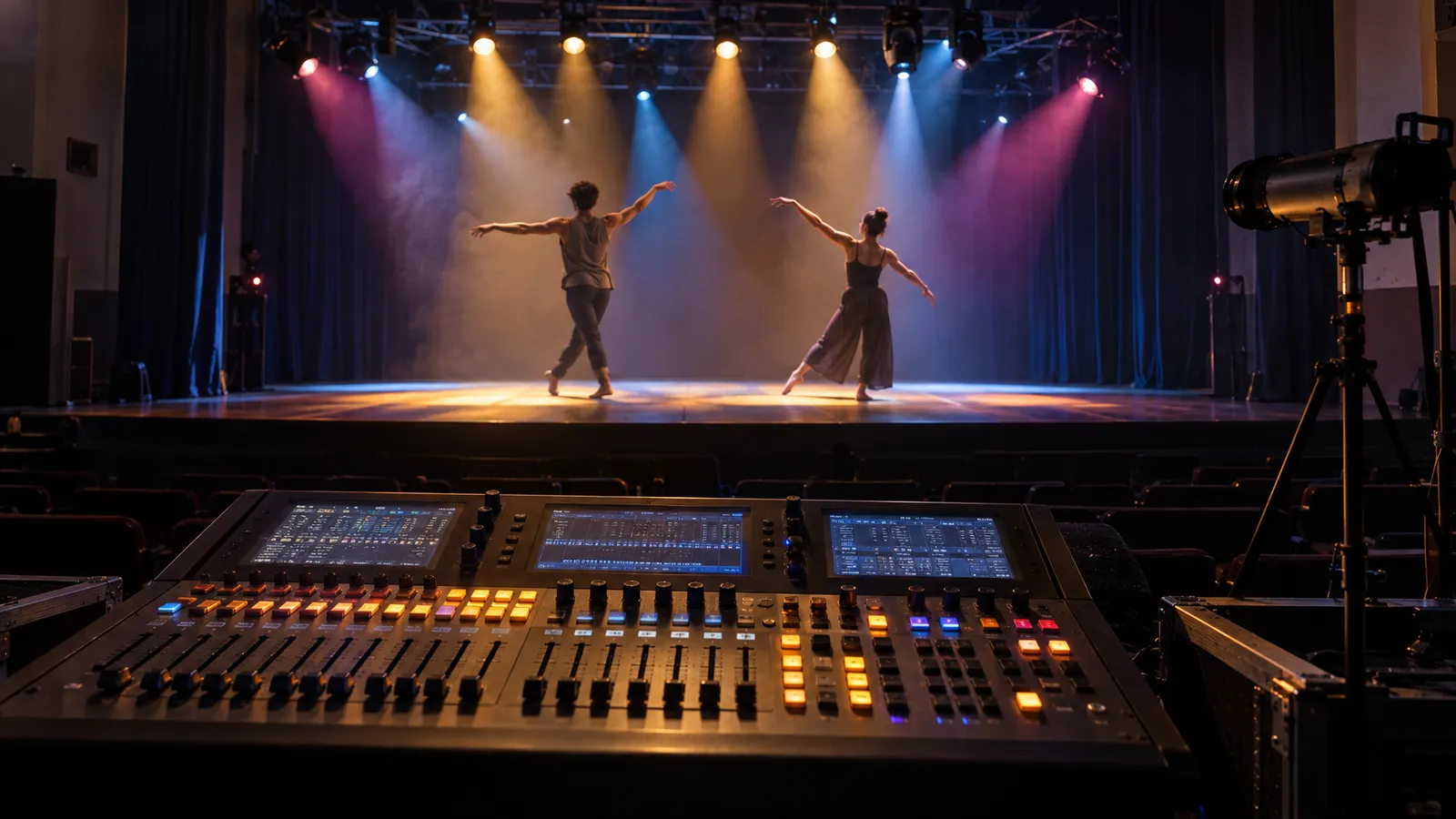
Renting lighting for a community theater show, a dance recital or a school musical comes down to four decisions: how you light faces from the front, how you add color and shape from the sides and back, whether you need a followspot, and how you will control and record the cues. This guide walks through those decisions, the rental items VENEGEEST lists for each, and the safety questions to settle with your venue before anything goes overhead. Whether you're mounting a one-act in a black-box theater, staging a youth ballet in a rented hall or running a musical in a multipurpose room, the planning steps are the same; the numbers come from your stage, your fixtures and your venue.
Front Light, Side Light and Back Light: Planning the Layers
Stage lighting can be planned in layers. Front light is what lets the audience see faces and expressions. Side light adds shape and helps separate performers, especially dancers, from the backdrop. Back light outlines performers from behind and helps lift them off the scenery. A production may use all three; how much of each you need depends on the stage, the seating and the show, so treat any fixture count as a starting sketch rather than a minimum.
For front light, VENEGEEST lists a COB Front Light at $35 per day, described in the catalog as essential stage front illumination. For color from the sides or back, the Full-Color LED Par Light is an 18-LED RGBW wash light listed at $25 per day, and the LED Par Can range includes warm/cool white COB pars and several RGBW models, priced on request.
Rather than copying a plot from another show, work it out for your space:
- Measure the playing area. Width, depth and the height available for hanging positions decide how many pools of light you need to cover the stage evenly.
- Check each fixture's beam data. How wide a fixture's beam spreads at your throw distance decides how many units a wash takes. Ask for the specification of the exact model you're quoted.
- Find your hanging positions. A catwalk, a balcony rail, boom stands in the wings or a freestanding truss each give different angles. If the venue has no overhead position, VENEGEEST lists an Aluminum H-Frame Truss (lightweight aluminum truss) at $10 per day; see the rigging section below before you plan loads on it.
- Book a focus session. Set aside time in the venue, with the set in place, to aim fixtures, fix hot spots and keep spill off the audience. How long it takes depends on the size of the rig.
Color: RGBW Fixtures, Gels and Correction Filters
Color helps an audience read time of day, mood and scene changes. Warm tones can suggest daytime interiors or lighter scenes, cool tones night or tension, and saturated colors for dance solos or dream sequences. These are conventions, not rules; the director and designer decide what the show needs.
There are two ways to get color. An RGBW fixture such as the Full-Color LED Par Light mixes its color from red, green, blue and white LEDs, so you can change hue from the console between cues instead of swapping filters by hand. A fixture with a white output can instead take a color filter (gel) in its filter frame.
If you use filters, order them by the manufacturer's exact name and number, because Lee and Rosco number their ranges differently and the same number can mean different colors in each. Rosco publishes a Lee-to-Rosco equivalence chart for matching between the two. Two Lee correction filters, as described by the manufacturer:
- LEE 201 Full C.T. Blue "converts tungsten (3200K) to photographic daylight (5700K)" (LEE Filters).
- LEE 200 Double C.T. Blue is described as converting "tungsten (3200K) to daylight" with a stronger shift than 201, so it is a heavy correction, not a light cooling tint (LEE Filters).
For gel sheets, cut filters to the fixture's own filter frame, following the fixture manufacturer's instructions for filter holders and ventilation. How many cuts you get from a sheet depends on the actual frame size, so measure the frame before ordering. Label each frame with its fixture position so a filter change goes back in the right unit.
How many colors does a one-act need?
There is no fixed number. A single-set play with few changes may need only a handful of looks, while a musical with many scenes may need more. Start from the script: list each scene, the time of day and the mood the director wants, then group scenes that can share a look. A limited, deliberate palette is usually easier to program and run than a new color for every moment.
Followspots: When You Need One and How to Run It
A Followspot Light picks out a soloist, a principal dancer or a featured performer and follows them across the stage. VENEGEEST lists a 330W–440W manual followspot at $80 per day. A manual followspot needs an operator for each unit.
Whether you need one spot or two depends on the production: how many featured performers are on stage at once, how often they cross, and whether a single position can reach the whole stage. Where the spot sits depends on the room. Measure the throw distance and the height of the position you have, then check the fixture's beam data to see what size of pool it gives at that distance. Make sure the position keeps the beam clear of audience heads and is somewhere an operator can safely stand for the whole show.
Operator training depends on the fixture and on the operator's experience, so allow rehearsal time for the operator to practise pick-ups, fades and blackouts with the cast. A cue sheet helps: list the cue number, script page, performer, where they enter or exit, the size of the pool and the color for every pick-up and drop.
Moving-head fixtures can also be programmed to go to preset positions on cue. That is not the same as automatic performer tracking: a moving head goes where it was programmed to go, so if a performer is somewhere else, the light will miss them. Automated performer-tracking systems are separate products; like other equipment beyond the listed catalog, they are available on request, subject to availability — contact us for a quote.
DMX Consoles and Cue Workflow for Tech Rehearsal
A Lighting Control Console lets you record, edit and play back lighting cues. VENEGEEST's catalog lists DMX consoles from the grandMA2, Avolites Tiger Touch and Quartz families among others; consoles are priced on request.
Two numbering systems are easy to confuse. The console's channel or fixture number is how you call up a fixture. The DMX address is where the fixture listens on the cable. One fixture can use several DMX addresses: ETC's documentation explains that each device occupies "the number of DMX addresses used by its footprint, starting from the address you specify," and warns that spacing them too closely "will cause overlaps and unexpected behavior from your devices" (ETC). RGBW pars and moving heads can have several modes with different footprints, so:
- Pick the mode first. Look up each fixture's DMX modes in its manual and choose one.
- Assign non-overlapping start addresses. Each fixture's range runs from its start address through start + footprint − 1; the next fixture starts after that.
- Record the patch. Write down every fixture's mode and start address, and set the fixtures to match before power-on.
- Build groups. Groups such as "front warm" or "side cool" let you adjust several fixtures together.
- Save the show file. Back up the show file after every rehearsal, using the backup method in your console's manual, and keep a copy off the console.
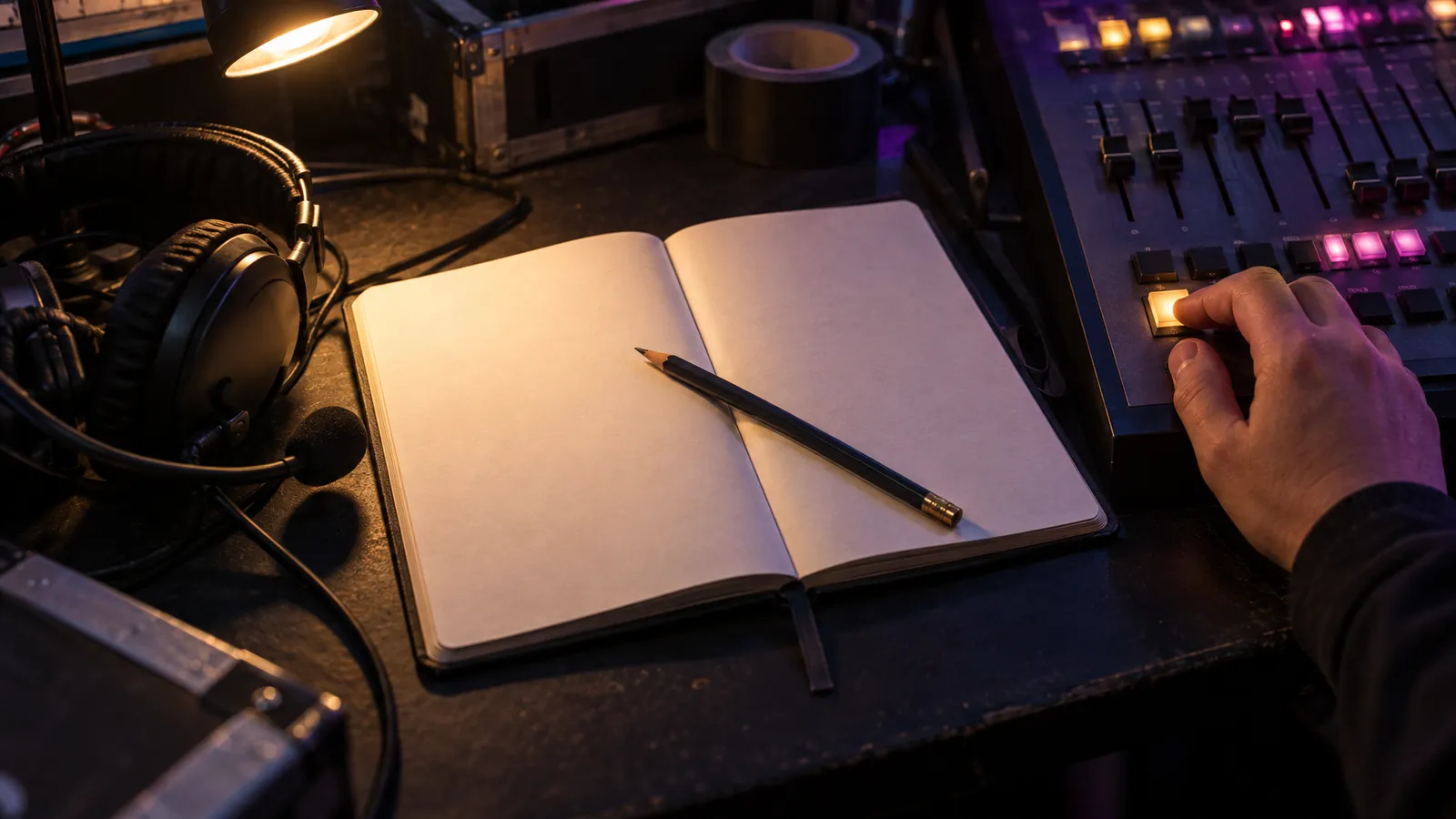
During tech rehearsal, the lighting designer and stage manager build the cue list together. Each cue records levels, fade time and the line or action that triggers it. For example, a cue might read "Act I, Scene 2, on the line 'I never wanted this': fade to the cool night look over four seconds." Some consoles can edit cues without changing what is on stage (often called a blind mode); check what your console offers. Once the show is running, use the console's own documented access or playback-only settings, if it has them, to protect the cue list from accidental edits.
Moving Heads, Gobos and Haze for Dance
Dance often uses moving light. VENEGEEST lists an LED Spot-Wash Moving Head, a mid-power LED moving head with CMY+CTO color mixing, an animation wheel and dual gobo wheels, in several wattages, priced on request. A moving head can change color, project a gobo pattern and change position from the console.
Use motion with restraint. Sweeping beams can pull attention away from the choreography, so one approach is to keep movement for moments in the music that call for it and return to steady looks for solos. Plan each number with the choreographer: which moments need a change, what color, and whether a gobo texture on the floor or backdrop helps.
Beams in the air show up only when there is something in the air to catch them, which is why productions use haze. VENEGEEST lists a 1000W Haze Machine at $25 per day, and haze fluid is available on request with a quote. Before planning haze:
- Ask the venue first. Haze can affect smoke detection and ventilation, and some venues do not allow it.
- Use the fluid the machine's manufacturer specifies. Water-based fluids are not automatically glycol-free; Rosco, for example, describes its fog fluid as "a series of glycols of low molecular weight mixed with de-ionized water" (Rosco).
- Set output in the room, not from a rule. Follow the manufacturer's instructions, start low, and tell performers and staff in advance so anyone with a respiratory concern can raise it.
Rigging and Safety: Truss, Lifts and Loads
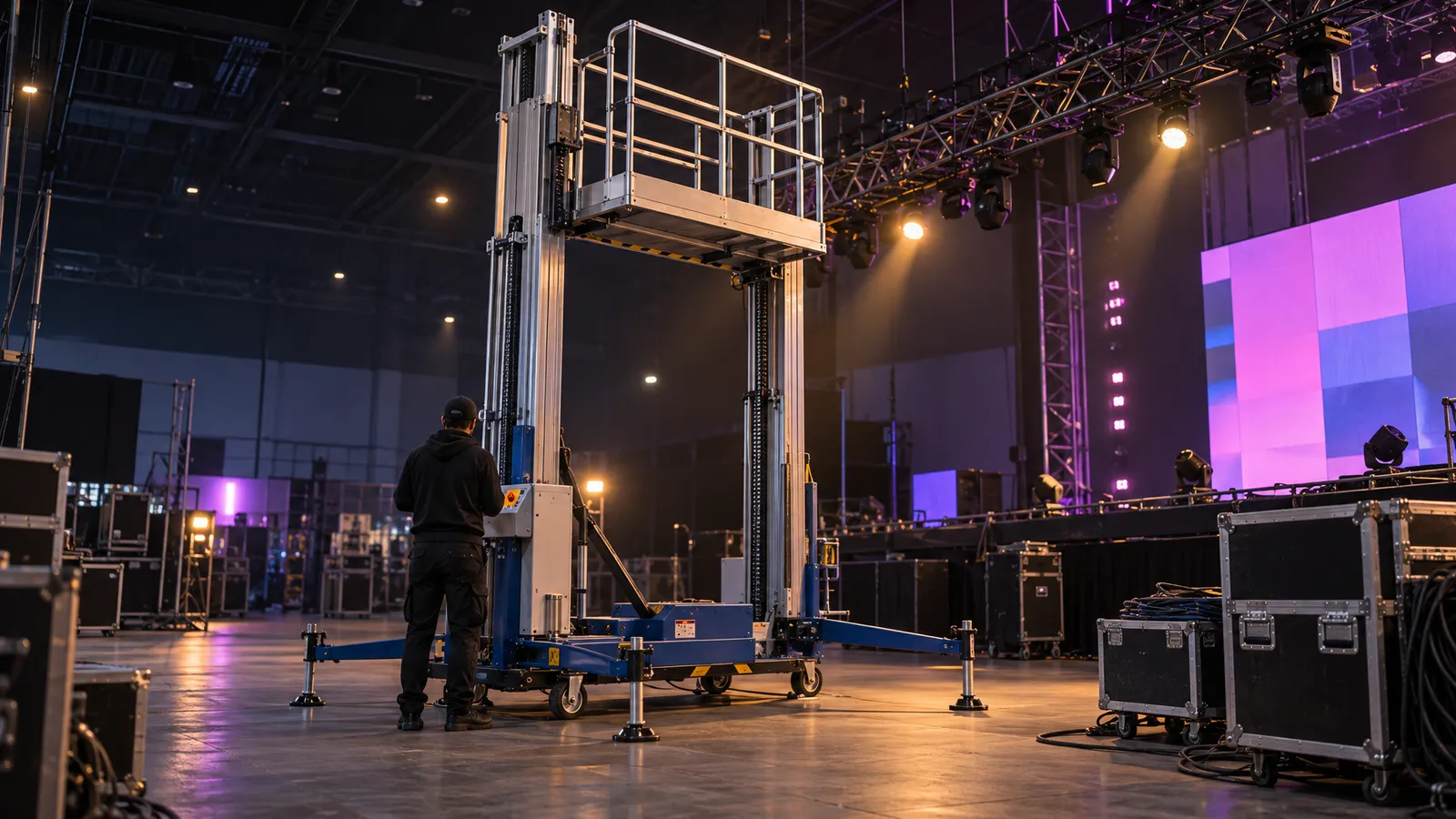
Not every venue has a catwalk or fly system. School multipurpose rooms, fellowship halls and studio spaces may need ground-supported truss or a lift to reach overhead positions. VENEGEEST lists an Electric Lift Scaffold, a motorized height-adjustable lift, at $80, and the Aluminum H-Frame Truss at $10 per day.
Rigging is where a guide like this has to stop and hand over to qualified people. A few principles apply whatever you rent:
- Use the manufacturer's load data, for your configuration. A truss's capacity depends on the product, the span and how the load is applied; Prolyte's truss user manual, for example, states that "the correct load can only be determined by examining each load case individually" (Prolyte). Weigh or look up each fixture in its manual, include clamps and cables, and have a qualified person check the total.
- Ask the venue for rated loads of any catwalk, rail or pipe you plan to use, and use only the hanging points it approves.
- Use a lift or scaffold only as its manufacturer allows. OSHA's scaffold guidance says to "follow the manufacturer's allowable load for the casters, scaffold components and platforms," to "lock scaffold wheels with positive wheel and/or wheel and swivel locks to prevent movement while in use," and that "only trained and authorized persons should be allowed to use a scaffold" (OSHA). Do not hang fixtures from a lift or use it as a lighting tower unless its manufacturer approves that use and a qualified person has planned it.
- Use rated hardware suited to the fixture and the pipe or truss, and a safety cable on every overhead fixture.
- Plan power with the manuals. How many fixtures can be linked on one power run depends on each fixture's input current and the manufacturer's power-link limits, and on the circuits the venue provides. Have a qualified person approve the power plan.
- Supervise work at height. For a school production, the school's own rules and a competent adult decide who works at height and how.
Delivery, setup and technician services are scoped and quoted to your show, and self-pickup from the South San Francisco warehouse is allowed. If you want help on site, ask for technician time in your quote.
FAQ: Theater and Dance Show Lighting Rentals
How many fixtures do I need for my stage?
It depends on the size and shape of the stage, your hanging positions and throw distances, the beam spread of the exact fixtures, and how many areas and looks the show needs. Measure the stage, get the specification of the fixtures you're quoted, and sketch how many pools of front, side and back light cover the playing area. Treat any count you see elsewhere as an example, not a minimum.
Can I use household LED bulbs in stage fixtures to save rental costs?
No, not unless the fixture's manufacturer approves it. Use only the lamp or light source the fixture's manual specifies for that fixture. Stage fixtures are rented as complete units, so compare rental prices rather than trying to adapt household bulbs.
How do I program lighting cues if I've never used a DMX console before?
Read the console's manual and practise before tech rehearsal. Learn the basics: patching fixtures (mode and start address), recording cues with fade times, editing levels, building groups and playing back cues. Write the cues on paper first, then build them in order during tech. Afterwards, run the show start to finish to check the timing. If no one on your team has used a console before, consider adding a technician; VENEGEEST scopes and quotes technician time to your show.
Do I need haze for a straight drama with no dance?
Not necessarily. Haze makes light beams visible, which some designers use in drama as well as dance. Whether you use it depends on the look you want and on the venue: ask whether haze is allowed, use the fluid the machine's manufacturer specifies, and follow its instructions for output.
When should I schedule the focus call?
Before tech rehearsal, with the set, floor and masking in place, so the designer can aim fixtures and fix spill without actors waiting. Stand-ins at key positions help check that front light reaches faces. How much time you need depends on the rig, and some venues limit overhead work to certain hours, so confirm access windows in advance. For the fixtures covered here and their day rates, see our event lighting rental page.