A retail grand opening needs five things from its production: an entrance moment for the ribbon cut, facade lighting if doors open near dusk, an in-store photo activation that doesn't block merchandise, music at a level the landlord accepts, and a screen that loops the brand story. Whether you're opening a Union Square flagship, a Santana Row pop-up or a neighborhood storefront in Hayes Valley, this checklist walks through each one, with list prices from the VENEGEEST catalog so you can rough out a budget before you ask for a quote.
Ribbon-Cutting Reveal Effects and Entrance Staging
The ribbon cut is the headline moment for press photos, social content and local news B-roll. The goal is a single dramatic beat, usually sparks or confetti timed to the scissors, that doesn't spill debris onto merchandise or cause trouble with the building's fire systems. Check the mall or landlord's effects policy early; California regulates titanium/zirconium spark effects as dangerous fireworks, so confirm with the local fire authority. Outdoor storefronts on city sidewalks also need a plan for pedestrian clearance, and anything you place in the public right-of-way may need a city permit, so ask the city before you put a riser or barricade on the sidewalk.
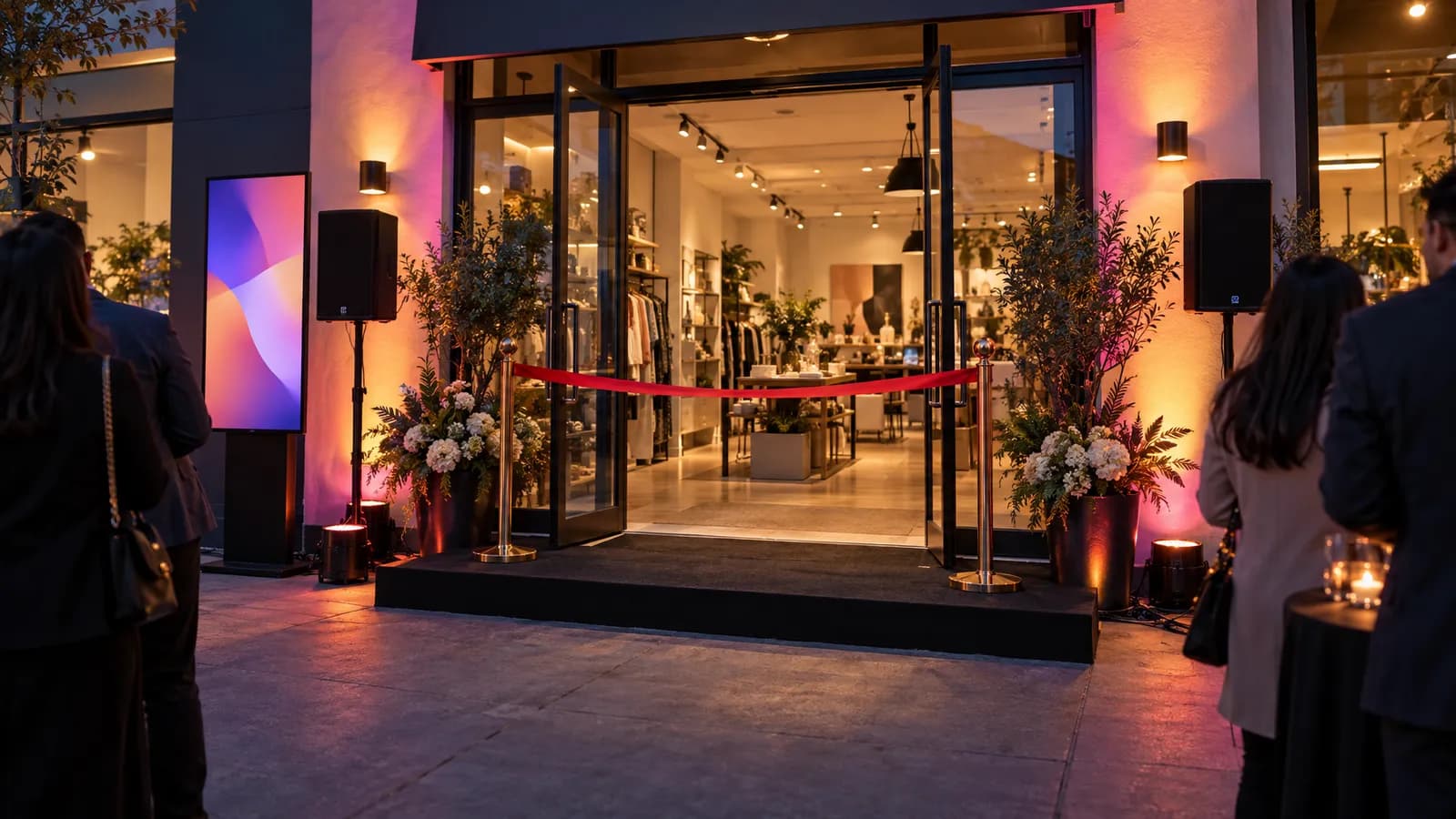
A typical entrance setup places a photo riser a few feet back from the door, angled to capture both the ribbon and the storefront sign in frame. If the venue and fire authority approve sparks, two Cold Spark Machines ($35 each per day) can flank the door and fire for a few seconds as the ribbon is cut. Under California Health and Safety Code section 12505, the titanium and zirconium material these machines use is classed as Dangerous Fireworks; in approved cases it has to be handled by a pyrotechnic operator licensed by the State Fire Marshal, and some fire authorities (Central County Fire, covering Burlingame, Millbrae and Hillsborough) prohibit the devices outright. When VENEGEEST's crew runs the machines, VENEGEEST holds the operating permits; if you rent them and operate them yourself, that responsibility, including the liability, is yours. The same fire authority warns that the heat from cold sparks can still ignite nearby materials, so keep ribbons, banners and guests' clothing well clear. If you want falling confetti instead, or in addition, a Confetti Cannon / Streamer Launcher can add falling confetti; the catalog lists manual and electric launcher models, quoted by model. Where any effect is placed, how it is aimed and mounted, and how far it stays from guests and decor should be set by the operator following the manufacturer's instructions for that exact unit, and approved by the landlord.
- Photo riser or step-and-repeat backdrop: a branded banner placed back from the entrance so the ribbon-cutting principals stand with the storefront behind them; a low riser gives photographers shooting from street level a clean sightline over the crowd.
- Spark units near the door (only with approval): the licensed operator decides placement, orientation and clearances from people, ceilings and decor according to the manufacturer's instructions and the fire authority's conditions.
- Confetti or streamer effect: the operator sets the launcher's position, any rigging and the clearances from guests using the manufacturer's instructions; agree the confetti material and the cleanup with the landlord in advance.
- A cue plan for the reveal: decide who fires the effect and from where, so it syncs with the scissors cut; rehearse the countdown once before doors open.
- Pre-positioned scissors and ribbon: oversized ceremonial scissors and a wide satin ribbon in brand color, strung between freestanding posts at chest height for the principals.
Storefront Facade Lighting for Evening Foot Traffic
A grand opening that runs into the evening benefits from facade lighting so the storefront stands out from across the street and down the block. Mall or street lighting is not usually aimed at your signage, and it won't wash the front in brand color. Battery-powered uplights can reduce power-cable runs when they are fully charged, since they don't need a cable to an outlet; confirm the run time, placement and control for the model you order. A row of fixtures along the base of the facade washes the wall in brand color. Full-color LED pars placed in planters or against the building add accent layers, such as slow color fades or white washes on window displays.
Anything you place on a public sidewalk has to leave room for pedestrians, so keep fixtures tight against the building face or inside planter boxes, and ask the city whether your layout needs a permit. Shopping centers set their own rules for fixtures in common areas, from sandbag weighting to no floor-placed fixtures at all, so get the landlord's requirements in writing before you finalize the plan.
- Battery-powered uplights along the storefront base: Wireless Battery Uplights in brand color, spaced evenly and angled up to wash the facade. VENEGEEST quotes these by model; ask for run time on the unit you order so it covers setup through teardown.
- Full-color LED pars for color accents: 4 Full-Color LED Par Lights ($25 each) for color accents on the facade. These are RGBW wash lights, so color can be adjusted as daylight fades. They don't project logos; logo projection needs a spot or profile fixture.
- Freestanding LED video screen for rotating brand content: a Foldable LED Ad Screen ($200 per day; 2 m² to 12 m², portable on casters) placed just inside the storefront window, facing out, looping product videos, opening-day promos and social handles.
- Power: ask the landlord which circuit you may use for the screen and any wired lights, and keep cable runs out of walkways. If there's no power available outdoors, you'll need a generator; plan it with the landlord or a power vendor.
How much light do I need to make the storefront visible at dusk?
It depends on the facade color, the streetlights and how bright the neighboring signs are, so the reliable way to decide is a test: stand across the street at the time your doors open and look. Darker brick or stucco absorbs more light and needs more fixtures than a pale wall. Try a saturated color and a white wash during the test and compare them against the street lighting. On blocks with a lot of competing signage, also try lighting the sign itself from above or below before adding more fixtures along the base.
Interior Photo Activations That Don't Block Merchandise
The inside activation should generate social shares without turning the store into a photo-booth queue that blocks browsing. A good placement is often a back corner or side alcove, anywhere that forms a natural endpoint for guest flow but doesn't sit in front of featured product or the checkout counter. Leave queue space if you expect a crowd in the first hour. The VENEGEEST Interactive Photo Booth ($400 per day) is listed as an interactive experience with instant sharing. If you want branded overlays, text or email delivery, or any data collection, ask before booking which of those the booth supports; do not assume them.
Some retail launches use a photo activation to collect emails or phone numbers. Treat that as a separate decision from how the photo is delivered: if you collect contact details for marketing, tell guests on the screen how their contact information will be used and get their opt-in, and have your own counsel check the wording against California privacy law. For a franchise launch or multi-location rollout, a QR code or a code unique to the opening makes it easy to see which first-day guests come back.
- Photo booth in a back corner or side alcove: placed where guests discover it naturally without being funneled past the checkout.
- Questions to ask about the booth: whether it can apply a branded overlay (store handle, hashtag, promo code), how guests receive their photos, and whether it collects any guest data at all.
- Separate, clear opt-in for marketing: if you collect contact details for marketing, ask for consent separately from photo delivery and keep the form short.
- Props and signage that reinforce the brand: a few handheld props and a floor decal with the store logo in front of the backdrop; props should be photogenic but not so bulky that they hide faces.
Music and Audio Levels in Mall and Street Retail Environments
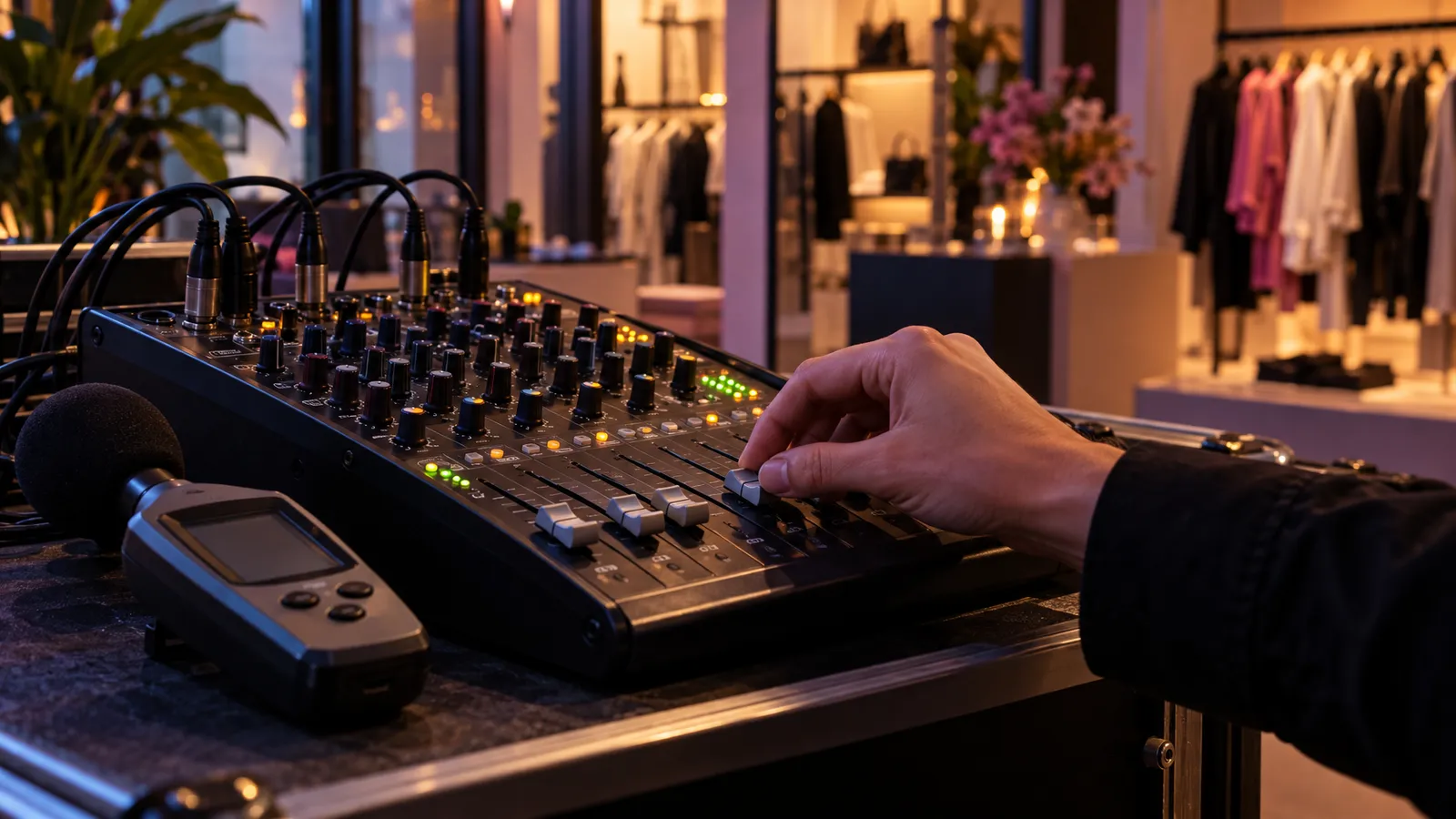
Settle sound with the landlord before the day, since audio can carry into neighboring stores and food courts. Ask the landlord for its actual sound limit and where levels are measured, in writing. In San Francisco, outdoor storefronts are subject to the city's noise ordinance in the Police Code; keep levels modest, especially at night. The practical solution is several small speakers spread through the space instead of one loud stack, with one person holding the volume control all event. The Bluetooth Speaker System ($60 per day) comes with a controller, six speakers and two mics; tell us the size of the store and we can confirm whether it fits, including the welcome remarks at the ribbon cut. For a larger space or an outdoor crowd, a pair of Commercial PA Speakers ($200 each) adds throw.
The music should match the brand: upbeat but not overwhelming. Playing music publicly at a business event generally needs public-performance permission. Confirm with the landlord or your own counsel that the event is covered for the music being played; a DJ having lawful copies of the tracks is a separate matter from that permission. Brief any DJ on the landlord's level limit and curfew, and run a sound check before doors open with the landlord's operations contact present, so level issues are settled before guests arrive.
- Distributed speakers for even coverage: louder at the back of the store, quieter at the entrance, so the room feels energetic without spilling into the corridor or onto the sidewalk.
- One operator with the volume control: recheck and adjust levels as the store fills and empties, rather than setting them once in an empty room.
- Public-performance coverage: confirmed by the organizer or landlord for the event and the music played.
- DJ brief with level limits and curfew: a one-page sheet with the landlord's audio policy, the city noise rules, the event timeline and the security contact.
- A mic for welcome remarks: test it near the storefront glass during sound check to catch feedback early.
Video Screens for Branding and Guest Wayfinding
Screens do two jobs at a grand opening: they loop brand content for guests inside, and they catch the eye of passersby outside. A 43″ or 65″ LED TV Display ($35 or $55 per day) on a TV Floor Stand ($20) near the entrance plays the brand story video, product demos or a feed of tagged photos from the event. For a bigger statement, a P1.9–3.9 LED Rental Screen ($200 per day, configurable from 12 m² to 48 m²) can face out through a large window. If you want a screen outdoors, ask us to confirm the outdoor rating, brightness, support and power for the exact panels first, and get the landlord's and city's approval. Keep the content loop short, with the logo, the opening-day promo, a product highlight and the social handles, so someone walking past sees the offer before they're gone.
- Indoor TV for brand storytelling: a 43″ or 65″ display near the photo activation or checkout, looping a captioned brand video with no audio needed.
- LED wall facing the street: a modular LED wall placed inside the window; any outdoor placement only after the exact panels' outdoor rating, brightness, support and power are confirmed and the landlord and city allow it.
- Content loop with the promo and social handles: delivered in the playback format and resolution the specific screen, LED processor or media player calls for (ask for the exact spec; a 1920×1080 MP4 is one example for a 1080p display), with the store's handle, the opening hashtag and the first-purchase code on screen long enough to read.
- Playback: a media player or USB drive the screen can read; test the file ahead of the event to confirm it loops cleanly, and check brightness for daylight.
FAQ: Retail Store Grand Opening Production
How far ahead should I book AV and effects for a Bay Area grand opening?
Same-week delivery is available across the Bay Area for most VENEGEEST items, so ask about availability for the specific items you need, including any LED wall, when you request a quote. Build in time for the landlord's approvals too: malls and shopping centers often ask vendors for insurance certificates and effect spec sheets before load-in, and any spark effect needs sign-off from the venue and the local fire authority. A booking is confirmed in writing and secured with a non-refundable 25% deposit.
How do I stay within mall sound limits while still creating energy inside the store?
Use several small speakers spread through the store instead of a single PA stack. Put more level at the back and less at the entrance, so the store feels lively while the levels at the landlord's measurement points stay under its limit. Check levels with the meter and method the landlord accepts (a phone app is only a rough guide unless it has been checked against a calibrated meter) at the center of the store, at the entrance and just outside, and if the mall's operations contact is at the sound check, ask them to confirm the level before doors open.
Can I use confetti or cold sparks in an enclosed mall?
Only with the mall's approval, and for sparks, the local fire authority's as well. California Health and Safety Code section 12505 classes titanium and zirconium spark material as Dangerous Fireworks, some Bay Area fire authorities prohibit cold spark devices outright, and the heat from the sparks can still ignite nearby materials. Confetti needs approval too: the exact launcher, the material, the clearances from guests, any overhead rigging and the cleanup should all be agreed with the landlord and set up by the operator following the manufacturer's instructions. Haze, fog and CO2 effects can also be restricted indoors, so raise them with the landlord before you plan them.
Can I collect email addresses at the photo booth?
First ask whether the booth you rent collects any guest data at all, since features vary by booth. If you collect contact details for marketing, keep it separate from photo delivery: ask for one field, explain on screen what guests will receive and how to unsubscribe, get their opt-in, and have your counsel review the wording against California privacy law.
How much should I budget for a grand opening with lighting, sound, photo activation and reveal effects?
Start from the list prices. A storefront setup with a Bluetooth Speaker System ($60), an Interactive Photo Booth ($400), two Cold Spark Machines ($35 each, $70), a 43″ LED TV Display ($35) on a TV Floor Stand ($20) and four Full-Color LED Par Lights ($25 each, $100) comes to $685 per day in equipment. Battery uplights and confetti launchers are quoted by model, an LED rental screen adds from $200, and delivery, setup, technicians and any overtime are scoped and quoted to your event. VENEGEEST designs a custom solution around each opening's space and requirements, and multi-item packages are quoted per project, so send the full list for a firm price.