If you're running a pet adoption fair or a dog-rescue fundraiser in a Bay Area park, your AV checklist is different from most outdoor events: the audience includes animals in crates and on leashes. Noise-related fears are common in dogs, so sound that suits a street fair may be too much near kennels. Stage placement has to account for shade and for animals that need to stay at ground level. LED displays and sponsor signage still matter — your featured adoptions and brand partners expect visibility — but fog, haze and cold-spark effects are a poor fit when leashed dogs and crated cats are close to your stage. This guide walks through the outdoor PA, staging, display and lighting decisions to plan with your animal-care team.
Outdoor PA and Animal-Aware Sound Levels
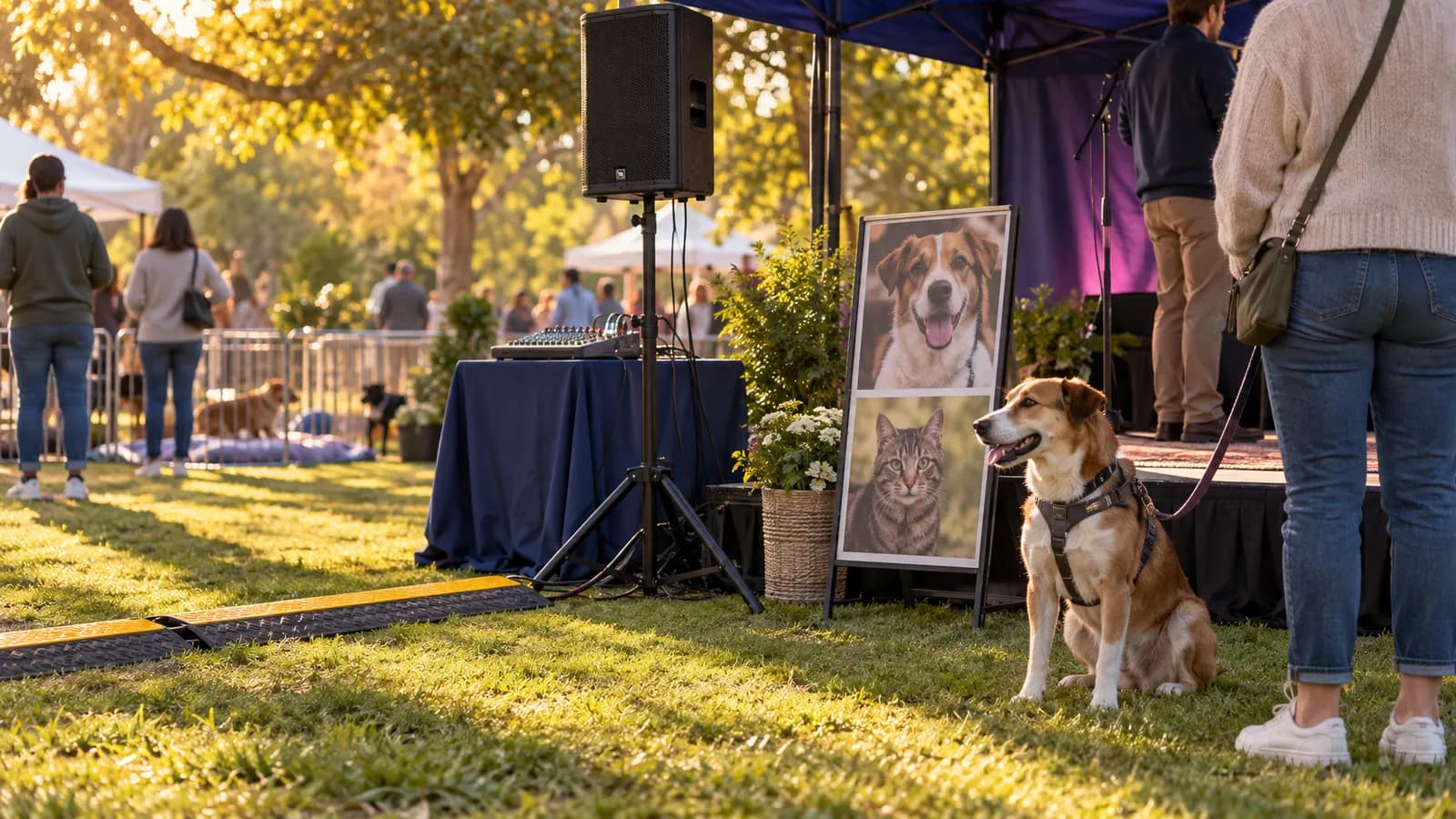
A single PA tower at the center of a pet expo has to be run loud to reach the far rows, which puts the loudest sound right next to the stage and anyone crated nearby, while booths farther away still struggle to hear. Distributed coverage is the usual alternative: several Commercial PA Speakers ($200 per day) on stands around the perimeter of your event footprint, each run at a moderate level, so no single zone has to be loud. As a hypothetical example, on a rectangular lawn you might put one speaker near each corner and the emcee platform in the middle of a long side, then walk the space during setup to check coverage and adjust.
There is no sound level that suits every animal, so plan it with the shelter's animal-care staff rather than from a number. Keep levels moderate where animals are crated or leashed, put speakers where they don't point straight at kennels, and watch the animals during the event. Panting, trembling, hiding and pacing are among the commonly described signs of noise fear in dogs; if animals near a speaker show them, turn that zone down or move the animals. Distributed speakers let you do that without losing intelligibility for adoption-coordinator announcements and sponsor callouts.
For smaller rescue pop-ups in a paved courtyard or playground, the Bluetooth Speaker System ($60 per day) is listed in our catalog as "1 controller + 6 speakers + 2 mics." Ask us to confirm the mic type, how the speakers mount and how the system connects before you plan the layout. As with a larger PA, keep the volume moderate near crates, walk the space to check coverage, and let the animal-care team decide where the animals sit relative to the speakers. Two mics let your emcee and a guest vet or trainer share duties without passing a single handheld back and forth, which helps when hands are full of leashes or paperwork.
- Several perimeter speakers instead of a single center tower — spreads the sound so no zone has to be loud.
- Moderate levels near animals — plan placement with the animal-care team and turn a zone down if animals show signs of stress.
- Speakers on stable stands — keep them out of walkways and away from where leashes and crates sit.
- At least two mics — one for the adoption coordinator, one for rotating guest speakers (vets, trainers, rescue founders).
- Bluetooth control for walk-up music — volunteers can cue music and sponsor announcements from a phone at a volume agreed in advance.
Shade Staging and Emcee Platform Placement
A Portable Stage Platform ($30 per day; the catalog describes it as "modular, combine for any size") gives the emcee a visible home base, but placement matters more than size. Where the shade falls depends on the site, the date and the time of day, so visit the site at the same time of day as your event, or check its map, and plan shade from what you find: under trees if the site has them, or under a canopy tent if it doesn't. Multiple stage sizes and configurations are available and are configured to your site on request; ask for the section sizes and leg heights (spec details are provided on request) so you can plan the footprint, and ask for the lowest height available.
Keep the animals themselves at ground level. A simple approach is to use the platform for the emcee's announcements and sponsor shoutouts, and set up a shaded meeting area in front of it on the ground where a dog is brought out for introductions, so no animal has to climb onto a stage. If any animal does go on the platform, cover the surface with non-slip matting, and have the animal-care team decide whether that animal should step up at all.
- Platform for people, ground-level area for animals — the emcee speaks from the platform; introductions happen on the ground in front of it.
- Plan shade from the actual site — trees or a canopy tent, based on a site visit at the time of day of your event.
- Non-slip surfaces — if animals will be on any raised or smooth surface, add non-slip matting.
- Protect the rental deck — ask us what protective flooring we approve for the platform and have a clean-up kit on hand for accidents.
- Ask for section sizes and leg heights — provided on request, so you can plan the footprint and keep the platform as low as possible.
Sponsor Signage and Adoption-Profile Displays
Pet brands and corporate sponsors funding your adoption event expect logo visibility at the entrance and inside the main activity zones. A Foldable LED Ad Screen ($200 per day; listed as "2m²–12m², portable with casters") at the entrance or parking-lot checkpoint can rotate sponsor slides and QR codes for same-day donation links. How long each slide stays up is a design choice you can test: long enough to read at walking pace is a reasonable starting point. Before you plan its spot, confirm the screen's power needs and whether it suits daytime outdoor use with the rental quote.
Inside the event footprint, LED TV Displays (catalog sizes from 43″ to 120″; the 65″ is $55 per day and the 75″ is $75 per day) on stands can show a looping reel of adoptable-animal profiles: name, age, temperament notes and a short clip. Whether it prompts people to ask about a specific animal is worth trying rather than assuming. Set the screen height so both children and adults can see it comfortably, and use stable stands placed where leashes and tails won't catch them.
- A foldable LED screen at the entrance — rotates sponsor logos and donation QR codes; confirm power and daytime outdoor suitability when you book.
- LED TVs at the adoption table — loop adoptable-animal profile videos; only where the display suits the setting (see below).
- Comfortable viewing height — for kids and adults; stable stands out of leash paths.
- Slide timing — try different dwell times and see what people can read at walking pace.
How bright do outdoor LED screens need to be for a midday pet expo?
Brightness is measured in nits, and displays built for indoor use can be hard to read in direct sun. For a daytime pet expo, ask the vendor for the nit rating of the screen you are renting, whether it is rated for daylight viewing and for outdoor conditions, and test it in place before gates open. Indoor TVs are for indoor settings; if you plan to use one under a tent, confirm with us that the tent and the conditions suit it. If your event runs past sunset, adjust brightness as light levels drop so the screen isn't glaring.
Animal-Aware Lighting and Effects
Haze, fog, cold spark and CO2 jets are common at concerts and galas, but they're a poor fit at a pet event. Haze and fog drift, including toward crates, and flat-faced breeds such as pugs, bulldogs and Boston terriers are prone to brachycephalic obstructive airway syndrome, which can cause breathing difficulty. Cold spark and CO2 jets are sudden and noisy. Skip all four. Instead, Wireless Battery Uplights (listed with a 12–15 hour battery; choose an IP65 variant outdoors) can accent the stage, sponsor booths and the adoption-table backdrop. Set them to steady colors and lock the setting so no one triggers a chase or flash program mid-event.
A Bubble Machine is sometimes suggested for family-friendly events, but around animals it needs care. Only consider it if your animal-care team approves, the bubble fluid is confirmed suitable for use around pets (ask for the fluid's Safety Data Sheet), and it is placed away from walkways, since soap residue can make surfaces slippery. If in doubt, leave it out. For an evening component, Full-Color LED Par Lights ($25 per day; listed as an "18-LED RGBW wash light") on stands can wash the stage and adoption table in a soft, steady color; how many you need depends on the area, so ask us to plan coverage.
- No haze, fog, cold spark or CO2 jets — atmosphere drifts toward crates, and cold spark and CO2 are sudden and noisy.
- Battery uplights in steady colors — accent the stage, sponsor booths and adoption table; lock the setting.
- Bubbles only with animal-care approval — pet-suitable fluid confirmed, away from walkways.
- RGBW pars for evening — soft, steady washes; ask us to plan how many.
- No strobes, chases or rapid color changes — keep lighting steady so there are no sudden changes around the animals.
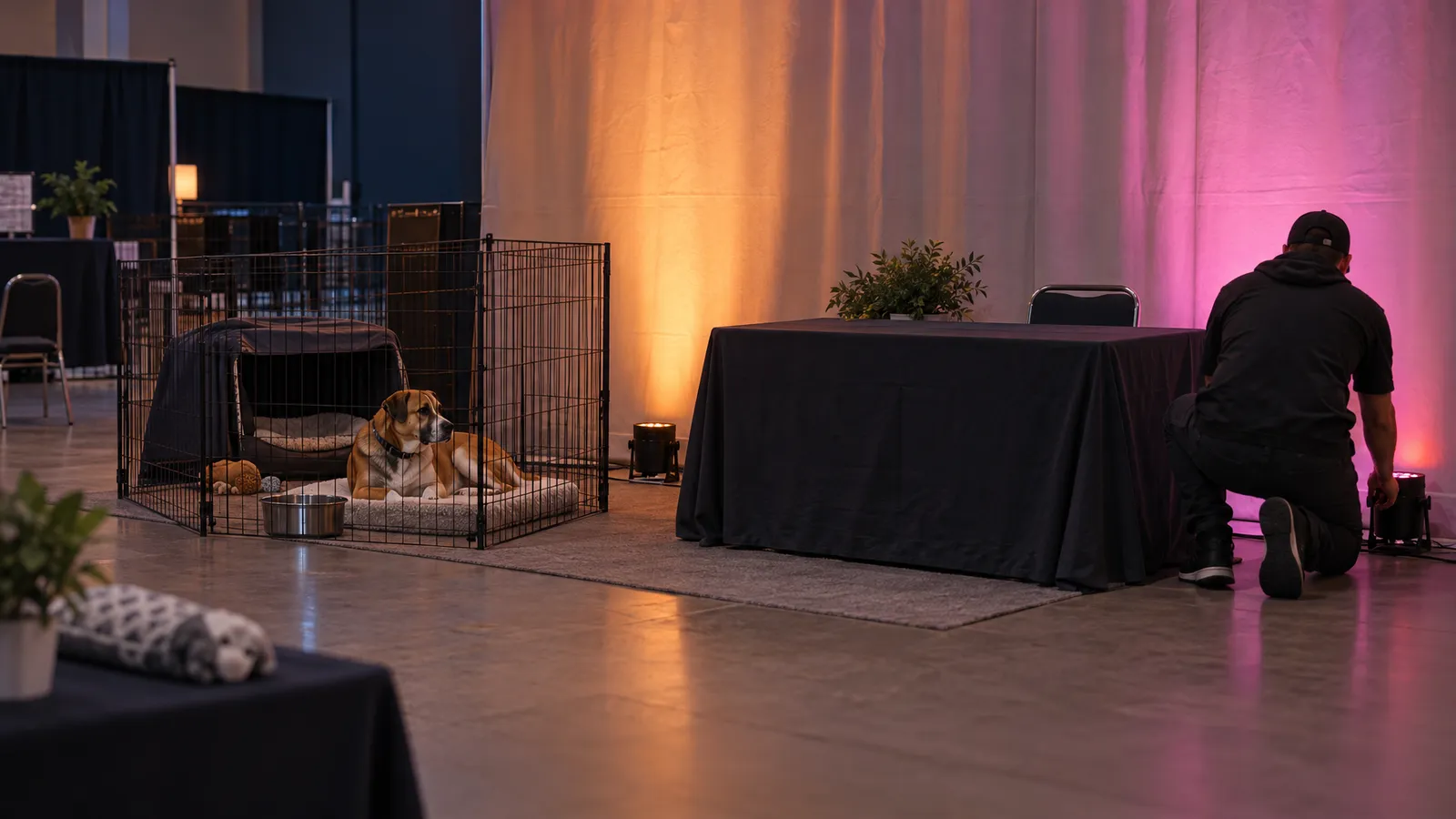
Planning Checklist for the Day
Pull the pieces above into one plan and walk it with the venue and the animal-care team before the event:
- Site walk: at the time of day of your event, to see where shade falls, where power is and where animals will be held.
- Layout drawing: speakers, stage, screens, animal holding areas and walkways, with cable runs kept out of paths.
- Power plan: confirm the power needs of each item on your quote and where it will come from.
- Venue and permit rules: check the park's or venue's rules on amplified sound, tents and equipment.
- Sound check: with the animal-care team present, before animals arrive if possible.
- Booking terms: under our rental terms, delivery, setup and technician services are scoped and quoted to your event, and a 25% deposit secures the booking; ask for a quote with the items you need.
FAQ: Pet Adoption & Pet Expo Event AV Setup
What's the maximum safe sound level for an outdoor dog adoption event?
There is no single number that suits every animal. Plan levels and speaker placement with the shelter's animal-care team, keep sound moderate where animals are crated or leashed, and watch for signs of fear such as panting, trembling, hiding or pacing; if you see them, turn that zone down or move the animals. Distributed speakers around the perimeter make it easier to keep every zone moderate than a single loud tower.
Do I need a stage if my event is only three hours long?
Not necessarily, but a low platform can make the emcee easier to see from across the event, which helps people know where announcements happen. Keep animals at a shaded, ground-level meeting area in front of it rather than on the platform, and ask us for the platform's leg heights so you can keep it as low as possible.
Can I use indoor LED TVs for outdoor adoption-profile displays?
Only where the setting suits the display. Indoor TVs can be hard to read in daylight and are not designed for outdoor conditions, so for a daytime outdoor event ask for a display rated for daylight and outdoor use; equipment beyond the listed catalog is available on request, subject to availability — contact us for a quote. If you plan to put an indoor TV under a tent, confirm with us first that the tent and the weather suit it; there is no time of day that makes an indoor TV outdoor-ready.
What lighting effects are suitable around dogs and cats?
Steady uplights in soft colors, without strobes, chases or sudden brightness changes, are the simplest choice. Avoid haze, fog, cold spark and CO2 jets: atmosphere drifts toward crates, flat-faced breeds are prone to breathing difficulty, and cold spark and CO2 are sudden and noisy. A bubble machine should only be used with the animal-care team's approval and a fluid confirmed suitable for use around pets.
How do I prevent feedback when multiple wireless mics are active during a dog introduction?
Feedback is a loop: sound from a loudspeaker reaches an open microphone and is amplified again, producing a howl. Keep mics out of the direct path of the PA speakers, keep the emcee from pointing the mic at a speaker, don't push the gain higher than you need, and mute any mic that isn't in use. Directional (cardioid) mics help too. Test the actual layout during the sound check, with the emcee walking the area where introductions will happen.