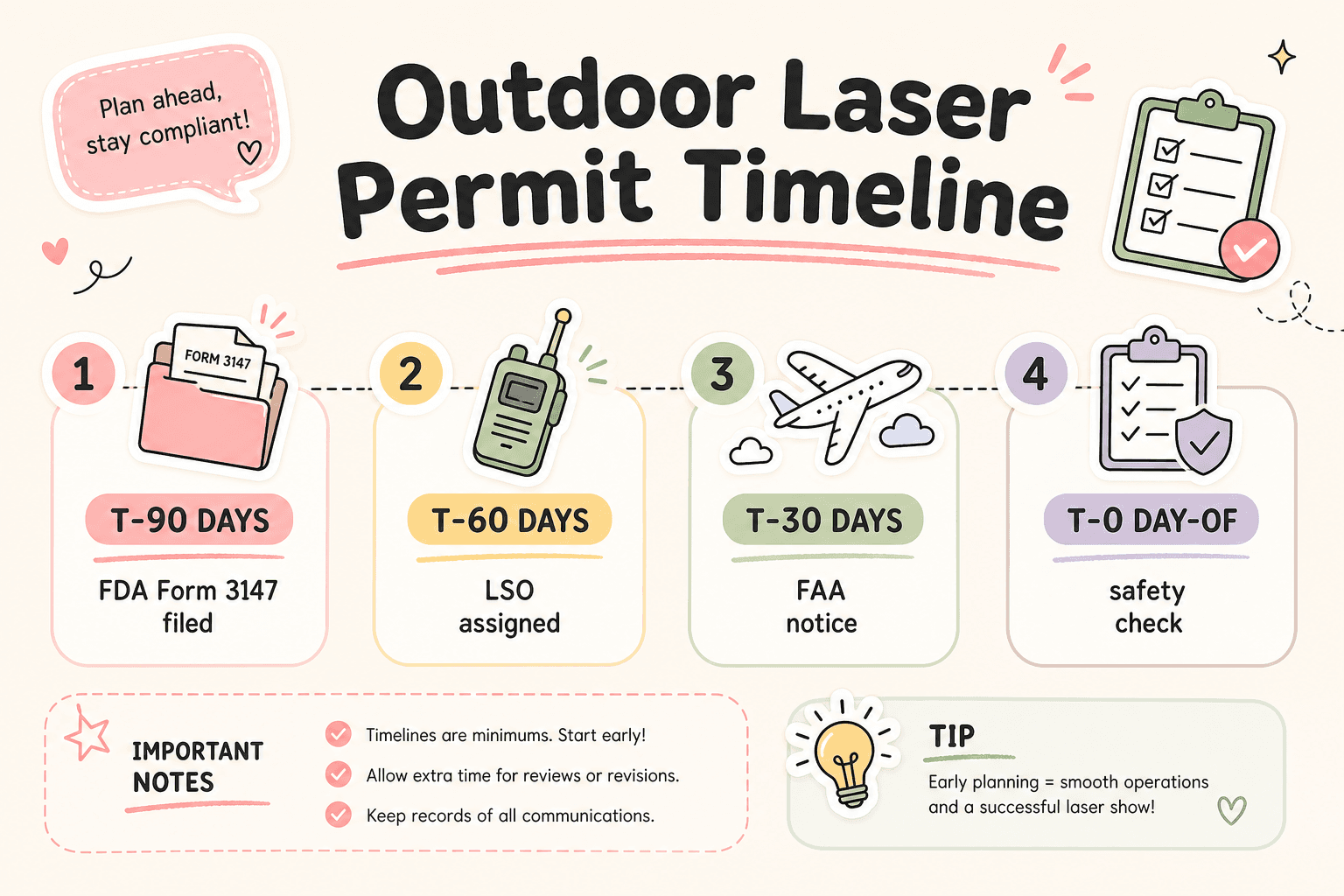
An outdoor laser show in California that uses a projector above the FDA's Class IIIa demonstration limit needs an FDA variance, and if its beams go into navigable airspace above the FAA's thresholds, the FAA asks for notice at least 30 days before the event. Neither agency publishes a guaranteed turnaround, so start early.
This guide explains what each agency asks for, what the standard variance conditions say about audience areas and the operator, and what to ask a laser producer before you commit to a date.
Two federal tracks: the FDA variance and the FAA notice
Laser light shows fall under the FDA's laser product rules in 21 CFR 1040.10 and 1040.11. The FDA states that "laser light show manufacturers must submit a variance request for FDA approval in order to sell and operate higher class (Class IIIb and IV) laser light show equipment," using Form 3147, an application for a variance from "the demonstration laser product hazard class limit of IIIa (5mW visible output)" (FDA, Laser Light Shows). The FDA treats laser light shows as demonstration laser products whose manufacturers must comply with those rules (FDA Laser Notice 55), and Form 3147 describes a party that leases or borrows a projector as an "independent light show manufacturer" responsible for obtaining its own variance. In practice, the variance sits with whoever produces the show, not with the event host.
The FAA side is separate. FAA Advisory Circular 70-1B explains that the FDA "requires notice to FAA as a condition of a variance for a laser light show, display, or device operated outdoors that intends to project into open airspace at any time" (FAA AC 70-1B). The circular itself is guidance: it says its contents "do not have the force and effect of law and are not meant to bind the public in any way." The binding piece is the variance condition; the circular explains how to give the notice the FDA condition refers to.
The two are not interchangeable. An FAA letter does not replace an FDA variance, and a variance does not remove the FAA notice its own conditions call for.
The FDA variance: Form 3147 and its standard conditions
Form FDA 3147 is titled Application for a Variance From 21 CFR 1040.11(c) for a Laser Light Show, Display, or Device. Beyond contact details, it asks for the product and where it will be used (indoor or outdoor, fixed or touring), the laser effects to be performed, and laser radiation levels such as wavelengths and power. The form notes that "in general, the Agency will approve a variance for only two years" (Form FDA 3147).
Section 13 of the form lists the alternate means of radiation protection the applicant commits to, and asks the applicant to justify any it does not check. The ones that matter most to an event planner:
- Audience areas. "Scanning, projection, or reflection of laser and collateral radiation (Light show radiation) into audience or other accessible uncontrolled areas will not be permitted except for diffuse reflections produced by the atmosphere, added atmospheric scattering media, and target screens."
- Height and separation. Levels above Class I are not permitted "at any point less than 3.0 meters above any surface upon which persons other than operators, performers, or employees are permitted to stand or 2.5 meters below or in lateral separation from any place where such persons are permitted to be."
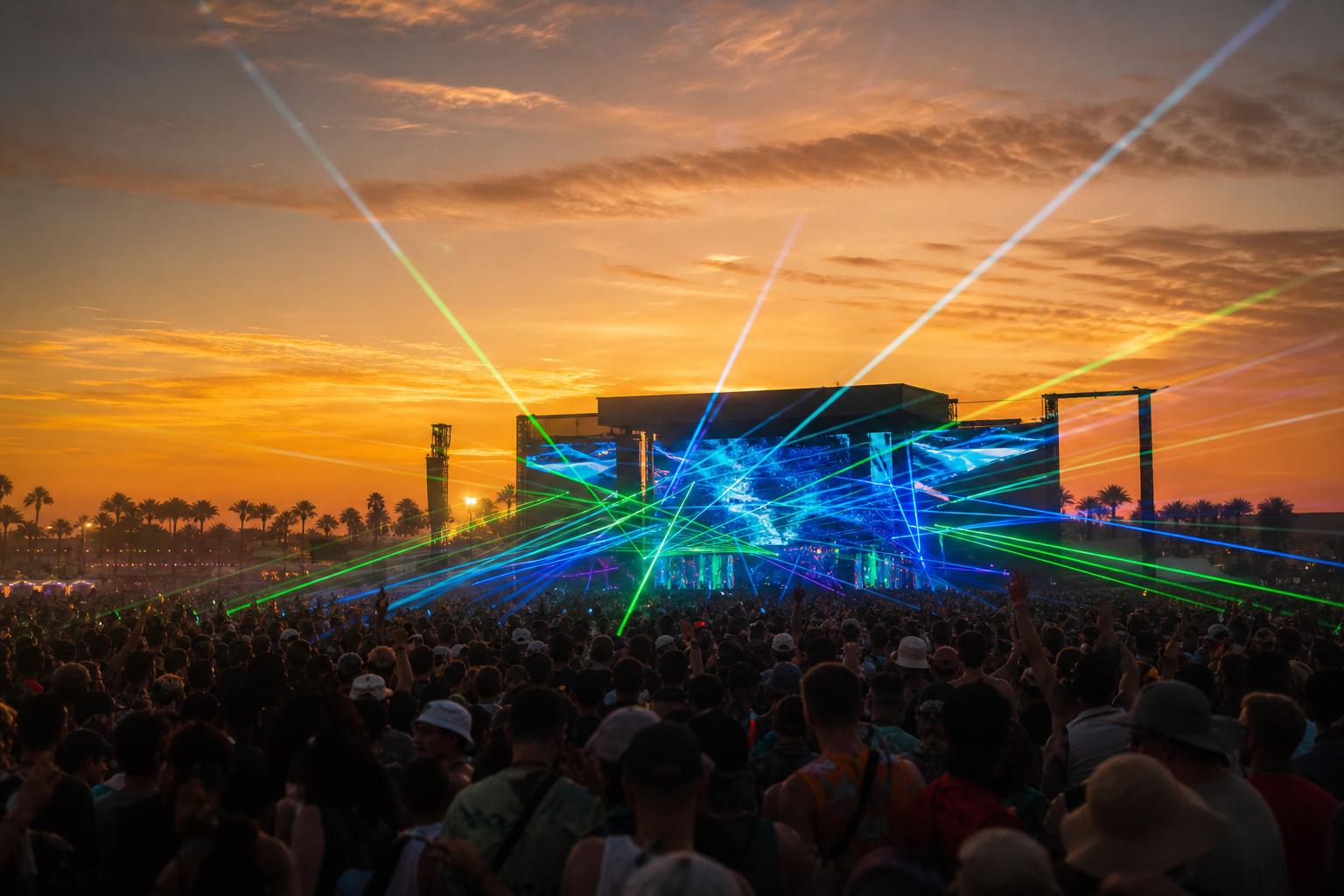
- The operator. Shows are "under the direct and personal control of trained, competent operator(s)" who are employees of the variance holder, are "located where all beam paths can be directly observed at all times," and immediately terminate emission "in the event of any unsafe condition; or, for outdoor shows, upon request by any air traffic control officials."
- Effects. "Effects not specifically indicated in this variance application will not be performed. No other effects will be added until an amendment to the variance has been obtained."
- Notifications. Advance written notice to appropriate federal, state and local authorities, including the FAA "for any projections into open airspace at any time (i.e., including set up, alignment, rehearsals, performances, etc.)," and state and local radiation control agencies where the show is performed.
- Equipment on loan or lease. Projectors are not delivered to another party "under an agreement of sale, lease, or loan unless and until the recipient demonstrates that they have a variance in effect."
So a new effect, not a new date, is what the form ties to an amendment. Whether a particular show fits an existing variance is a question for the variance holder to answer from their own approval letter. Variance holders also file an annual report; the FDA's reporting guide says it is due "by September 1 of each year" for the July-to-June reporting year (FDA annual report guide).
The FDA's laser light show page does not publish a processing time for a new variance or an amendment. If your date depends on one, ask the producer how long their recent filings took and plan with margin.
Audience areas: why outdoor beams go overhead
Producers are most often asked whether beams can hit the audience. Under the standard condition quoted above, projection into audience or other accessible uncontrolled areas is not permitted, apart from diffuse reflections from the atmosphere, haze or target screens. Form 3147 does list "audience scanning" among the effects an applicant can declare, and an applicant who does not accept a standard condition has to justify it; whether any such request is approved is up to the FDA.
For planning purposes, the working assumption is the standard one: beams stay out of the areas where guests can stand, above the 3-meter height and outside the separation the condition describes. Ask the producer to show you, on the site plan, where the beams go and where guests will be.
The FAA notice: who files, when and what
AC 70-1B says a notice should be submitted by anyone planning outdoor laser operations "with visible laser beams, wavelengths of 400 nanometers (nm) to 700 nm, exceeding 50 nanowatts per square centimeter (nW/cm2) in navigable airspace or with any laser beams (visible or non-visible) that exceed the maximum permissible exposure (MPE) in navigable airspace." If the proponent is unsure whether an operation stays out of navigable airspace, the FAA encourages contacting the service center. Whether a given show crosses those thresholds is a calculation for the producer from the projector data and beam paths.
The FAA "requests proponents file a notice at least 30 days before the planned event," which gives it time for an aeronautical study. The filing is FAA Form 7140-1, Notice of Proposed Outdoor Laser Operation(s), which includes a Laser Configuration Worksheet "for each laser configuration," plus diagrams of the planned laser paths. It goes to the FAA service center responsible for the area that includes the site; Appendix E of the circular lists them.
After review, the FAA issues a letter of determination stating either that it has no objection or that it objects and "the laser use should not proceed until resolution of objectionable effects." The circular defines airspace flight zones by exposure level; for example, in a Critical Flight Zone laser light is restricted to 5 µW/cm² or less, "a level that should not cause veiling (obscuring) glare."
Bay Area venues and airspace
The Bay Area has three major commercial airports (SFO, OAK and SJC) and a number of general aviation fields, including Hayward, Palo Alto, Reid-Hillview, San Carlos, Napa County, Santa Rosa and Livermore. Distance from an airport is not the filing test, and it does not predict the outcome: the FAA reviews each proposal, coordinates with parties potentially affected, and states the result in its letter of determination. Plan on filing for any show whose beams will reach navigable airspace above the thresholds, wherever the venue is.
Laser classes: where the variance line falls
The FDA's hazard classes run from I to IV, with IEC equivalents. The FDA describes Class IIIb (IEC 3B) as an "immediate skin hazard from direct beam and immediate eye hazard when viewed directly," and Class IV (IEC 4) as an "immediate skin hazard and eye hazard from exposure to either the direct or reflected beam; may also present a fire hazard," listing laser light show projectors as examples of both (FDA, Laser Products and Instruments).
For a light show, the line that matters is the demonstration limit: the FDA's variance form refers to the "hazard class limit of IIIa (5mW visible output)," and the FAA glossary notes that "any demonstration laser in excess of 5 mW requires a variance from the CDRH." A product's class is set by its manufacturer's certification under the FDA standard, not by a single power figure, so check the label and the manufacturer's documentation. Form 3147 also commits the applicant that "the maximum laser projector output power will not exceed the level required to obtain the intended effects."
Show day: the operator, the beam paths and the stop
The standard conditions set out what has to be true while the show runs: a trained, competent operator in direct and personal control, positioned to observe all beam paths, able to terminate emission immediately, including for outdoor shows on request from air traffic control; projection equipment securely mounted with beam masking to prevent overfilling; and written procedures for setup, alignment, testing and performance, with access to laser radiation areas controlled. Any conditions the FAA sets in its letter apply on top of that.
How airspace is protected is part of the FAA filing. AC 70-1B gives examples of control measures to describe: "termination on a building or surface," "use of observers, use of radar and/or imaging equipment, or physical methods of limiting the beam path." A proponent using an electronic protection system in lieu of safety observers documents that it meets SAE AS6029. Ask the producer which measures the filing uses and who does each job on the night.
Weather is a practical question as much as a regulatory one: rain, wind or unplanned haze can change the effect and the reflections. Agree in advance who decides to hold or cut an effect and on what basis.
What to line up, and what VENEGEEST rents
An outdoor Class IIIb or IV show needs a producer who holds an FDA variance covering it and who handles the FAA notice for that site. Before you book, ask whose variance the show runs under and whether it covers the effects you want, who files the FAA notice and when, who operates the show on the night and how aircraft are watched for, and whether their liability insurance covers laser operation, since venue certificates of insurance often ask.
VENEGEEST rents laser fixtures: the 10W Laser Show Light ($100/day) and the Outdoor IP67 Sky Laser in 20W to 50W versions. Renting a projector is not the same as holding a variance. Tell us the venue and the effect, and confirm the variance and operator arrangement before the date is set.
What stays with the event side: the venue contract, coordination with the venue and local authorities, and creative direction.
For other effects you might pair with laser, such as cold sparks, CO2 jets or fog, see the special effects category and check each one's own venue and fire-authority rules; cold sparks are covered in our Bay Area cold spark guide.
FAQ: Outdoor Laser Show Permits
How far in advance do I need to start the FDA variance?
The FDA does not publish a processing time on its laser light show page. If your producer does not already hold a variance covering the show, start as early as you can and ask them how long recent filings took. If they already hold one, ask whether the show's effects are covered or need an amendment.
Does FAA notice apply if my venue is far from a major airport?
Distance is not the test. AC 70-1B asks for notice when visible beams exceed 50 nW/cm² in navigable airspace, or any beam exceeds the maximum permissible exposure there, and requests it at least 30 days before the event. The FDA's standard variance conditions call for notifying the FAA of any projections into open airspace.
Can the beams sweep into the audience like in festival videos?
Under the standard variance condition, no: projection into audience or other accessible uncontrolled areas is not permitted except for diffuse reflections from the atmosphere, haze or screens. Form 3147 lists audience scanning as an effect an applicant can declare, but whether it is approved for a show is up to the FDA, so ask the producer what their variance covers.
What if an aircraft enters the show area mid-show?
The standard condition requires the operator to terminate emission immediately in any unsafe condition, and for outdoor shows on request from air traffic control. How aircraft are detected, by observers or an electronic protection system, and any further FAA conditions come from the filing and the FAA's letter.
Does the process change outside the Bay Area?
The federal framework is the same across the US: the FDA variance is national, and the FAA notice goes to the service center responsible for the site. The variance conditions also call for notifying state and local radiation control agencies where the show is performed. VENEGEEST serves San Francisco, San Jose and the South Bay, and the wider Bay Area.
Plan from the date backwards
If you are planning a sky-laser or other outdoor laser effect, start with the date: confirm a variance-holding producer first, then count back at least 30 days for the FAA notice, and more if a variance or amendment is still needed. Send VENEGEEST the venue, the date and a sentence about the effect, and we'll tell you which laser fixtures fit. Browse the equipment catalog for the lighting and effects that pair with an outdoor laser. Service area: San Francisco, San Jose and the South Bay, and the wider Bay Area.