Lighting an outdoor festival comes down to four checks: equipment with ingress-protection ratings and operating limits that suit the site, a power plan built from the real input loads of what you rent, screens bright enough for the light at show time, and freestanding rigging designed for the wind and ground you actually have. Bay Area parks and plazas add fog, damp and wind that can change over a day, so plan for the forecast and the site rather than for a typical day.
This checklist is for festival producers, city event teams and brand activators planning outdoor events in San Francisco, Oakland, Berkeley, San Jose and elsewhere in the Bay Area. It covers IP ratings, power, LED screens, rigging and the permits to ask about.
IP Ratings: What They Mean for Outdoor Gear
The IP code comes from IEC 60529, which classifies the protection an enclosure gives against dust, contact and water. The first digit covers solids and the second covers water. A first digit of 6 means dust-tight. For water, a 4 means splashing from any direction should have no harmful effect, a 5 covers water jets from a 6.3 mm nozzle, and a 7 covers immersion up to 1 meter for 30 minutes under defined conditions. The ratings are not cumulative above 6: a device rated IPX7 for immersion is not necessarily rated for water jets.
Two practical points follow. First, a rating describes a lab test, not every outdoor condition — it does not by itself tell you how a fixture handles hours of condensation or temperature swings, so read the manufacturer's operating instructions and environmental limits for the exact model. Second, equipment without a water rating (such as a typical IP20 indoor fixture) should not be used where it can get wet unless the manufacturer approves a specific cover or enclosure.
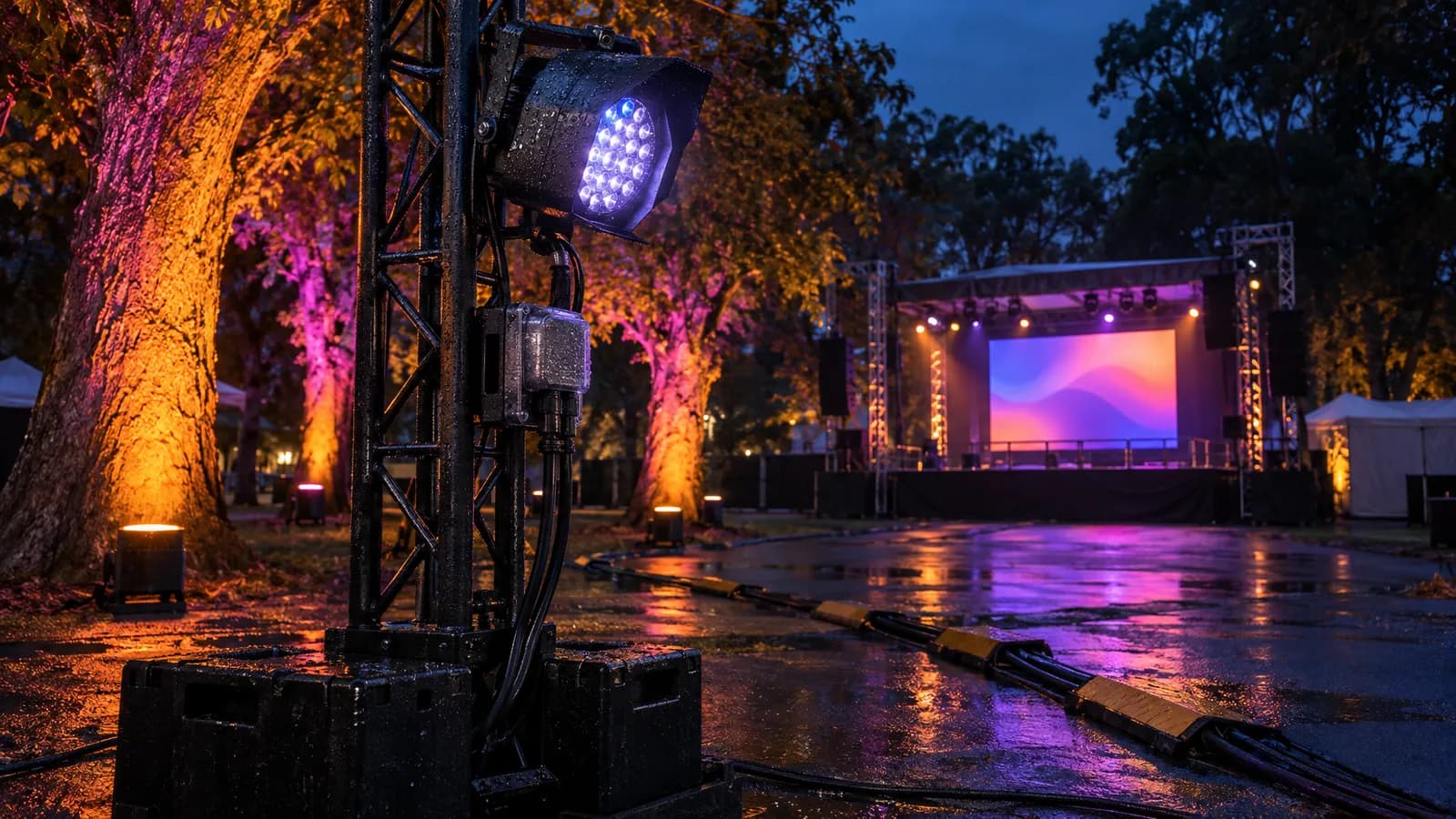
In the VENEGEEST catalog, the Outdoor IP67 Sky Laser is listed in 20W to 50W versions and described as a weatherproof sky laser for outdoor festivals; Wireless Battery Uplight units are listed with a 12–15 hour battery, wireless DMX and IP65 ratings on most versions; and several LED par variants are listed as IP65. Ask for the exact model's specifications when you quote.
- Battery uplights: wireless DMX and battery operation mean no power cables to run to each fixture, which helps where cables can't cross pedestrian paths or ground power isn't available.
- Sky lasers: a weather rating does not remove the FDA and FAA steps covered in the permits section below.
- LED screens: ask whether the specific panels are rated for outdoor use and what protection they need from rain.
- Power and data connections: use connectors and cable rated for outdoor use, and have a qualified electrician specify the protection the power distribution needs under the rules that apply to your site.
Power: Site Power, Generators and Battery Fixtures
An outdoor festival's power comes from some combination of the site's own supply, generators and battery-powered fixtures. Start with a site walk with venue operations: what power exists near the stage, how much of it is already allocated to permanent fixtures or vendors, and whether you're allowed to use it.
If you need a generator, size it from the real input loads of the equipment you will run — each device's rated input power or current from its specifications, not a speaker's audio output rating or a guess. Give the list to the generator supplier and let them recommend a unit with headroom for startup loads, and ask for the selected model's fuel consumption at your expected load so you can plan fuel for the full event plus a reserve. Commercial PA Speakers and a P1.9–3.9 LED Rental Screen are in the catalog; ask for their power specifications when you quote so your list uses real figures.
Wireless Battery Uplights draw no site power while they run, which can take perimeter and tree lighting off the generator entirely. Runtime and charging depend on the model and how you run it, so check the manual for the version you rent, and plan a recharge or swap if the event runs longer than the rated battery life.
- Site power: confirm availability and capacity with venue operations on a site walk
- Generator sizing: build a load list from rated input figures and have the generator supplier size the unit
- Fuel: plan from the selected generator's fuel consumption, with a reserve, and confirm whether the rental includes refills
- Battery fixtures: check runtime and charging in the exact model's manual
- Fuel and generator permits: fire departments set their own rules for generators and on-site fuel; confirm with the city's special-event office and fire marshal
How much power do I need for a 1,000-guest outdoor reception?
There is no single number. It depends on the audio system, the lighting, any screens and the catering, and on which of those run on battery or site power instead of a generator. Make a load list with each device's rated input, add the catering and vendor loads, and give it to the generator supplier to size the unit and plan fuel. Ask the venue where generators may sit and what noise limits apply, and confirm fuel, permit and operator requirements with the city's special-event office before you budget.
Outdoor LED Screens: Brightness, Viewing Distance and Sun Angle
A projected image loses contrast when daylight falls on the screen, while an LED screen produces its own light, which is why LED screens are usually chosen for daytime outdoor events. Whether a particular screen is readable depends on its brightness and contrast, the ambient light at show time, the content and the sun's position, so ask for the brightness specification of the exact panels and plan against the conditions you expect.
Pixel pitch is the distance in millimeters between neighbouring pixel centers. Planar's guide to viewing distance describes a "10x rule" — pitch in millimeters times ten — as a quick approximation of the visual acuity distance, where a viewer with 20/20 vision stops being able to distinguish individual pixels. That is not the same as the closest acceptable viewing distance: Planar describes a separate average comfortable viewing distance, and says acceptable viewing distance is subjective and depends on eyesight, application and content. So a finer pitch suits closer viewing, but test your actual content at the distances your audience will be. Our LED video wall rental guide covers indoor and outdoor panel questions in more detail. The LED Rental Screen is configurable from 12 m² to 48 m², from $200 per day.
Sun angle matters too. Viewers facing a screen look in the opposite direction to the way the screen faces, so check where the sun will be at show time relative to both the screen face and the audience's line of sight. Use the site's orientation, the date and times, and any buildings or trees that will shade the screen, and plan stage orientation or content timing from that.
- Brightness: ask for the panel's specification and plan against the expected ambient light
- Viewing distance: use pitch as a guide, and test content at real audience distances
- Wind and support: ground-supported screens need wind load and ballast from the truss and panel manufacturers' data or a rigging engineer
- Power and signal: use the exact panels' power specification in your load list, and confirm the signal path and cable runs with whoever sets up the screen
- Spares: ask what spare modules or panels will be on site for your configuration
- Setup time: VENEGEEST's terms state a minimum of 2 hours for standard setups, with more for large productions; ask for a setup and access plan for your site
Rigging Overhead Lighting Without Permanent Infrastructure
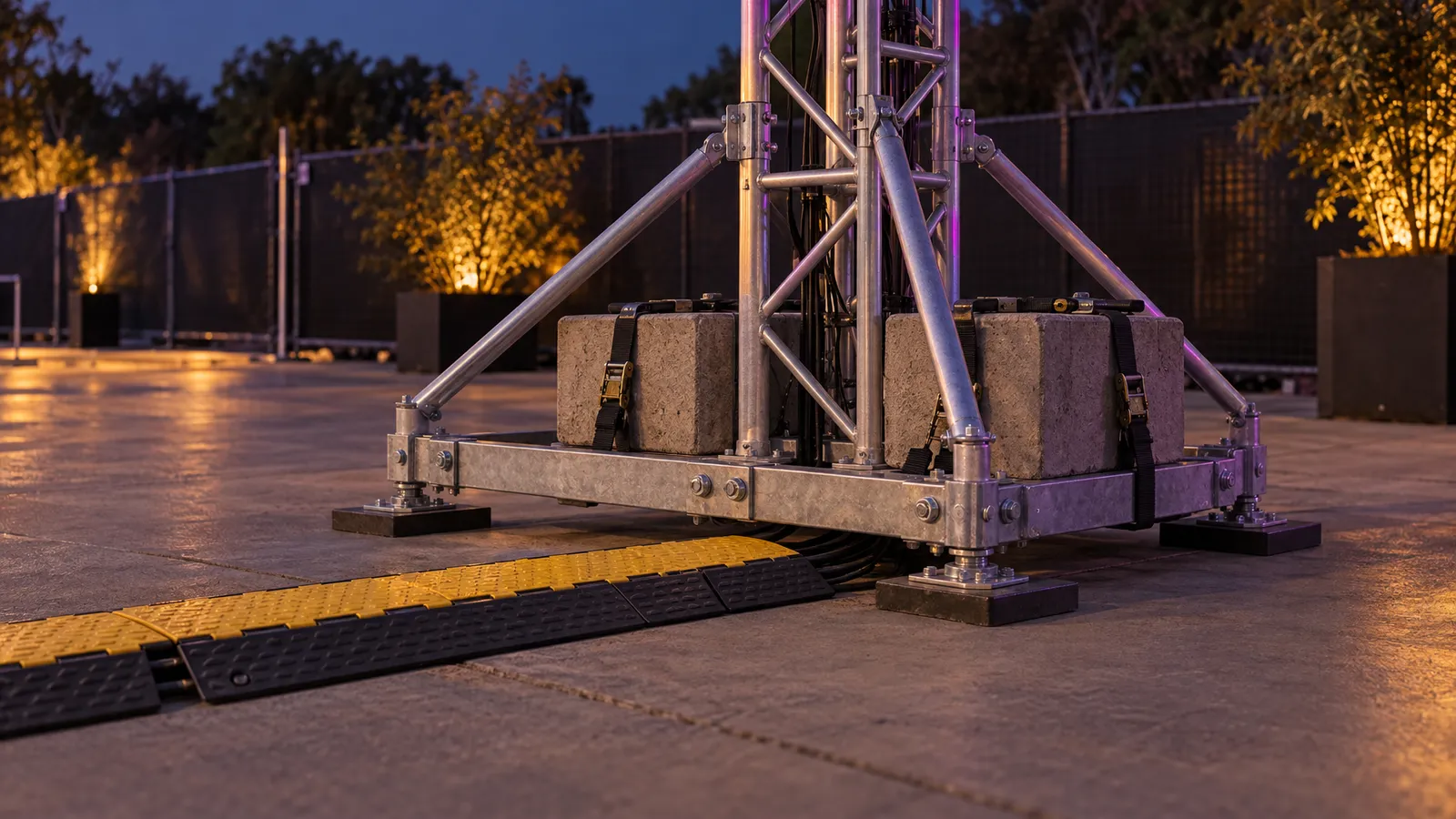
Where a park or plaza doesn't allow ground anchors, overhead lighting goes on freestanding truss or towers. How much a truss can carry, how far it can span, and how much ballast it needs depend on the specific truss system, the load, the height and the wind, so those figures must come from the manufacturer's load tables and a site-specific design by a qualified person — not a rule of thumb. Aluminum H-Frame Truss is in the catalog at $10 per day; ask for its specifications when you quote.
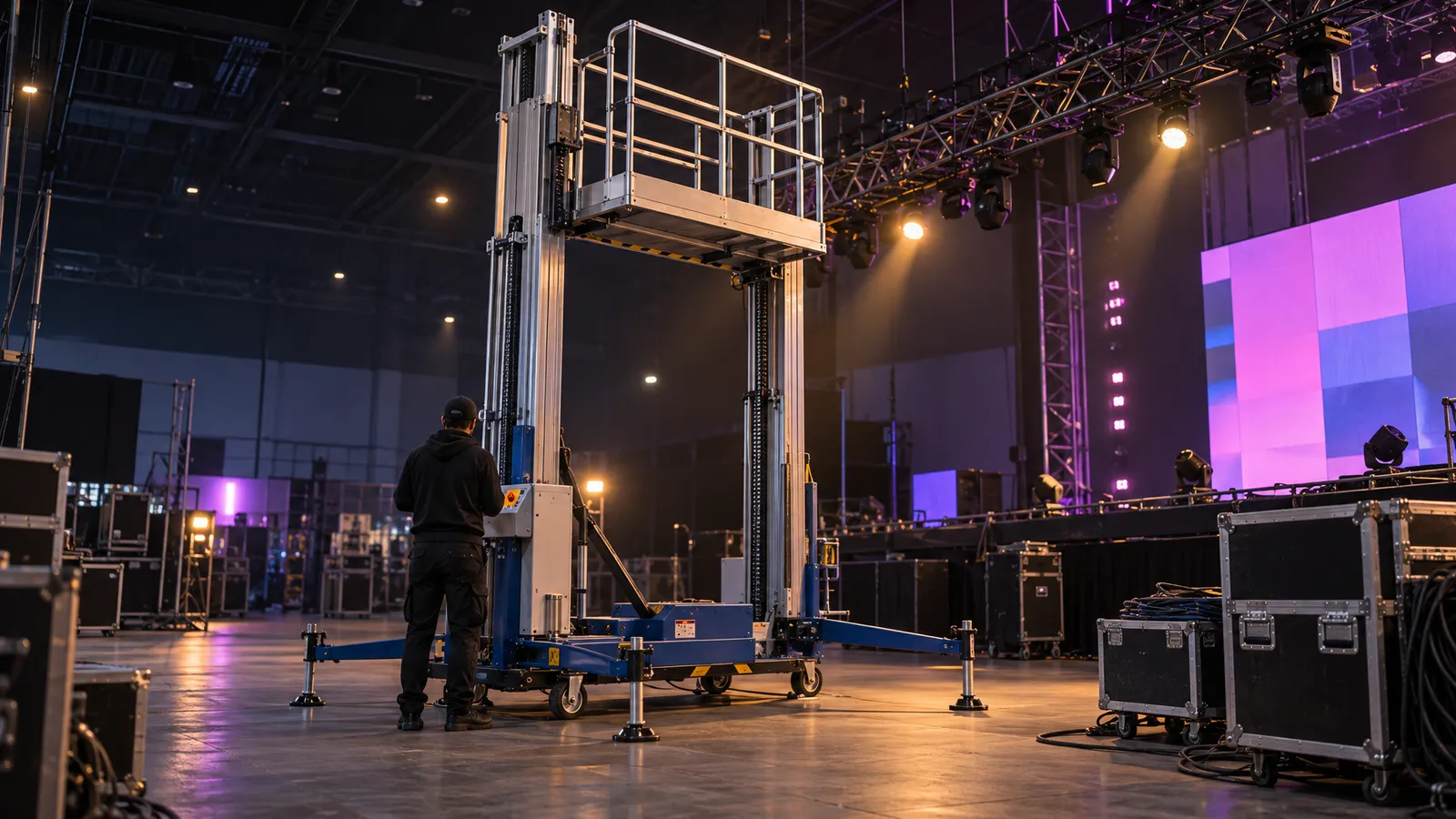
Set a wind limit in advance at which fixtures come down or the rig is lowered, and make sure someone is responsible for watching the forecast and conditions during the event. Check towers are plumb before loading them; as a matter of geometry, a 2° lean moves the top of a 15-foot tower about 6 inches sideways. A modular Portable Stage Platform ($30 per unit per day) gives performers a deck. For work at height, the Electric Lift Scaffold ($80 per day) is a motorized, height-adjustable lift; follow its operating instructions and the site's rules for work at height.
- Loads, spans and ballast: from the truss manufacturer's tables and a qualified, site-specific design
- Wind: set a wind limit and a plan for lowering or de-rigging before the event
- Cables: agree routes with the venue and use cable ramps or covers where power and DMX cross pedestrian paths; many venues require them
- Permits: some jurisdictions ask for truss drawings or stamped load calculations for tall rigs; confirm with the city's special-event office before you design the rig
Permits, Noise Ordinances, and Curfews
Outdoor event rules — sound curfews, decibel limits, sound-permit fees and security requirements for larger crowds — vary between San Francisco, Oakland, Berkeley and San Jose, and sometimes between venues in the same city. Confirm the limits for your date and site with the city's special-event office, then build the show to them. Keeping a sound level meter at front of house and logging readings helps you show you stayed inside the permit.
- Event insurance: public venues usually require a general liability certificate naming the venue as additional insured; the venue sets the amounts and the deadline.
- Generator and fuel permits: fire departments set their own fees, notice periods and fuel-containment rules.
- Lasers: the FDA's laser light show page says that before Class IIIb and IV lasers are used for a laser light show in the United States, documents must be submitted to the FDA. For outdoor laser operations, the FAA's Advisory Circular 70-1B describes a notification process and requests that proponents file notice at least 30 days before the planned event; check with the laser operator how FAA notification and any variance conditions apply to your show. An Outdoor IP67 Sky Laser's weather rating does not change any of this.
- Site deposits: venues may hold a deposit until a site inspection after the event; budget time for strike and site restoration.
FAQ: Outdoor Festival Lighting Setup
What's the difference between IP65 and IP67 ratings for outdoor lighting?
Both are dust-tight (the 6). The second digit differs: 5 means tested against water jets from a 6.3 mm nozzle, and 7 means tested for immersion up to 1 meter for 30 minutes. Because the water ratings aren't cumulative above 6, an IP67 device is not automatically rated for jets. Neither rating on its own covers every outdoor condition, so follow the manufacturer's instructions and environmental limits for the exact model.
How do I calculate generator size for a 500-person outdoor event?
List every powered device — audio, lighting, video, catering — with its rated input power or current from the manufacturer's specifications. Give the list to the generator supplier, who can size the unit for continuous load and startup demand and tell you the model's fuel consumption at your expected load. Plan fuel for the full event plus a reserve, and confirm whether the rental includes refills or a delivery.
Can I use standard moving heads outdoors in Bay Area fog?
Not unless the manufacturer says they can be used in those conditions. Fixtures without a water rating aren't designed to get wet. Use moving heads rated for outdoor use, or keep standard fixtures under a structure that keeps them dry, following the manufacturer's guidance on covers and ventilation. A roofed truss structure needs its own engineering and ballast for wind load.
Do battery-powered uplights really last a full event day?
The catalog lists the Wireless Battery Uplight range with a 12–15 hour battery, but the runtime you get depends on the model and how you run it. Check the manual for the exact version, charge fully before the event, and plan a recharge or battery swap if the event is longer than the rated runtime.
What viewing distance do I need for a P3.9 LED screen at an outdoor festival?
By Planar's 10x rule, P3.9 gives an approximate visual acuity distance of about 39 feet — the distance at which a viewer with 20/20 vision stops distinguishing individual pixels. Viewers closer than that can still find the image acceptable, depending on the content and their eyesight, so test your content at the distances your audience will stand. For a wide or deep crowd, screen size and placement matter too; the rental screen configures from 12 m² to 48 m², and a second screen can help sightlines across a wide site.