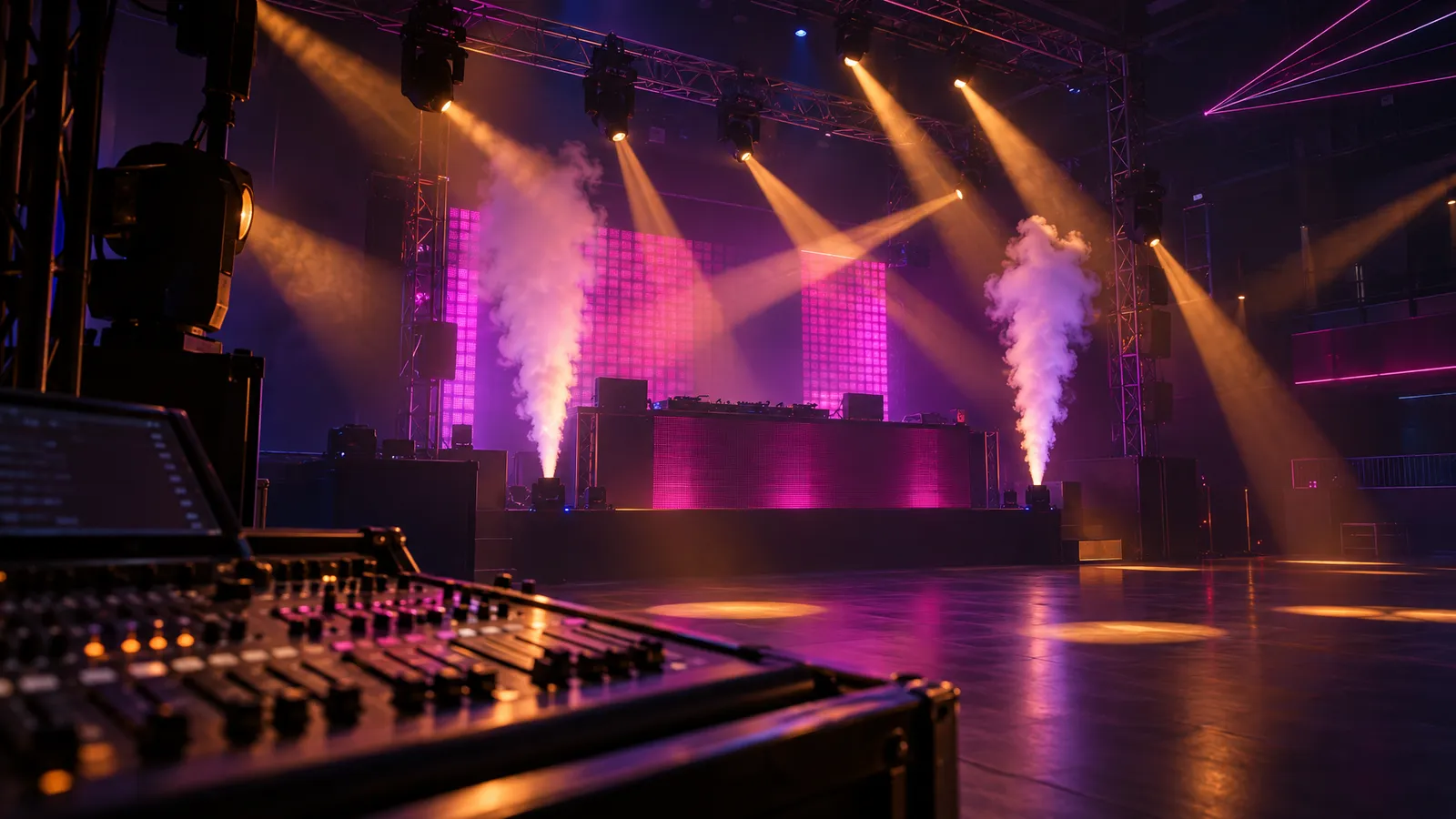
If you're producing a DJ night, brand takeover, or club residency in San Francisco or Oakland, a club lighting rig is usually built from three layers: moving heads for beams and color, atmosphere so the beams read in the air, and one or two punctuation effects such as CO2 jets or lasers. This guide walks through the gear categories promoters rent for high-energy nights, from small lounges to large warehouse rooms, with example fixture counts to start a conversation, DMX basics, how to plan haze with the venue, and the options for triggering CO2.
Beam vs. Wash vs. Spot: Building Your Moving-Head Array
Three fixture types define modern club lighting, and many rigs layer all three. Beams cut narrow, intense shafts through haze — think the skyward pillars sweeping over the dance floor during a drop. Washes flood color across crowds and architecture; they're your ambient layer between songs. Spots add texture — gobos, framing shutters, tight focus on the DJ booth or a sponsor logo mid-wall.
How many you need depends on the room's size and shape, the rigging available and the look you want, so treat any count as a starting point for a venue-specific plan. As an illustration, a small lounge design might use four 380W Beam Moving Heads overhead for aerial effects, two wash fixtures on the perimeter for crowd color, and two spots for key light, eight in all. A larger room might use something like eight beams, four washes and two to four spots, fourteen to sixteen fixtures in total. A lighting designer who has seen the room should size the final rig.
Hybrid fixtures combine several functions in one chassis. Our catalog lists the LED Beam-Spot-Wash Hybrid Moving Head with a 4–50° zoom range, CMY+CTO color mixing and framing, so a single rig can shift between tight beam looks and wide wash looks; whether a smaller count of hybrids can replace a mixed rig depends on the design. Check the rated power of each model you rent; power draw matters when you're close to the limit of a venue's house service. For tight aerial beams with prism rotation, the catalog also lists the Discharge-Lamp Beam Moving Head, described as a "classic lamp-based beam moving head." The 380W Beam Moving Head rents for $50 per day; hybrids and lamp beams are quoted per event. Delivery, setup and technician services are scoped and quoted to your event, or you can arrange self-pickup.
- Beam fixtures: 380W or discharge-lamp models for aerial coverage. Hang them only from rated supports — truss or rigging points approved for the load — using the manufacturer's mounting hardware and safety cables, under a rigging plan from a qualified rigger.
- Wash fixtures: RGBW or CMY units — position on vertical towers at room corners or mid-wall for even crowd illumination.
- Spot fixtures: Framing-shutter models for logo projection, DJ-booth key light, or architectural texture.
- Hybrid fixtures: Beam-spot-wash hybrids can reduce the number of fixture types you carry; program mode-switching from the console.
- Power budgeting: Collect the input power or current rating from each fixture's spec sheet and have the venue or a qualified electrician confirm the circuits can carry the load, or specify a generator in the contract.
Haze Integration: Venue Rules and Beam Visibility
Beams are hard to see in clean air: what makes a beam visible is light scattering off particles in the air, which is what haze provides. Ask the venue which atmospheric fluids it allows before you book a machine. Our Haze Machine (listed as a 1000W atmospheric haze generator, $25 per day) is one option, and the catalog lists other hazers from 600W to 3000W that are quoted per event. Haze fluid is available on request; contact us for a quote. The wattage is the machine's power rating, not a measure of how much room it fills, so ask for the model's output specifications and plan how many machines you need with the venue's ventilation in mind. Test density at soundcheck, since the room's HVAC changes how fast haze clears, and use fans to spread haze evenly rather than letting it collect in one spot.
Will haze set off the venue's fire alarm system?
It can. Detectors respond to particles in the air, and a dense haze can trip them. Before load-in, ask the venue's engineering or fire contact what its procedure is for haze during the event; that decision belongs to the venue and its fire authority, never to the lighting crew. Document the answer in your production rider. If the venue approves haze, test at low output during soundcheck and build up; if it won't allow haze, ask whether a low-lying fog effect is allowed instead.
Pixel-Wash Effects: Color Blocks and Eye-Candy Looks
Standard RGBW wash fixtures flood a single color, but pixel-mapped washes like the LED Pixel-Wash Moving Head (B-EYE Style) split the front into individually controllable cells; our range runs from 6-cell to 37-cell models. You can program checkerboard patterns, color wipes and kaleidoscope spins across the fixture face, which suits brand takeovers and EDM nights that want a busy visual. Pixel washes flanking the DJ booth can act as animated backdrops. Collapse all the pixels to a single color and they work as ordinary washes too.
- Pixel density: fewer cells for blocky geometric looks; more cells for smoother gradients.
- Placement: Upstage on vertical towers or mid-truss for backdrop effects; audience-facing for immersive color blocks during drops.
- Programming: Use fixture macros for built-in effects or map individual pixels in your console for custom content. Pixel mapping uses many more DMX channels than a single-color mode, so budget channels from the mode you choose.
- Music sync: If you want effects to follow the tempo, confirm with the console operator which inputs the specific console accepts (for example MIDI or audio input) and what the DJ's setup can send, and test it before the show.
CO2 Jets for Drop Moments: Manual vs. DMX Triggers
A vertical column of white CO2 fog can mark the peak moment of a set: the drop, the brand reveal, the countdown. CO2 Jets fire from pressurized cylinders in short blasts. Ask your rental vendor how many blasts a cylinder gives with the specific jet, plan your cylinder count from that, and confirm the venue allows pressurized cylinders indoors. Place jets where the plume is visible and does not block sight lines to the DJ, and follow the jet's manual for placement and clearances.
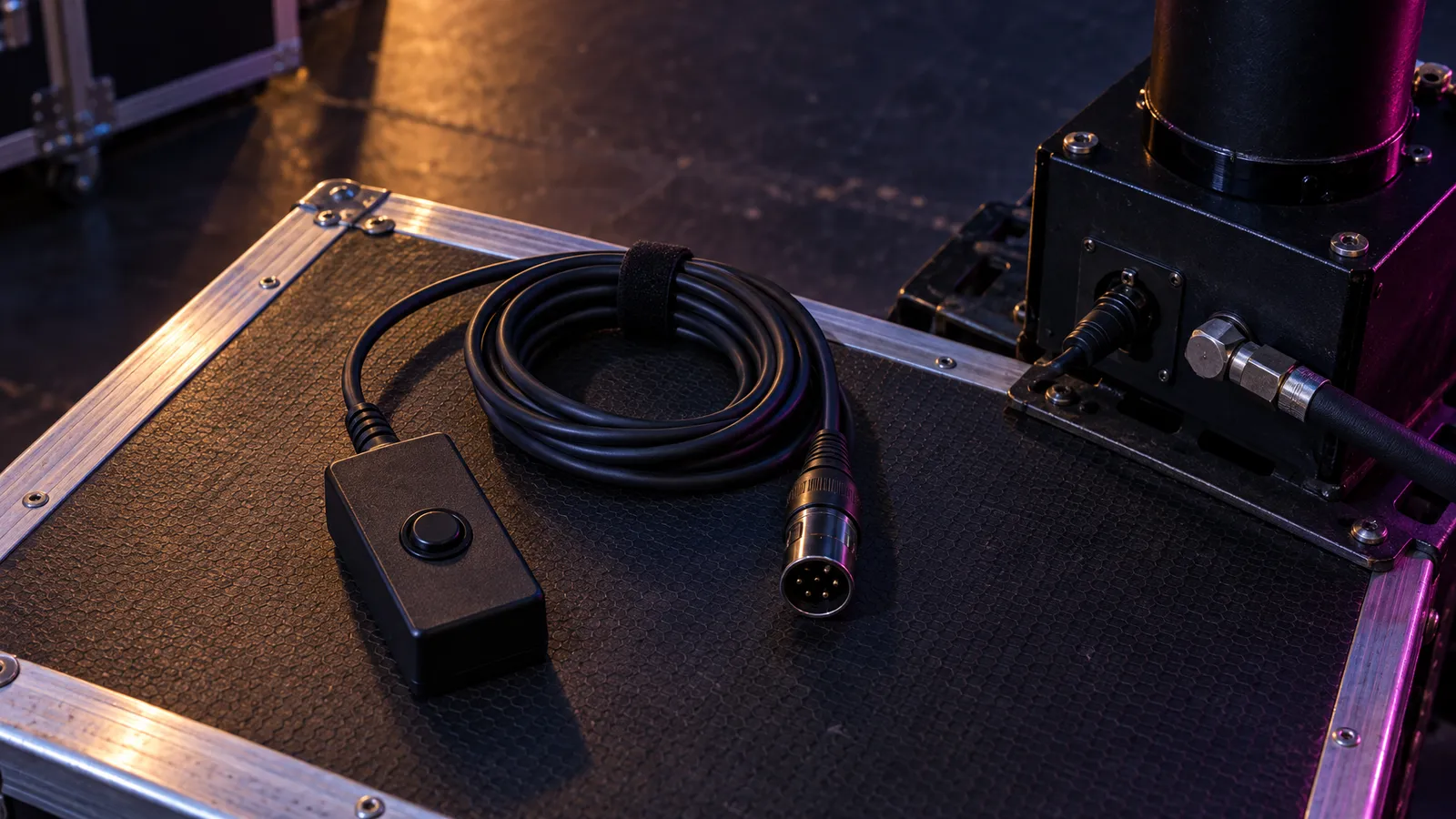
There are two common ways to fire a jet, and the right one depends on the model and the show. Some jets are fired by an operator with a push-button or from the lighting console, which lets you adjust in real time if the set timing shifts; a console cue can be fired by hand, so DMX control does not require a timecode show. Timecode is an option when a set is fully programmed against locked tracks. Confirm which control methods the specific jet you rent supports. Either way, test each jet during soundcheck, and follow the manual's guidance on repeated firing and handling cylinders. CO2 jets are quoted per event.
- Blast duration: keep blasts short; long blasts use more CO2.
- Cylinder count: plan from the vendor's per-cylinder figure with a margin so you don't run dry mid-show.
- Placement: Where the plume is visible to the crowd and clear of the DJ's sight lines, following the manual's clearances.
- Trigger method: Manual or console control, depending on what the jet supports; ask how the operator stops it in a hurry.
- Safety: keep jets well back from the audience so nobody takes the cold plume at close range, and ask the venue about ventilation.
DMX Control: Consoles, Scenes, and Timecode Integration
DMX512 is the standard lighting control protocol, carrying 512 channels per universe. Many moving heads and effects accept DMX, but not every model does, so confirm the control protocol and channel mode of each item you book; our 380W Beam Moving Head and 10W laser, for example, are listed with DMX control. How many universes you need depends on the channel count of each fixture in the mode you choose, not just on the number of fixtures, so add up channels from the spec sheets before you plan the patch. You control the rig from a lighting control console: the catalog lists grandMA2 and Avolites Tiger Touch and Quartz consoles as well as simpler DMX desks. Pre-programmed scenes (called "cues" or "presets") let you snap between looks: Cue 1 might be all-blue washes with slow beam movement for an intro; Cue 2 fires all beams to white with fast pan/tilt for the drop. Many operators build scenes during setup and trigger them by hand while watching the DJ.
Timecode operation locks lighting to the playback of a pre-recorded set. The console receives timecode (SMPTE or MIDI timecode) from playback software or a timecode generator and fires cues at set timestamps. Timecode suits fully produced sets; for open-format DJ nights where track selection is spontaneous, manual cueing is the usual choice. Note that MIDI clock, which carries tempo, is different from MIDI timecode, which carries position. If you're hiring a lighting operator, confirm whether they'll run manual or timecode; timecode needs pre-programming time and a recording or project file from the DJ well before the show.
- Console choice: match the console to the rig; a large multi-universe show calls for a full-size desk, a small lounge rig doesn't.
- Scenes: Build pre-programmed looks during setup — intros, verses, buildups, drops, ambient holds — and fire them from faders or buttons.
- Tempo sync: Some consoles can follow MIDI clock for tempo-locked chases; confirm what your console and the DJ's gear support.
- Backup cues: Program a "house lights up" cue and a "blackout" cue on dedicated buttons for emergencies and end-of-night cleanup.
Lasers: 10W Systems and Laser Show Rules
Lasers add effects no other fixture does — geometric tunnels and aerial fans that cut through haze. A 10W DMX laser show system ($100 per day) draws beams and patterns in the air, and DMX control lets you recall patterns from the console. Laser shows are federally regulated: FDA limits demonstration laser products to Class IIIa (5 milliwatts visible output), and Class IIIb and IV light show equipment needs an approved FDA variance before it is operated. A 10W unit is far above that line, so confirm who holds the variance before show day, and never scan beams into the audience unless the variance holder confirms the show is approved for it. Mount lasers high, with the scan zone kept above head height.
Like beams, laser effects read in the air only when there are particles to scatter the light, so plan haze for laser-heavy moments. Never point lasers at mirrored surfaces, DJ booth monitors, or windows — reflected beams can leave the controlled scan zone. The 10W Laser Show Light rents for $100 per day; any variance or permit arrangements are separate.
FAQ: Nightclub & Lounge Lighting Production
How many moving heads do I need for a 500-capacity nightclub?
It depends on the room, the rigging and the look, so have a lighting designer size it for your venue. As an illustrative starting point, a design might use eight beams for aerial effects, four washes for crowd and architecture color, and two to four spots for DJ-booth key light and texture — fourteen to sixteen fixtures in total. Hang fixtures only from rated truss or rigging points under a qualified rigging plan, and have the venue confirm its rigging points can carry the combined weight of fixtures, truss and hardware from the spec sheets.
Will haze damage the venue's sound system or DJ equipment?
Follow the haze machine and fluid manufacturer's guidance on residue and ventilation, and the venue's rules on fluids. Run hazers at the lowest output that keeps beams visible, and if the venue or DJ is concerned, position hazers away from monitor wedges and mixer zones and aim fans toward the dance floor rather than the booth.
Can I control all the lighting from the DJ booth, or do I need a separate lighting operator?
A small rig can be run from a laptop lighting program or a compact desk in the DJ booth, firing pre-programmed scenes, which can suit intimate lounge nights where the DJ handles lighting between tracks. For larger rigs, or any setup involving lasers and CO2, a dedicated lighting operator lets the DJ focus on the music and can adjust intensity and timing in real time. Technician services from us are scoped and quoted to your event.
How do I know if the venue's power service can handle the lighting rig?
Collect the input current (or input power) rating from each fixture, haze machine and console spec sheet, request a venue power plot showing circuit locations and breaker ratings, and have the venue's engineer or a qualified electrician plan the distribution across circuits. Simple watts-divided-by-volts arithmetic is only a rough first check (it assumes a power factor of 1 and ignores continuous-load limits), so rely on nameplate data and qualified sizing. If the venue can't support your draw, specify a generator in the production contract.
What's the difference between a discharge-lamp beam and an LED beam moving head?
A discharge-lamp beam uses an arc lamp; the catalog describes ours as "classic lamp-based" beams with "tight aerial beams, prism rotation," from 230W to 480W. Arc lamps generally need to warm up after they strike and may need to cool before they can be relit. LED fixtures switch on without a lamp warm-up. Which suits your show depends on the specific models' output and features, so compare spec sheets; many rigs mix both types. Our LED hybrid and pixel-wash fixtures are listed above.