A graduation day often means two very different events: a ceremony where every family needs to hear and see each name, and a party where students want music, color and a photo booth. Outdoor ceremonies on a football field or quad may have little or no permanent sound system, and it is easy to find out late that the venue's speakers don't reach the back rows, that the name-reading screen doesn't accept the laptop's output, or that the party needs different gear from the ceremony. This checklist walks through the questions to settle early — PA coverage, the screen feed, lighting for photos, the party rig, and power and logistics — so both events are planned rather than improvised.
Outdoor Ceremony PA: Covering Every Row
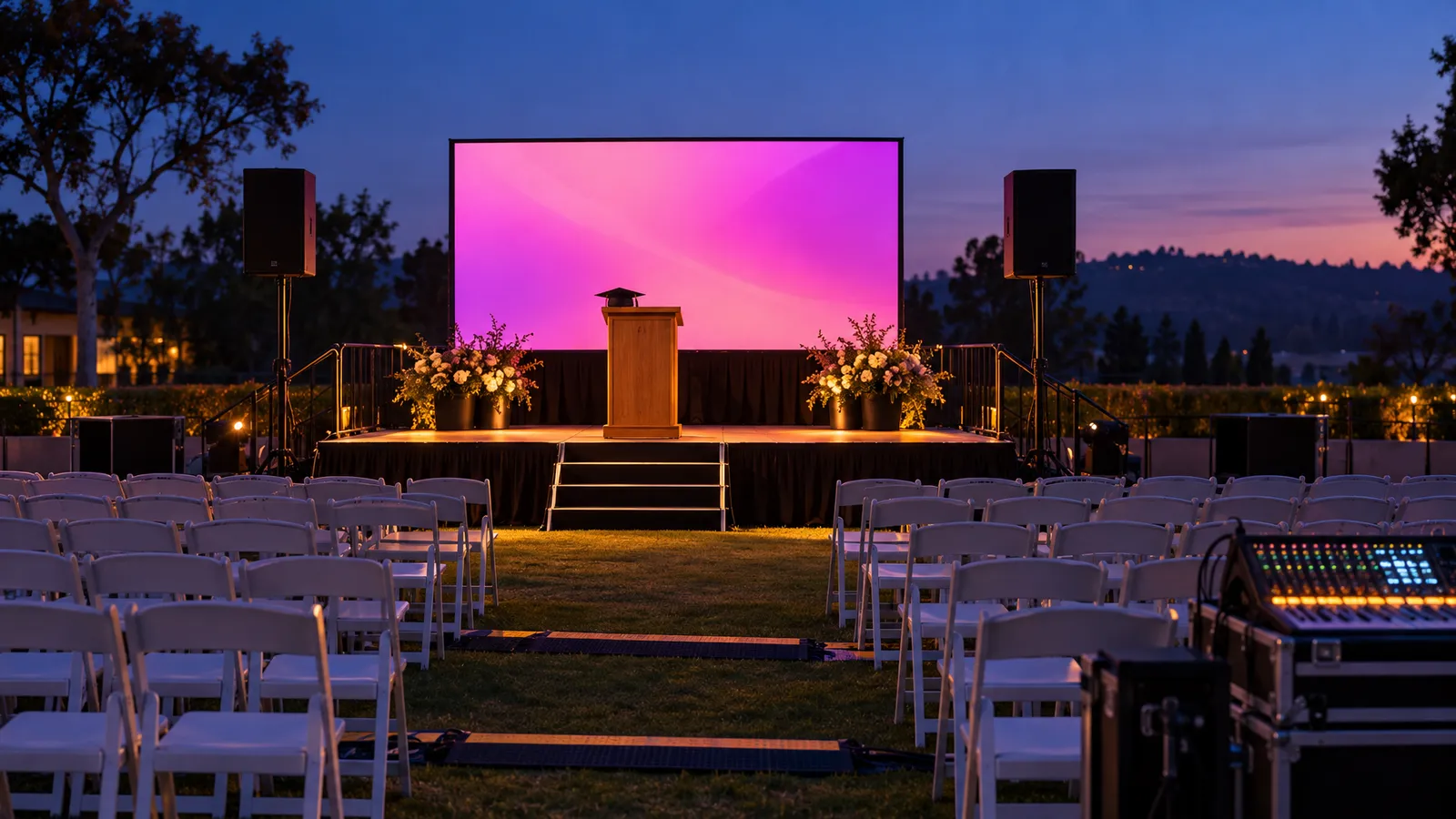
The goal of a ceremony sound system is simple to state: families in the back rows should hear each name as clearly as families in the front. Sound level falls with distance from a speaker, so a single pair of speakers at the stage has to be very loud at the front to reach the back. A common alternative for a wide or deep seating area is a distributed system — additional speakers placed out in or around the audience so no seat is too far from one. How many speakers, where, and at what height depends on the seating layout, the speakers' specifications and the site, so it should be designed for your field rather than copied from a rule of thumb. VENEGEEST's Commercial PA Speaker rents for $200/day each. Delivery, setup and technician services are scoped and quoted to your event; confirm in your quote which stands and cables come with the speakers.
- Speaker placement designed for the seating layout — using the actual speakers' coverage specifications, mounted high enough that the sound clears the heads in front.
- Delay for speakers further out — sound from a speaker in the audience arrives before the sound from the stage. A delay processor lets the technician align them; the right setting comes from the measured distances on site, checked by ear during the sound check.
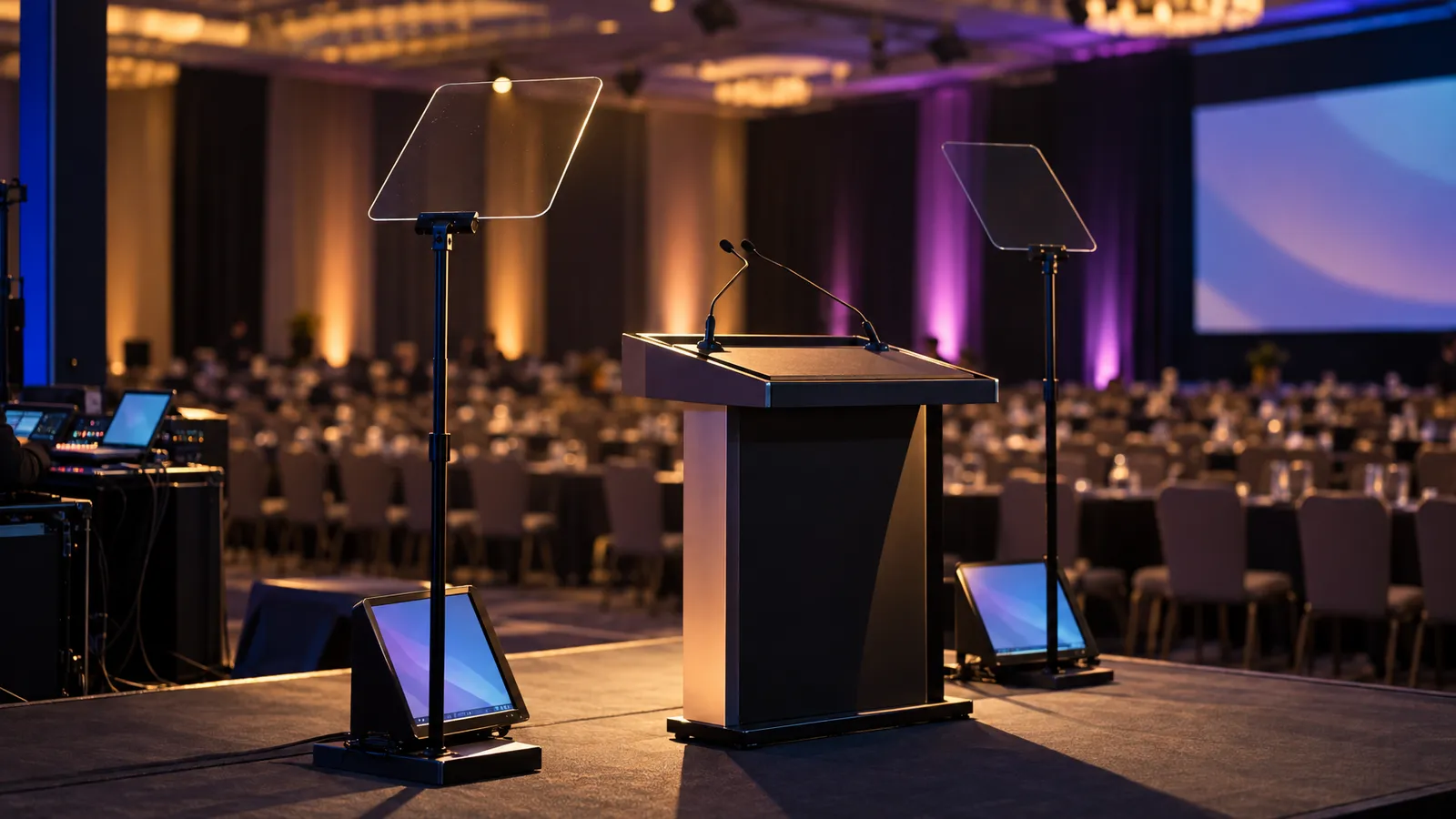
- Microphones — typically lavaliers or handhelds for speakers plus a podium microphone, with a wired backup. Lavalier, gooseneck and handheld wireless microphones are available on request, subject to availability (the Bluetooth Speaker System package in the catalog comes with two microphones), so add them to your quote request.
- A technician at the mixer — outdoor conditions such as wind change how the PA carries, so someone should be adjusting levels throughout the ceremony.
- Power planned from the actual equipment — whoever provides the event power should calculate the load from each item's electrical specification and allocate it to suitable circuits. Many fields have few or no usable outlets, which may mean a generator.
Name-Reading LED Screens: Feed Workflow and Viewing Angles
Many ceremonies show each graduate's name — and sometimes a portrait, major or honors — on a screen behind the stage as the student crosses. The usual workflow is a slide deck with one graduate per slide, advanced by a stage manager with a presentation clicker in step with the names being read. What matters is that the text is large enough for the farthest seat and that the laptop's output matches what the screen's processor accepts.
Size the screen and the text from the viewing distance to the farthest seat and the smallest thing that has to be read, not from a fixed formula. An LED Rental Screen in VENEGEEST's catalog is a P1.9–3.9 panel system configurable from 12 m² to 48 m², listed from $200/day; the exact panel layout, aspect ratio and processor inputs depend on the configuration, so confirm them in the quote and build the slides at the resolution the processor expects. For indoor ceremonies, large-format LED TV Displays placed beside the stage are another option (the 75-inch model is $75/day).
- Screen configuration confirmed in the quote — panel layout, size, aspect ratio and the processor's accepted inputs, so the slide deck can be built to match.
- A signal path rated for the distance — choose a cable or extender rated for the resolution you are sending and the distance it has to travel, and test the complete path end to end on site.
- Backup laptop with a duplicate slide deck — ready backstage so a crash doesn't stop the names.
- Screen height from the sightlines — high enough that the audience in front doesn't block the view for people further back, mounted on supports rated for it.
- A tech rehearsal before the day — confirm every slide advances, the clicker works from where the stage manager will stand, and the text reads from the back row.
How much screen brightness do I need for a daytime outdoor ceremony?
More than indoors, and how much more depends on the sun's position, whether the screen faces the sun or sits in shade, reflections, the content and the specific product. Ask for the brightness specification of the exact screen being quoted, and if possible look at it on site at the time of day of the ceremony. Indoors, large-format LED TVs can be good value: three 75-inch displays at $75/day each, against a modular LED rental screen listed from $200/day. Outdoors in daylight, check a TV's visibility before relying on it.
Stage Lighting for Phone-Camera Graduation Photos
Many parents photograph the diploma handshake from their seats on a phone. Outdoors, a stage with the sky or a bright background behind it can leave faces dark in photos; indoors, a stage may simply be dim. Front light on the stage helps. Full-Color LED Par Lights (18-LED RGBW wash lights, $25/day each) can add front wash, and a Followspot Light (a 330W–440W manual followspot, $80/day; an operator is technician time, scoped and quoted to your event) can pick out each graduate as they cross. Whether a given set of fixtures is enough, particularly against daylight, depends on their output and the conditions, so plan fixture positions and levels with the lighting technician and check them with a phone camera during rehearsal.
- Front-of-stage wash — placement, angle and count worked out for the stage size and the fixtures' output, with stands or mounts that are secured.
- A followspot with an operator — cued by the stage manager, so each graduate is lit from the stairs to the handshake.
- Lighting control with simple presets — for example, separate looks for the processional, the name reading and the recessional, run from a position where the operator can see the stage.
- Backlight (optional) — light from behind or above can separate people from the background; any overhead rigging needs a rated support and a qualified rigger.
Grad Party & Grad Night: Separate Rig, Separate Plan
The evening party is a different event from the ceremony. Students usually expect a dance floor, a photo booth and colored lighting, not a system set up for speech. How much sound you need depends on the room or lawn, the number of guests and the speakers themselves, so size it with the provider rather than by a watts-per-guest rule. Wireless Battery Uplights (the catalog lists 12–15-hour batteries, wireless DMX and IP65 models) can ring the dance floor with color without running cords across the floor, and an Interactive Photo Booth with instant sharing is $400/day. A Portable Stage Platform ($30/day) makes a DJ riser. Most DJs bring their own controller.
- Party speakers sized to the space — from VENEGEEST's catalog (Commercial PA Speakers, or the Bluetooth Speaker System package for smaller groups) or from your DJ; if you are bringing third-party equipment, have the DJ confirm what it covers.
- Uplights around the dance floor — count and spacing chosen for the room and the fixtures; ask how the models on your order are controlled.
- Photo booth — the catalog lists instant sharing; ask which features, such as prints or backdrops, come with the booth on your order.
- Someone responsible for the sound — a DJ or a designated person to manage volume, take requests and hand over the microphone for speeches.
Can I use the same PA system for both ceremony and party?
Sometimes. A ceremony system is set up for clear speech across the seating area; a party setup usually puts more emphasis on music and low end around a dance floor. Converting one into the other takes crew time — moving, re-aiming and re-tuning speakers — and whether that fits depends on the gap between events, whether the venue changes, and the crew available. Ask for both options in one quote: one system reconfigured between events, or two separate setups, with the labor and timing for each, and compare.
Backup Power, Permits, and Load-In Logistics
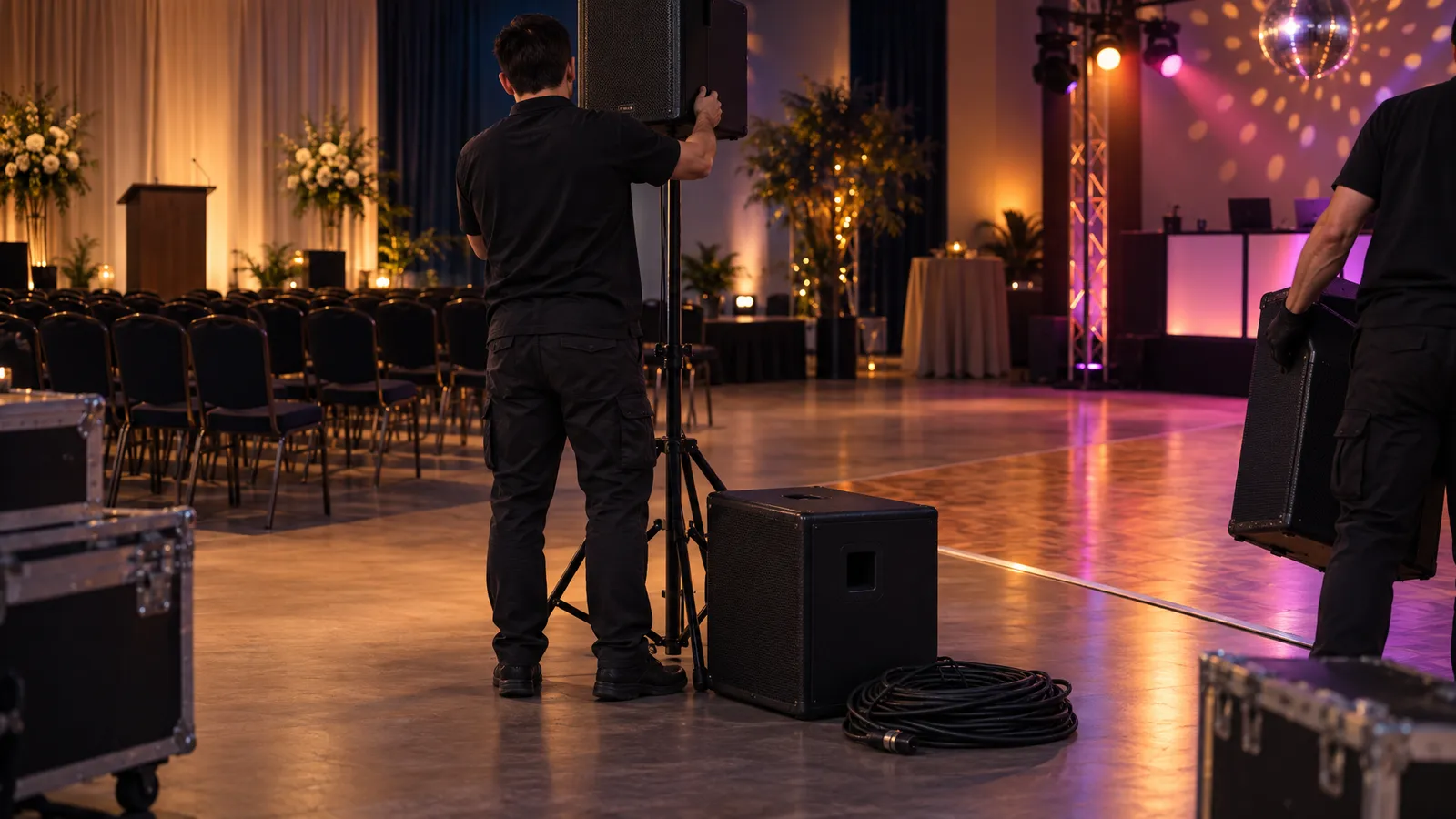
Outdoor ceremonies on fields without usable power need a generator. Have the power provider size it from the rig's actual electrical load, and place and ventilate it as its manufacturer requires, away from the audience. Check the city or county rules for special events and amplified sound; requirements vary, and many events are asked for proof of insurance. Load-in time and crew size depend on the design and the site, so get them in the quote, and confirm early whether vehicles are allowed on the turf or whether equipment has to be carted in from a parking area.
- Generator and power distribution — sized, grounded and protected as the power provider specifies, with the exhaust clearance and placement its manufacturer requires.
- Special-events permit from the city or county — lead times and requirements (site diagram, sound information, proof of insurance) differ, so check early.
- Liability insurance certificate — the venue or permit office sets the amount; a school may be able to issue one, while a parent-organized party may need its own event policy.
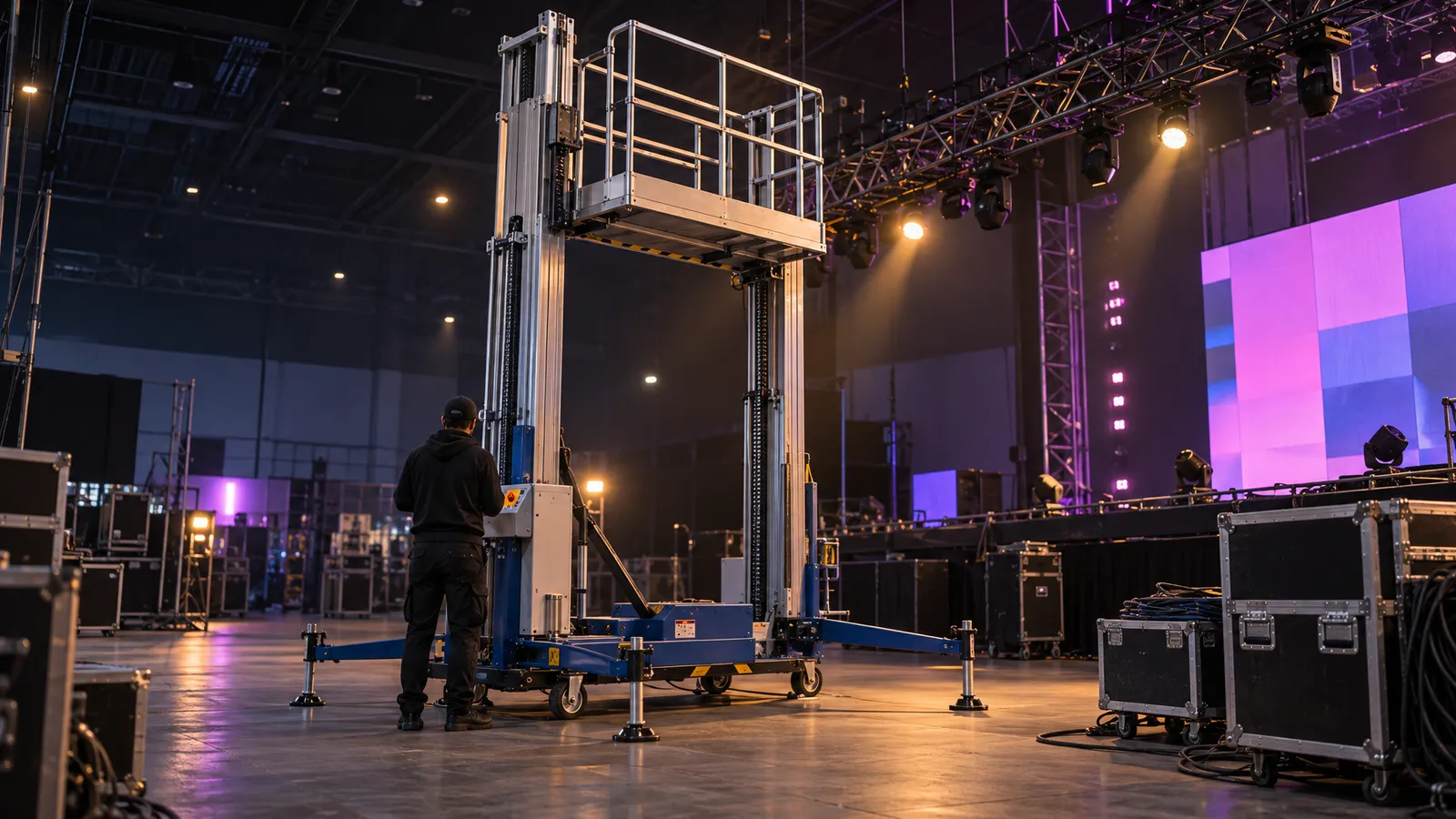
- Load-in crew and time quoted for the design — screens, speaker mounts and long cable runs across a field take people and time; ask for the estimate in writing.
- A weather plan — decide in advance who makes the indoor/outdoor call and by when, check each item's environmental rating rather than improvising covers, and confirm the indoor backup venue's approved capacity, layout and what sound coverage it would need.
FAQ: Graduation Ceremony and Party AV
How far in advance should I book AV gear for a June commencement?
Request a quote once the date is set; availability is confirmed for your date when you request a quote. VENEGEEST offers same-week delivery across the Bay Area for most items. A booking is secured with a non-refundable 25% deposit.
What's the difference between a ceremony followspot and party uplights?
A followspot is a manually operated spotlight — VENEGEEST's is listed as a 330W–440W manual followspot — that an operator aims at a moving subject, such as a graduate crossing the stage. It rents from $80/day; an operator is technician time, scoped and quoted to your event. Wireless battery uplights are wash lights placed around a room's perimeter to color walls and define a dance floor, and they run on batteries so there are no cords to run. They do different jobs: the followspot highlights one person, the uplights set the look of a space.
Can I skip the LED screen and just use printed programs?
Yes. Printed programs with every graduate's name remove the screen, the slide deck, the cabling and the screen rehearsal from the plan. The trade-off is that families can't see on a screen which student is crossing at that moment, and a printed program can't be updated at the last minute. Weigh that against the size of the audience and the budget.
How loud should a ceremony PA be to avoid noise complaints?
Loud enough to be clearly understood in the back row, and no louder than the local rules allow at the property line. There is no single number that guarantees both: cities set their own noise limits, so look up the ordinance and any permit conditions that apply to your venue. During the sound check, listen from the back rows for clarity and measure at the venue boundary with a sound level meter; if the level there is too high, work with the technician on speaker aim, placement and level.
What happens if it rains on the outdoor ceremony?
That depends on the plan you make beforehand. Agree who makes the call to move indoors and by what time, leaving enough time for the move. Check each piece of equipment's environmental rating: some outdoor speakers and screens are rated for weather, others are not, and laptops and control equipment need to be kept dry. Confirm that the indoor backup space is approved for your audience size and layout, and ask what sound and screen setup it would need, since a different room needs its own plan.