
Fog vs Haze: Which Triggers Fire Alarms (Bay Area)
The particle-size and detector-type reality behind every Bay Area hotel ban on smoke effects, and how planners actually get haze cleared in a ballroom.
Almost every couple who books a Bay Area hotel ballroom hears the same sentence at the walkthrough: no smoke, no fog, no fire. What the venue contact means is "don't evacuate 400 guests at 9pm." What they rarely explain is that fog, haze, and smoke are three different things to a fire detector — and one of them clears at most Bay Area venues with a 20-minute conversation. This is the technical reality.
Three different effects, three different products
The words get used interchangeably and that is where the trouble starts. They are not the same.
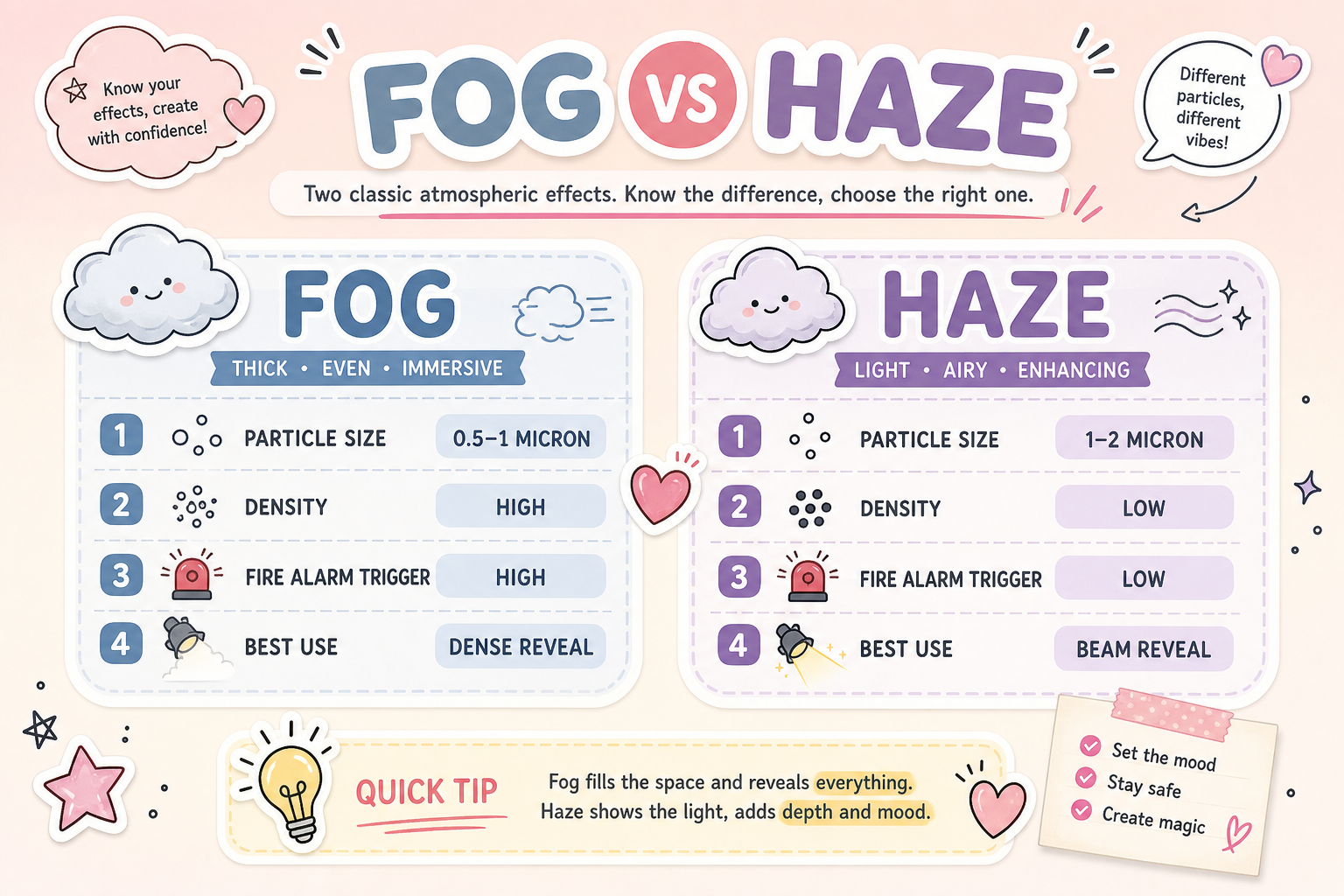
Fog is dense, white, and fills a volume — the "dance floor disappears" look, the dramatic first-dance reveal. A fog machine flash-vaporizes glycol-and-water fluid through a hot heat exchanger, producing a thick cloud. Particles from a typical 1500W fog machine sit in the 0.5–1 µm range, squarely inside what fire detectors are tuned for.
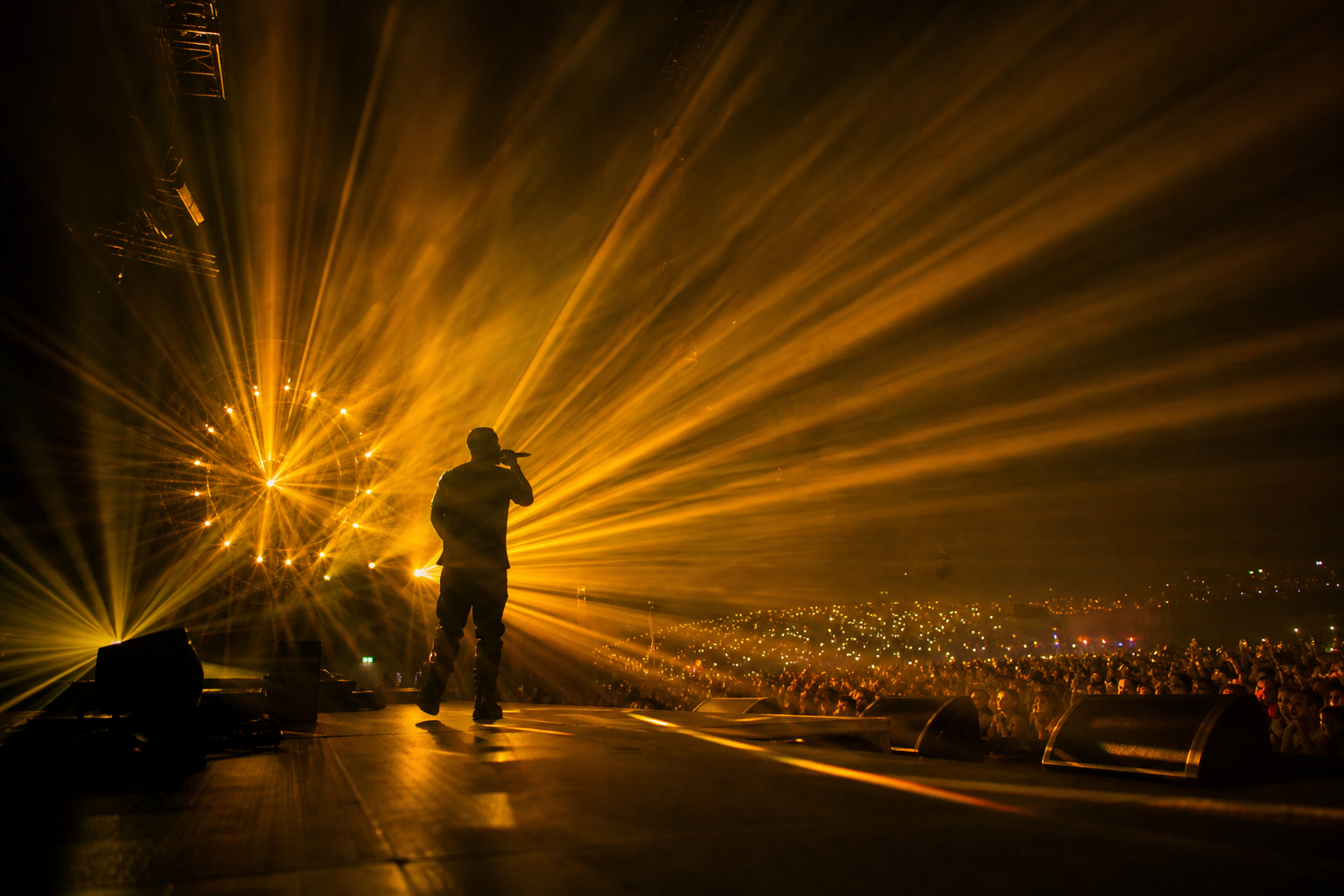
Haze is subtle, transparent, and exists to make light visible. You don't see haze — you see beam shafts, gobo edges, laser fans hanging in the air. A haze machine atomizes fluid into much finer airborne particles; modern water-based haze runs roughly 1–2 µm with a long tail above. Atmosphere clears within 5–10 minutes once generation stops.
Smoke in the theatrical sense — actual combustion smoke from a burned compound — is rare in modern AV. Cold sparks, low fog, and dry ice cover every visual that used to call for it. When a venue says "no smoke," they usually mean the whole category in their head, including fog and haze.
How a fire alarm actually decides to go off
Most venue conversations break down here — the venue treats "particles in the air" as one thing, when the detector is engineered around a specific particle size.
Two technologies dominate ceiling smoke detection. Ionization detectors ionize air inside a chamber; particles disrupt the ion current and trigger the alarm. They are tuned for very small particles under 0.3 µm — the signature of a flaming fire. Photoelectric detectors shine a beam across a chamber and watch for scattered light. They respond best above 0.3 µm, peaking at 1 µm — the smolder-fire signature.
The trigger map matters:
- Fog at 0.5–1 µm: photoelectric detectors light up reliably. Ionization detectors trigger less but can still alarm at high density. Fog will set off a detector zone you didn't cover in 90% of indoor venues.
- Water-based haze at 1–2 µm with a long tail: photoelectric detectors see something, but density rarely crosses the trigger threshold for typical event-level use. Ionization detectors mostly ignore it. This is why haze has a real path to clearance.
- Oil-based haze (~0.1–1 µm, longer hang time): the particles are smaller and linger 20–30 minutes versus 5–10 for water-based. That extended hang time means the cumulative density across an evening gets higher even if a single burst is invisible. Some venues will clear water-based haze and refuse oil-based on the same logic.
Haze is not "less bad fog" — it is a different particle profile sitting near the lower edge of photoelectric detection and the upper edge of ionization sensitivity. With venue cooperation it is workable. Fog rarely is, indoors, without active detector management.
Which detector is actually on the ceiling above your dance floor?
Hotel ballrooms and conference spaces in the Bay Area do not use one type. Patterns we see:
- Hotel guest rooms: photoelectric, almost universally. NFPA 72 guidance and modern renovations both push photoelectric for soft-furnishing fire signatures and to cut shower-steam nuisance trips.
- Hotel ballrooms and meeting rooms: mixed. Older buildings often have ionization detectors at the perimeter and photoelectric or dual-sensor units near kitchens and HVAC returns. Newer or recently renovated hotels skew photoelectric or dual-sensor throughout.
- Conference centers and expo halls: typically photoelectric or beam detectors (long-throw units mounted across high ceilings). Beam detectors are forgiving for haze — density has to obscure a long path before the signal trips.
- Historic and converted spaces: inconsistent. A converted warehouse might have a recent photoelectric retrofit; a historic hall might still run 1990s-era ionization heads. The walkthrough is the only way to know.
A planner who phrases the question as "we want to coordinate with your engineering team on detector zones during the first dance" gets a much better answer than "can we use fog?"
The walk-through with hotel engineering
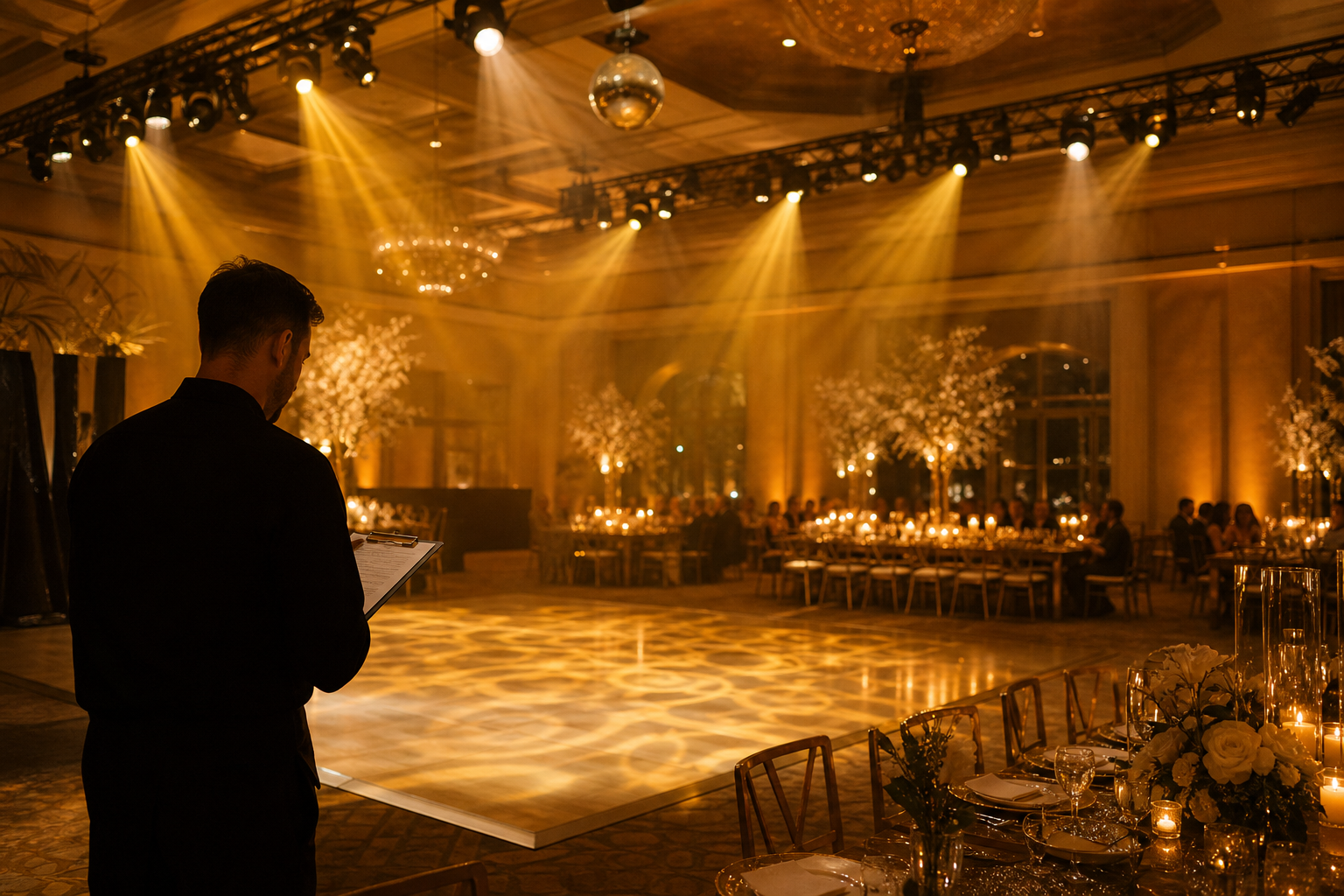
Every Bay Area hotel that has cleared haze for us followed roughly the same path. The conversation is procedural, not adversarial — the engineering team has done this before.
- Identify the zones. Engineering pulls up the fire panel and identifies which detector zones cover the dance floor and stage. A typical ballroom has 2–6 zones in the room.
- Bypass window. Those specific zones go on test mode for a defined window — usually 30 to 90 minutes covering the first dance through the dance set. The rest of the building stays armed.
- Fire watch staffed. A trained person — venue engineering, hotel security, or a dedicated fire-watch contractor depending on AHJ — stands in the room with eyes on the effect, a radio, and a manual pull station nearby. Most Bay Area jurisdictions require it.
- Effect runs. Haze comes up, the dance floor reads cinematic, beam light has a job to do.
- Reset. Atmosphere clears (5–10 minutes for water-based haze, 20–30 for oil-based), HVAC stays running, and engineering walks the panel back to armed.
Couples and planners almost never own this conversation directly. Your AV vendor handles the engineering call and the fire-watch logistics; your job is to surface the request 4–6 weeks out, not at load-in.
Specific Bay Area patterns we see
The same effects clear and don't clear in roughly the same buildings, year after year:
- Fairmont SF and Pier 27: haze almost always cleared with the standard bypass-and-fire-watch protocol. Fog sometimes — depends on the specific ballroom and how dense the cue is. Light low fog for a first dance is more often a yes than full-room dance fog.
- Bently Reserve: haze nearly always cleared. The historic building has photoelectric retrofits and an engineering team familiar with the procedure. Fog is tougher — the old volume traps atmosphere longer.
- Half Moon Bay outdoor tents and lawn ceremonies: no detector overhead, no issue. Fog and haze both work freely. The constraint is wind direction for the photographer, not the alarm panel.
- SF City Hall: no atmospheric effects under the dome. Beam light works on its own under the rotunda — the building does the visual work that haze normally provides.
- Napa winery barrel rooms: mixed. Working barrel rooms have ammonia and refrigeration detectors that respond to atmosphere unpredictably. Check before committing to a beam-heavy lighting design.
- Converted warehouses (Dogpatch, West Oakland, Berkeley): most permissive. High ceilings, photoelectric or beam detectors, operators who've run dozens of theatrical events. Haze almost always works, fog often does.
For a deeper read on building a haze-and-beam-light show that survives a Bay Area ballroom walkthrough, see our haze machine rental guide. For the parallel question on dense low-fog effects (which clear differently because the fog stays at the floor and never reaches the ceiling sensor), see our dry ice rental guide and the dry ice vs fog machine comparison.
Outdoor and atmosphere-controlled spaces
Step outside or into a space without ceiling detection and the entire conversation goes away.
Outdoor weddings on a Half Moon Bay bluff, a Napa lawn, a Sonoma vineyard: fog and haze both work freely. The new questions are wind dispersion, fluid spend (outdoor effects need 2–4× the indoor volume to read on camera), and fire-season awareness for any open-flame effect (a haze rig is electric and not a fire risk; flame jets are a separate conversation).
Tented receptions sit in between — no detector, but the air volume is bigger and the haze fluid budget goes up. Wind through a tent flap can clear atmosphere mid-cue.
The simplest effect to clear at any indoor Bay Area venue is also the most photogenic for first dances: low fog from a chilled fogger or a dry-ice machine. The fog is so dense and so cold that it falls to the floor and never reaches the ceiling sensor. Most venues that say no to standard fog will clear low fog without a panel bypass — because there is nothing to bypass.
FAQ
Will a haze machine set off the fire alarm at a Bay Area hotel?
Not usually, when handled correctly. Water-based haze produces 1–2 µm particles at density well below typical detector trigger thresholds, and most Bay Area hotels will coordinate a detector-zone bypass for a defined window. Showing up with a haze machine and no advance arrangement is what triggers alarms. A 4–6 week heads-up almost always clears it.
What's the difference between fog and haze for fire-alarm purposes?
Particle size and density. Fog particles are 0.5–1 µm and produce visually dense clouds that reliably trigger photoelectric detectors. Haze particles are 1–2 µm but at much lower density — visible only as illuminated beam shafts, not as a cloud. Photoelectric detectors register haze less, and most ionization detectors largely ignore it.
Why do hotels say "no smoke effects" if haze is technically safe?
Because the venue contact uses "smoke" to mean the whole category — fog, haze, dry ice, cold sparks. No is the safe default answer from someone who isn't a fire-life-safety expert. The conversation that gets to yes happens between the AV vendor and the venue engineering manager. Frame the request as a coordinated procedure, not a yes/no question.
Can I use a water-based fog machine indoors at a Bay Area venue?
Sometimes, with detector-zone bypass and fire watch in place. More commonly the right answer is to switch to low fog for first-dance density and haze for beam-light work — both clear venue conversations more easily than standard rising fog.
Do outdoor weddings have any of these issues?
No detector, no issue. Outdoor and tented venues clear fog and haze freely. Constraints shift to wind direction for the photographer and fluid budget for the larger air volume. For most Bay Area outdoor spaces — Half Moon Bay, Napa, Sonoma, Marin coastline — atmospheric effects are a yes by default.
Get a venue walkthrough done right
If your Bay Area venue has told you "no smoke effects" and you want to know what is actually possible, send the venue name and date. We'll tell you within a day what we've cleared in that room before, what the engineering protocol looks like, and which effect fits the look you want — often a different effect than the one you started with. Browse our equipment catalog or the special effects category for fog, haze, low fog, and cold spark options.