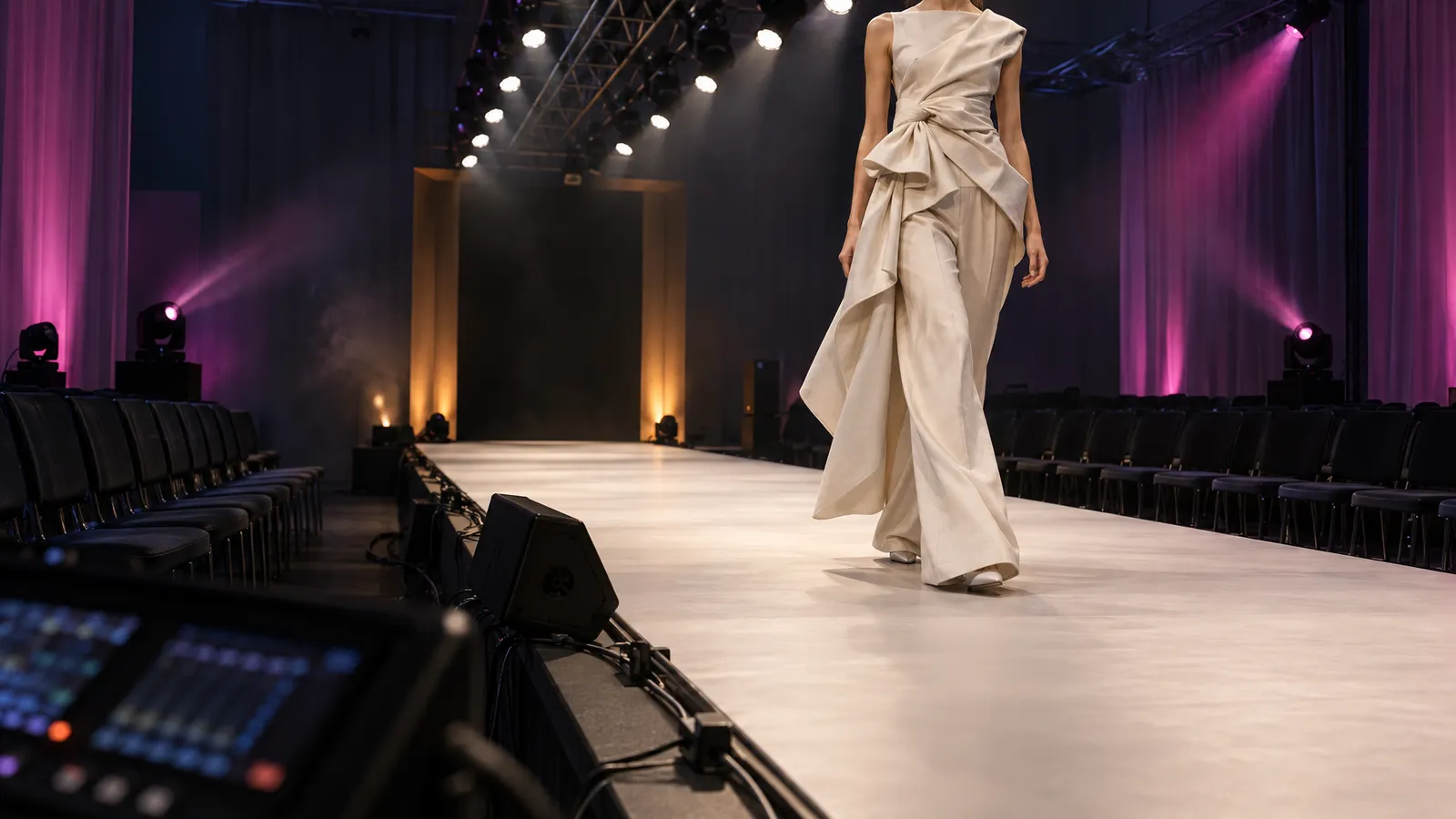
A runway show's lighting checklist comes down to four things: even front light along the catwalk so faces and fabric read on camera, a color-wash layer for the mood of each part of the collection, clear music playback and announcements, and a backstage and cable plan that keeps the walkways clear. This guide covers each for San Francisco shows of roughly 80 to 200 guests — a student capstone, a pop-up in a gallery or a private presentation in a loft.
Exact quantities depend on the runway's length, the fixtures' beam angles, how far they throw and what the cameras see, so treat every number of fixtures below as a starting point to test at tech rehearsal, not a formula.
Runway Front Light: Even Light for Cameras and the Front Row
Front light is the layer photographers and videographers depend on: it lights faces and garments as models walk, and uneven light shows up as hot spots and dark patches along the catwalk. A common approach is to place front-light fixtures such as the COB Front Light along both sides of the runway on stands or truss towers, just outside the audience's sightlines, and aim them so their pools of light overlap. How many you need, how far apart and how high depends on each fixture's beam angle and throw — walk the runway at tech rehearsal, look through the camera, and add, move or re-aim fixtures until the light is even from end to end.
Check the color temperature and color rendering of the units on your order so skin tones and fabric textures look right on camera. Where the ceiling is low and side positions are tight, LED Tri-Color Panel Light units can add fill; the catalog lists them as flicker-free with even illumination, which matters for video.
Keep front-light towers clear of exit paths and aisles, and confirm the layout with the venue. The COB Front Light rents from $35 per fixture per day; ask for a quote that covers stands, control and rigging, along with delivery, setup and technicians, which are scoped and quoted to your show. If you want a highlight moment for close-up detail — jewelry, embroidery, fabric — ask your lighting operator to build it as a cue at rehearsal and check it on camera.
- Start with front-light fixtures on both sides of the runway and adjust count and aim at rehearsal until the light is even on camera from end to end.
- Match the color temperature of the front-light fixtures and white-balance the cameras to it so fabric colors stay accurate.
- Overhead or side fill should only go on rigging points the venue has approved for the load, and never in a way that blocks exits.
- Set levels and any dimming for walk-on moments with the actual fixtures and cameras during rehearsal, and check that color still looks right at the levels you use.
- Route cables where the venue approves, and use cable covers or ramps suited to the cable and the foot traffic where lines must cross a walkway.
Color-Wash Moving Heads: Programming Mood Blocks
Once front light is set, color wash adds the creative layer — for example, cool blue for an opening block and warm amber for evening wear. How you group looks into blocks is up to the designer; some shows have one mood throughout, others change with every section. LED Spot-Wash Moving Head (CMY) fixtures on Aluminum H-Frame Truss are one option: the catalog lists them with CMY color mixing, a CTO channel, an animation wheel and dual gobo wheels, so they can change color and add texture to the backdrop or floor. Confirm the gobo options on the model you book.
Have the cues programmed on a Lighting Control Console during tech rehearsal so each change is one planned cue during the show rather than something improvised live. The catalog lists grandMA2 and Avolites Tiger Touch-series desks, among others.
For smaller shows in a gallery or loft, static Full-Color LED Par Light units — 18-LED RGBW wash lights in the catalog — are a lower-cost alternative that still change color under DMX control. The trade-off is that a static par can't be re-aimed from the console; once it is focused at load-in, it stays where it is. The Full-Color LED Par rents from $25 and the 380W Beam Moving Head from $50; other moving heads, including the CMY spot-wash models, are quoted. If your venue has its own house lighting, coordinate with the in-house crew so your wash layer doesn't conflict with any house or safety lighting that has to stay on.
How many moving heads do I need for a sixty-foot runway?
There isn't a single answer. It depends on the fixture model and its zoom range, the rigging height and position, the runway's width, and whether you want to light the whole runway at once or isolate parts of it. Ask for a lighting plot based on the specific fixtures you are renting and your venue's rigging points, and confirm the coverage at tech rehearsal. If the budget is tight, a smaller number of moving heads upstage with static pars for fill is one way to start; ask for the console and operator as separate quote lines.
- Moving heads or static pars add a color layer on top of front light; keep front-light levels consistent when the wash changes.
- Pre-program color cues during tech rehearsal; the operator should run planned cues, not improvise color shifts during the show.
- Static RGBW pars are a lower-cost option for smaller shows; the Full-Color LED Par is listed at $25 per day, against $50 for the 380W Beam Moving Head.
- Coordinate with the venue's house lighting so your wash layer does not conflict with any lighting the venue requires to stay on.
- Use gobo projection with restraint if close-up video of garment details matters.
Audio: Music Playback and Announcements
Decide early whether the music will be played back from a prepared file or mixed live, and who will run it. If it is played back, one approach is to split the soundtrack into cues at the block or look changes and run them from cue-based playback software; QLab, for example, describes itself as "macOS software for designing and playing back sound, video, light, and show control cues." Whatever you use, rehearse the transitions with the lighting operator so music and light change together.
Commercial PA Speaker units rent from $200 per day each. How many you need and where they go depends on the room and the audience layout; place them, set levels and walk the room at sound check so the whole audience hears clearly without the front row being blasted. Loud playback also makes backstage communication harder. Ask your venue whether it has sound curfews or level limits before finalizing the run of show.
Give your lighting and audio operators a way to hear the show mix, especially if the tech table is backstage or in a side room. If your show includes live announcements — a designer introduction or sponsor thanks — plan a microphone for them. Standalone wireless mics and mixers are available on request, subject to availability; contact us for a quote (the Bluetooth Speaker System, $60, includes two mics). Test it at sound check. Shure explains that feedback happens when amplified sound "is then picked up again by the same microphone or another open microphone in the system and re-amplified," and advises keeping microphones and loudspeakers "far away from each other, as best managed within the environment."
- Decide on playback or live mixing, and rehearse music and lighting transitions together.
- Place and level PA speakers at sound check so the whole audience hears clearly.
- Give the lighting and audio operators a way to hear the show mix at their position.
- Plan a microphone for announcements and keep it away from the speakers' output to reduce the risk of feedback.
- Confirm the venue's sound curfew and factor it into your run-of-show timing.
Backstage Logistics and Front-of-House Staging
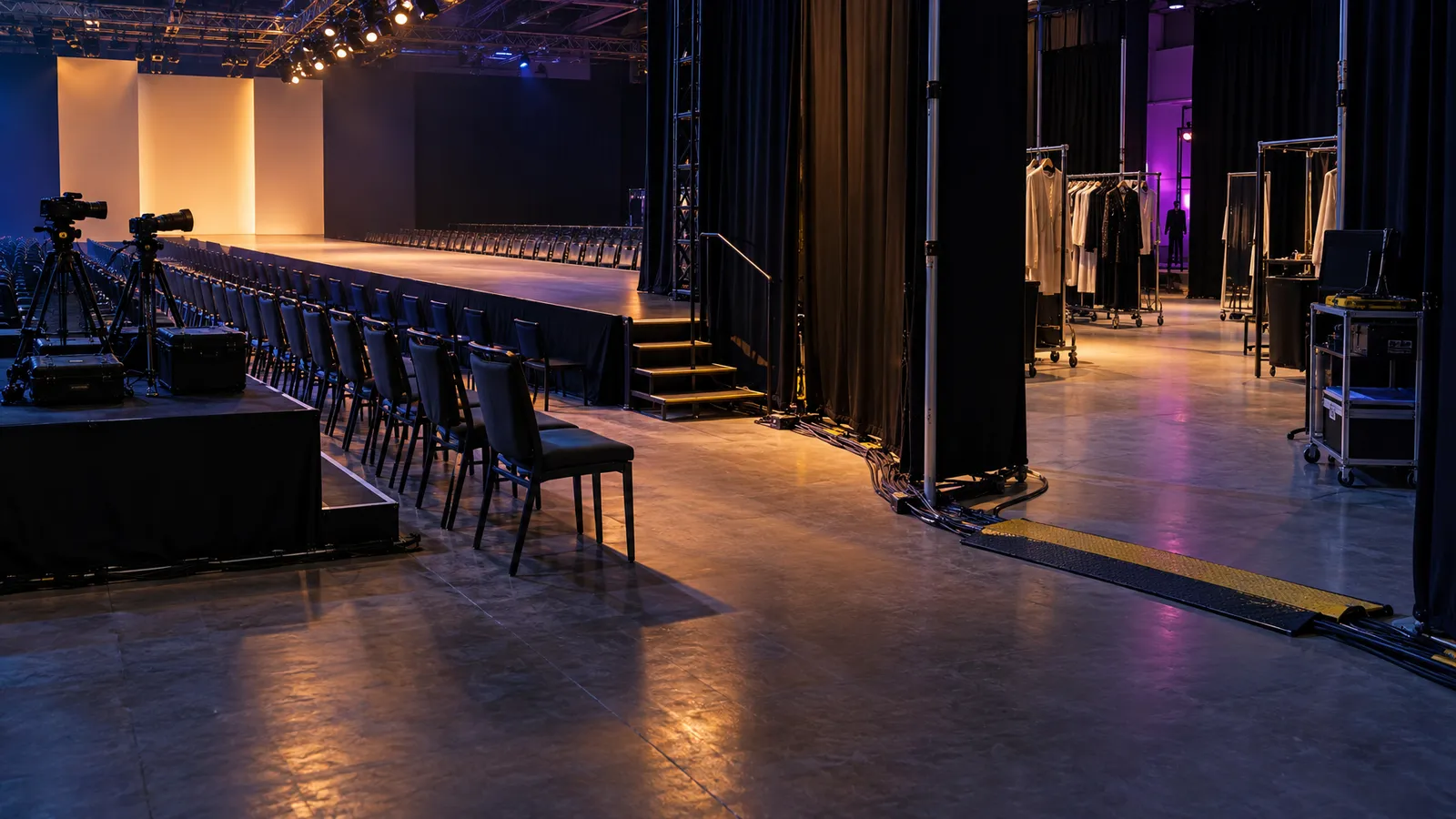
Cables across walkways are a trip risk for models, crew and guests. Agree cable routes with the venue before load-in, keep runs out of the models' path where you can, and where a cable has to cross a walkway use a cover or ramp suited to the cable and the traffic. For the photo pit or a front-row area, a small Portable Stage Platform riser ($30 per unit; modular, so units combine to size) can lift photographers above seated guests and mark the boundary between seating and press. If your runway is also on risers, confirm the platform heights when you quote so camera positions line up with the catwalk.
Backstage usually needs a dressing area with garment racks and mirrors, a quick-change area, and a place where models line up in show order. Put the quick-change area where the access and circulation work in your venue — close to the stage entrance if you can — and give it more floor space than it looks like it needs on paper, especially for complex closures or layered looks. If your venue is a raw gallery space with no dedicated backstage, pipe-and-drape can create a visual barrier; confirm there is enough house power for steamers, lit mirrors and any portable AC units. Coordinate load-in windows and elevator or cart access with venue management, and share them with your AV vendor for the delivery window.
- Agree cable routes with the venue and use covers or ramps where cables cross walkways.
- A portable stage riser can lift the photo pit and define the boundary between press and general seating.
- Give the quick-change area generous floor space, plus a lineup area near the stage entrance.
- In raw gallery venues, pipe-and-drape can create a backstage area; confirm house power for steamers and portable AC.
- Coordinate load-in windows and elevator or cart access with venue management.
FAQ: Fashion Runway Show Lighting & Production
What is a starting lighting package for a forty-foot runway with eighty seated guests?
As an illustration only: a few COB front-light fixtures on each side of the runway, a few static RGBW pars for color wash on a truss upstage, and a lighting console with an operator. At listed prices, four COB Front Lights ($35 each) and four Full-Color LED Pars ($25 each) come to $240 per day for the fixtures; truss, the console, delivery, setup and an operator are scoped and quoted to your show. Whether that is enough depends on the fixtures' coverage in your room, so confirm it at tech rehearsal. If the budget is tight, front light is the layer to keep; the color wash is the one to drop.
Do I need a lighting designer or can the AV vendor handle programming?
At VENEGEEST a lighting operator can run the console for your show, as part of a solution designed around your show's requirements; technician services are scoped and quoted to your event. Either way, expect to provide the creative brief — color palette per block, transition timing, and any special moments like a blackout before the finale. If your collection has a strong visual concept and you want custom looks or color shifts tied to specific musical moments, consider a freelance lighting designer to attend your tech rehearsal and program the console, then hand the show file to the operator who runs it during the event.
How much front light is too much for a fashion runway?
If models are squinting or photographers are seeing blown-out highlights on pale fabrics, it is too bright. Set levels at tech rehearsal with a light meter at face height and with the cameras you will use. If your venue has large windows and daylight will change during the show, check the look at the time of day the show will run, and white-balance your cameras to the front light before the show starts.
What is the typical load-in and strike window for a runway show?
Our crew needs a minimum of two hours for a standard setup, and larger productions need more, so a raw space with truss, front light, moving heads and a programming session calls for a longer window; build tech rehearsal time on top of that. Some venues require their own staff for rigging, so ask during the site visit. Confirm load-in elevator and loading-dock access well before the event, since delays caused by venue restrictions can add labor charges.
Can I use the venue's house lighting instead of renting a separate package?
Sometimes. Ask the venue what its system can do: which fixtures there are and where they hang, whether they can be dimmed and colored individually, whether they can be run from a console you can program, and whether a house operator is available. Then check the coverage on the runway itself during a site visit or rehearsal. If the house system covers the runway evenly and can run your cues, you may only need to add fixtures for what it can't do; if it can't, plan a rental package.