A concert lighting rig comes together from six decisions: where the truss goes, which fixtures hang on it, which console runs them, how the artists' faces are lit, how haze and DMX are handled, and where the power comes from. This checklist walks through each one for a club headliner, a theater bill or an outdoor festival stage. The numbers below are worked examples to plan from, not rules; the final plot, rigging and power plan belong to your lighting designer, a qualified rigger and the venue.
It is written for venue managers speccing a house rig, touring techs checking rental inventory, and festival producers building a lighting plot.
Truss Anatomy: Front, Mid and Riser Positions
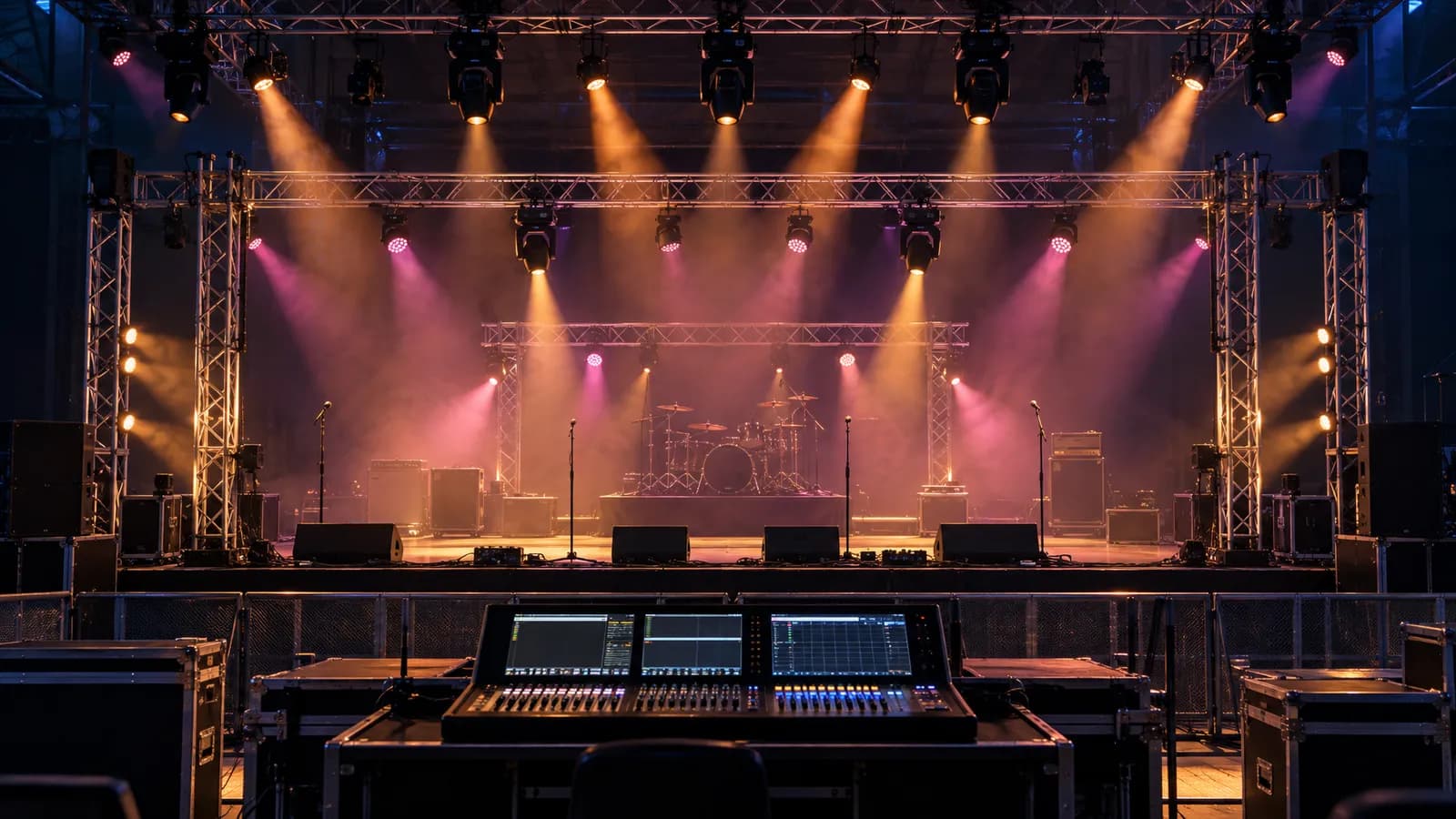
Most band rigs start from the same positions: a front truss over the downstage edge facing the audience, a mid or upstage truss for backlight and aerial beams, and sometimes a short section above the drum riser for specials. Side positions, either ground-supported towers or booms, add cross light. How long each span is, how high it hangs and what it carries depends on the stage, the venue's rigging points and the truss itself.
That last point is the one that cannot be guessed. Truss manufacturers publish load tables for their truss models; Global Truss, for example, publishes a load/span table for its F34 truss. The entertainment-industry standard for aluminum truss is ANSI E1.2, published through ESTA as "Design, Manufacture and Use of Aluminum Trusses and Towers" — not to be confused with ANSI E1.21, which covers temporary structures used for outdoor entertainment events. The allowable load changes with the model, the span, how it is supported and how the load is spread along it. So before anything is hung on an aluminum H-frame truss or any other section, add up the real weights from each fixture's spec sheet, plus clamps, safety cables, cable and any other hardware, and check the total against the manufacturer's table for that truss and that support arrangement. On a flown rig, the rigging plan and the hanging points are for a qualified rigger and the venue to approve.
- Front truss: front wash, key light and front specials; its height and angle decide how faces read, so plan it with the front-light section below.
- Mid or upstage truss: backlight color, aerial beam looks and a share of the moving heads.
- Drum riser position: a short span or floor-mounted fixtures for the drummer and cymbal highlights, if the show needs them.
- Side towers or booms: cross light and extra movers; ground-supported towers need their own base, ballast and stability check.
- Load check per position: fixture weights from spec sheets, plus hardware and cable, against the manufacturer's load table for that exact truss, span and support.
Moving Heads and Pars: Building the Fixture Mix
There is no required number of moving heads for a given room size. The count comes from the look the lighting designer wants, the stage width, the trim height and the budget. What follows are illustrative mixes to start a conversation with your LD, not minimums.
- Small club (illustrative): a handful of moving heads split between front and back, LED pars for stage wash and backlight color, and one haze machine.
- Mid-size room (illustrative): more movers so front and back can run different looks, side light for separation, a followspot if the headliner wants one, and haze sized to the room after a test.
- Festival stage (illustrative): separate fixtures for aerial beams and for face light and texture, a larger par wash, and a dedicated front-light array.
Our catalog has two kinds of moving head that often share a rig. The 380W Beam Moving Head is listed as a "380W concentrated beam" fixture with DMX control, at $50 per day. The LED Beam-Spot-Wash Hybrid Moving Head is listed with framing, CMY+CTO color mixing and a 4–50° zoom, in 700W to 1400W versions, and is quoted per event. A third family, the LED Spot-Wash Moving Head (CMY), is listed with CMY+CTO, an animation wheel and dual gobo wheels, also quoted per event. Where each type goes is a design choice: beams often sit upstage for aerial looks, while fixtures with zoom and framing are useful on the front truss for shaping light on people.
DMX channel counts depend on the fixture and the mode you run it in, so read them from each fixture's manual rather than assuming a figure. A DMX universe carries 512 channels. As a worked example only: if each mover ran in a 24-channel mode, sixteen movers would use 384 channels; twenty-four pars in a 4-channel RGBW mode would add 96, for 480 in total. That still fits one universe, but some designers split fixtures across universes anyway to leave room for changes and to keep patching tidy. That is a routing choice, not a capacity requirement at that size.
How many par cans do I need to light a four-piece band stage?
It depends on the stage, the looks and whether moving heads are doing the face light. A common way to plan is by job rather than by total: front wash, backlight color for each band member, side fill, and a couple of specials on the drummer, plus uplights if there is a backdrop or cyc. Our LED Par Can range runs from small RGBW pars to COB and zoom pars, quoted per event. Check each par's power draw, output and beam angle on its spec sheet before you finalize the count. A rig with no moving heads will usually lean on more pars for front and side light, since nothing else is covering faces.
Console Choice: grandMA2, Avolites and Quartz
The lighting control console sets how quickly your LD can program, how they busk during the set, and whether a show file they bring will load. Our catalog lists grandMA2 models (full size, Light, Compact and grandMA onPC/laptop options), Avolites desks including the Tiger Touch II, Tiger Touch Plus, Sapphire Touch, Arena and Quartz, and smaller DMX consoles; console rentals are quoted per event.
- grandMA2 Light: MA Lighting lists motorized faders, an effects engine and timecode connectivity among its features.
- Avolites Tiger Touch II: a touchscreen Avolites desk; ask your LD whether it suits how they program and busk, and check the universe count you need against the desk before booking.
- Quartz and smaller desks: suited to rigs with a modest fixture count and simpler cue stacks.
- Ask the LD first: desk preference is personal and depends on what they have programmed on before. If the headliner brings their own LD, confirm the exact console model and software version well before load-in.
- Show files: MA documents that grandMA2 show files use the .show.gz format. Avolites' manual explains that whether a show loads depends on the software version and console generation. Do not assume a file moves between brands; confirm compatibility with the LD for the exact desk and software version you are renting.
- Front-of-house position: the console needs a clear sightline to the stage and a planned data run to the stage racks, plus a backup plan the LD has agreed to.
Front Light: The Most Underrated Piece of a Concert Rig
Without dedicated front light, faces can go flat or disappear against strong backlight, and camera operators have a harder time with exposure. Moving heads on the front truss help, but saturated beam looks are not the same as even, neutral light on a face. That is the job of a front-light array: COB front lights (listed as "essential stage front illumination", from $35 per day) or LED tri-color panel lights (listed as "even illumination, flicker-free", from $25 per day).
- How many: it depends on the stage width, the throw and the fixture's beam angle. Plan a count with your LD and check the coverage on stage and on camera during focus.
- Angle: front-light angle is a design choice. Very steep angles tend to put shadows under the brows and very low angles can look like uplighting, so the LD sets it during focus.
- Balance against backlight: there is no fixed ratio. If the show is filmed or streamed, set the front-to-back balance with the camera operator looking at the actual picture.
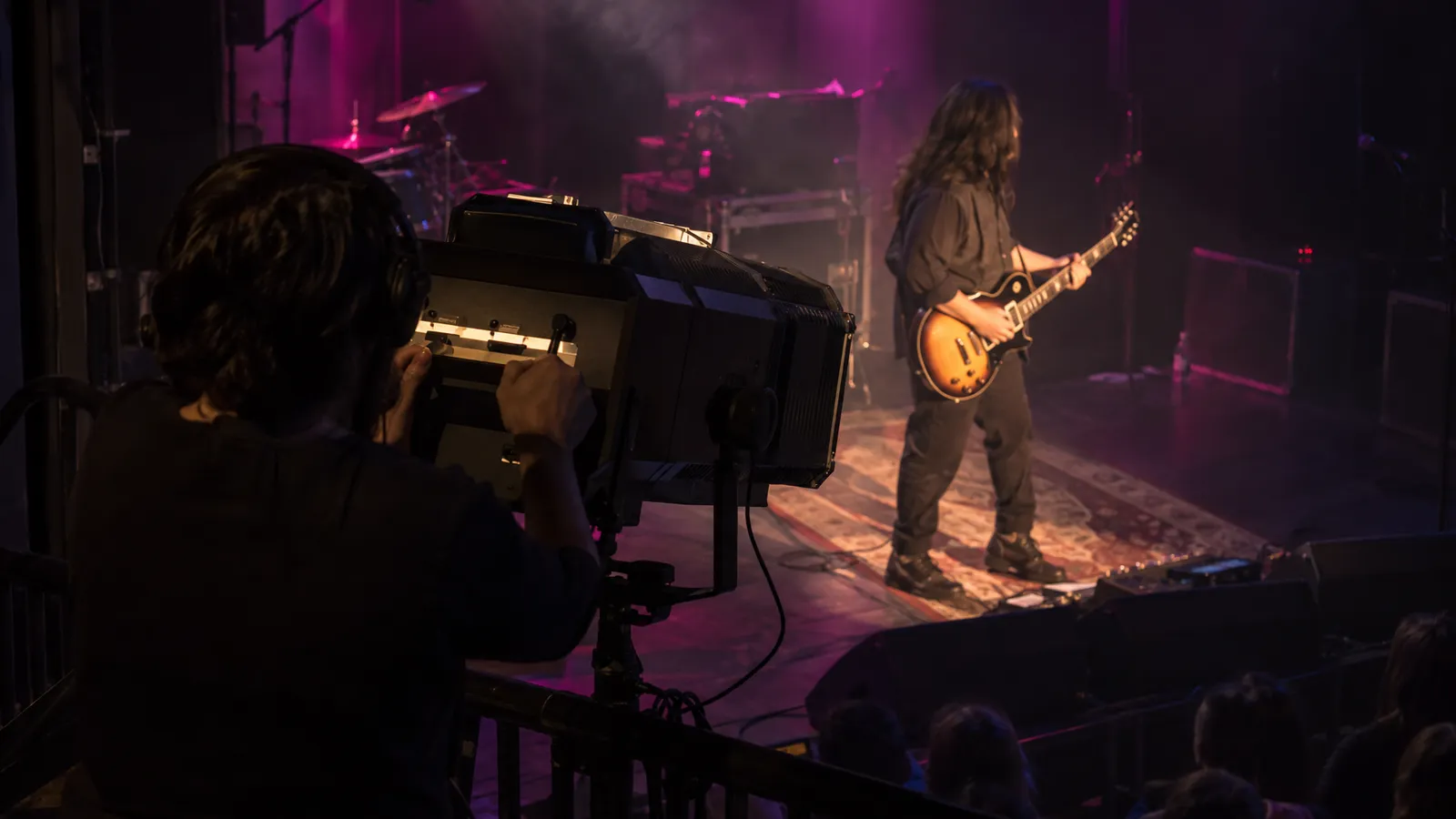
- Followspot: a Followspot Light (330W–440W manual followspot, from $80 per day) gives an operator direct control of a lead performer.
Haze, DMX Routing and Power
Beam looks depend on haze: without particles in the air, the path of a beam is hard to see, though a gobo projected onto a surface still shows on that surface. Our Haze Machine is listed as a 1000W atmospheric haze generator, from $25 per day. How many machines a room needs, where they sit and when they run depends on the machine's output, the room's size and airflow, and the ventilation, so size it with a test in the venue rather than by volume alone. Get the venue's approval before using haze at all, since smoke detectors respond to particles in the air (NIST) and the venue decides how that is handled.
- Haze control: the number of DMX channels and the control modes depend on the machine; read them from its manual.
- Fluid: consumption depends on output level and set length. The machine's spec details, including its consumption figure, are provided on request, and haze fluid can be provided on request too — contact us for a quote.
- DMX timing: ETC notes that DMX typically refreshes 44 times a second. Splitting fixtures across universes is useful for organization and growth, but it is not a way to promise a particular response time.
- Data runs: DMX is sent either over DMX cable or over an Ethernet network through nodes or gateways. These are different systems with different hardware, so decide which one the rig uses and make sure the cable and connectors match what the console and nodes expect.
- Backup: plan a spare data path and a backup control option, and test the changeover during the rehearsal so the crew knows the procedure.
Power works the same way: every figure has to come from the actual equipment and the actual supply. Add up the input power for every fixture, the haze machines and the console from their spec sheets, and give that list to the venue or the power provider. They confirm what circuits or distribution are available and how the load is split across them. A distribution box splits the supply you have into more outlets; it does not add capacity.
FAQ: Concert Lighting Rig Checklist
How long does load-in and strike take for a moving-head rig?
It depends on crew size, whether truss is already hung, access to the stage and dock, and how much programming is needed on site. Build the schedule with the crew and the venue, and allow separate blocks for hanging and circuiting, running data and power, patching, focus and haze testing. A venue with no house rigging needs time for ground support or rigging to be built and checked before any fixture goes up.
Do I need a lighting designer for a local band show or can the sound engineer run lights?
For a simple rig of static color washes, a sound engineer can sometimes trigger a few pre-programmed scenes between songs. Once the show has moving heads, haze and cues that follow the music, a dedicated lighting operator is the usual choice for a complex show, because both jobs need attention at the same moments. If you need an operator from us, ask for it in the quote; technician services are scoped and quoted to your event. If the headliner brings their own LD, agree in advance on the console, the fixtures and when they get access to the stage.
How do I calculate power requirements for a lighting rig?
Add up the input power of every fixture, the haze machines and the console from their spec sheets. As an arithmetic illustration only, with assumed figures: sixteen moving heads at 350 watts plus twenty pars at 200 watts, one 1,000-watt haze machine and a 150-watt console come to 10,750 watts; with 25% headroom that is about 13,438 watts, or roughly 112 amps at 120V. Real loads depend on each fixture's actual input current, voltage and power factor. Give the full equipment list to the venue or a qualified electrician, who confirms the available supply and how it is distributed. Adding a distribution box does not add capacity.
Can I use the same moving heads for both face light and aerial beams?
A fixture with a wide zoom range can cover more than one role. Our LED Beam-Spot-Wash Hybrid Moving Head is listed with a 4–50° zoom plus framing and CMY+CTO, so it can be focused tight for beam looks and opened up for wider coverage. A dedicated beam fixture such as the 380W Beam Moving Head is built around a concentrated beam, so it is usually chosen for aerial looks rather than face light. The 380W beam fixture is $50 per day; hybrid rates are quoted per event, so ask for both when you compare. The mix is your LD's call.
What's the difference between LED pars and tungsten pars for stage wash?
LED pars mix color electronically (RGBW and similar), so there are no gels to swap, and they generally draw less power than tungsten fixtures of similar use. Tungsten pars need gel for color and run hot; they go beyond the listed catalog and are available on request, subject to availability, with a quote. LED fixtures still get warm: follow each fixture's manual for handling and let it cool before refocusing by hand. Our Full-Color LED Par Light (18-LED RGBW wash) rents for $25 per day, and the wider LED Par Can range is quoted per event.