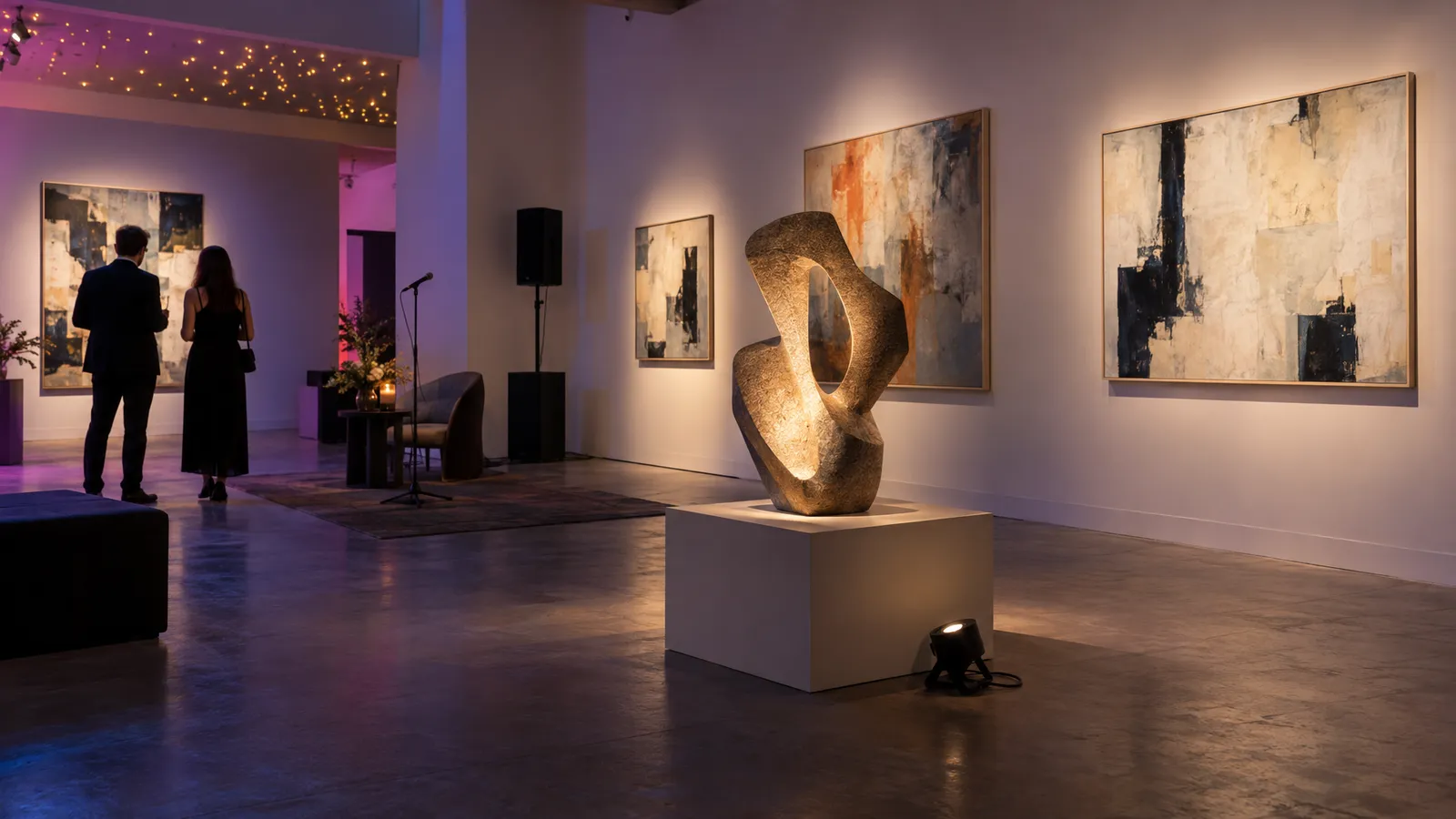
An art gallery opening is a short, busy evening in which guests, collectors and press all see the work for the first time, and the lighting decides how well they see it. Many independent galleries are set up for daytime viewing, and some operate in converted commercial or industrial rooms, so it is worth walking the space at the hour of your reception and noting what the existing light does to the work. Your plan needs to support the art without overpowering it, give the entrance one deliberate visual moment, and cover a short artist talk if there is one. This checklist covers ambient light, accent light for three-dimensional work, a simple talk setup, background music, and the one projection effect that suits a gallery. The equipment named below is from the VENEGEEST catalog, and anything beyond it is available on request, subject to availability; delivery, setup and technicians are scoped and quoted to your event.
Gallery Floor Ambient Light: Start With the Curator's Requirements
The first rule is that the gallery and the artist decide how the work is lit, not the rental list. Colored wash lights have their place in event design, but a Full-Color LED Par Light (an 18-LED RGBW wash light in the catalog) is not something to aim at walls where paintings hang. For the floor itself you want even, steady light.
The catalog describes the LED Tri-Color Panel Light ($25) as giving "even illumination, flicker-free." How many you need, where they stand and how bright they run depends on the room, the ceiling, the existing overhead light and what the curator wants, so plan it on site rather than from a formula. Measure the light on the work with a light meter once the fixtures are placed, check it again when the room is full, and adjust by what you see and what the curator asks for.
Canada's Conservation Institute (CCI), which advises museums on LED lighting, gives three points worth carrying into any gallery evening (CCI Technical Bulletin 36):
- Color temperature is a choice, not a quality score. CCI says "Colour temperature is a matter of preference, not quality." Agree the warmth of the light with the curator and artist rather than following a rule.
- Color rendering is what makes colors read accurately. CCI calls color rendering "the primary measure for the quality of light from a lamp" and, for museum applications, describes good-quality light as "CRI at least 90. R9 at least 50." Ask for the rendering specifications of any fixture that will light the work.
- Exposure matters for sensitive work. CCI notes that damage from electric light depends on "the sensitivity of the material, the intensity of the light and the duration of the exposure." If the show includes light-sensitive pieces, let the curator set the limits, and switch off added fixtures when they are not needed.
Photographers will be shooting phones and cameras all evening, so flicker is worth asking about. CCI's bulletin gives 1250 Hz as the preferred minimum frequency for dimming. If you plan to dim a fixture, ask for its dimming specifications and test it on camera during load-in at the settings you will use.
Accent Lighting for Sculpture and Installation Work
Three-dimensional work usually needs directional light to show its edges and depth; an even wash alone can flatten it. You also want fixtures that can be moved while the artist finalizes placement. Check early whether the venue has ceiling rigging points you are allowed to use, and whether its rules require approval for anything you hang. Under the rental terms, securing venue-specific permits or approvals for equipment installation is the client's responsibility. Where overhead rigging is not an option, floor-standing fixtures become your accent tools.
For installations where cables would be a problem, the catalog's Wireless Battery Uplights are the cable-free option. The catalog's summary for this family mentions a 12–15 hour battery and wireless DMX; confirm the specifications of the exact variant you rent, because the family includes several models. Place and aim each fixture with the artist present, and keep color effects off the work unless the artist asks for them.
- Floor placement near the piece, angled to show form, with the artist and curator deciding the angle and brightness by eye.
- Weather rating by variant, not by family. Several variants carry "IP65" in their names, among them the 4×18W Mini Battery Par IP65, 6×18W Battery Par IP65 and 9×18W Battery Par 6-in-1 IP65, while the catalog code for the 4×18W Mini Battery Par 6-in-1 marks it IP20. If any fixture will be outdoors, ask for an IP65 variant by name.
- Individual control, so you can adjust or dim a single piece during the talk without changing the rest of the floor; confirm the control method for your variants when you book.
- Neutral white where the gallery requires it. Some galleries and artists do not want colored light on the work. If you need white-only fixtures, the LED Par Can range includes a 4×50W COB Par WW+CW (warm white and cool white); ask about its specifications for your use.
How Many Accent Lights Do I Need for a Group Show?
Not every piece needs its own fixture. Flat work on walls is usually covered by the gallery's lighting or your ambient light. Count the pieces that stand on the floor, occupy space as installations, or sit in corners and alcoves the general light does not reach, then walk the room with the curator and decide which of those need accent light. Add one position for the artist talk and one for the entrance effect. If the budget is tight, prioritize the largest or most complex piece, the entrance, and the talk position.
First-Entry Projection: A Firefly Effect on the Ceiling
Guests often take their first photos from the entrance looking into the main room. A single, deliberate visual touch in that view gives them something to notice. The catalog's Firefly Projection Light ($20) is described simply as an "enchanting firefly effect projection."
How well it reads depends on the room: ceiling height, the color and finish of the surface you project onto, and how much other light is in the space. Try it during load-in, aimed at the ceiling or a blank wall, and make sure the projected points do not land on the artwork. Ask when you book how the unit is mounted and powered and what adjustments it offers.
- One projector at the entrance, aimed at the ceiling or a blank surface, away from framed work.
- A test during load-in at reception lighting levels before you decide whether you need a second unit.
- A slow, quiet effect suits most exhibitions better than a busy one; agree the look with the curator.
Artist Talk: One Microphone and Optional Visuals
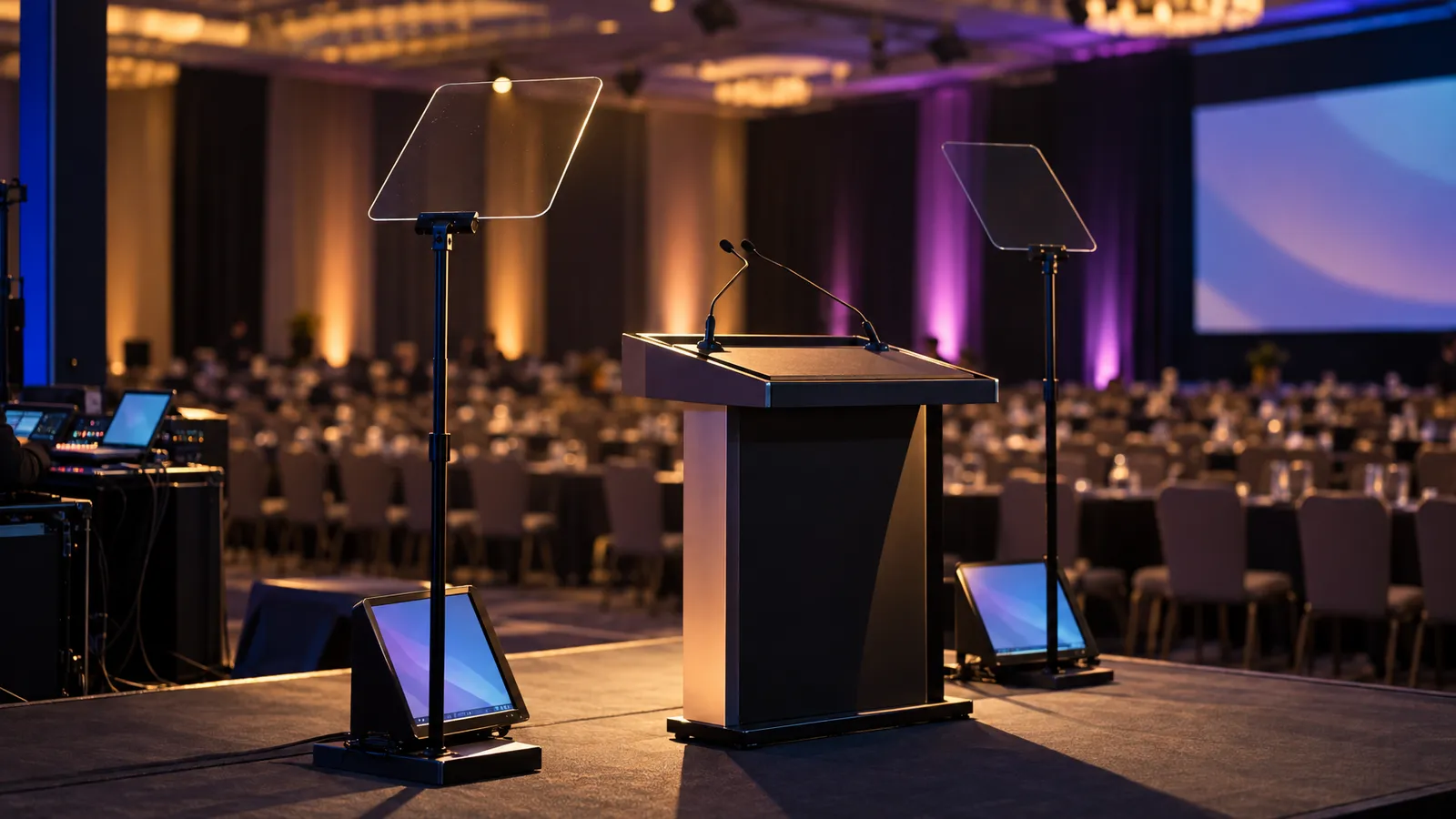
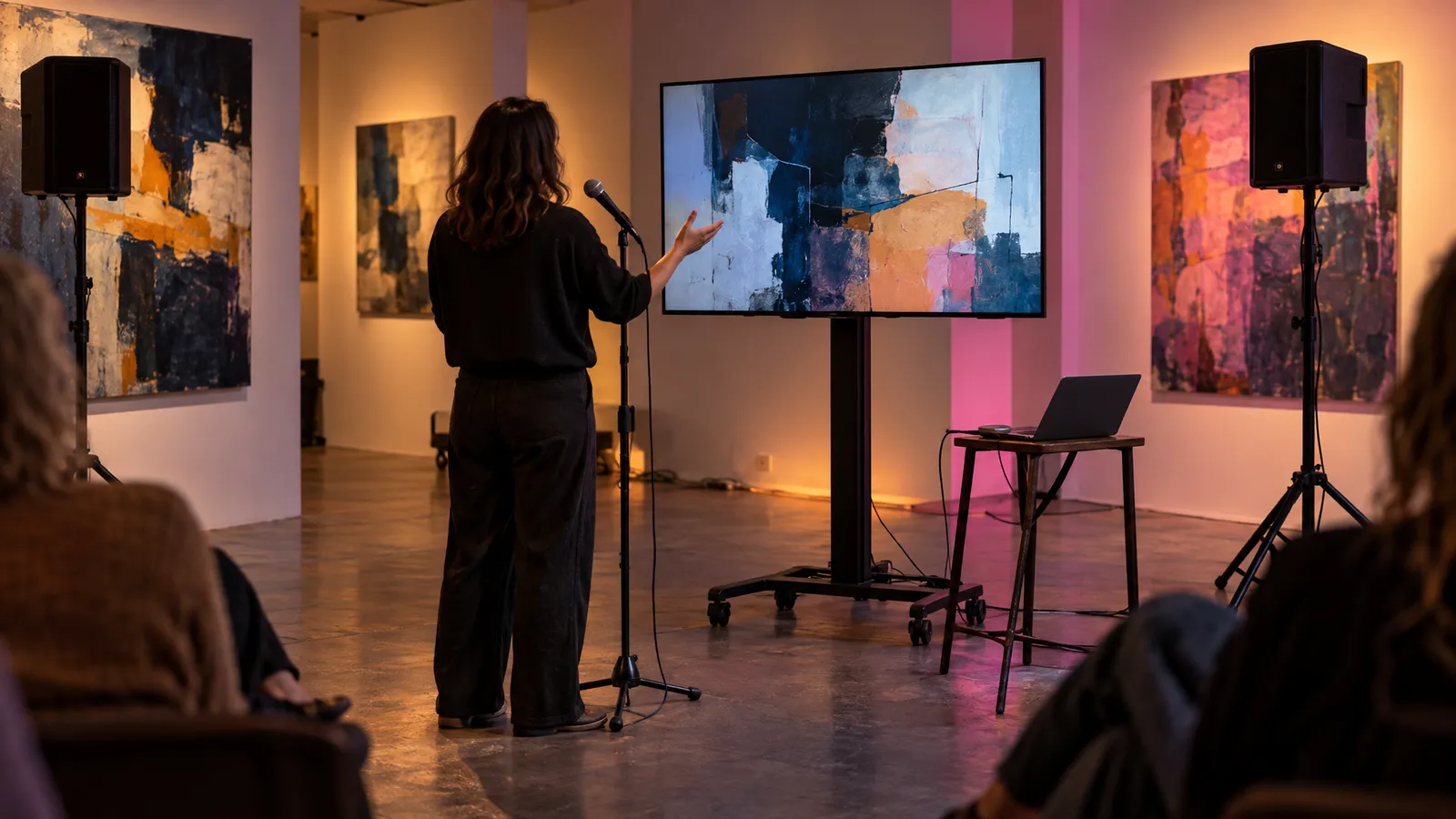
If the artist speaks, you usually need one microphone, enough speaker coverage for the room, and optionally a screen for images. The catalog's Bluetooth Speaker System ($60) is listed as "1 controller + 6 speakers + 2 mics." Ask when you book how the speakers connect to the controller and how the microphones work, and plan placement around the actual room.
Hard surfaces make a room reverberant, and feedback is the main risk with a live microphone. Shure's advice on controlling feedback (Shure) is practical here: "Try to keep microphones and loudspeakers far away from each other," "Move the microphone closer to the desired sound source," "Reduce the number of open microphones – turn off microphones that are not in use," and "The best thing to do to control feedback is turn everything down." Do a sound check in the room with the artist, at the volume you plan to use, before guests arrive.
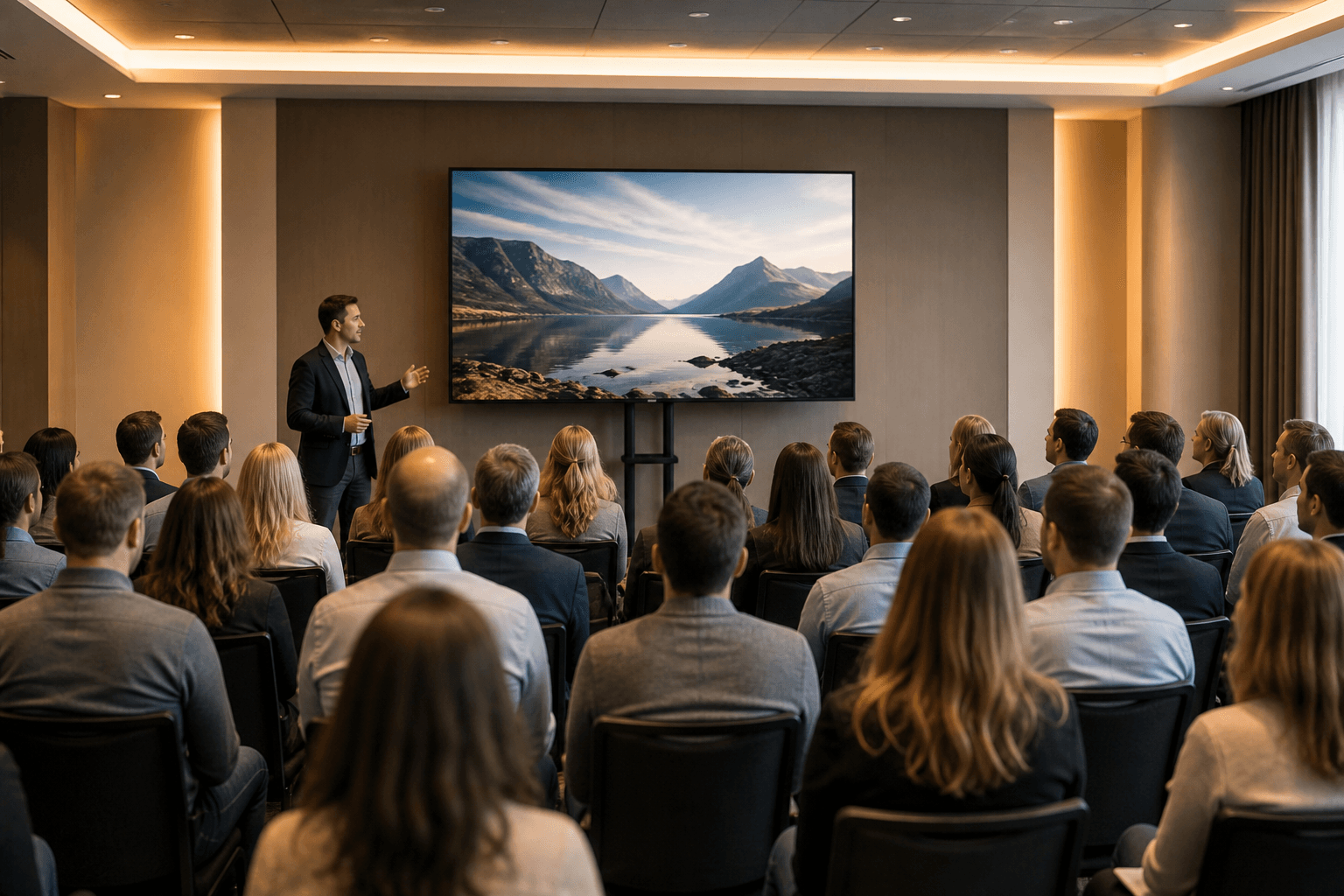
If the artist wants to show process photos or sketches, add an LED TV Display. Catalog prices run $35 for the 43-inch, $55 for the 65-inch, $75 for the 75-inch, $95 for the 85-inch and $120 for the 120-inch. The right size depends on viewing distance and sightlines in the room, so choose it on site with the layout in hand rather than by headcount alone.
- Microphone at the talk position, kept away from the speakers and closed when not in use.
- Speakers placed for the room, not pointed at the microphone, with volume set during a sound check.
- A display on a TV Floor Stand ($20, an adjustable floor mount) placed so viewers can see both the artist and the screen.
- The Wireless Screen Caster ($60), described in the catalog as "wireless casting from any device," if the artist wants to show images from a laptop or phone; test it with their device beforehand.
Background Music During the Reception
Background music should stay in the background. The simplest test is conversation: if guests have to raise their voices to talk at normal distance, turn it down. Ask the gallery whether its lease, building or neighbors set a volume limit, and whether the artist or curator has a view on the music.
Place speakers where they cover the room evenly without sitting right next to a group of guests or a piece of work, and secure every stand so it cannot be knocked over. Keep speakers clear of the art and of hanging hardware, and never stand anything against a wall that carries work. If you are also using the system for the talk, plan where the microphone will be before you place the speakers, so the talk does not become a feedback problem.
- Even coverage from speaker positions chosen by walking the room, not from a fixed count.
- Volume set by conversation comfort and any venue limit, checked again once the room is full.
- Stable, secured stands away from the art and from walking routes.
- One person in charge of the music, so volume changes do not depend on whoever is nearest the controller.
FAQ: Art Gallery Opening & Exhibit Lighting
What color temperature should I use for a photography exhibit versus an oil painting show?
There is no single correct number for either. Canada's Conservation Institute says color temperature "is a matter of preference, not quality," and puts the emphasis on color rendering instead, describing good-quality museum light as "CRI at least 90. R9 at least 50." Agree the warmth of the light with the curator and artist, ask for the rendering specifications of any fixture aimed at the work, and test the setup with the artist present during installation.
Can I use battery-powered uplights outdoors for a courtyard opening?
Only variants rated for it, and only after checking the forecast and the site. Several of the catalog's battery uplights carry "IP65" in their names, while the catalog code for the 4×18W Mini Battery Par 6-in-1 marks it IP20, so ask for an IP65 variant by name and confirm its specifications when you book. If the courtyard has no cover, plan where fixtures will stand if the weather turns, and ask the venue about any rules for equipment outdoors.
How do I keep light off framed artwork during the artist talk?
Choose a talk position away from wall-mounted work where you can, aim any light for the speaker so it falls on them rather than the nearest canvas, and switch off colored or effect lighting for the talk. If the artist wants to stand beside their own work, agree the lighting with the curator beforehand and check it by eye from where guests will stand.
How long does load-in take for a gallery lighting setup?
It depends on the room, the equipment list, access and power, so get a time as part of your quote. Delivery, setup and teardown are scoped and quoted to your event, and the team requires a minimum of 2 hours for standard setups, with more for large-scale productions. You are asked to provide accurate venue details, including load-in access, power supply and timing windows. Leave time after setup for the artist and curator to walk the room and ask for adjustments before doors open, and confirm the gallery's load-in window early.
Do I need a lighting operator on-site during the event?
It depends on whether anything changes during the evening. A plan that stays the same all night may need little more than someone assigned to the music volume and the talk microphone. If you plan cues, such as dimming for the talk or a timed reveal, ask about an operator; VENEGEEST's site notes that a lighting operator runs the console for events that shift through the evening, and technician services are scoped and quoted to your event. The full fixture range is on our event lighting rental page.