
Truss and Rigging Safety Checklist for Stage Lighting
A pre-rig checklist for truss and moving lights at Bay Area events: manufacturer load data, hardware inspection, qualified people and sign-off.
A truss and rigging safety checklist covers three things before any lighting goes overhead: the load, taken from the manufacturer's load data for the exact truss and configuration; the condition of every truss section, connector and piece of hardware; and who is competent to assemble the rig and qualified to approve it. A few hundred pounds of aluminum and fixtures above a stage full of people leaves no room for guessing. This guide walks through those checks, from ground-supported towers to motor-flown truss.
Venues set their own rules for what may be rigged and what paperwork they want before load-in, so ask each venue early what it requires: a rigging plot, proof of insurance, calculations or an engineer's review. The requirements differ from one venue, employer and local authority to the next, and nothing below replaces them.
1. Know Your Load Ratings Before You Touch a Beam
A truss's capacity is not one number. It depends on the truss model, the span, how and where it is supported and how the load is applied, and the manufacturer publishes it as load tables for defined cases. Prolyte's truss user manual, for example, states that its load charts assume the self-weight is already accounted for, static loads only, single-span girders, and loads applied at the node points; it says that all other structures made of trusses "require dedicated structural reports." Any configuration outside the published cases needs that kind of analysis rather than an estimate.
So start with real weights. Take the weight of each fixture from its manual or spec sheet, include clamps, safety attachments and cable (which adds up over long runs), and total the load for each span. Then compare it with the manufacturer's load table for your truss model and your span and support arrangement. The same manual notes that under ANSI E1.2, BS 7905-2 and EN 17115, trusses in repetitive use may need a load reduction factor (loads multiplied by 0.85) and directs users to the product-specific instructions to find out whether it applies.
ANSI E1.2, published through ESTA, is the standard that covers the design, manufacture and use of aluminum trusses, towers and related structural components used in entertainment. Hoists have their own standard: ANSI E1.6-1 covers powered hoist systems used to lift and suspend loads in production, and it explicitly does not cover the structure the hoist hangs from. Hardware such as shackles, wire rope and slings is selected from its own manufacturer-rated working load limit, taking account of angles, terminations and any deratings the manufacturer lists; that selection belongs to the qualified person designing the rig, not to a rule of thumb in an article.
2. Inspect Hardware Before Every Rig, Not Just Once a Season
Wear on truss and hardware isn't always obvious at a glance. Prolyte's manual calls for a competent person to carry out a regular visual inspection each time before the product is used, looking for signs of external damage and wear, and for periodic inspections by a qualified person, with records, at least once a year. If the visual check finds damage, a qualified person has to carry out a detailed inspection. The manual's instruction for anything damaged is plain: "Do not use damaged trusses, connectors or pins," and mark damaged or worn material clearly and discard it. ANSI E1.47 offers recommended guidelines for inspecting entertainment rigging systems more broadly.
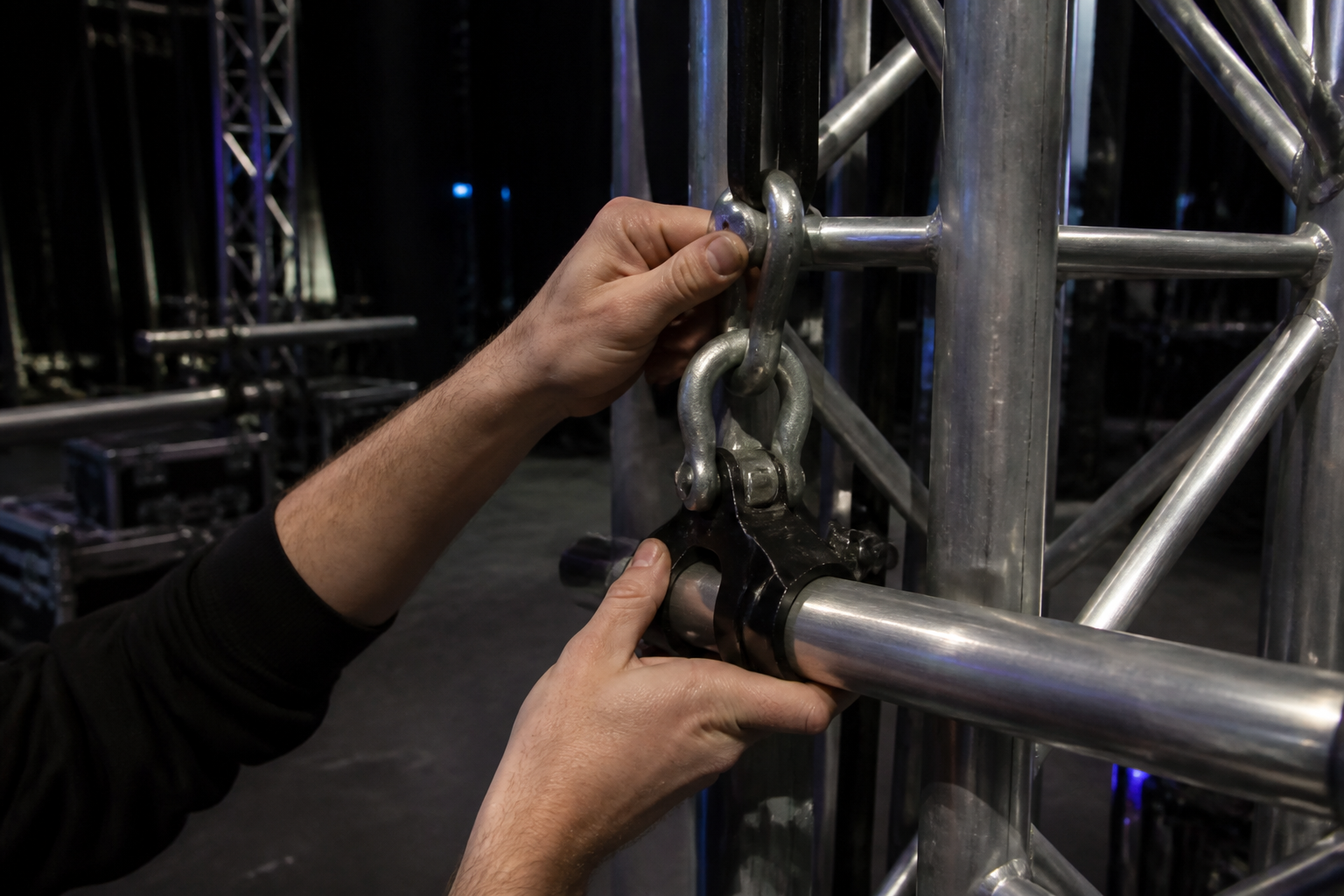
Truss clamps (the couplers that attach loads to the truss or connect the truss to a suspension point) need the same attention. Check them against their manufacturer's instructions. On motor-driven rigs, have the hoist inspected under its manufacturer's requirements and confirm that the hoist's rated capacity covers the calculated load at that point.
- Truss sections and connectors: look for bent members, cracks, deformation, corrosion and damaged pin holes, and check that pins and their clips are fitted as the manufacturer shows.
- Fixture attachments: each luminaire is hung with the clamp and secondary attachment its manufacturer specifies; what secondary retention a fixture needs is set by the fixture's manual and the rig's designer.
- Structural connections: truss-to-truss joints, suspension points and tower bases are part of the engineered structure. Build them exactly as the truss manufacturer and the rig's designer specify, rather than adding improvised extras.
- Ground support bases: set bases, outriggers and any ballast as the tower manufacturer specifies, on a floor whose capacity has been confirmed with the venue.
- Motors and hoists: confirm the hoist's condition and that its rated capacity, not its size, matches the calculated load.
That's why a rigging inspection belongs on the call sheet as its own line item, done before house lights ever come up.
3. Ground Support vs Motor-Flown Rigs: Choosing the Right Method
Not every event needs a motor-flown truss system. In ground support, the truss sits on towers standing on the floor instead of hanging from the venue's overhead rigging points. That avoids attaching to the building's structure overhead, but it does not remove the need for checks: the tower manufacturer's load data, base and ballast requirements, the floor's capacity and the venue's approval all still apply, and a qualified person should confirm the design for the specific installation. VENEGEEST rents aluminum H-frame truss and portable stage platforms.
Motor-flown rigs make sense when you need a lighting truss to hang independent of the stage deck, when the ceiling height allows a cleaner sightline, or when the venue has rigging points engineered for that use; ask the venue what its points are rated for and what it requires. The tradeoff is complexity: a flown rig calls for people qualified in that work, a documented rigging plot showing every point load, and the venue's sign-off before anything goes up.
Outdoors, wind becomes part of the design. Wind load on a truss grows with everything attached to it, including fixtures, banners and fabric. ANSI E1.21 sets minimum design and performance parameters for temporary ground-supported structures used at outdoor entertainment events, and ESTA notes that its 2024 version is referenced by the 2024 International Fire Code and correlated with the 2024 International Building Code's requirements for temporary structures. For an outdoor rig, ask the structure's manufacturer or engineer for its wind limits, including gusts, and write an operations plan that sets out who watches the weather, at what wind speed each action starts, and how long it takes to lower equipment or clear the area.
4. Weight Distribution and Point Loading
How weight is distributed across a span matters as well as the total. A single heavy fixture at mid-span bends the truss more than the same total weight spread across the span at several points, so a truss that can carry a total load spread evenly may not carry it concentrated in one place. Check which loading case your manufacturer's table assumes, and whether it matches how your fixtures actually hang.
Where the load attaches matters too. Prolyte's manual says that if the truss is not supported or loaded at a node point, the main chords take an additional local bending moment that could reduce the load capacity, and that "the correct load can only be determined by examining each load case individually," which "should be done by a structural engineer." Plan fixture positions with the truss's node points in mind, and when a fixture has to sit at a particular spot for sightlines, have that load case checked rather than assuming the table covers it.
Also note that published load charts are often calculated for static loads. Prolyte's manual states that its truss calculations consider only static or virtual static loads, not fatigue loads from a high number of load cycles. If your rig involves movement, such as moving the truss itself during a show, raise it with the manufacturer or the rig's engineer.
5. Documentation, Sign-Off, and Who's Actually Qualified
A rigging plot is the drawing that shows every hang point, its calculated load and the hardware used. Whether a venue asks for one, and what it must contain, is up to the venue and the local authority, so ask. Even when nobody asks, it is the record that shows the load was worked out rather than guessed.
Competence and certification are different things. Prolyte's manual defines a competent person as someone "capable of identifying existing and predictable hazards" and authorized to take prompt corrective measures, and a qualified person as someone who, by a recognized degree or certificate or by extensive knowledge, training and experience, has demonstrated the ability to solve problems in that work. It recommends that a competent person, or sufficiently instructed personnel under a competent person's supervision, assemble the truss. ETCP (the Entertainment Technician Certification Program) offers rigging certification; its rigging certification handbook describes personnel certification as "the voluntary process" by which a nongovernmental organization recognizes an individual's knowledge and skills. Whether a particular job requires a certified rigger is set by the venue, the employer or the local authority, not by the certification program, so ask what applies to your event.
Before any show, walk through this sign-off sequence:
- Rigging plot and calculations reviewed and approved as the venue requires, by the venue's technical staff or the person it designates
- All truss and hardware inspected, with any damaged component marked, removed and replaced before load-in
- Load calculations checked by a second person, not only the person who did the initial math
- Fixtures attached, and secondary retention fitted, as each fixture's manufacturer and the rig's designer specify
- Final visual walk-through of the completed rig before house lights or audience access
A second person checking the numbers costs little time, and a calculation checked independently is more likely to have its errors caught than one checked by its own author under time pressure.
6. Why Rigging Safety Belongs in Your Vendor Selection, Not Just Your Checklist
Rigging safety is also a vendor selection question. When you're comparing AV production companies for a corporate event, ask directly how they handle rigging plots and calculations, who on their crew is qualified to design and approve the rig and on what basis, whether anyone holds ETCP certification, and what insurance they carry for overhead rigging work.
The same questions help when you're deciding between a flown lighting truss and a simpler setup. If your event doesn't need fixtures suspended over the audience, a ground-supported rig or fixtures on stands may be enough, with different tradeoffs in look, footprint, sightlines, setup and approvals; ground support still needs its own load, base and floor checks. Browse our stage lighting, and see our guide to moving head vs par lights if you're still finalizing your fixture plan.
If you're also sizing a stage for the event, our portable stage sizing and pricing guide covers deck footprint and height. The two decisions are linked: a taller deck leaves less clear height between the stage and the lighting above it, so settle the stage before you finalize where the truss goes.
Whatever route you take, the principle stays the same: rigging checks happen at every load-in, on every show, and are carried out by people with the competence to stop a rig that doesn't check out.
FAQ: Truss and Rigging Safety
What safety factor do I need for stage rigging hardware?
There isn't one number to take from an article. Truss capacity comes from the manufacturer's load tables for your model, span and support arrangement (ANSI E1.2 covers aluminum truss and towers), and hardware such as shackles and wire rope is selected from its manufacturer-rated working load limit with any deratings for angles and terminations. A qualified person designing the rig should make those selections. Damaged hardware is removed from service whatever its rating.
Do I need a certified rigger for every event?
ETCP certification is voluntary, so whether a certified rigger is required depends on the venue, the employer and the local authority; ask each. Every rig, flown or ground-supported, should still be assembled under a competent person and designed or approved by someone qualified to read the manufacturer's load data and judge the specific installation.
How much weight can standard box truss hold?
There is no standard figure. Capacity depends on the truss model, span, supports and how the load is applied, and manufacturers publish it as load tables for defined cases (Prolyte's, for example, assume static loads applied at the node points of a single span). Use the manufacturer's table for your exact configuration, and get an engineer's analysis for anything the tables don't cover.
What wind speed is unsafe for outdoor rigging?
It depends on the structure, what is attached to it and how it is ballasted, so the limits come from the structure's manufacturer or engineer. ANSI E1.21 covers temporary ground-supported structures for outdoor entertainment events. Build an operations plan that includes gusts, who monitors the weather, at what point each action starts, and how long lowering equipment or clearing the area takes.
What's the difference between ground support and motor-flown rigging?
Ground support truss stands on towers on the floor instead of hanging from the venue's overhead rigging points; it still needs the tower manufacturer's load data, correct bases and ballast, a floor rated for the load and the venue's approval. Motor-flown rigs hang from the venue's rigging points using hoists, which offers more freedom in positioning but requires rated points, qualified people, a rigging plot and venue sign-off.